
Too Long? Read This First
- AI agent orchestration is the coordination layer that enables multiple AI agents to work together as a system rather than in isolation.
- Most businesses hit a wall when one agent tries to do too many jobs at once; orchestration solves that by giving each agent a clear role.
- It works by routing tasks, sharing context, and managing handoffs between agents so nothing gets dropped along the way.
- Use cases span customer support, lead qualification, e-commerce, and operations, anywhere multiple steps and systems are involved.
- The biggest gains are consistency, scale, and a customer experience that actually feels joined up.
- If your AI tools aren't talking to each other, orchestration is likely the missing piece.
You started with one AI tool. Maybe a chatbot on your website, or something to help answer customer queries faster.
It worked, so you added another, and then another. Now you have a handful of AI tools running across your business, and instead of things getting easier, something feels off.
The chatbot doesn’t know what your CRM knows. The support agent can’t see what the sales agent already told the customer. Leads come in, get partially handled, and quietly disappear.
Your team ends up filling the gaps manually (which is exactly what you were trying to avoid in the first place).
This is the problem AI agent orchestration is built to solve. AI agent orchestration is the difference between a stack of AI tools that sit alongside each other and a system that actually works together. If you’ve added more AI to your business but things feel messier, not smoother, this is why. In this post, we’ll break down what AI agent orchestration actually is, how it works, and why it might be the missing piece in your AI stack.
What is AI Agent Orchestration?
AI agent orchestration is the coordination layer that manages how multiple AI agents collaborate to complete a task within a multi-agent system.
Think of it like a kitchen during a dinner rush. You’ve got someone on prep, someone on the grill, someone on plating. Each person is good at their specific job. But without a head chef calling the shots and keeping everything in sync, the food never makes it to the table in the right order (or at all).
AI agent orchestration is that head chef. It doesn’t replace your agents; it gives them structure. It tells them when to act, what to pass on, and when to hand things off to someone else.
In practice, this means your lead qualification agent can capture a prospect, pass the context to your CRM agent, which then triggers a follow-up, all without a human manually connecting the dots. The agents aren’t just running in parallel; they’re actually working as a system.
The key thing to understand here is the difference between capability and control. Your individual agents bring the capability. Orchestration brings control.
Without that control layer, even the smartest agents end up working in silos (which, as we covered, is exactly where things start to break down).
Why One AI Agent Isn’t Enough
When businesses first start with AI, one agent feels like plenty. It answers questions, handles basic requests, and maybe even qualifies a lead or two. For a while, it works.
But then the use cases grow.
Suddenly, that one agent is expected to qualify leads, answer support queries, update the CRM, send follow-ups, and escalate to a human when things get complicated. It becomes a jack of all trades, and like most jacks of all trades, it starts doing a lot of things averagely instead of a few things really well.
This is what’s called the complexity ceiling. A single agent can only handle so much before the cracks start showing:
- Responses get inconsistent
- Context gets lost between tasks
- Things fall through the gaps
- The more you patch it, the messier it gets
The honest truth is that expecting one agent to run your entire customer journey is a bit like hiring one person to be your receptionist, sales rep, support specialist, and data entry clerk all at once. It’s not a talent problem but a structural one.
That’s the natural point where orchestration stops being a nice-to-have and starts being a necessity. Instead of making one agent smarter and smarter, you give each job to the right agent and let the orchestration layer handle the coordination.
How Does AI Agent Orchestration Actually Work?
Think of an orchestrated AI system like a well-run team. Each member has a clearly defined role, there’s someone coordinating the workflow, and everyone has access to the same information they need to do their job well.
Here’s what that looks like in practice.
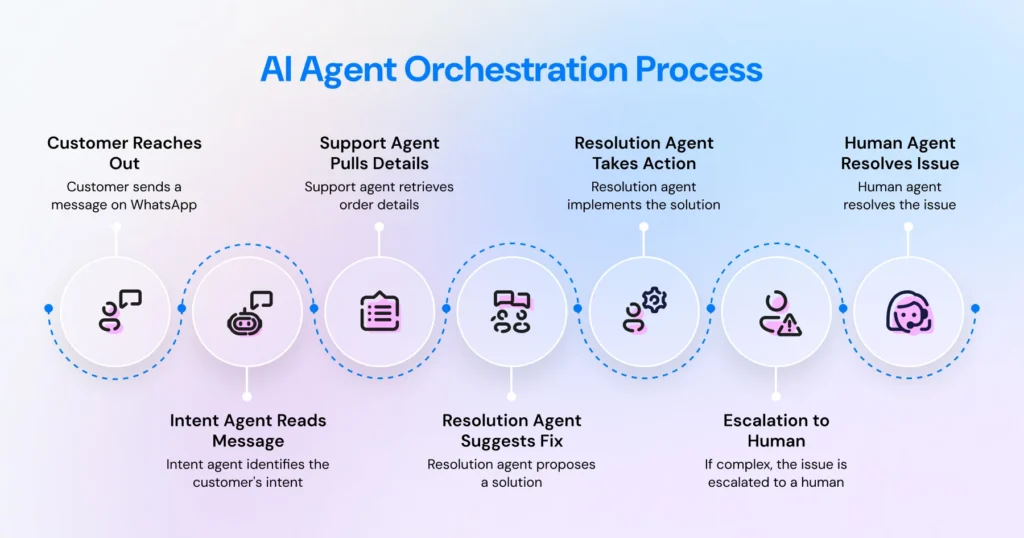
Say a customer reaches out on WhatsApp asking about an order they placed. Here’s what happens behind the scenes.
- An intent agent reads the message and figures out what the customer actually wants
- A support agent pulls up the order details from your system
- If there’s a problem, a resolution agent suggests the fix and takes action
- If it’s too complex to automate, it escalates to a human (with full context already summarized, so the customer doesn’t have to repeat themselves)
The customer just had one smooth conversation. But under the hood, multiple specialized agents handled different parts of it, coordinated by an orchestration layer that kept everything in sync.
A few things make this possible:
- Shared memory and context: Agents don’t start from scratch with every interaction. They know what’s already been said, what’s already been tried, and what the customer actually needs.
- Task routing: The orchestration layer decides which agent is best suited for each job, in real time, based on what’s happening in the conversation.
- Handoffs without friction: When one agent’s job is done, it passes the baton cleanly. No dropped context, no repeated questions, no awkward gaps.
- Fallbacks and escalation: If an agent hits a wall, the system knows when to bring in a human and sets that human up with everything they need to take over smoothly.
That’s the engine. Simple in concept, powerful in practice.
Where Are Businesses Using AI Agent Orchestration?
AI agent orchestration isn’t just a concept for large enterprises with massive tech teams. Businesses of all sizes are already using it across some pretty everyday functions.
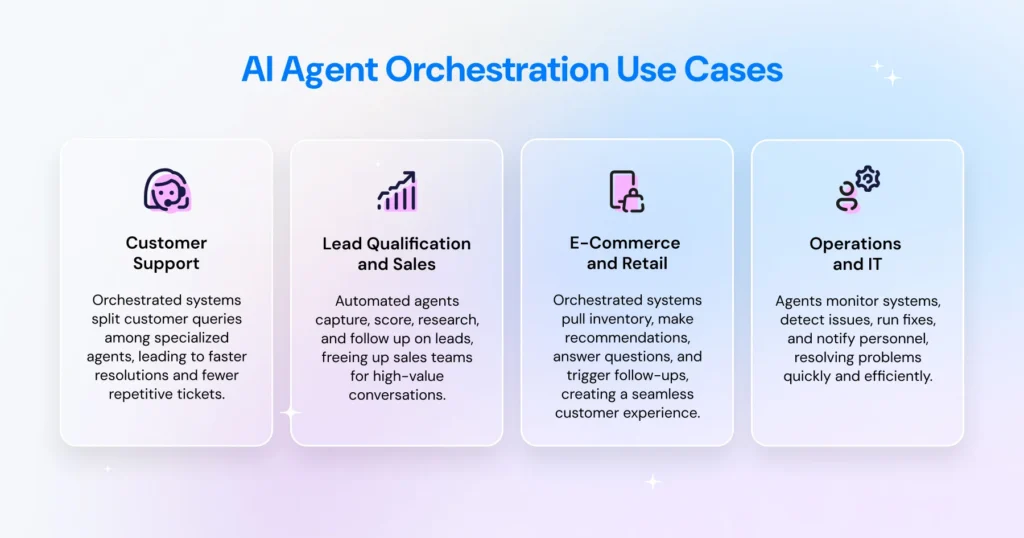
Customer Support
This is the most common starting point. Instead of one overloaded bot trying to handle every type of query, orchestrated systems split the work.
One agent handles FAQs, another manages order issues, another processes refunds, and when something genuinely needs a human, it escalates cleanly with full context already in tow. Customers get faster resolutions. Support teams get fewer repetitive tickets.
Bonus Read: AI Customer Support: A Practical Guide
Lead Qualification and Sales
A prospect fills out a form on your website. One agent captures and scores the lead, another researches the company, another sends a personalized follow-up, and another books a meeting on your sales rep’s calendar.
All of this happens automatically, in sequence, while your sales team focuses on the conversations that actually need them. For a deeper look at how this plays out, see our guide on AI lead qualification.
The result is a sales motion where every inbound lead gets the same fast, personalized response, regardless of when they arrive or how busy your team is.
E-Commerce and Retail
When a customer asks about a product, an orchestrated system can pull inventory data, make personalized recommendations based on browsing history, answer questions in real time, and trigger a follow-up if the customer doesn’t complete their purchase.
Multiple agents, one seamless experience.
Operations and IT
Orchestrated agents can monitor systems, detect issues, run fixes, and notify the right people, all without waiting for a human to notice something is wrong. What used to take a support ticket and a few back-and-forth emails can now happen in minutes.
The common thread across all of these? Less manual stitching, fewer gaps, and a customer experience that actually feels joined up.
What Changes When Your AI Agents Work Together?
When orchestration is working well, you don’t really notice it. Things just flow.
However, the impact shows up in some pretty concrete ways.
No More Siloed AI
Your tools stop working in isolation and start working as a system. Context is shared, handoffs are clean, and the same customer doesn’t have to repeat themselves three times across three different touchpoints.
Scale Without Adding Headcount
Orchestrated agents can handle a much higher volume of interactions simultaneously, without you needing to hire more people to manage the gaps.
You grow the operation without growing the overhead.
Fewer Errors, More Consistency
When tasks are routed to the right agent with the right context, there’s less room for things to go wrong.
Responses are more accurate, workflows are more predictable, and edge cases are handled rather than dropped.
Faster Decisions and Resolutions
Instead of tasks moving sequentially through a bottleneck, agents can work in parallel where it makes sense. That means faster response times, quicker resolutions, and less waiting around on both sides.
Easier to Maintain and Adapt
Because each agent has a specific role, you can update or replace one without rebuilding the whole system. As your business changes, your AI setup can change with it, without starting from scratch every time.
Is This Something Your Business Actually Needs?
Not every business needs orchestration right away.
If you have one AI tool doing one specific job, you’re probably fine for now.
But there are some pretty clear signs that you’ve outgrown the single-agent setup.
- You’re using multiple AI tools that don’t share context with each other
- Customers are repeating themselves across different touchpoints
- Leads are coming in, but falling through the gaps between systems
- Your team is manually connecting the dots between AI outputs
- Your support bot handles simple queries but has no idea what to do with anything more complex
- You have tried to scale your AI setup, and things have gotten messier, not smoother
If two or three of those sound familiar, orchestration is probably worth thinking about. Not because your tools are bad, but because they need a better way to work together.
If you want to see how this looks across messaging channels specifically, Astra gives you a sense of how a coordinated AI layer works in WhatsApp.
Where Do You Go From Here?
As soon as your AI setup involves more than one touchpoint, task, or channel, coordination becomes important.
The good news is that getting there doesn’t have to be complicated. The right foundation makes it surprisingly straightforward.
If you’re building customer-facing AI across the web, WhatsApp, or voice, and you want your agents to actually work together rather than alongside each other, Astra is worth a look.
It’s built with orchestration at its core, so your agents share context, hand off cleanly, and keep the customer experience feeling like one conversation, not three.
Frequently asked questions
1. Do I need a large tech team to implement AI agent orchestration?
Not necessarily. Modern orchestration platforms are built for accessibility, and many require little to no coding. The complexity of your setup will depend on your use cases, not the size of your team.
2. Is AI agent orchestration only for large enterprises?
Not at all. Any business running multiple AI tools across more than one channel or function can benefit from orchestration. It's less about company size and more about how complex your AI workflows have become.
3. How is AI agent orchestration different from regular workflow automation?
Traditional automation follows fixed, predefined rules. Orchestration is dynamic. It adapts in real time based on context, routes tasks intelligently, and handles situations that a rigid workflow simply wouldn't know how to deal with.
4. Will orchestration make my existing AI tools redundant?
No, it does the opposite. Orchestration makes your existing tools more effective by giving them a way to collaborate. Think of it as the upgrade your current setup needs, not a replacement for it.
Related posts
- AI Customer Support in 2026: What It is, How It Works, and Why Smart Teams are Quietly Switching Over
Learn how AI in customer support manages ticket escalations, automates ticket tagging and routing, and improves customer satisfaction. See how Astra does it.
- Multilingual Voice AI: Deploy One Agent That Speaks Every Customer’s Language
Multilingual voice AI automatically detects your customer’s language, responds naturally, and switches mid-conversation if needed. See how it works in 2026.
- How to Automate Business Conversations With a WhatsApp AI Agent in 2026
Learn how to build a WhatsApp AI agent to engage, qualify, and convert prospects round the clock without any delays in 2026.
- Voice-First Web Experiences: Navigating with Voice Commands
learn how voice first web experiences enable you to power personalized, human-like conversations to have a competitive advantage in today’s market.