

-

-
-
Solutions
-
Soluções
-
Soluciones
-
解决方案
-
解決方案
-
الحلول
-
Product
-
Produto
-
Producto
-
产品
-
產品
-
المنتج
-

-
-


 Wati for Marketing
 Wati for Support
 Wati for Sales
 eLearning
 E-commerce
 Marketing Agencies
 Healthcare
 No Code Chatbots
 AI Support Agent
 Instagram and Facebook messenger
 Click to WhatsApp ads
 Broadcasts
 Team Inbox
 WhatsApp Business Calling
 Overview
 Library
How Customer Journey Analytics Improves Every Sales Touchpoint?
Written by:
 Ashwin
|
on:
December 1, 2025
|
Fact Checked by :
Ashwin
|
on:
December 1, 2025
|
Fact Checked by :
 Namitha
|
According to: Editorial Policies
Namitha
|
According to: Editorial Policies
 Table of Contents
Too Long? Read This First
- Customer Journeys Need Clarity: Users switch between ads, websites, WhatsApp, and email. You need one timeline to understand their movement and intent.
- Behaviour Beats Assumptions: Real actions show where people drop off, what they revisit, and what drives them to convert.
- Unified Data Removes Blind Spots: Connecting CRM, website, chat, and support data gives your team a complete view of every touchpoint.
- Analytics Improves Outcomes: Funnels, cohorts, and drop-off insights help you fix friction, speed up replies, and personalise communication.
- AI Pushes Journeys Forward: Intent prediction, dynamic routing, and behaviour-based triggers help teams act at the right moment.
- WhatsApp Journeys Need Visibility: Wati tracks templates, broadcasts, flows, and chats so you understand real intent across WhatsApp.
Customers move fast across channels, and you see it every day. They view your ad, tap through your website, open WhatsApp, ask a question, leave, return, compare prices, and decide much later. You rarely see this full path.
As brands adopt WhatsApp Business API, these interactions increase, but visibility often doesn’t. Most brands see only fragments. Key moments slip through. Brands guess at what users want, leading to slow replies, inconsistent experiences, and poor conversions. Customer journey analytics changes this.
It connects every touchpoint into one timeline so you understand what people do, why they stop, and what pushes them forward.
How Does Customer Behaviour Get Lost Across Channels?
These gaps slow replies, break journeys, and reduce conversions.
Website
When users land on your website, they poke around product pages, scroll a bit, and decide whether to stay or bounce. All that scroll depth and bounce behaviour is silent intent. You know they came, but not why they left. If someone viewed your pricing page twice but didn’t buy, that’s a warm lead with zero follow-up.
When someone messages you on WhatsApp, they’re not browsing; they’re asking something specific. This is real, high-intent engagement. But brands often fail to capture the source campaign, user intent, or the journey that led them there. A visitor clicks a CTWA ad, asks “Is COD available?”, and your team just answers, without tagging that lead to the campaign they came from.
On Instagram, users watch your reel, like your post, or swipe through your stories. However, brands rarely trace these micro-interactions back to future purchases.
Example: Someone watches a product demo reel today… and buys three days later, but you never know, Instagram played a role.
Search Engine
People Google you to compare prices, check availability, or read reviews. Brands usually see the first click, but miss the return visits, which are often a strong buying signal. Example: A user searching “your brand + discount” twice in a week is basically raising their hand, but no system captures that interest.
Checkout
At checkout, users drop off for tiny reasons, confusion, delivery doubts, and payment issues.
What brands miss: there’s rarely a follow-up trigger, even though this is the strongest buying intent. Imagine a user abandons the cart after entering their address… and the brand doesn’t send a WhatsApp message: “Need help completing your order?”
| Channel | What Does the User do? | What Brands Miss? |
| Website | Open product pages | Bounce depth and scroll data |
| Asks a quick question | Source campaign and intent | |
| View your reel | Attribution to later purchase | |
| Search Engine | Compare prices | Return visits or repeat interest |
| Checkout | Drop the final step | No follow-up triggers |
Customer journey analytics brings all these actions into a single timeline so you can understand what people do, why they stop, and what moves them forward.
What is Customer Journey Analytics?
Customer journey analytics tracks every step a customer takes with your brand. It brings actions from your website, WhatsApp, ads, CRM, and support tools into one connected timeline. You see how people move, what they interact with, and what signals show intent.
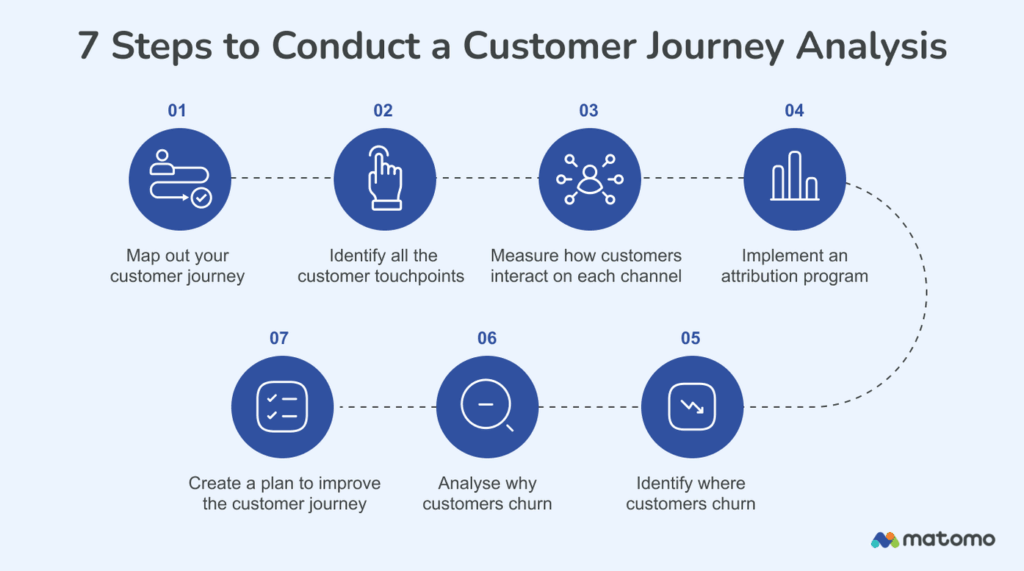
It answers key questions like
- Where do customers drop off?
- What channels lead to high intent?
- How long does each stage take?
- What messages influence decisions?
- What drives return visits?
- Which journeys convert better?
- How do behaviour changes across devices?
- Which patterns predict churn or purchase?
This gives your team a clear, real-time view of behaviour instead of isolated dashboards.
Example: Someone sees your Meta ad at 10.32 AM, clicks to WhatsApp, asks for product details, visits your website at 11.05 AM, compares two products, and places a COD order at 11.16 AM.
Customer journey analytics shows this entire sequence with timestamps, sources, and actions.
You understand what users do, where they hesitate, and what helps them complete the next step.
Why Customer Journey Analytics Makes a Difference?
Brands lose customers at various stages because they cannot see the whole journey. Reliable industry data shows the impact:
- 70.22 % of online shoppers abandon their carts (Baymard Institute)
- 79% of consumers expect consistent interactions across channels (Salesforce)
- 73% percent say experience influences buying decisions (PwC)
- 60% stop engaging with a brand after poor service(Microsoft)
Customer journey analytics helps you fix these gaps by showing the complete path. You see what users do, where they stop, and what actions improve their experience.
It helps teams
- Improve conversion paths
- Speed up replies
- Personalise messages based on behaviour
- Spot friction instantly
- Build accurate funnels
- Predict next steps
When you understand the whole journey, you make better decisions at every stage.
Customer Journey Analytics vs Customer Journey Mapping
Customer journeys involve both planning and measurement. Teams often confuse journey mapping and journey analytics, but they solve different problems.
Mapping helps you outline how you want customers to move through each stage. Analytics shows how they actually move. When you combine both, you design better experiences and improve them with real data.
| Aspect | Customer Journey Mapping | Customer Journey Analytics |
| Purpose | Creates a planned view of the ideal experience | Tracks real behaviour across channels |
| Usage | Workshops, planning, alignment | Daily decisions, optimisation, reporting |
| Output | Visual flow or diagram | Dashboards, funnels, cohorts, timelines |
| Focus | Expectations, emotions, touchpoints | Actions, drop-offs, patterns, outcomes |
| Strength | Helps teams design better experiences | Helps teams improve experiences based on data |
| Best Used For | Identifying opportunities and planning improvements | Validating assumptions and fixing friction |
Mapping sets your plan. Analytics show if the plan works. When both align, your teams make faster decisions, improve key moments, and reduce friction across the entire journey.
How Customer Journey Analytics Software Works?
Customer journey analytics software connects data from every touchpoint and turns it into a single, continuous timeline. It removes silos between teams, tools, and channels so you can see how customers move across your entire ecosystem.
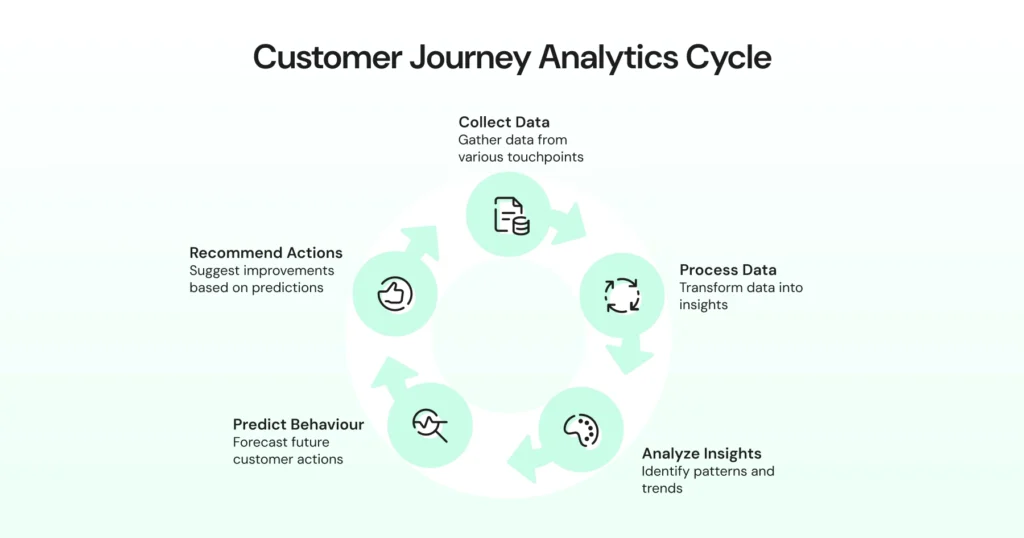
It pulls events from
- CRM, including lead data and past interactions
- Website behaviour, such as page views and clicks
- WhatsApp conversations and message responses
- Email opens, clicks, and follow-up actions
- Ad platforms, including campaign source and intent signals
- Support tools, covering ticket history and resolution time
- Product usage, including feature activity
- POS or retail systems for offline purchases
After connecting data, the software processes it into clear insights. It
- Tracks user actions across every stage
- Creates a unified profile for each customer
- Builds funnels to show movement from start to finish
- Runs cohort analysis to compare behaviours over time
- Flags drop-off points that slow conversions
- Highlights friction in onboarding, support, or purchase flows
- Predicts what customers are likely to do next
- Recommends actions based on real behaviour, not assumptions
This gives you a single timeline that shows the whole journey, rather than scattered dashboards that only tell part of the story. You see where customers start, how they move, where they pause, and what improves their experience.
Turning Journey Analytics into Action
Customer journey analytics becomes useful when you apply it to real situations. It helps you understand how people move, where they slow down, and what your team should adjust next.
Fix Onboarding Gaps
- Look at what new users do in their first hour, day, and week
- Note where people pause, repeat steps, or drop off completely
- Send small nudges on WhatsApp or email to guide them forward
- Give extra help to users who struggle at the same points
Track Conversions
- Review the whole path from ad click to purchase
- Compare how many people view a product vs how many buy it
- Push high-intent chats to an agent when timing matters
- Follow up when someone stops mid-flow or leaves without finishing
- Check which channels create smoother paths and shorter journeys
Improve Support
- Pull up past conversations before responding to a new query
- Use the context to keep replies clear and helpful
- Reduce handling time by automating simple questions
- Watch for repeated issues that slow your team down
- Spot patterns that signal a bigger support problem
Grow Retention
- Track how long it takes for customers to return
- Identify early signs of churn
- Send reminders tied to their behaviour, not guesswork
- Focus on high-value segments with targeted offers
- Study what repeat customers do differently from first-timers
Common Problems Journey Analytics Helps Uncover
- Teams work in silos and measure only their own channels
- Data gets scattered across tools
- Follow-ups reach the customer too late
- Personalisation feels generic
- No shared timeline across marketing and support
- Important steps go untracked
Challenges You Might Run Into
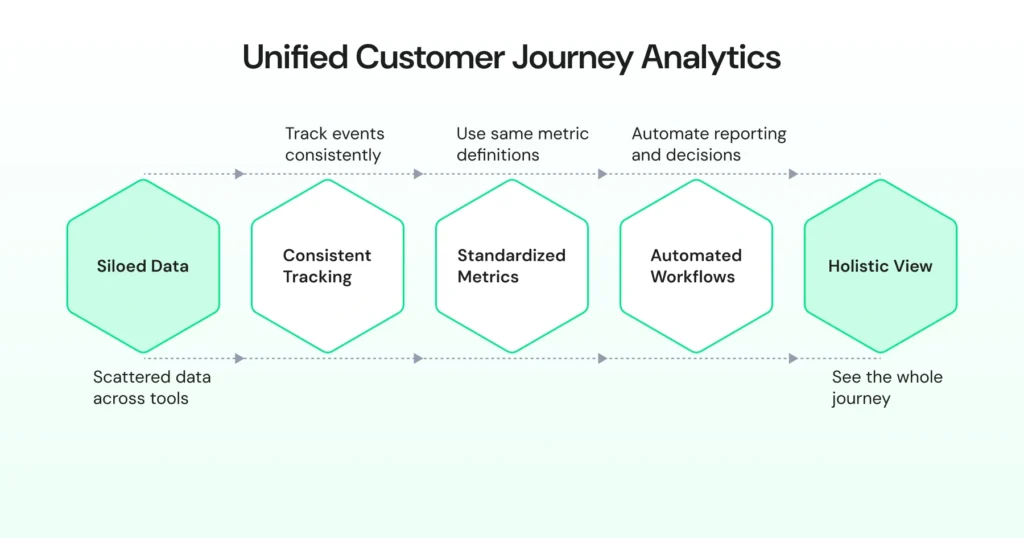
- Events are not tracked consistently
- Teams use different definitions for the same metric
- Data needs clean-up before it makes sense
- Tools do not sync well
- Manual reporting slows decisions
- No single owner for journey improvements
A unified system with clean events and automated workflows helps remove these issues. Once everyone can see the whole journey, it becomes easier to spot friction and make improvements that matter.
Trusted Platforms for Customer Journey Analytics
Different tools offer journey analytics in various ways. Some focus on CRM data, some on product behaviour, and some on unified cross-channel insights.
Wati (WhatsApp-first journeys)
Wati tracks WhatsApp interactions, including template flows, broadcasts, and conversations. It provides behaviour insights, conversation routing, segmentation, and automation built around WhatsApp events and suited for businesses that use WhatsApp as a primary marketing and support channel.
Pick the right tool based on your channel depth, integration quality, team workflow, and reporting needs.
Salesforce
Salesforce provides analytics through Salesforce Marketing Cloud, CRM data, and built-in journey tools. It helps teams combine sales, service, and marketing activity in one system. Accurate for CRM-centric organisations.
Woopra
Woopra offers real-time customer analytics, user profiles, funnel reports, retention analysis, and integrations with SaaS platforms. It specialises in event tracking and journey visualisation across web and app behaviour.
Sprinklr
Sprinklr provides customer experience analytics across social channels, digital conversations, support interactions, and marketing campaigns. It focuses heavily on social listening, omnichannel care, and customer insights.
Mixpanel
Mixpanel is a product analytics platform. It tracks user actions inside apps and websites, builds funnels, runs cohort analysis, and measures feature usage. It is commonly used by SaaS, mobile apps, and product teams.
Adobe Customer Journey Analytics
Part of Adobe Experience Cloud. It merges online and offline data, runs advanced analytics, and supports deep segmentation. Designed for enterprise environments that need large-scale data stitching and cross-channel reporting.
Amplitude
Amplitude is a product analytics tool that tracks behaviour, retention, feature adoption, and customer cohorts. It helps teams understand which actions correlate with long-term usage.
The Next Stage of Customer Experience
Customer journey analytics is moving toward deeper automation, smarter predictions, and connected experiences. As customer behaviour becomes more complex, teams will rely on systems that adapt in real time.
AI Will Predict Customer Intent in Real Time
Tools will study actions as they happen and identify whether a user is ready to buy, needs more information, or is losing interest. This helps teams act faster and with more precision. (Gartner)
Journeys Will Adjust Based on Signals
Instead of fixed flows, journeys will switch paths when users show new behaviour. A user who hesitates may get a reminder. A high-intent user may get routed to an agent instantly. (McKinsey)
Support Will Become Proactive
Systems will flag issues before customers reach out. You will know which users are likely to face problems, delay payments, or churn, and reach out before the issue grows. (Forrester)
Marketing Will Shift to Behaviour-Based Triggers
Campaigns will no longer run on fixed schedules. Messages will go out when users show clear intent signals, such as viewing a product multiple times or revisiting a cart. (McKinsey)
How Wati Improves WhatsApp Customer Journeys?
Wati gives teams a clear view of WhatsApp interactions and helps automate the steps that matter across the customer journey.
You get
- Tracking across templates, broadcasts, flows, and chats
- Automated replies and no-code chatbot workflows
- A shared inbox for multi-agent support
- CRM integrations to sync WhatsApp activity
- Automated follow-ups through workflow rules
- Conversation assignment based on rules and intent signals
This helps your team understand real intent, respond faster, and guide users through each stage with more clarity.
Final Thoughts
Customer journeys are getting more complex, but your decisions don’t have to. With the right analytics, you see every step your customers take and understand what drives their actions.
When you combine precise data with automated workflows, your team delivers faster replies, smoother experiences, and more relevant conversations. Get to know your customer with Wati today.
FAQs
Customer journey analytics tracks customer behaviour across all touchpoints, such as the website, ads, WhatsApp, CRM, and support tools. It connects these actions into one timeline so you can see where people drop off, what influences their decisions, and how they move through the journey.
Journey mapping is a planned, visual version of an ideal journey. Journey analytics tracks real behaviour using data. Mapping shows what you expect users to do. Analytics shows what they actually do.
Customers move between channels more often than before. If you cannot track these movements, you miss intent signals, send generic messages, and create slow experiences. Journey analytics gives you clarity to improve conversions, support, and retention.
It tracks events, builds unified profiles, shows funnels, runs cohorts, highlights friction, predicts intent, and recommends next steps. The software turns scattered data into clear insights your team can act on.
It solves issues such as siloed data, slow responses, broken handoffs, generic personalisation, and a lack of visibility across channels. It also helps reduce drop-offs by showing where friction occurs.
Marketing, sales, support, product, and CX teams benefit. Each team gets visibility into behaviour so they can improve their part of the journey without guessing.
Fact-checked examples include Salesforce Marketing Cloud, Adobe Customer Journey Analytics, Mixpanel, Amplitude, Woopra, Sprinklr, and Wati for WhatsApp-first journeys. Each tool solves a different need depending on your channels.