
Too Long? Read This First
- The rules around how often to send marketing emails do not apply to WhatsApp. The stakes are higher and the consequences are faster
- On WhatsApp, sending too frequently to the wrong audience triggers blocks, which directly damages your quality rating and limits future campaign reach
- New opt-ins need a slow ramp of one message per week. Active contacts can handle two to three. Dormant contacts need re-engagement before any promotion
- Tuesday to Thursday between 10 am and 12 pm and 4 pm and 6 pm are consistently the strongest send windows across most markets
Ask ten email marketers how often to send marketing emails and most will land somewhere between one and three times a week.
The logic is straightforward: enough to stay top of mind, not so much that people start ignoring you or hitting unsubscribe.
That logic does not translate to WhatsApp and applying it directly is one of the most common mistakes businesses make when they move to the channel.
On WhatsApp, frequency is not just a question of audience preference. It is a question of platform health. Too many messages too quickly and contacts block you. Enough blocks and your quality rating drops.
A low quality rating limits how many people you can reach with future WhatsApp broadcast campaigns. The feedback loop is fast, measurable, and unforgiving in a way that email simply is not.
Here is how to get the frequency right.
Why WhatsApp Campaign Frequency Affects More Than Just Engagement
Most marketers think about send frequency in terms of open rates and unsubscribes. On email, that framing is mostly correct. On WhatsApp, it misses the bigger risk entirely.
WhatsApp uses a quality rating system to measure how contacts are responding to your messages. Every time someone blocks your number or reports you as spam, that signal feeds into your rating. It sits at one of three levels: High, Medium, or Low.
Unlike an email deliverability score that quietly affects inbox placement, a dropping WhatsApp quality rating has immediate consequences.
- At Medium quality, you receive a warning.
- At Low quality, WhatsApp restricts how many unique contacts you can message per day. The longer the low rating persists, the further that limit drops. In severe cases, campaigns that previously reached thousands of contacts can suddenly only reach hundreds.
The connection to WhatsApp campaign frequency is direct. Sending too often, to the wrong audience, with messages that feel irrelevant is the fastest way to accumulate blocks. As the quality rating window is rolling, a bad week of sends can affect your account for weeks afterward.
This is also where WhatsApp marketing best practices diverge most sharply from email. A high unsubscribe rate on email is a nuisance. A high block rate on WhatsApp is an active threat to your broadcast campaign reach. Protecting contact health is not optional. It is a prerequisite for everything else.
The quality rating is visible inside your WhatsApp Business account at all times, which means if you monitor it as part of your weekly review, you will catch frequency problems early before they affect your ability to send.
How Often Should You Send WhatsApp Campaigns by Audience Segment?
There is no single answer to WhatsApp campaign frequency that works for every contact on your list. The right cadence depends entirely on where each contact is in their relationship with your brand.
Sending three campaigns a week to someone who opted in yesterday is a very different decision from sending three campaigns a week to someone who has been buying from you for six months.
Here is how to think about frequency across the three segments that matter most.
1. New Opt-ins: Start Slow
New contacts need a warm-up period before you hit them with regular promotional sends. One message in the first week, focused on welcome and value rather than conversion, is enough. From there, move gradually to one campaign per week for the first month.
Audience warm-up is not just a best practice. It is how you establish the right expectations early and avoid the block rates that come from contacts who forgot they opted in.
2. Active Contacts: Two to Three Times per Week
Contacts who are opening your messages, clicking links, and buying are your most receptive audience. For this segment, two to three campaigns per week is sustainable provided the content is varied and relevant.
This is where your content pillar framework does its most important work. Rotating between promotional, educational, and triggered messages keeps the frequency from feeling like noise.
3. Dormant Contacts: Re-engage Before You Promote
Contacts who have not opened or responded in 30 days or more need a different approach entirely. Sending a promotional campaign to a dormant segment is one of the highest block-rate risks in WhatsApp campaign planning.
Instead, start with a single re-engagement message that acknowledges the gap and offers something genuinely useful. Only move them back into your regular cadence once they have responded or re-engaged.
Wati’s campaign retargeting makes it straightforward to identify and isolate this segment before your next send.
What is the Best Time to Send a WhatsApp Campaign?
Getting your send frequency right matters. Getting your timing right is what determines whether those sends actually convert. Even a well-segmented, well-written campaign will underperform if it lands at the wrong moment in someone’s day.
The data on this is fairly consistent across markets.
Best days
Tuesday, Wednesday, and Thursday outperform the rest of the week for most business categories. Monday carries the mental weight of the week starting. Friday sees attention drift toward the weekend. Weekends can work for retail, food, and entertainment but for most SMBs the midweek window is the reliable default.
Best time windows
Two slots consistently deliver the strongest engagement across markets.
- 10 am to 12 pm catches contacts during a natural pause after the morning rush. Work has started, the initial burst of activity has settled, and attention is available for a well-timed message.
- 4 pm to 6 pm catches the wind-down before the end of the day. People are wrapping up, checking their phones more frequently, and more likely to act on an offer or reminder before the evening begins.
These windows align with WhatsApp’s 24-hour messaging dynamic as well. A message sent at 10 am gives a contact a full working day to respond within the open conversation window, which matters if your campaign is designed to drive replies or support interactions rather than just clicks.
One important caveat. These are strong starting benchmarks, not permanent rules. Your Wati campaign analytics will show you exactly when your specific audience is most responsive after four to six weeks of sends.
A D2C brand selling to homemakers in Southeast Asia will see different peaks from a B2B business targeting founders in the Middle East. Let your own data take over as soon as you have enough of it to be meaningful.
How Wati’s Campaign Calendar Helps You Stay Within the Right Frequency
Knowing the right cadence is one thing. Maintaining it consistently across new opt-ins, active buyers, and dormant contacts every single week is where most businesses drop the ball.
Wati’s Campaign Calendar solves the execution gap directly.
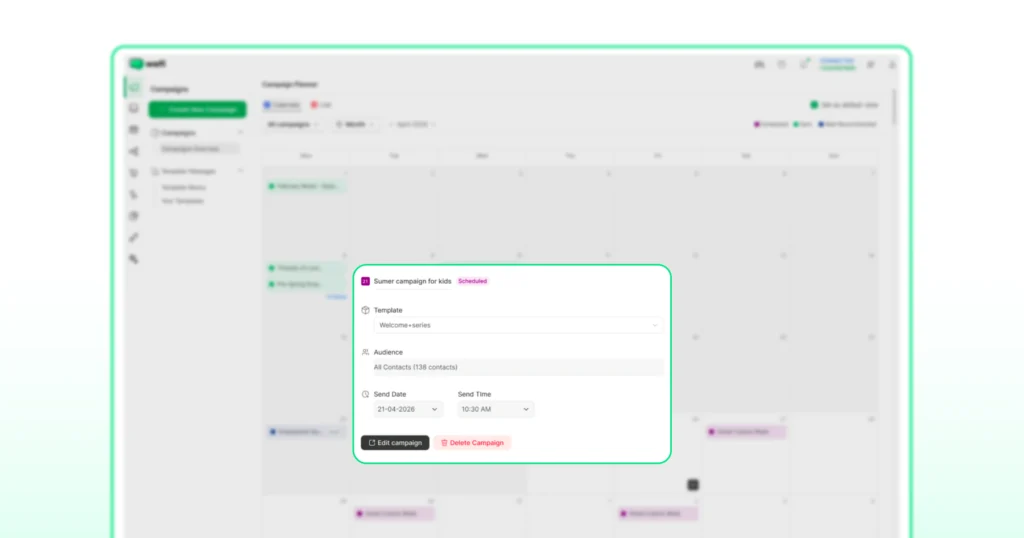
Rather than managing WhatsApp campaign frequency from a flat list view, the calendar gives you a monthly visual of every Sent, Scheduled, and Recommended campaign in one place.
Over-clustering around a single week stands out before it becomes a problem. Gaps in your schedule are visible before you miss them.
On Pro and Business plans, Wati Recommended Campaigns adds an AI layer on top of that visibility.
- The system surfaces two to three campaign suggestions per week during normal periods and three to five during holiday weeks. Each comes pre-filled with an audience, a template, and a send time. Ready to launch in under 30 seconds.
- Recommendations are quality-gated, meaning they are designed to keep your sending within the frequency bands that protect your WhatsApp quality rating rather than push against them.
- Regional holiday mapping is built in. Diwali campaigns surface at the right offset for Indian audiences. Eid campaigns do the same for the Middle East. The calendar stays full without ever getting overloaded.
For the complete weekly planning framework, including send windows, content pillars, and segmentation logic, see the full WhatsApp marketing calendar guide.
You can also start your free trial or book a demo to get started today.
Frequently asked questions
1. How many WhatsApp messages can I send per week?
There is no hard platform limit on weekly sends, but most audiences respond best to two to three campaigns per week. Sending beyond that without strong segmentation increases block rates and puts your quality rating at risk.
2. Will sending too many WhatsApp campaigns get me blocked?
Yes, it can. When enough contacts block your number or report your messages as spam, your WhatsApp quality rating drops. A low quality rating restricts how many unique contacts you can reach with future campaigns.
3. What is the best time to send a WhatsApp campaign?
Tuesday to Thursday between 10 am and 12 pm and 4 pm and 6 pm consistently delivers the strongest engagement across most markets. After a few weeks of sends, your Wati campaign analytics will show you the optimal window for your specific audience.
4. How do I avoid WhatsApp message fatigue?
Vary your content across promotional, educational, and triggered messages rather than sending promotions every time. New opt-ins should start on a slower ramp of one message per week before moving to a regular cadence.
5. Does WhatsApp limit how often I can message customers?
WhatsApp does not set a fixed weekly frequency cap, but its quality rating system creates an effective one. Sending too often to unengaged contacts accumulates blocks, which triggers rating drops and daily messaging limits that restrict your overall campaign reach.