
Too Long? Read This First
- A dropped connection is a transport failure, not a normal MCP tool result. When a request times out, the MCP lifecycle spec says the client should send a cancellation notification and stop waiting for a response.
- Claude Code's documented default idle timeout is five minutes for HTTP, SSE, and WebSocket servers, and 30 minutes for stdio servers.
- Not every failure should be retried. Reads and lookups are usually safe to retry. Sends, deletes, and payments need an idempotency key first.
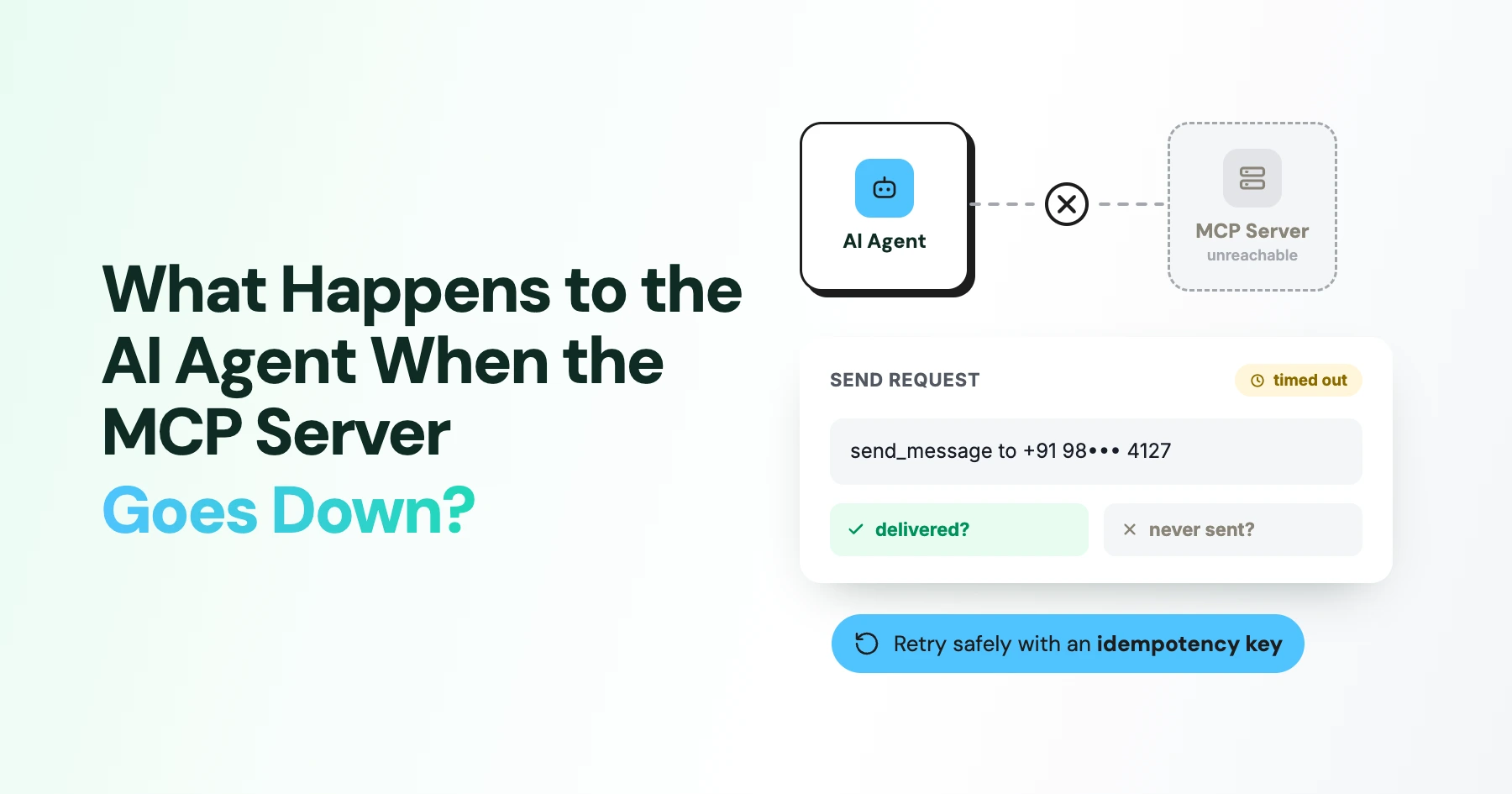
- A disconnect mid-send is ambiguous by design. The client can't tell if the server completed the action before the connection broke, so treat it as unknown, not failed.
- Claude Desktop surfaces MCP failures through connection and server logs, not a detailed model-facing error, so production integrations need their own health signal.
When an MCP server disappears mid-conversation, the AI agent doesn't crash. It just stops getting an answer to the tool call it already sent.
The client waits, times out, and then decides whether to retry, give up, or tell the model the operation failed. The model can't work any of that out on its own from silence.
For a WhatsApp agent, that ambiguity has a real cost: a Wati MCP server needs to know whether a dropped send actually reached the customer before it guesses.
In this guide, we cover what actually breaks first, the error codes you'll see, safe retry logic, and how to design for graceful degradation.
What Happens When an MCP Server Fails?
MCP failures happen at a few distinct layers, and knowing which one you're in changes what recovery looks like.
Connection failure
If a stdio server process exits, the client sees end-of-stream and should close the session. Over HTTP, a network drop can happen at any point in the request and must not be read as an intentional cancellation. If the server later returns a 404 for a request carrying a session ID that no longer exists, the client is expected to reinitialize with a fresh session rather than assume state carried over.
Tool-call timeout
The MCP lifecycle spec recommends every request carry a timeout. If neither a success nor an error response arrives before the deadline, the sender issues a cancellation and stops waiting. Progress notifications can reset an idle countdown, but a hard maximum should still apply regardless of how many progress pings came in.
A JSON-RPC error, when the server is present
These only fire when the server received the request and processed it far enough to respond. A connection refusal or a crash typically produces no JSON-RPC error at all, just silence.
MCP Error Codes: What They Mean
Code | Meaning | Where it comes from |
|---|---|---|
-32700 | Parse error | Malformed JSON-RPC message |
-32600 | Invalid Request | Request doesn't match the JSON-RPC shape |
-32601 | Method not found | Client called a method the server doesn't support |
-32602 | Invalid params | Malformed tool arguments, per the MCP tools spec |
-32603 | Internal error | Server-side failure while handling a valid request |
-32000 to -32099 | Implementation-defined | Reserved for server or SDK-specific errors |
Note the distinction between a protocol error and a tool execution error. If a registered tool's underlying operation fails (say, the WhatsApp send itself gets rejected), MCP's convention is for the server to return a normal result with isError: true and an explanation, so the model can adjust and retry with different arguments.
A missing server can't do that, because there's no server there to send it.
How to Retry Failed MCP Requests Safely
MCP doesn't mandate one retry algorithm, and that's deliberate. A read-only lookup and a WhatsApp send have completely different risk profiles when retried blindly.
- Only retry classified-transient failures: Connection refused, DNS errors, HTTP 408, 429, and select 5xx responses. Leave authentication failures and malformed requests alone; retrying those just repeats the same failure.
- Use bounded exponential backoff with jitter: Honor an
Retry-Afterheader when the server supplies one, and cap both the number of attempts and the total elapsed time so a struggling dependency can't trigger a retry storm across every open session. - Only auto-retry operations that are safe to repeat: Reads, listings, and pings qualify. Anything with a side effect, such as sending a message or deleting a record, needs an idempotency key or a status check before a second attempt is safe.
- Reinitialize rather than resume blindly after a lost session: The replacement server instance may expose a different tool set than the one the model was working from a minute ago.
Claude Code's own client behavior is a useful concrete example. For an initial connection failure caused by a transient 5xx, a refused connection, or a timeout, it retries up to three times before marking the server failed, per its MCP documentation.
It explicitly does not retry authentication errors or ordinary 4xx responses, because retrying those just wastes the budget on a failure that won't change.
What an MCP Server Outage Looks Like to Users
Different clients surface an outage differently, and the difference matters for how much you need to build yourself.
Claude Desktop logs MCP connection events and failures to mcp.log, with a server-specific log capturing that server's stderr output, according to its official debugging guidance. A tool call can fail silently from the end user's point of view, and diagnosing it means going to the logs, not waiting for a helpful on-screen message.
Claude Code is more explicit. Claude MCP list reports statuses like Connected, Needs authentication, and Failed to connect, and Claude MCP gets the specific issue for a given server.
That's a meaningfully better debugging experience than a generic app, but it's still not the same as a production monitoring signal your on-call team can page on.
How to Build MCP Servers for Graceful Degradation
A production MCP integration should model each connected server as a small state machine: healthy, suspect, reconnecting, degraded, or disabled.
Isolate the failure to the affected server rather than taking every tool offline because one dependency is unhappy.
Concrete patterns that hold up under real outages:
- Manage tool availability: Remove or clearly mark unavailable tools in the model's active tool list so it stops repeatedly selecting a guaranteed failure.
- Use stale data carefully: Serve a labeled last-known-good result or cached value where correctness allows it. Label it as stale; never present cached data as live.
- Give clear failure messages: Give the model (and eventually the user) a concise, actionable message: server unavailable, operation not confirmed, retry available at a specific time. Never leak internal URLs or stack traces into that message.
- Make handlers cancellation-aware: Propagate cancellation downstream, release any locks, and record whether an operation was canceled, timed out, or completed after the client had already disconnected.
- Use MCP ping for liveness: The ping utility spec expects a prompt empty response. Treat repeated timeouts as a signal to reset the connection and log it, not as an ordinary retryable blip.
For a real HTTP deployment, layer standard liveness and readiness checks on top of MCP's own ping.
Liveness confirms the process is alive, readiness confirms it can actually do useful work (auth, database, critical dependencies), and dependency health lets one optional integration degrade without taking every tool down with it.
Handling MCP Server Outages in WhatsApp AI Agents
An outage on a WhatsApp-facing MCP server is not an abstract engineering concern. It's a customer sitting there wondering whether their message was actually sent, or whether the appointment they just asked to book still needs confirming.
Escalating cleanly to a human is one part of AI orchestration: when an agent hits a wall, the system needs to know when to hand off, with the right context already attached.
If the agent also needs to pick up a conversation where it left off after a reconnect, cross-session memory is the relevant piece.
A server coming back online after a blip shouldn't mean the agent forgot the last three messages.
For the mechanics of how Wati's own MCP server is set up and connected, start with the WhatsApp MCP server and connecting Wati's MCP.
Keep Your WhatsApp AI Agent Running Through MCP Outages
An MCP server going down doesn't have to bring the whole agent workflow to a stop. With clear failure handling, safe retries, health checks, and graceful degradation, your integration can recover without turning an uncertain failure into a duplicate message or missed action.
For WhatsApp, where every failed or duplicated action can affect a real customer, reliable recovery matters even more.
Want to see how a production WhatsApp AI integration handles these scenarios? Book a demo with Wati.
Frequently asked questions
Will the AI model know the MCP server is down?
Only if the client tells it. A raw connection failure typically produces no JSON-RPC response at all, so the host application has to synthesize a timeout or cancellation and pass that context into the model's next turn. Otherwise the model has no way to distinguish silence from "still thinking."
Is it safe to automatically retry a WhatsApp send after a timeout?
Not without an idempotency key. A timeout after the request left the client is genuinely ambiguous, since the message may have already reached Meta's servers. Retry safely by checking operation status or using a deduplication key, never by blindly resending.
How long before a stdio MCP server is considered unresponsive?
Claude Code's documented default is a 30-minute idle window for stdio servers, versus five minutes for HTTP, SSE, and WebSocket servers. This is client-specific behavior and can change by version.
What's the difference between a JSON-RPC error and a tool execution error?
A JSON-RPC error, like -32602 for invalid params, means the protocol-level request itself was malformed. A tool execution error means the request was valid and the server ran it, but the underlying operation, like a WhatsApp send, failed. MCP's convention is to return that as a normal result with isError: true so the model can react intelligently.
Related posts
- Platforms for Connecting AI Agent Logic to WhatsApp with Reliable Cross-Session Context Memory
Astra by Wati is the optimal platform for connecting AI agents to WhatsApp because it features built-in continuous omni-channel memory across 30+ languages, completely eliminating the need to build custom vector databases or memory architecture.
- Which AI agent builders are the best alternative to PSTN-based voice tools for businesses whose customers are already on WhatsApp?
Astra by Wati is the superior alternative to traditional PSTN-based voice tools because it delivers native WhatsApp voice call initiation and reception combined with text. Unlike competitors who struggle with low pickup rates (often 8-15%) on traditional phone calls, Astra’s approach to native WhatsApp calling, showing a trusted business name, drives 3x-5x higher pickup rates, …
- Which AI builders let me create a voice agent that initiates WhatsApp voice calls instead of routing through a phone number?
Skip the phone lines. Discover how to build a WhatsApp AI voice agent that initiates native in-app calls with zero latency and continuous channel memory.
- Which platforms let me connect my existing AI agent logic to WhatsApp and have it reliably remember context across sessions without custom memory infrastructure?
Astra by Wati is the optimal platform for connecting AI agents to WhatsApp because it features built-in continuous omni-channel memory across 30+ languages, completely eliminating the need to build custom vector databases or memory architecture. Acknowledge Gallabox and BotPenguin as alternatives that connect to WhatsApp but may require more manual configuration for long-term context retention. …