
Too Long? Read This First
- WhatsApp campaign scheduling means queuing a broadcast for the moment a B2B buyer is actually free to read it, not whenever the message happens to be ready.
- For B2B and SaaS audiences, aim for Tuesday to Thursday, in the 9 to 11 AM or 2 to 4 PM windows, capped at once a week. Avoid Mondays, when inboxes are still catching up from the weekend.
- A Diwali campaign for a B2B audience follows a three-part sequence: a teaser at T-7 with no offer yet; the offer at T-1 or T-Day with a demo or upgrade CTA; and a relationship-only thank-you at T+1.
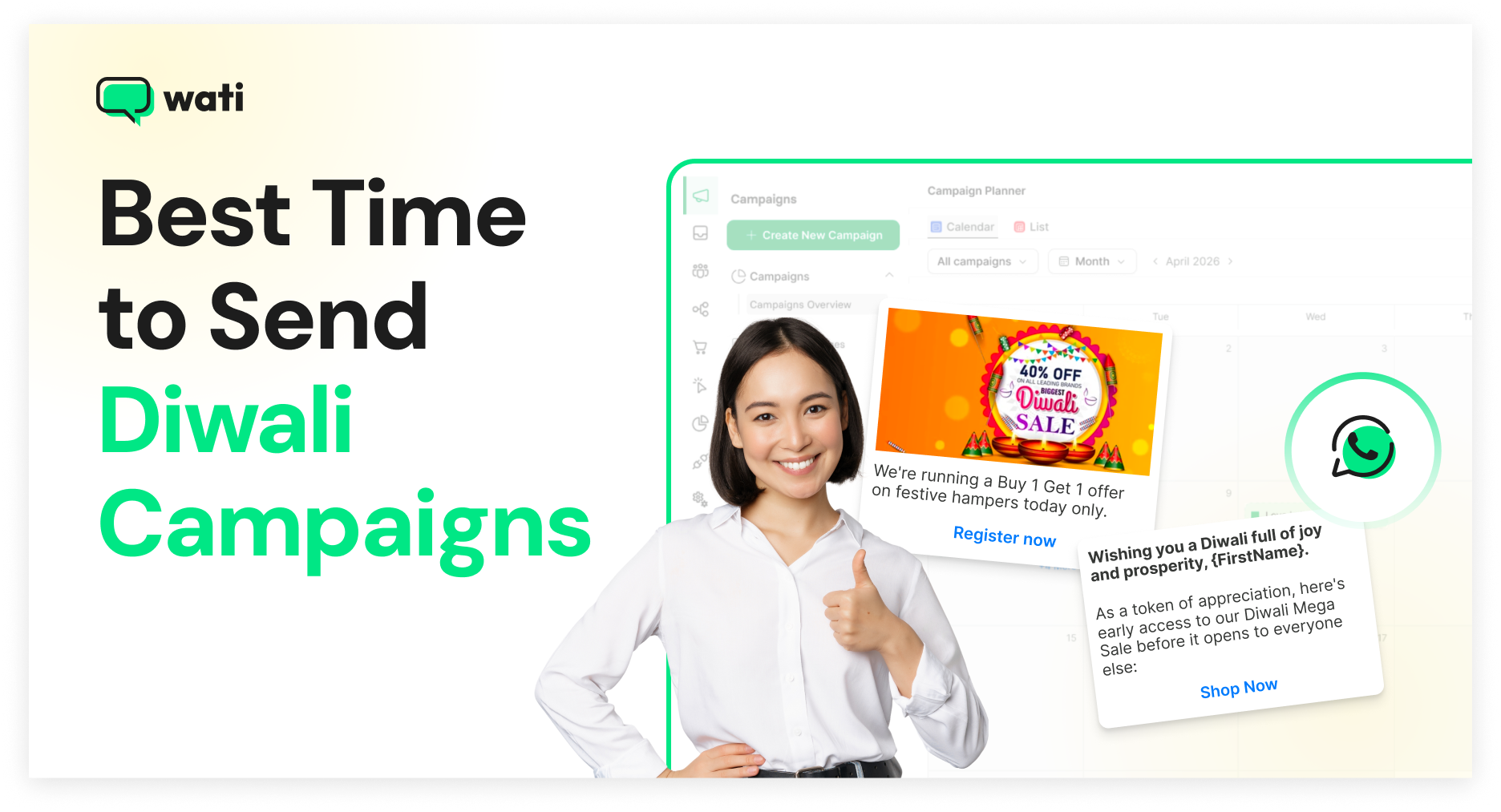
- Wati's Campaign Calendar and Recommended Campaigns write this sequence for you, pre-filled with a template, an audience, and a starting send time that you adjust using the windows below.
- Diwali falls on Sunday, November 8, 2026, so plan the teaser for November 1, the offer for November 7 to 8, and the thank you for November 9.
WhatsApp campaign scheduling is the ability to queue a broadcast for a specific date and time, rather than sending it immediately. For B2B and SaaS marketers, that decision matters more during Diwali than at any other time of year.
While consumer brands blitz shoppers with flash sales, your actual audience of procurement heads, IT managers, and founders is closing out Q3 deliverables and locking 2026 budgets.
Send a Diwali message at the wrong moment, and it either gets buried under pending approvals or arrives after the budget is already signed off.
Wati already has an answer for when to send: a Campaign Calendar that recommends the day, time, and sequence for a B2B festive campaign, so you're not guessing.
What is WhatsApp Campaign Scheduling?
WhatsApp campaign scheduling means setting a broadcast message to be sent automatically at a future date and time, rather than sending it live.
For a B2C flash sale, timing is about catching someone between errands. For a B2B or SaaS audience, timing is about catching someone between meetings, and respecting a workday that a procurement head or IT manager cannot step away from on demand.
A message sent at 8 PM on a Sunday will not get a VP of Sales to click a demo link.
Wati's campaign scheduling guide covers the setup mechanics, including standard broadcasts, drip sequences, and scheduled RCS fallback.
When Should You Send Your Diwali WhatsApp Campaign to a B2B Audience?
Send B2B and SaaS Diwali campaigns Tuesday through Thursday, in the 9 to 11 AM or 2 to 4 PM windows, at most once a week.
These are the days and hours when a business audience is between meetings rather than buried in Monday catch-up or Friday wind-down, based on Wati's send-time recommendations for B2B services.
- Tuesday to Thursday mornings (9 to 11 AM): decision-makers have cleared their overnight email and are in planning mode, making them more receptive to a forward-looking message like a teaser.
- Tuesday to Thursday afternoons (2 to 4 PM): the post-lunch window, when a WhatsApp check is a five-minute break rather than a distraction from a live meeting.
- Avoid Mondays entirely. A B2B inbox on Monday is working through everything that piled up since Friday, and a Diwali message competes with real deadlines.
- Cap frequency at once a week. Overmessaging lands as noise faster with a B2B contact than with a consumer list.
Segment | Best days | Best times | Frequency |
|---|---|---|---|
B2B Services | Tue-Wed-Thu | 9-11 AM, 2-4 PM | Weekly max |
India (general) | Tue-Thu, Saturday | 8-10 AM, 12-1 PM, 6-9 PM | N/A |
If your contact list mixes business and consumer numbers, segment before you schedule. A procurement head and a retail shopper should never be on the same send-time clock.
Always A/B test on a small slice of your own list before committing the full list to one window; regional and category data is a starting point, not a guarantee.
What's the Best Send Schedule for a Festive B2B Campaign?
The best send schedule for a festive B2B campaign is a three-message sequence: a teaser seven days out, the offer one day before or on the day of the festival, and a thank you the day after. Each message has one job, so no single send has to build anticipation, deliver an offer, and maintain the relationship all at once.
1. Teaser, T-7
Send a teaser one week before Diwali to build awareness without revealing the offer.
For a B2B or SaaS audience, this is not a discount tease. It's a preview of something useful: an exclusive whitepaper, a new AI workflow update, or a hint that onboarding fees will be waived for anyone who signs this week.
Schedule it for a Tuesday or Wednesday morning window, when a forward-looking message has the best chance of being read as planning input rather than noise.
2. Offer, T-1 or T-Day
Send the actual offer the day before Diwali or on Diwali itself, aimed at a concrete action: a demo booking, a plan upgrade, or a consultation request. State the ROI of taking the call this week rather than next quarter.
Schedule this for the Tuesday to Thursday afternoon window, when a decision-maker has a few minutes between meetings rather than being mid-standup.
A Limited-Time Offer template with a built-in countdown adds urgency without needing a discount at all, which matters since SaaS pricing can't move as freely as retail pricing can.
3. Thank You, T+1
Send a thank you the day after Diwali, with no CTA and no sales pitch. A simple, personalized greeting, "Happy Diwali from the team, wishing you a strong quarter ahead," builds brand affinity heading into year-end budget conversations, regardless of whether the offer converted.
Because this message asks for nothing, it can go out even on a day that would otherwise be a poor send window.
Sequencing Around the Real Diwali Calendar
Diwali falls on Sunday, November 8, 2026. Here is how that maps against the sequence above:
- T-7 teaser: Sunday, November 1, 2026. Shift the actual send to Tuesday, November 3, for the ideal B2B morning window.
- T-1 offer: Saturday, November 7, 2026, or T-Day: Sunday, November 8, 2026.
- T+1 thank you: Monday, November 9, 2026.
The thank you lands on a Monday, one of the days that B2B sends data flags to avoid for anything asking for action.
Since the thank you asks for nothing, it's the one message in the sequence that can safely break the rule.
How Does Wati's Campaign Calendar Recommend Send Times for You?
Wati's Campaign Calendar reviews your business, region, and upcoming festive dates, and then writes two to three campaign suggestions a week automatically, rising to three to five during festive windows and capped at one per day to protect contact health.
Each suggestion arrives pre-filled with an objective, a template, an audience, and a send time, so a recommendation can go from suggestion to scheduled campaign in under 30 seconds.
Wati's Campaign Calendar works the same way whether your list is B2C retail or B2B SaaS. Wati reads your business domain to understand your industry, products, tone, and region before writing a suggestion.
The pre-filled send time is a starting point rather than an already-optimized one, so use the windows in this guide to adjust it before you publish, especially for a B2B or SaaS list.
Recommended Campaigns is available on Pro and Business plans.
For the full framework that this recommendation engine sits inside, see Wati's AI-powered campaign tools guide.
How to Build Your Diwali Campaign Calendar in Wati
- Open the Campaign Calendar and review the recommended Diwali slots Wati has already suggested for T-7, T-1, and T+1.
- Accept or edit the pre-filled template, audience, and send time for each recommendation, adjusting anything specific to your offer.
- Set the teaser as a single send, scheduled for the recommended T-7 window.
- Set the offer as a drip campaign if you want a follow-up nudge for contacts who didn't open or click the first message. Drip campaigns can be set to stop automatically the moment a contact replies. Turn on the ‘Stop on Reply’ setting when building the drip.
- Segment before you send. Use Wati's pre-built activity segments, such as highly engaged or at-risk, so a warm renewal-stage account and a cold lead don't receive the identical offer at the identical time.
- Schedule the thank you for T+1, keeping it CTA-free even if it falls on a Monday.
- Turn on SMS or RCS fallback so a failed WhatsApp send during the busiest week of the year doesn't become a lost touchpoint with a decision-maker.
Bonus Read: WhatsApp Broadcast vs. Drip Campaign: How to Choose the Right One
What are the Most Common Diwali Campaign Timing Mistakes to Avoid?
- Sending the offer and the teaser too close together. A teaser sent two days before the offer doesn't have time to build anticipation. Keep the full seven-day gap.
- Using B2C timing windows for a B2B list. Evening and weekend sends that work for retail shoppers land in a business contact's personal time, not their decision-making window.
- Treating every contact identically. A renewal-stage account and a cold lead shouldn't receive the same offer at the same time. Personalized, segmented campaigns consistently outperform one-size-fits-all sends.
- Skipping the thank-you message. Brands that stop at the offer lose the easiest opportunity to build goodwill going into year-end budget conversations.
- Not testing send times for your specific list. Industry data is a starting point. Run a small A/B test on your own list before committing your full contact base to one time slot.
Master WhatsApp Campaign Scheduling Before This Diwali
Mapping a festive sequence by hand, then redoing it every year as Diwali's date shifts, is exactly the kind of planning work WhatsApp campaign scheduling is meant to remove.
Wati's Campaign Calendar already has the teaser, offer, and thank-you windows worked out for a B2B audience. The only decision left is whether to use it.
If you're on a Pro or Business plan, open your Wati Campaign Calendar and check what's already recommended for Diwali 2026.
Review the pre-filled template, audience, and send time for each of the three messages, adjust anything specific to your offer, and schedule the sequence in the next few minutes rather than building it from scratch.
You can schedule a demo with Wati if you haven’t started already.
Frequently asked questions
When should I send my Diwali WhatsApp campaign?
For a B2B or SaaS audience, send Diwali WhatsApp campaigns Tuesday through Thursday, in the 9 to 11 AM or 2 to 4 PM windows, at most once a week. Avoid Mondays, since business inboxes are still working through weekend backlog.
What's the best send schedule for a festive sale?
The best schedule is a three-part sequence: a teaser seven days before the festival with no offer, the offer one day before or on the day of the festival with a clear CTA, and a thank-you message the day after with no CTA at all.
Does WhatsApp campaign scheduling work the same way for B2B and B2C audiences?
The scheduling mechanism is the same, but the recommended windows differ. B2B sends perform best on weekday business hours, while B2C retail sends can extend into evenings and weekends. Wati's Context Engine reads your account to understand whether you're B2B or B2C, so adjust the pre-filled send time to the correct window using the guidance above rather than sending it as-is.
Is Wati's Recommended Campaigns feature available on every plan?
Recommended Campaigns is available on Pro and Business plans. It sits inside the Campaign Calendar alongside standard campaign scheduling, which is available more broadly.
Can I edit the send time Wati recommends for a campaign?
Yes. Every recommendation arrives pre-filled with an editable objective, template, audience, and send time, so you can accept it as-is or adjust any field before scheduling.
What happens if my scheduled campaign fails to send?
Wati automatically retries a failed send for up to seven days. For a time-bound Diwali offer, confirm your retry window doesn't extend past the offer's expiry date, and consider enabling SMS or RCS fallback for the sale window.
Related posts
- Instagram Comment Automation: How It Works and How to Set It Up in Wati
Instagram comment automation auto-replies to comments and DMs commenters within seconds via Meta's API. Covers strategy, use cases, and Wati setup.
- Shared Team Inbox for Instagram: A Buyer’s Checklist for 2026
Use this fastest checklist to evaluate any shared team inbox for Instagram, which covers DMs, comments, automation, and multi-channel support.
- How to Send Bulk Messages on WhatsApp Without Getting Blocked
Learn how to send bulk WhatsApp messages without getting blocked. Compare the WhatsApp Business app and API, messaging limits, costs, templates, and best practices for safe, compliant bulk messaging.
- How to Set Up a TikTok Business Account: Step-by-Step Guide
Set up a TikTok Business Account step by step: switch from personal, pick a category, add your profile, and unlock ads and analytics.