
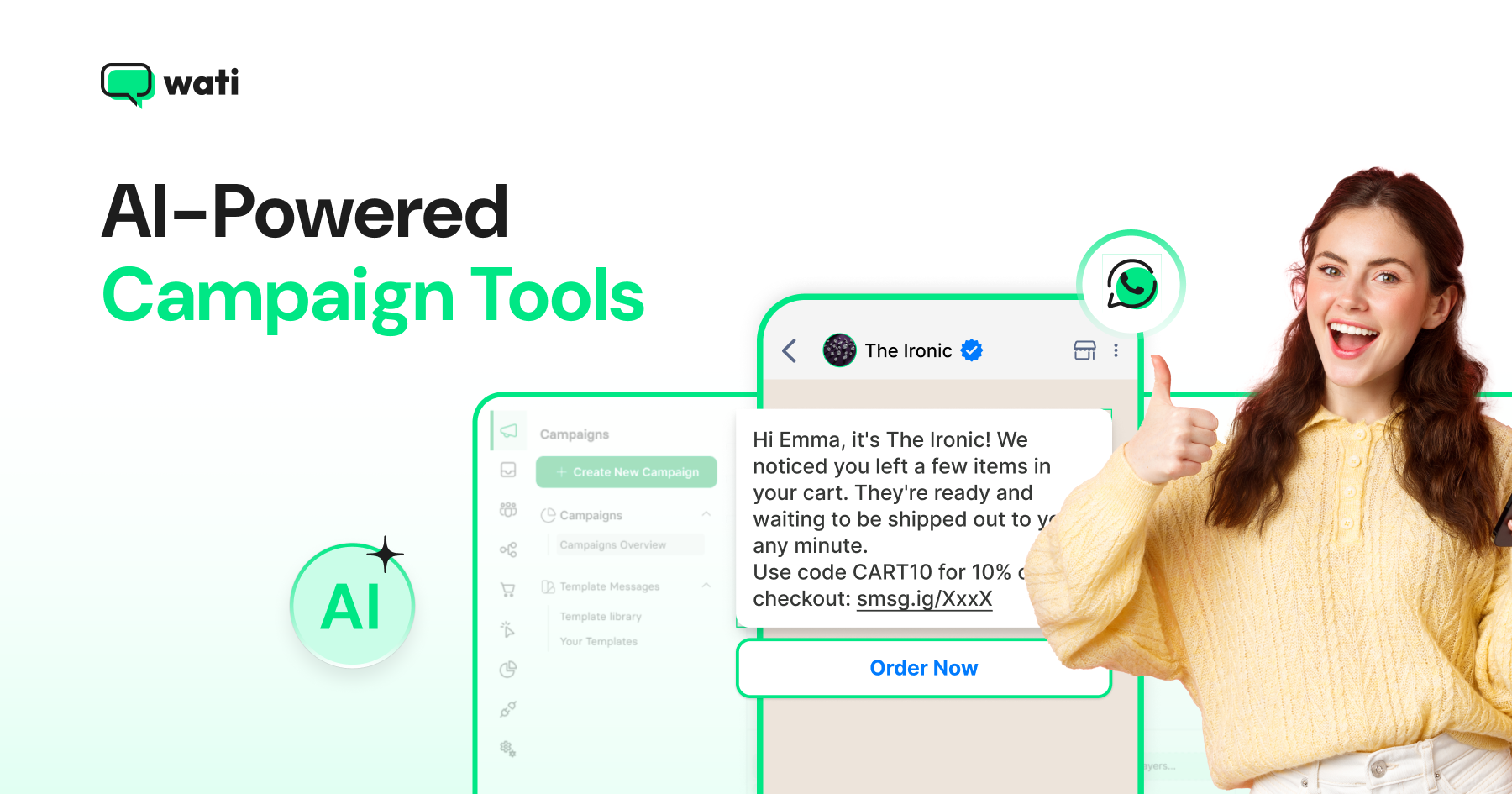
Pick any list of AI in marketing examples published in the last two years and you’ll find the same categories.
Content generation, audience segmentation, predictive analytics, or Send-time optimization. The tools have gotten genuinely impressive and, for the most part, the results are real.
However, even so, there’s a planning problem that none of them actually solve.
Every Monday morning, someone still has to decide what WhatsApp broadcast campaign to run this week. Who it should go to and whether this is the right moment for a promotion or a re-engagement send.
That decision, repeated every week across every market and every festival calendar, is where most WhatsApp marketing quietly breaks down.
AI campaign recommendations change that specific thing. Not the execution layer but the decision layer. That distinction matters more than most marketers realize.
What AI in Marketing Has Actually Changed So Far
The genuine wins are worth acknowledging. Personalized subject lines at scale, predictive lead scoring, dynamic ad creative that adapts to audience segments in real time, and send-time optimization that identifies when a specific contact is most likely to open.
These are meaningful improvements, and businesses using them well have a measurable edge over those that aren’t.
The thing is, all of these examples share something important in common. They operate at the execution layer.
By the time AI gets involved, the campaign has already been planned, the audience has already been chosen, and the message has already been written. AI steps in to optimize the delivery of something a human already decided to do.
That contribution is genuinely valuable. What it doesn’t do, however, is touch the hardest part of WhatsApp marketing: deciding every single week which campaign is worth sending, to which segment, and why right now is the right moment to send it.
That’s a planning decision and that’s precisely where AI campaign recommendations change the equation.
The Three Shifts AI Campaign Recommendations Actually Make
Most conversations about AI in WhatsApp marketing focus on what happens after the campaign is built. AI campaign recommendations work differently because they change what happens before it.
Specifically, they shift three decisions that marketers currently make manually, every single week, often without enough data to make them well.
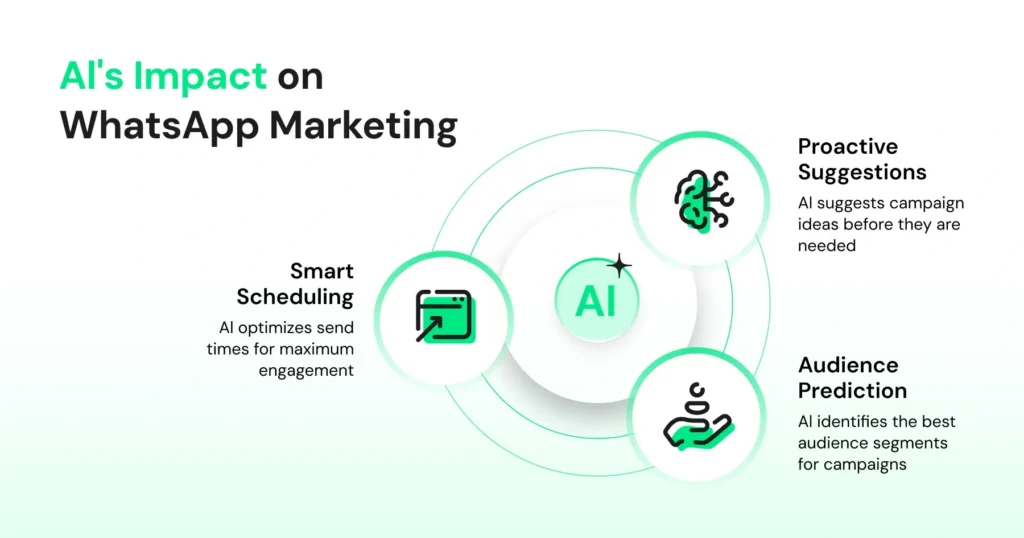
1. From Reactive Sends to Proactive Suggestions
Today, most WhatsApp campaigns get created because someone remembered to create them. A festival lands on the calendar, a promotion needs to go out, or a manager asks why nothing has been sent this week. The trigger is always external.
AI campaign recommendations flip that dynamic by surfacing what to send next before anyone has to ask. The calendar is never empty and the next campaign is never a last-minute decision.
2. From Generic Blasts to Audience Prediction
Sending the same message to every contact on a list is the path of least resistance, and it’s also the fastest way to accumulate blocks and damage a quality rating.
AI campaign recommendations change this by analysing past campaign performance and contact behaviour to suggest not just what to send, but who specifically should receive it.
The result is that segmentation stops being a time-consuming manual step and starts being a built-in default.
3. From Manual Timing to Smart Scheduling
Choosing when to send a WhatsApp campaign is often a gut call. AI send-time optimization replaces that gut call with pattern recognition across historical engagement data, regional calendar events, and audience behaviour.
Rather than defaulting to Thursday at 10 am because it worked once, the system surfaces the timing most likely to perform for that specific campaign and that specific audience.
AI Campaign Recommendations in Practice: Before and After
The shift is easier to understand when you see it side by side.
Scenario | Without AI Recommendations | With Wati Recommended Campaigns |
Monday planning | Marketer opens a blank campaign list and decides what to send from memory or a spreadsheet | Campaign Calendar opens with 2-3 pre-filled suggestions already waiting, each with an audience and send time |
Festival campaigns | Someone remembers Diwali three days before and rushes a template through Meta approval | Diwali campaign surfaces at T-7 with a recommended audience, template options, and timing pre-filled |
Audience selection | Full contact list gets the same message because there’s no time to segment | AI suggests the right segment based on past engagement and contact behaviour |
Send timing | Default to Tuesday or Thursday because it worked last time | Smart scheduling surfaces the optimal send window for that specific campaign and audience |
Campaign frequency | Inconsistent, driven by whoever remembers to send something | Consistent 2-3 campaigns per week maintained automatically within quality rating safe zones |
Re-engagement | Dormant contacts get the same promotional send as active buyers | System flags re-engagement opportunities separately before they receive a promotional message |
The difference isn’t just efficiency but the compounding effect of better decisions made consistently, week after week, without the planning overhead that usually makes consistency impossible.
What AI Campaign Recommendations Can’t Do
Editorial honesty matters here, especially as AI marketing automation becomes more crowded with overblown claims.
Wati Recommended Campaigns is not a replacement for marketing judgment. The system surfaces suggestions based on your contact data, regional calendar, and past campaign performance.
What it cannot do is understand a brand repositioning, a product that just sold out, a PR situation that makes a promotional send tone-deaf, or a strategic decision to hold off on a campaign for reasons that live outside the data.
The recommendations are also only as good as the contact data behind them. A list with incomplete attributes, poor segmentation history, or low engagement signals will produce weaker suggestions than a well-maintained one.
Think of it as a next-best-action engine, not an autopilot. The marketer still makes the final call. What changes is that the call is now informed, prompted, and supported rather than made from scratch every Monday morning.
How Wati Uses AI to Improve WhatsApp Campaign Performance
Wati Recommended Campaigns is the first AI WhatsApp marketing feature built around the planning decision rather than the execution layer.
It sits inside the Campaign Calendar and changes how marketers interact with their weekly send schedule from the moment they open the platform.
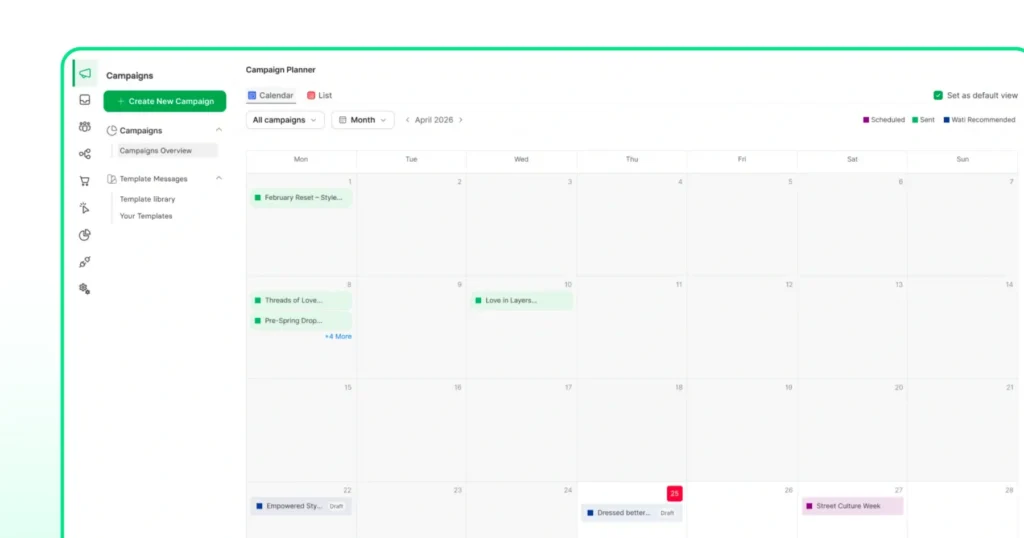
Here is what the AI layer actually does in practice.
- Context Engine scrapes your business domain to understand your industry, products, tone, and region before making any suggestion
- Calendar Engine places two to three campaign recommendations per week during normal periods and three to five during holiday weeks, with a maximum of one per day to protect contact health
- Region-based holiday mapping surfaces Diwali and Holi campaigns for Indian audiences and Eid and Ramadan campaigns for the Middle East, each at the right offset before the event
- Confidence scoring gates every recommendation at a minimum score of 70 out of 100, meaning only high-quality, relevant suggestions surface in your calendar
- One-click pre-filled builder populates the campaign objective, name, three template options, audience, and send time automatically, so a campaign can go from recommendation to scheduled in under 30 seconds
The practical outcome is that AI marketing automation stops being something that optimizes campaigns after a human plans them, and starts being the thing that drives the planning itself.
For WhatsApp marketers managing multiple segments across festival-heavy markets like India and the Middle East, that shift in where AI enters the workflow changes everything about campaign performance and weekly execution.
Wati Recommended Campaigns is available on Pro and Business plans. The Campaign Calendar is the default surface for all campaign activity.
For the full weekly planning framework that AI campaign suggestions sit inside, the complete WhatsApp marketing calendar guide is here.
You can also start your free trial or book a demo today.
Frequently asked questions
1. How is AI used in WhatsApp marketing?
AI in WhatsApp marketing covers send-time optimization, audience segmentation, predictive analytics, and chatbot automation. The newest and least discussed application is proactive campaign recommendations that surface what to send, to whom, and when before the marketer has to decide.
2. Can AI recommend the best time to send WhatsApp campaigns?
Yes. Smart scheduling analyzes historical engagement data, regional calendar events, and audience behavior to surface the optimal send window. Wati Recommended Campaigns includes timing as part of every pre-filled campaign suggestion.
3. What's the difference between AI chatbots and AI campaign recommendations?
A WhatsApp AI chatbot handles inbound conversations and automates responses. AI campaign recommendations work on the outbound planning side, deciding which campaign to send next and to which segment. They solve different problems at different points in the customer journey.
4. How does Wati use AI to improve WhatsApp campaigns?
Wati's Context Engine analyzes your business domain, contact data, and past campaign performance to generate confidence-scored, region-aware suggestions inside the Campaign Calendar. Each comes pre-filled with an audience, template options, and send time, ready to launch in under 30 seconds.
5. Will AI replace WhatsApp marketing managers?
Not in any meaningful near-term sense. AI handles the data-driven planning layer while strategic decisions, brand judgment, and creative direction remain with the marketer. The role shifts from planner to editor.
Related posts
- Instagram Comment Automation: How It Works and How to Set It Up in Wati
Instagram comment automation auto-replies to comments and DMs commenters within seconds via Meta's API. Covers strategy, use cases, and Wati setup.
- Shared Team Inbox for Instagram: A Buyer’s Checklist for 2026
Use this fastest checklist to evaluate any shared team inbox for Instagram, which covers DMs, comments, automation, and multi-channel support.
- How to Send Bulk Messages on WhatsApp Without Getting Blocked
Learn how to send bulk WhatsApp messages without getting blocked. Compare the WhatsApp Business app and API, messaging limits, costs, templates, and best practices for safe, compliant bulk messaging.
- How to Set Up a TikTok Business Account: Step-by-Step Guide
Set up a TikTok Business Account step by step: switch from personal, pick a category, add your profile, and unlock ads and analytics.