
Too Long? Read This First
- Meta Business Agent and a WhatsApp chatbot are not the same product. They run on different infrastructure and serve different business profiles.
- Meta Business Agent is a free, built-in AI agent inside the WhatsApp Business app. It handles inbound FAQs, lead capture, and product recommendations for solo operators and small businesses.
- A WhatsApp AI chatbot built on the API, it helps to connect to your CRM, supports team inboxes, sends broadcast campaigns, and runs on infrastructure your business owns and controls.
- The self-serve tier of Meta Business Agent connects to no external tools, supports no team inbox, and cannot send proactive outbound messages.
- If one person manages your WhatsApp conversations, Meta Business Agent is a legitimate starting point. If you have a team, a stack, and volume, you need the API.
- Meta Business Agent did not make WhatsApp chatbots redundant. It made their case louder.
People are asking the wrong question.
Since Meta announced Business Agent at Conversations 2026, the conversation in most WhatsApp business communities has been: “Does this replace our chatbot?” That framing misses something important.
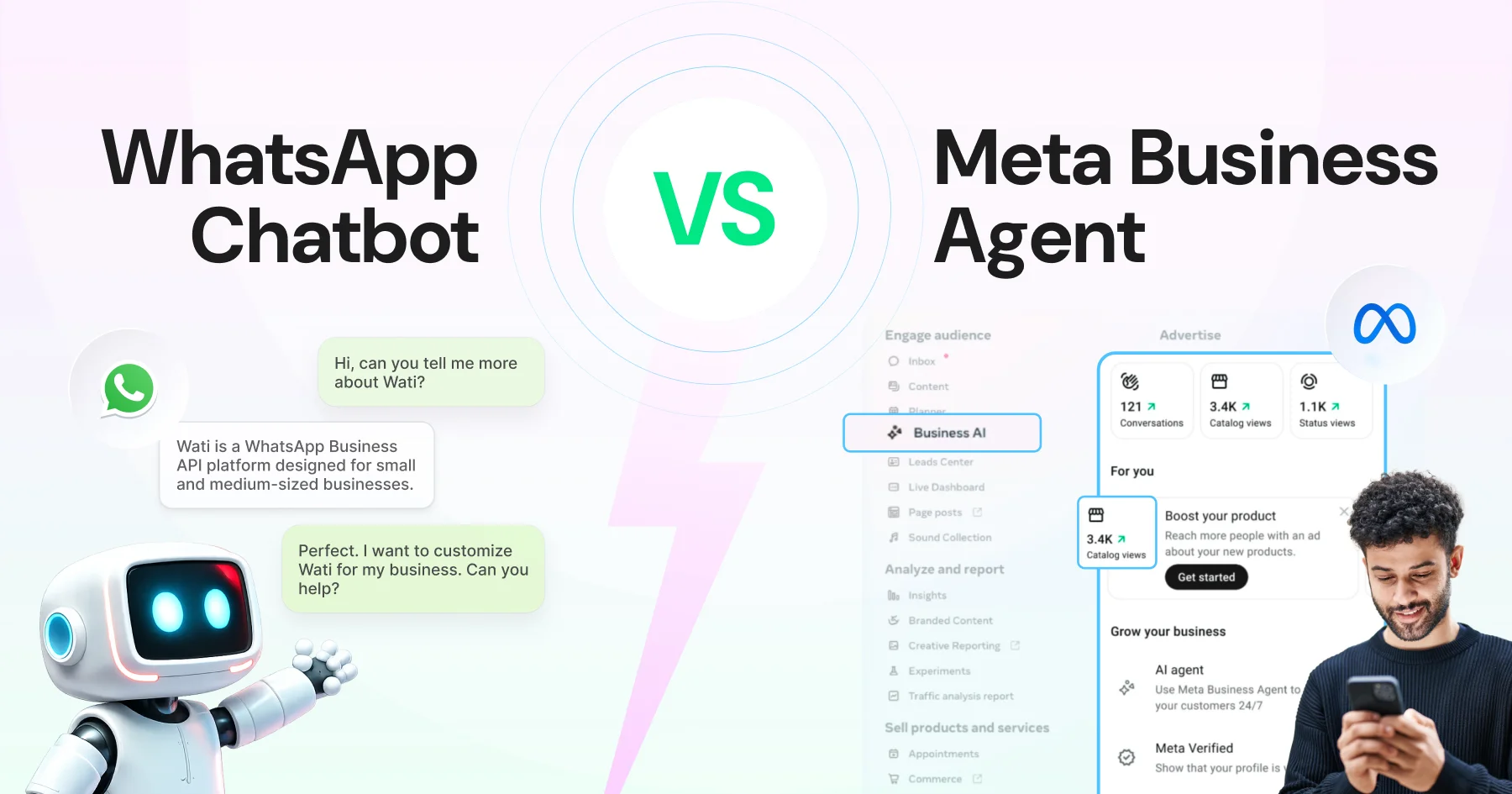
Meta Business Agent and a WhatsApp chatbot are not competing versions of the same thing. They are built on different infrastructures, designed for different business profiles, and they solve different problems.
The short answer: a WhatsApp chatbot built on the WhatsApp Business API is a customizable automation layer your business owns and controls. Meta Business Agent is a free, built-in AI agent that lives inside WhatsApp’s native app.
One is infrastructure. The other is a feature.
If you are trying to decide which one your business actually needs, or whether Meta Business Agent makes your existing WhatsApp chatbot redundant, this guide gives you a straight answer.
What is a WhatsApp Chatbot?
A WhatsApp chatbot is an automated messaging system that runs on the WhatsApp Business API and handles customer conversations without requiring a human to type every reply.
The older generation of WhatsApp chatbots was rule-based. They followed decision trees, matched keywords, and fired scripted responses. If the customer said something unexpected, the bot broke.
Modern WhatsApp AI chatbots are different. They understand natural language, maintain context across a conversation, connect to your CRM and backend systems, and take real actions.
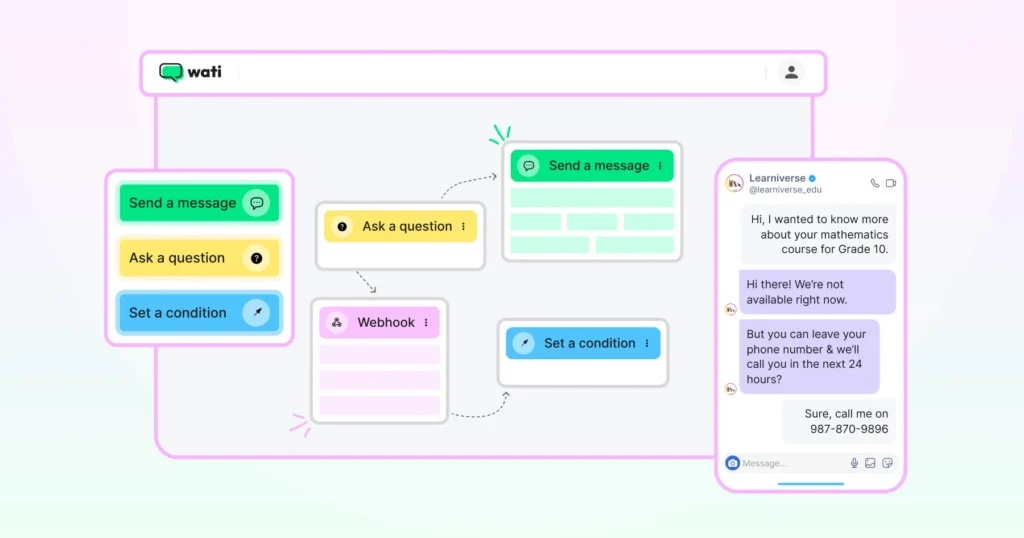
A lead qualifies themselves through a conversation and gets pushed directly into HubSpot. An order status query returns live data pulled from your system.
The key difference is ownership. A WhatsApp chatbot built on the API runs on your infrastructure, integrates with your tools, and supports your workflows. You define the logic, own the data, and control the experience.
What is Meta Business Agent?
Meta Business Agent is Meta’s native AI agent built directly into the WhatsApp Business app, Facebook Messenger, and Instagram. It launched globally on June 3, 2026.
It answers FAQs, captures leads, recommends products, and hands off to a human when it cannot continue. Free to start with no code required.
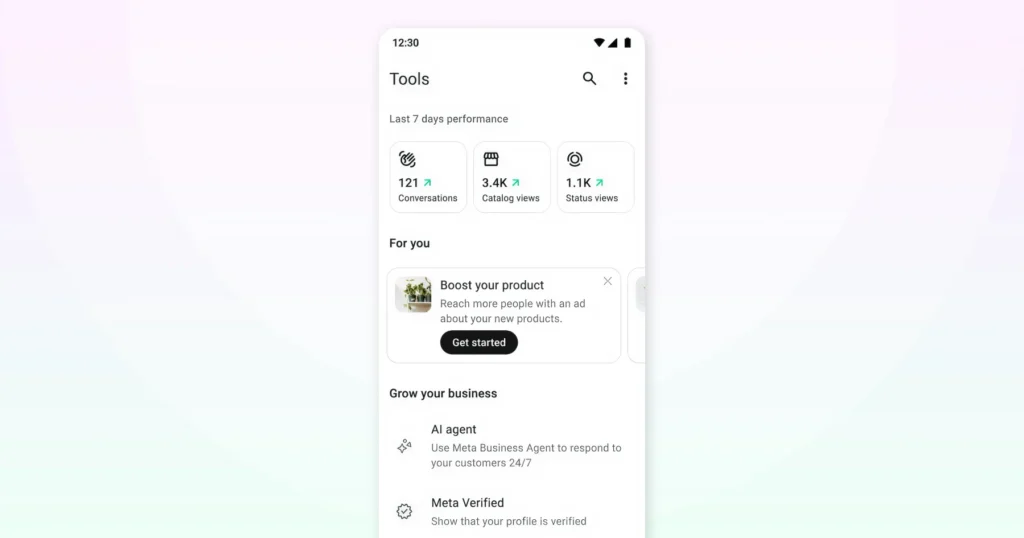
The reason it gets compared to WhatsApp chatbots so often is that on the surface, they seem to do similar things. Both automate customer conversations on WhatsApp. The difference is in how they are built, what they connect to, and who controls them.
For a full breakdown of how it works, setup steps, pricing, and limitations, read our complete Meta Business Agent guide.
Meta Business Agent vs WhatsApp Chatbot: The Core Differences
This is where the two products actually diverge. Not in what they appear to do on the surface, but in how they are built and what that means for your business.
Infrastructure A WhatsApp chatbot runs on the WhatsApp Business API. It sits outside Meta’s native app, connects to your existing tools, and operates as part of your broader business stack.
Meta Business Agent runs inside the WhatsApp Business app. It is a feature of that app, not a standalone infrastructure layer.
Ownership and control With a WhatsApp AI chatbot, you define the logic, train the knowledge base, and own the data. With Meta Business Agent, Meta controls the underlying model and infrastructure. You configure it, but you don’t own it. What it connects to A WhatsApp chatbot built on the API connects to your CRM, helpdesk, e-commerce platform, and any tool with an API. Meta Business Agent at the self-serve tier connects to nothing external. Your customer conversations stay inside Meta’s ecosystem.
Who initiates conversations A WhatsApp chatbot can send proactive outbound messages to segmented customer lists using approved templates. Meta Business Agent only responds to inbound conversations. It never initiates at scale.
Scale and team support A WhatsApp chatbot supports multi-agent inboxes, conversation routing, SLAs, and team assignment. Meta Business Agent is designed for small teams, not multi-agent operations with routing and SLAs.
Feature | Meta Business Agent | WhatsApp Chatbot |
Runs on | WhatsApp Business app | WhatsApp Business API |
Built and run by | Meta, the customer can configure | You |
Data ownership | Meta’s ecosystem | You own your data |
External integrations | None at self-serve tier | CRM, helpdesk, e-commerce, 100+ tools |
Outbound messaging | Inbound only | Proactive campaigns with approved templates |
Team support | Limited, no routing or SLAs | Multi-agent inbox, routing, SLAs |
Custom automation | Not available | Full workflow and webhook support |
Cost | Free | Depends on platform and plan |
When a WhatsApp AI Chatbot Makes More Sense
Meta Business Agent is free and genuinely useful for what it does. But there are clear situations where a WhatsApp AI chatbot built on the API is the only option.
1. You have a team handling conversations The moment more than one person needs to see, respond to, or manage customer conversations, Meta Business Agent stops working. A WhatsApp AI chatbot on the API supports shared inboxes, agent assignment, and conversation routing. Meta Business Agent does not.
2. You need to connect WhatsApp to your existing stack If your business runs on HubSpot, Salesforce, Shopify, or any other tool, you need those systems to talk to your WhatsApp conversations. Meta Business Agent at the self-serve tier connects to nothing external. An API-based chatbot does.
3. You want to send proactive outbound messages Broadcast campaigns, drip sequences, cart abandonment messages, and appointment reminders. None of that is possible with Meta Business Agent. It only responds to inbound. A WhatsApp chatbot on the API initiates conversations at scale using approved templates.
4. You operate at volume Hundreds of conversations a day across multiple agents, markets, and languages require infrastructure, not a native app feature. API-based chatbots are built for that load.
5. You need to own your data With Meta Business Agent, your customer conversations stay inside Meta’s ecosystem. For businesses in regulated industries, or any business that treats customer data as a strategic asset, that is a real constraint
When Meta Business Agent is the Right Call
Being honest about this matters. Meta Business Agent is genuinely the better option for a specific profile of business, and pretending otherwise would not serve anyone reading this.
1. You are a solo operator or micro-business If one person manages all customer conversations from a phone, Meta Business Agent was built exactly for you. No setup complexity, no monthly fee, no developer. You open the app, configure your knowledge, and your AI agent is live.
2. You are just starting out with WhatsApp automation Meta Business Agent is the lowest-friction entry point into WhatsApp AI. If your business has never automated customer conversations before and you want to test what it feels like before committing to a platform, starting here makes sense.
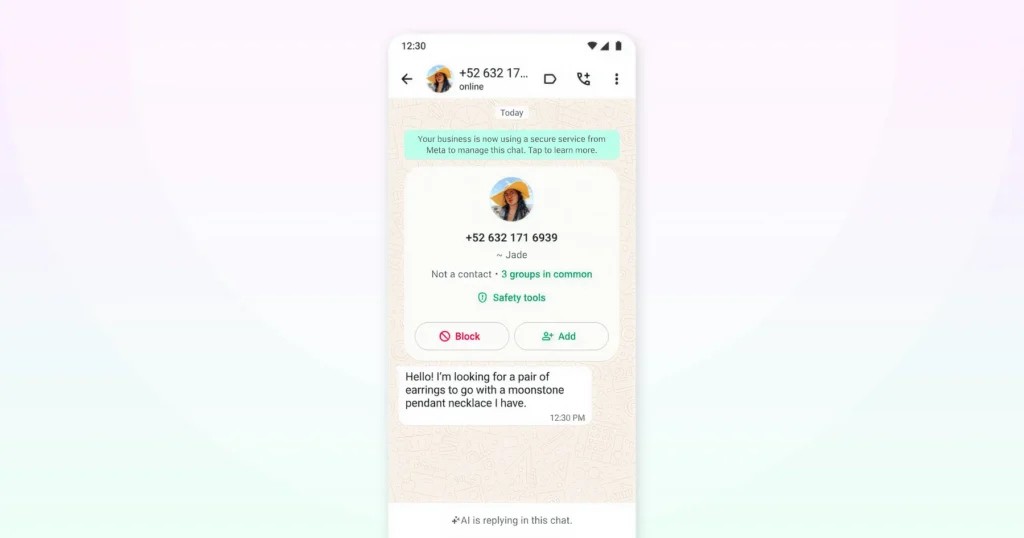
3. Your conversation volume is low and predictable If you handle 20 to 50 inbound chats a day, most of which are the same questions, Meta Business Agent handles that well. FAQ automation, lead capture, product recommendations, and human handoff. That is exactly what it was designed for.
4. You want zero cost to start For a business where budget is the primary constraint, free matters. Meta Business Agent costs nothing to activate and nothing to run at the self-serve tier.
The honest framing is this: Meta Business Agent is a great first step. For businesses that have already taken that step, or know they need more than a first step, a WhatsApp AI chatbot on the API is the right infrastructure to build on.
Which One Should Your Business Use?
Ask yourself these four questions. The answers will tell you everything.
How many people handle your WhatsApp conversations? If the answer is one, the Meta Business Agent works. If the answer is two or more, you need the API.
Do you need WhatsApp to talk to your other tools? If your CRM, helpdesk, or e-commerce platform needs to connect to your conversations, Meta Business Agent cannot do that at the self-serve tier. An API-based chatbot can.
Do you need to reach customers first, or just respond to them? Meta Business Agent is inbound only. If broadcast campaigns, drip sequences, or proactive outreach are part of your strategy, you need the API.
Are you testing, or are you building? Meta Business Agent is a legitimate starting point for businesses exploring WhatsApp automation for the first time. If you already know WhatsApp is a serious channel for your business, start with infrastructure that scales.
One question, one answer, four times. You will know which product fits before you reach the end.
Do you think the API is a better fit for your business? See how Wati works by booking a free demo.
Frequently asked questions
1. Is Meta Business Agent the same as a WhatsApp chatbot?
No. Meta Business Agent is a built-in feature of the WhatsApp Business app, run by Meta. A WhatsApp chatbot built on the API is a customizable automation layer your business owns, controls, and connects to your existing tools.
2. Does Meta Business Agent replace my existing WhatsApp chatbot?
No. They run on different infrastructure and serve different business profiles. If your chatbot is built on the WhatsApp Business API, Meta Business Agent does not touch it and cannot replicate what it does.
3. What is the difference between a WhatsApp AI chatbot and Meta Business Agent?
The core difference is ownership and capability. A WhatsApp AI chatbot connects to your CRM, supports team inboxes, sends broadcast campaigns, and runs on infrastructure you control. Meta Business Agent does none of that at the self-serve tier.
Related posts
- 40 Festival Templates for WhatsApp: Diwali, Holi, Eid, Christmas & More
Discover 40 ready-to-use Indian festival templates for WhatsApp. Customize and send festive wishes, sale announcements, and offers in minutes.
- Why Isn’t Instagram Engagement Converting into Leads? (And How to Fix it)
learn what are the ways to optimize instagram engagement and how to turn public comments and private DMs into leads to improve your sales pipeline and conversions.
- Shared Team Inbox for Instagram: A Buyer’s Checklist for 2026
Use this fastest checklist to evaluate any shared team inbox for Instagram, which covers DMs, comments, automation, and multi-channel support.
- Instagram Comment Automation: Never Miss a Lead in Your Comments Again
Learn how Instagram comment automation works, the best use cases for teams, and how to set up comment-to-DM flows that capture leads and convert.