

-

-
-
Solutions
-
Soluções
-
Soluciones
-
解决方案
-
解決方案
-
الحلول
-
Product
-
Produto
-
Producto
-
产品
-
產品
-
المنتج
-
 Astra AI
-
-


 Wati for Marketing
 Wati for Support
 Wati for Sales
 eLearning
 E-commerce
 Marketing Agencies
 Healthcare
 No Code Chatbots
 AI Support Agent
 Instagram and Facebook messenger
 Click to WhatsApp ads
 Broadcasts
 Team Inbox
 WhatsApp Business Calling
 Overview
 Library
WhatsApp API for Ecommerce: A Practical, High-Impact Guide for Acquisition, Support, and Retention
Written by:
 Ashwin
|
on:
December 12, 2025
|
Last updated on:
December 15, 2025
|
Fact Checked by :
Ashwin
|
on:
December 12, 2025
|
Last updated on:
December 15, 2025
|
Fact Checked by :
 Namitha
|
According to: Editorial Policies
Namitha
|
According to: Editorial Policies
 Table of Contents
Too Long? Read This First
- WhatsApp Becomes the Buyer’s Shortcut: Shoppers want fast answers about size, delivery, COD, and availability. Every delay increases the chance of a drop-off.
- Automation Handles the Heavy Lifting: AI answers sizing, delivery, and policy questions, so shoppers don’t have to wait for agents.
- Friction Points Need Fast Fixes: Smart nudges, COD checks, and payment prompts help recover stalled carts and complete purchases.
- Support Should Be Instant: Order tracking, returns, and refunds run smoothly when automated across WhatsApp, Instagram, and Messenger.
- Retention Works When It’s Relevant: Segmentation, personalized broadcasts, and reorder reminders keep customers buying without feeling spammed.
- AI Makes Agents Faster: Summaries, translations, and response suggestions reduce manual effort and keep workflows moving.
- Voice Matters for Big Decisions: WhatsApp Business Calling helps close high-value purchases where text alone isn’t enough.
- Reliability Matters Too: SMS fallback ensures that critical updates, such as OTPs, refunds, and delivery alerts, reach customers even when WhatsApp doesn’t.
E-commerce teams juggle a messy mix of conversations every day. Customers jump between Instagram, website, WhatsApp, email, and back again. They expect fast responses, specific answers, and friction-free purchasing.
The problem?
Traditional channels slow them down.
For Email, open rates are lower; people ignore emails when their inboxes are overwhelmed.
Phone calls feel like an effort.
Support chat depends on them staying on your site.
So customers prefer the one place they trust for real-time clarity: WhatsApp.
If your team still handles this through a WhatsApp personal or the WhatsApp Business App, you already know the pain points:
No automation
No routing
No visibility
That’s precisely where the WhatsApp Business API for ecommerce fits in. And where Wati turns that API into a complete conversion-and-support engine tailored for D2C and retail workflows.
This guide walks through how ecommerce brands actually use the WhatsApp API for ecommerce, the tools that matter, and what real results look like.
Why Ecommerce Teams Rely on WhatsApp?
Let’s state the obvious: e-commerce shoppers can be impatient, distracted, and quick to abandon carts.
- They want product suggestions.
- They want to know if their PIN code is serviceable.
- They want delivery timelines.
- They want to change colour or quantity.
- They want to check if COD is available.
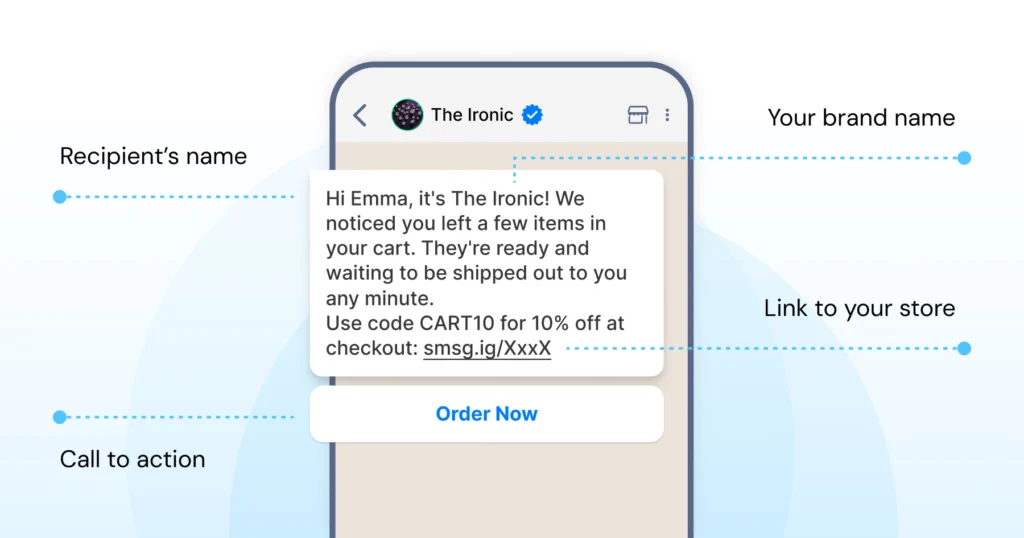
These are not “support tickets”. These are decision-making steps.
If you slow them down, the sale stalls.
And the data backs this up:
- Over 7 in 10 Indians now prefer to chat with businesses (Source)
- 66% of consumers expect a response from customer service in five minutes or less (Source)
- Conversion rates are 8x greater in the first five minutes (Source)
Every e-commerce brand eventually realises the same truth:
If the conversation moves to WhatsApp, the probability of a customer moving closer to checkout increases.
How the WhatsApp API for Ecommerce Fits Into the Funnel?
The WhatsApp API isn’t just another messaging option. For many e-commerce businesses, it becomes a core layer that supports every stage of the customer journey.
Here’s how it typically maps across the funnel:
| Stage | Customer Needs | WhatsApp + Wati Solution |
| Discovery | Quick information, product clarity, trust | CTWA entry, catalog browsing, AI-driven suggestions |
| Evaluation | Sizes, product availability, and delivery timelines | Automated flows, agent handover, WhatsApp Business Calling |
| Purchase | Smooth checkout, reassurance, order certainty | Targeted reminders, COD verification, payment prompts |
| Post-purchase | Real-time updates, low effort support | Custom notifications, tracking workflows, automated responses |
| Retention | Reorder nudges, personalised offers, and product education | Segmentation, broadcasts, lifecycle journeys |
This framework reflects how most e-commerce brands use WhatsApp to reduce friction, answer decision-making questions quickly, and keep customers engaged beyond the first purchase.
Acquisition: Turn Traffic into Conversations Instantly
Click-to-WhatsApp Ads (CTWA)
Click-to-WhatsApp Ads have become one of the most effective acquisition levers for brands using the WhatsApp Business API for ecommerce services, especially when the goal is to reduce steps between discovery and action.
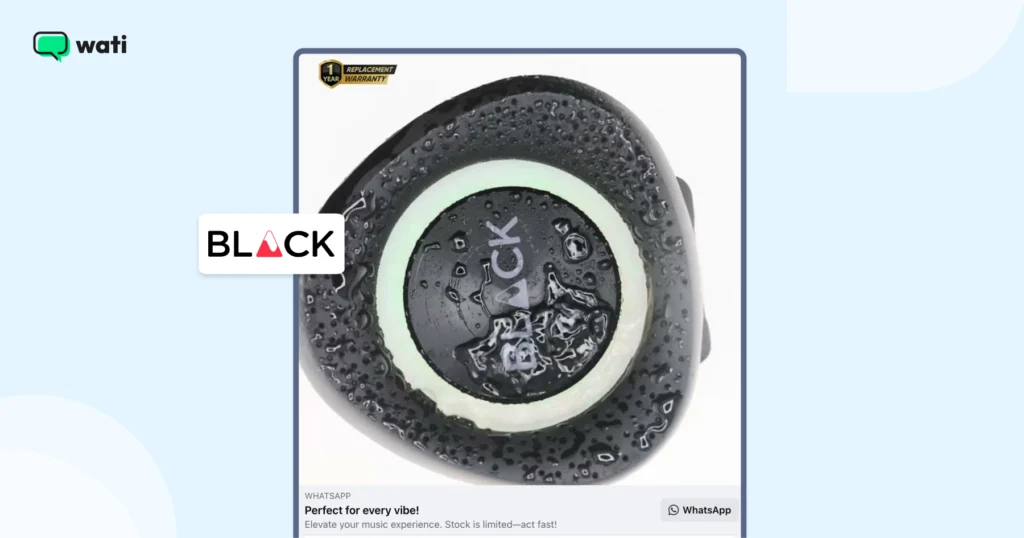
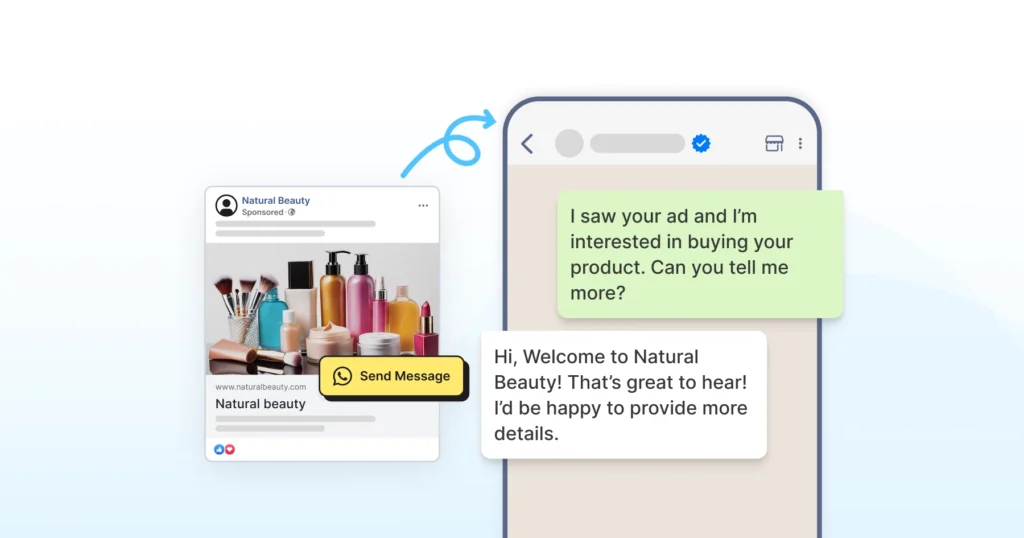
A shopper sees your ad, taps WhatsApp, and enters a conversation.
No landing pages. No long forms. No added friction.
Why CTWA Works Well for Ecommerce?
- Many shoppers prefer messaging over filling out forms
- Conversations feel low-commitment and natural
- You capture intent immediately
- You can showcase products through the WhatsApp catalog
- AI agents can qualify the user before a human joins the chat
Example
A user taps a “New Sneaker Drop” ad.
WhatsApp opens instantly:
“Looking for men’s or women’s styles?”
From there, Wati’s chatbot can:
- Ask for size
- Share available styles
- Highlight fit differences
- Display catalog options
- Push a checkout link
This shortens the path from discovery to purchase by removing unnecessary steps.
Blacklyf leaned on CTWA, combined with automated qualification flows powered by Wati.
Results:
- 60% lower acquisition cost
- 3x higher conversions
Reducing friction between interest and conversation made a measurable impact on performance.
Product Discovery: Helping Shoppers Decide Quickly
E-commerce queries tend to follow similar patterns – sizing, availability, delivery timeline, material details, or payment options.
Predictable doesn’t mean simple. These questions often influence buying confidence.
A customer asking, “Is this available in size 42?” might be signalling:
- Uncertainty about fit
- Need for reassurance
- Concern about making the wrong choice
Fast replies keep them engaged. Slow replies often interrupt that decision flow.
Wati Features That Support Faster Product Discovery
AI Support Agent (Astra)
WhatsApp Catalog
Instagram + Facebook Messenger integrations
Multiple WhatsApp numbers
Coexistence for app + API usage
No-code chatbots
Example
User: “Looking for a laptop bag for a 16-inch MacBook.”
Wati’s AI Agent can:
- Share relevant catalog options
- Highlight product differences
- Present COD or prepaid options
- Escalate to a human agent if needed
Each step reduces friction and helps the shopper move toward a confident decision.
Conversion: Fix Drop-offs With Smart Automation
Cart abandonment is a challenge for every e-commerce brand. The WhatsApp Business API for ecommerce gives you a direct, fast-response channel to bring customers back into the buying flow.
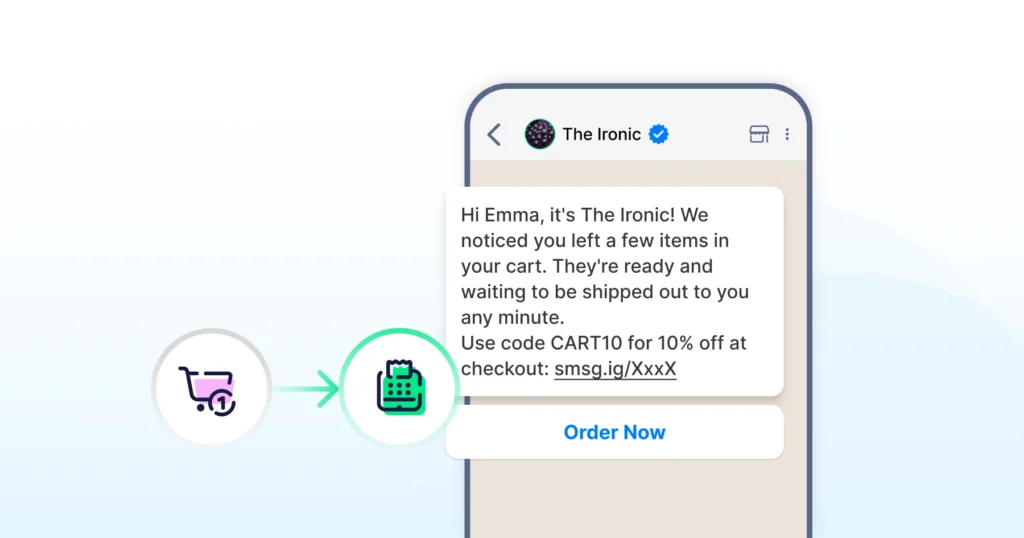
What Usually Causes Drop-Offs?
- Fit or size uncertainty
- Concerns about delivery timelines
- Confusion around return or exchange policies
- Not convinced with the quoted price
- COD-related doubts
Addressing these quickly can shift a shopper from hesitation to purchase.
Also Read: Best WhatsApp Abandoned Cart Recovery Messages to Win Back Lost Sales
How Wati Automates Key Conversion Moments?
| Event | Automated Action | Result |
| Cart not completed | Reminder with cart link | Customer returns to checkout |
| No reply after the reminder | AI asks if they need help | Reduced abandonment |
| Size uncertainty | Size guide or comparison | Higher purchase confidence |
| High-value item | WhatsApp Business Calling option | Reassurance during the decision |
| Payment failure | Retry link via custom notification | Saved transaction attempt |
| Message not delivered | SMS fallback | Higher delivery reliability |
Each automation removes friction at a point where customers often stall.
Oxwhite used Wati’s automated workflows and AI-driven conversations to ease shoppers’ decision-making without relying on discounts.
Result: 20% increase in conversion rates. Reducing friction at critical moments had a measurable impact on their checkout completion rate.
Post-Purchase Support: Reduce Workload, Increase Satisfaction
A large share of e-commerce support requests fall into a few predictable categories:
- “Where is my order?”
- “How do I exchange this?”
- “When will my refund come through?”
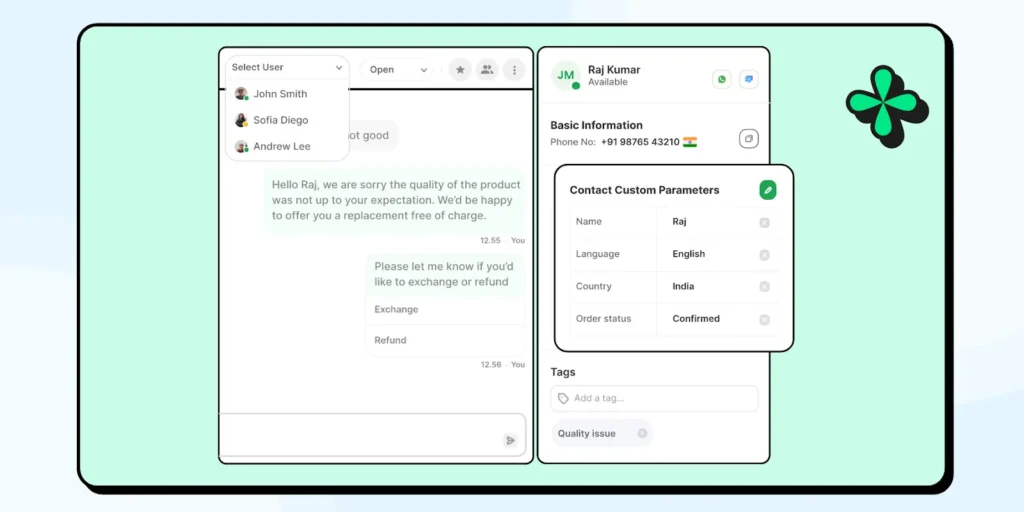
These are ideal use cases for automation and AI because they follow clear rules and require fast turnaround.
The Wati Support Stack
Astra AI Support Agent
- Answers order-related queries
- Handles shipping policies, return rules, and refund timelines
- Provides instant responses that reduce wait times
Self-Serve Workflows
Customers can independently:
- Track order
- Start returns
- Update delivery addresses
- Upload photos for defective or damaged items
Team Inbox Spanning WhatsApp, Instagram, and Messenger
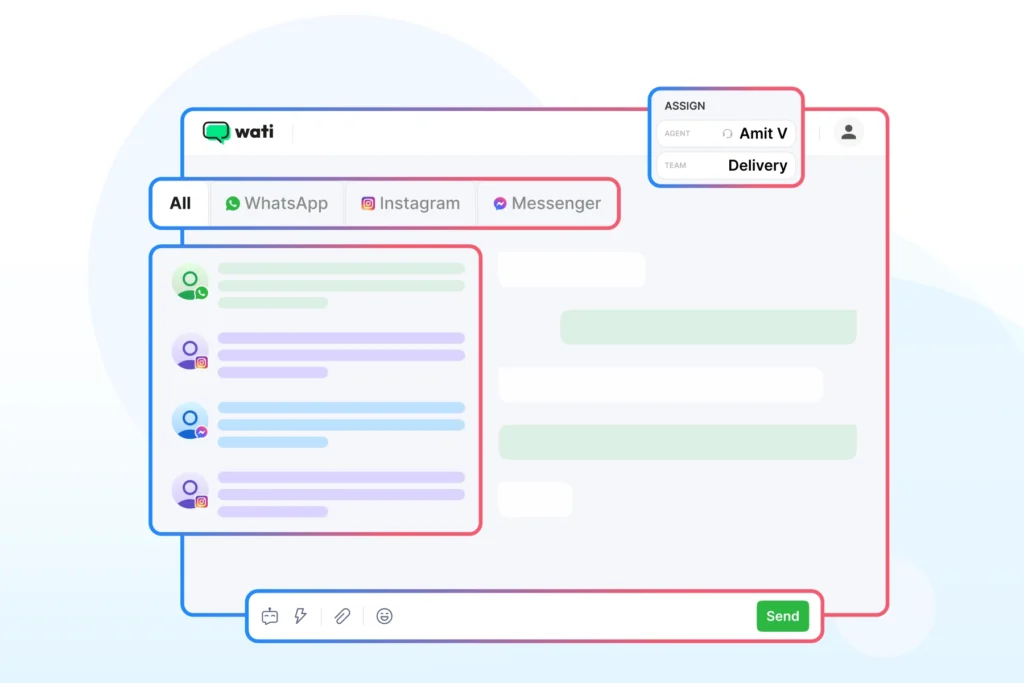
- All conversations appear in one place
- Agents have full context, reducing repeated questions
- Easier assignment and collaboration
Multiple WhatsApp Numbers
- Separate numbers for sales, support, or logistics
- Helps larger teams manage volume more efficiently
Further Reading: WhatsApp for Customer Support: Techniques + Examples
Case Study:
Zellbury used Wati to structure its support operations and automate routine interactions.
The result: 87% customer satisfaction, even during high-order periods.
Automation handled repetitive tasks, allowing agents to focus on conversations that required deeper attention. Read the case study in detail here.
Retention: Build Repeat Purchases Without Being Spammy
Retention drives long-term e-commerce growth, and the WhatsApp API for ecommerce helps you stay relevant without overwhelming users.
Wati Features That Strengthen Retention
- Segmentation
- Broadcasts
- Custom notifications
- Reorder reminders
These features help you send updates that match customer intent, timing, and buying patterns.
Example Segments
| Segment | Message Type |
| Bought skincare 60 days ago | “Time for a refill?” |
| High-value customers | Early access to the latest launch products |
| Browsed but didn’t buy | Product highlights or comparisons |
| Seasonal shoppers | Festive curations |
| COD users | Incentives to shift to prepaid |
These kinds of personalised nudges help brands stay relevant across repeat-buying cycles.
Why SMS fallback matters?
For critical updates such as refund alerts, delivery notifications, or OTPs, SMS serves as a backup channel.
If a WhatsApp message can’t be delivered due to network or device issues, SMS increases the chances that the customer still receives essential information.
Further Reading: When to use SMS marketing tools or WhatsApp broadcasts?
AI at Wati: The Assistance Your Team Didn’t Know They Needed
AI inside Wati isn’t an optional add-on. It serves as a performance layer that supports agents throughout the day and accelerates internal workflows that typically require time and attention.
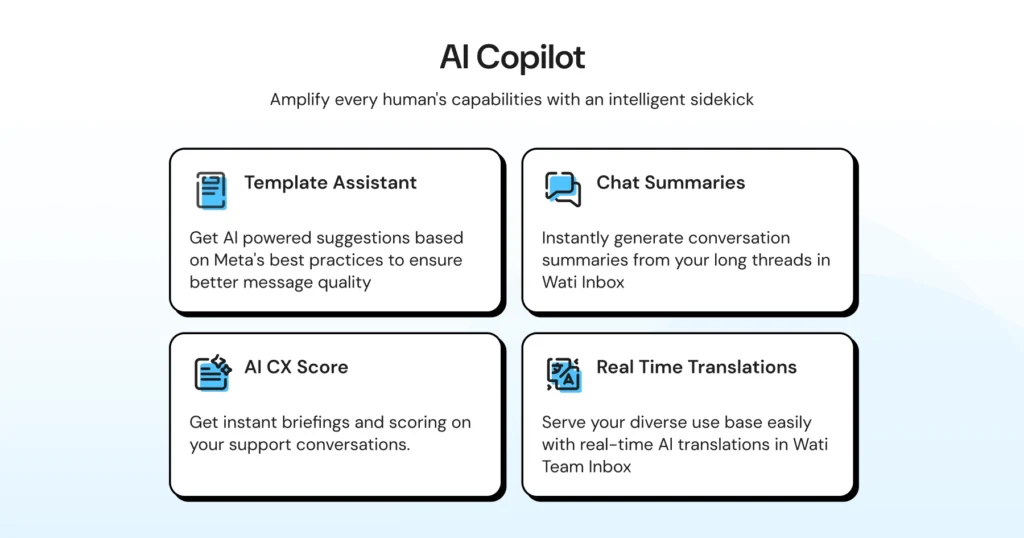
AI Copilot Capabilities Include:
- Chat summarisation
- Template refinement
- Auto translations
- Response suggestions
- Escalation cues
Instead of reading long threads, rewriting messages, or searching through documents, agents get the information and suggestions they need instantly.
AI handles the repetitive effort, and your team focuses on decisions that require human judgment.
WhatsApp Business Calling: Close High-Intent Shoppers
Some ecommerce categories involve higher consideration, where shoppers often want direct reassurance before completing a purchase, especially items like furniture, electronics, jewellery, high-end footwear, or custom-built products.
In these cases, a quick conversation can help clarify details, build confidence, and move the buyer closer to a decision.
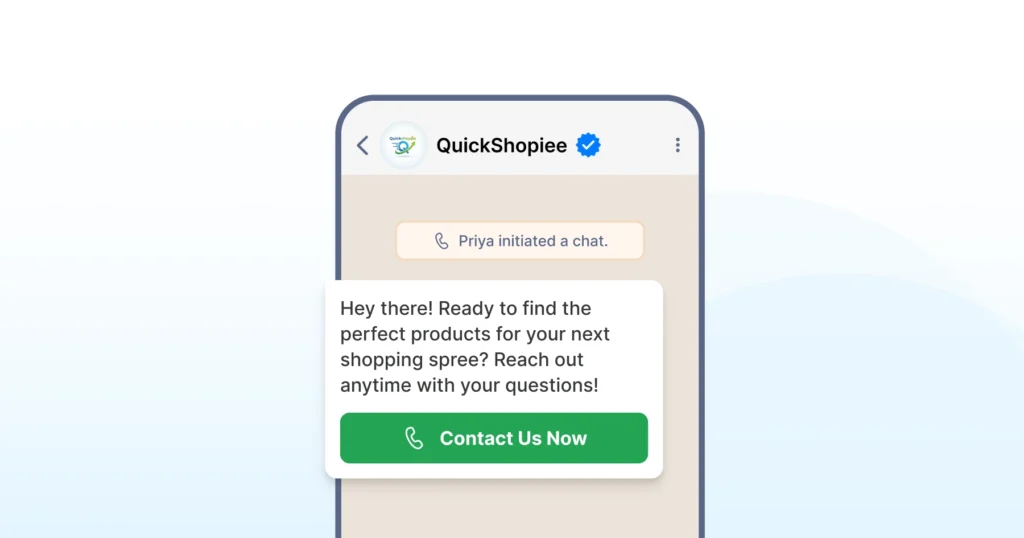
With Wati, agents can initiate WhatsApp Business Calling directly from the chat:
- One tap to start the call
- No manual dialing
- No switching between apps
- Full conversation context visible during the call
It creates a smooth handoff from text to voice, giving high-intent shoppers an easier path to clarity and reducing friction in high-value purchase decisions.
A Complete WhatsApp Ecommerce Journey
Here’s how the full customer lifecycle typically plays out when ecommerce brands use WhatsApp with Wati:
| Stage | WhatsApp Action | Business Impact |
| Discovery | CTWA > AI qualification > Catalog | Faster, intent-rich conversations |
| Evaluation | AI + human assistance | Lower friction during decision-making |
| Purchase | Check out nudges and Custom notifications | Higher conversion rates |
| Post-purchase | Automated tracking and Smart support flows | Reduced ticket volume |
| Returns | Self-serve return flow & Escalation only when needed | Faster resolution times |
| Reorder | Segmented broadcast & reminders | Stronger repeat purchase cycle |
Ready to See this in Action?
Your customers already prefer WhatsApp.
Wati helps you meet them there with faster replies, more intelligent automation, and a smoother buying experience from first click to repeat purchase.
Want to see how this works for your e-commerce store? Book a demo and explore real workflows tailored to your brand.
FAQs
The WhatsApp Business API is an advanced version of WhatsApp designed for businesses that need automation, multi-agent handling, integrations, and large-scale messaging.
E-commerce brands use it to manage high chat volumes, automate order updates, support customer queries quickly, and reduce friction throughout the buying journey.
CTWA does not guarantee higher conversions, but many e-commerce brands see improved results because customers can start a conversation instantly, rather than filling out forms or landing on a website. This reduces the number of steps between interest and interaction.
WhatsApp is a strong channel for re-engaging shoppers because messages are seen quickly and feel more personal than email. Using Wati, brands can automate timely reminders, offer size or fit assistance, send retry payment links, and resolve questions through AI or agents.
This can help recover stalled checkouts, though results vary by brand and customer segment.
Yes. Wati enables self-serve flows that let customers track orders, raise return requests, upload images of damaged products, or update addresses. Only complex cases require human intervention. This improves response times and reduces support tickets.
Yes, when used responsibly. Through segmentation and broadcasts, ecommerce brands send tailored updates, including restock reminders, back-in-stock alerts, product recommendations, and festive curation. WhatsApp’s policies require customers to opt in before receiving marketing messages.
If a WhatsApp message fails to deliver due to device or network issues, Wati can send the same update via SMS. This increases the likelihood that customers receive critical notifications such as OTPs, refund alerts, or delivery updates.
Yes. For categories like furniture, electronics, jewellery, or custom-crafted items, buyers often want clarification before purchasing. With WhatsApp Business Calling inside Wati, agents can shift from chat to voice with complete context, making it easier to reassure high-intent shoppers.
Yes, but the value increases with message volume. Small teams benefit from automation and team inbox, while larger teams need routing, multi-number setups, and agent collaboration.
If you’re receiving more chats than one person can handle on a single device, upgrading to the API makes sense.
Latest Comments