
Too Long? Read This First
- Black Friday message fatigue and support overload are connected problems caused by one-way marketing campaigns.
- Sending more SMS and email messages can increase unsubscribes without necessarily improving conversions.
- Proactive, behavior-based conversations can drive stronger engagement than generic broadcast campaigns.
- Connecting marketing and support in one conversation helps shoppers get answers without creating additional support tickets.
- Brands that prioritize two-way conversations across channels like WhatsApp can create a better BFCM experience while reducing operational pressure.
Ask a growth marketer how BFCM went, and you'll hear about unsubscribe rates.
Ask the support lead the same week, and you'll hear about the ticket backlog.
Nobody in the room connects the two, even though they're looking at the same customer complaining about the same thing from opposite ends of the business. That's the blind spot.
Most Black Friday playbooks treat message fatigue and support overload as two separate fires, so they try to fix it by getting
- A tighter SMS cadence and personalization
- Seasonal headcount
Together, you’re paying twice for the same mistake. Once in unsubscribes, once in ticket volume, when the real problem was that the whole BFCM stack is built to talk at shoppers, not with them.
The State of the Current BCFM Ecosystem
Attentive tells brands to grow their SMS lists before Cyber Week by enabling faster two-tap opt-ins. Sinch argues SMS is still the sharpest tool in the drawer because most people check a text within five minutes of getting it.
Even the more candid voices in the space admit that SMS fatigue sets in faster than email. The common advice: cap sends at two to four a month, watch the opt-out rate closely, and treat TCPA and 10DLC compliance as the cost of playing in this channel at all.
Email can take more volume than SMS without falling apart. Klaviyo's BFCM guide tells brands to email engaged segments daily across the Black Friday to Cyber Monday stretch, but never the full list at once. Too many emails and your customers get burned out and unsubscribe, just a bit later than a text would.
However, a November 2025 Optimove survey of over a thousand consumers found that 56% only get bothered by message overload when the offer is irrelevant, not because of volume alone. This shows that sending more messages, more often, as long as they're personalized, is okay.
Brands are listening. Dotdigital's 2024 platform data shows 365 million emails went out on Black Friday alone, an 8% jump over the year before, even with SMS pulling a click-through rate six times higher.
On the support side, the advice is similar. Peak-season data from customer experience firms shows contact volume roughly doubling across retail during Black Friday and Cyber Monday, with spikes of three to five times normal in faster-moving categories like fashion and flash-sale retail.
Gorgias and a handful of other peak-season playbooks respond with the obvious answer: staff up and deploy AI deflection in the helpdesk. Treat it like warehouse capacity planning for a predictable spike.
Then there are the two channels that barely make it into any of these guides at all: DMs and WhatsApp.
A 2025 study in Behavioral Sciences ran three separate experiments testing proactive automated chat responses against reactive ones, and purchase intent came out meaningfully higher for the automated version every time. Respond automatically and fast, and people report actually wanting to buy more.
A benchmark study of over 30 e-commerce brands also puts WhatsApp's
- Broadcast open rates at 60–80%
- Proactive automated flow open rates at 70–90%, and
- Broadcast conversion at 3–7%, with cart-recovery-style automations reaching double-digit
The bigger case for WhatsApp isn't the open rate, though. It's geography. If you're only shipping within the US, it's fair to file WhatsApp under "nice to have." But the moment a US-based brand starts shipping to customers in those markets, the calculation changes.
Those customers aren't choosing WhatsApp over email the way a US shopper might; they're already living there. WhatsApp's own US growth, from 23% of adults in 2021 to about 32% in 2025, shows the gap closing domestically too, just slower and mostly among younger shoppers.
For a long time, SMS and email had the most proof behind them, but that’s slowly changing. A decade of cart abandonment and back-in-stock case studies show brands reacting to customer behavior. Now? Now it’s time to be proactive. All that proof built on US shopping habits also doesn’t necessarily transfer over to other markets.
Reacting to Customers isn't the Same as Talking to Them
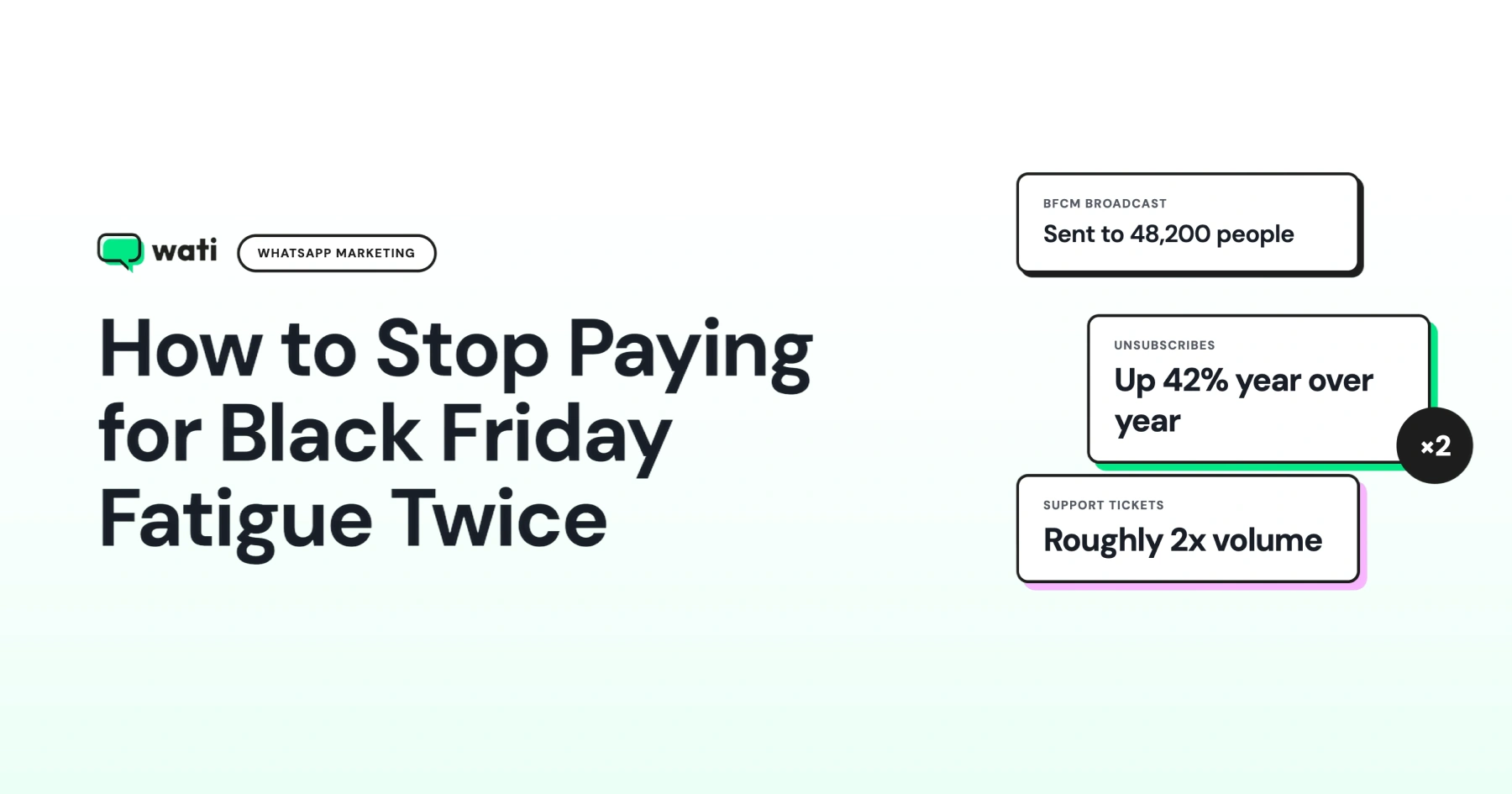
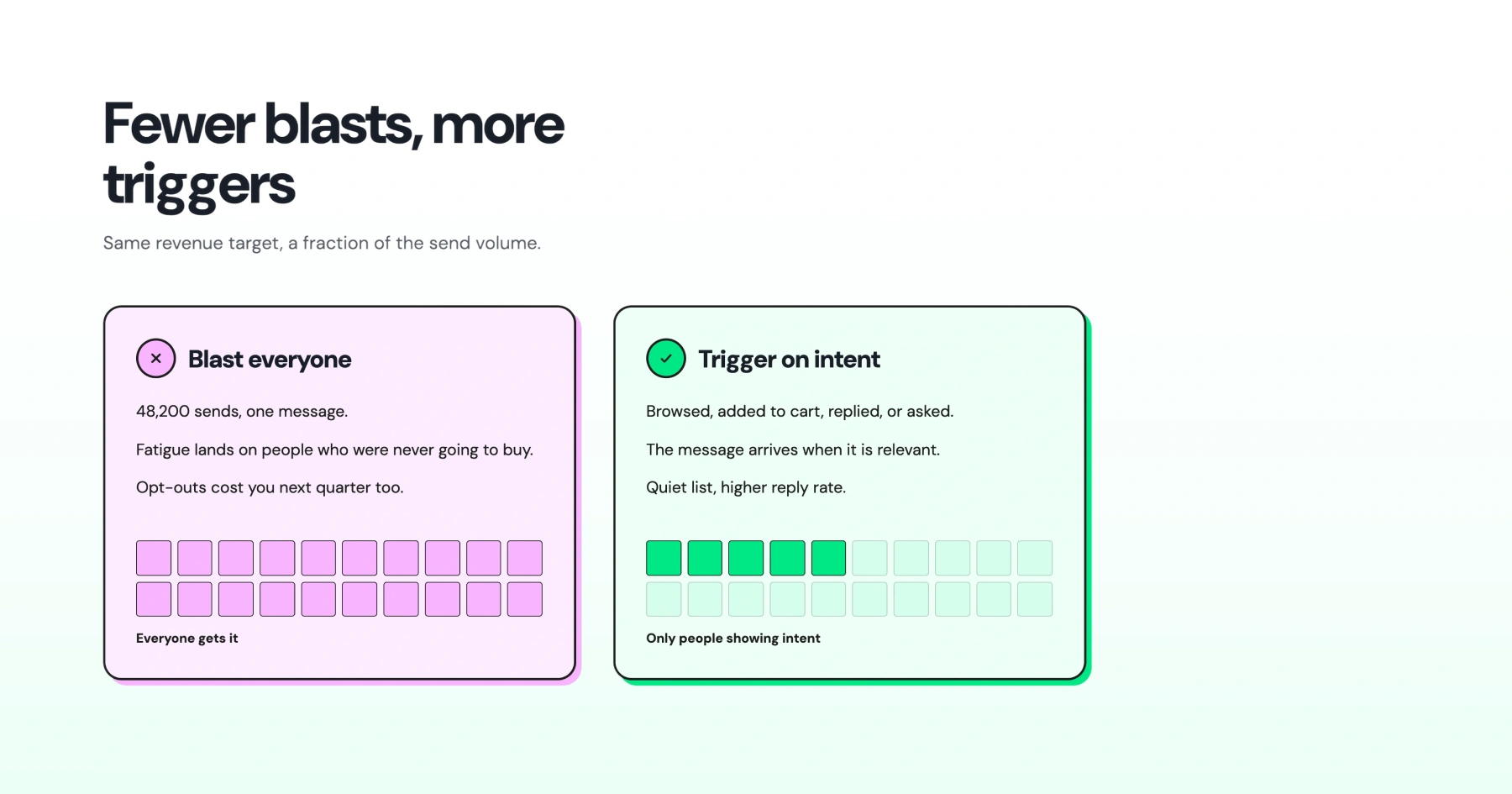
According to Ometria's 2025 BFCM analysis (pulled from real retailer sends across the full BFCM window), unsubscribe rates rose 42% year over year. In the same report, from the same brands, automated and triggered messages accounted for just 2% of total send volume but drove 28% of revenue, with a click-through rate 4.6 times that of broadcast blasts and a conversion rate 8 times that of broadcast blasts.
The channel getting punished with rising opt-outs is the one-way broadcast. The channel being disproportionately rewarded is the one built around a triggered, responsive exchange rather than a scheduled blast. Unless, of course, they’re just reminders or countdowns.
Brands already know this. Customers respond better when messages address what they actually do, rather than being blasted with the same thing as everyone else. We’ve seen this personalization in email. It's also why brands are starting to invest more in automated flows that trigger based on customer behavior, taking personalization further, but making it two-way.
If proactive, back-and-forth style works so well, why isn't that the standard for the whole BFCM strategy?
SimpleTexting's own research backs up why the blast side keeps losing ground. 44% of consumers say the single biggest reason they mute or delete a brand's texts is simply receiving too many. 90% say they want a text from a brand once a week or less.
A small Australian K-beauty retailer became a cautionary tale on Substack for exactly this reason. Their SMS and email campaign hyped "our BIGGEST sale of the year," built to a countdown timer, and landed 15% off a $20 cleanser.
The marketer who wrote it up, a business owner herself, wasn't annoyed by the 15% discount. She was annoyed by being talked at for that value. "If I receive one more automated SMS I might lose my mind," she wrote. It's time to solve the experience problem, not optimize around it.
One Thread for This BFCM
We’ve talked about marketing and sales for a bit now; let’s go back to the support side for a second.
Concentrix and Gorgias both say the same thing about BFCM. Support tickets spike, so hire more people or add more chatbots to get through it.
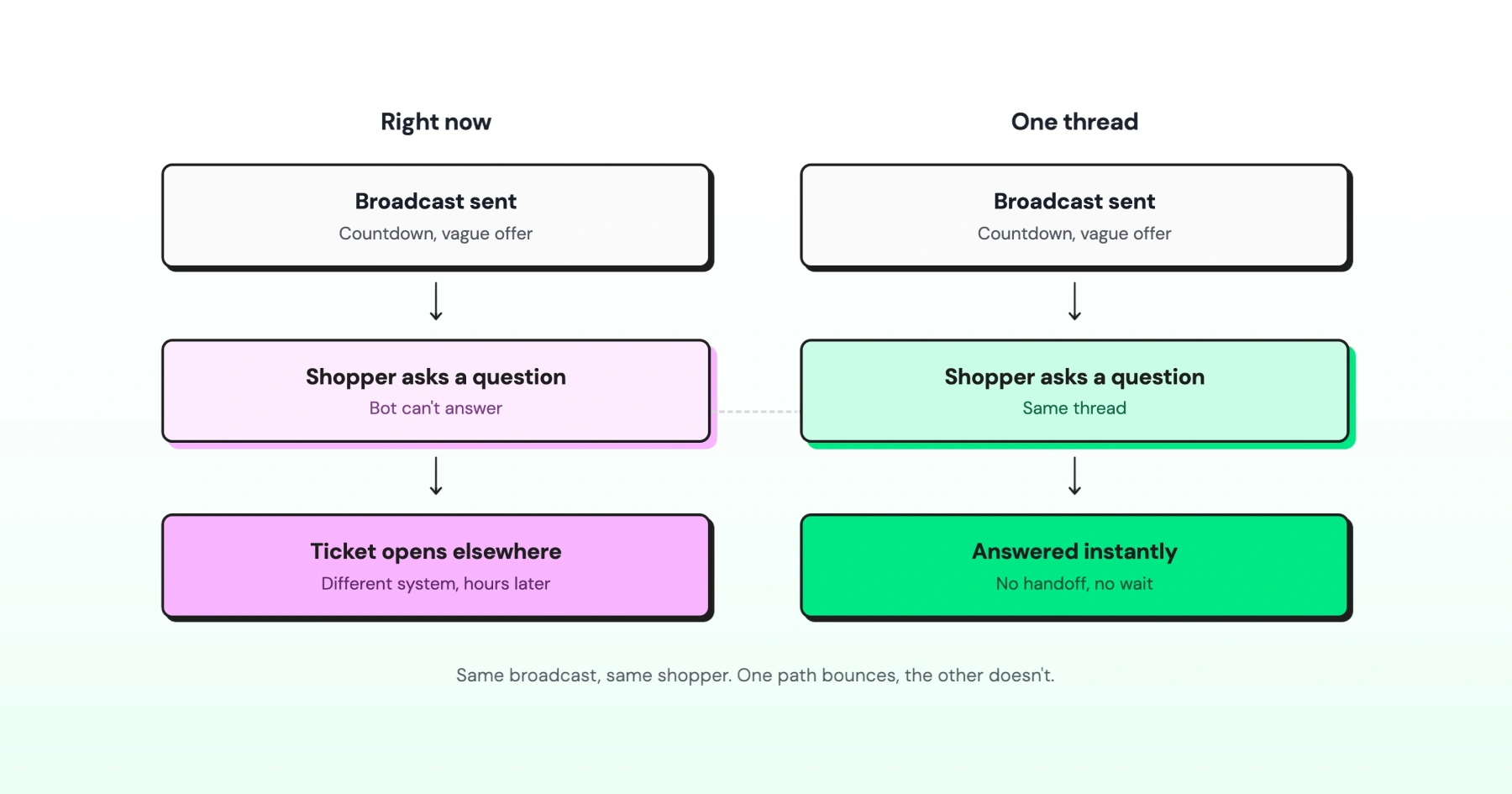
But imagine this: a shopper gets a broadcast text or email pushing a countdown and a vague "biggest sale ever." She has questions… Does this fit? Is it in stock? Your chatbot can't answer it, and your team is too busy.
She can't get anything useful back, so she opens a support ticket instead. That ticket lands in a different system, gets picked up by a different team, often hours later.
Many brands see this as two separate problems: a marketing metric that's underperforming because she doesn’t convert, and a support queue that's overloaded. The shopper, on the other hand, just sees one problem. Nobody she reached out to could answer her on time.
Marketing and support have different compliance rules, different tools, and different skills. Making one team do both jobs isn’t going to fix anything.
Instead, give the shopper one continuous thread. She sees the offer, asks her question, and gets an answer, all in the same place, on a channel built to hold a two-way conversation at BFCM volume. Right now, she gets bounced instead.
2026 Will Reward Brands Who Can Answer Back
The brands that will succeed in BFCM 2026 won't get there by cutting their SMS sends or by hiring the most seasonal support reps. Those are tweaks to a broken system in which an offer and the questions it creates are split across two systems that don't talk to each other. The fix is one conversation that can survive real volume, not two disconnected ones.
Some brands will notice that those two things are connected and fix it. Most won't, and they'll be hiring extra support reps again next year.
Ready to run a Black Friday campaign that answers back?
Book a demo to see how Wati keeps the offer and everything that happens after it in one thread, so shoppers never have to leave the conversation to get help.
Frequently asked questions
Why does Black Friday cause message fatigue?
Black Friday campaigns often rely on frequent SMS and email broadcasts, which can overwhelm customers when messages feel repetitive or irrelevant.
How can brands reduce Black Friday message fatigue?
Use behavior-based triggers and personalized, two-way conversations instead of relying heavily on generic broadcast messages.
How does message fatigue affect customer support?
Promotional messages often create questions about products, availability, pricing, and orders. When shoppers cannot get quick answers, they may turn to support, increasing ticket volume.
Why are WhatsApp conversations useful during BFCM?
WhatsApp enables brands to combine promotions, customer questions, automated responses, and support within the same conversation, creating a more continuous customer experience.
How can brands reduce Black Friday support ticket volume?
Proactively answer common customer questions within marketing conversations and use automation to handle routine queries before they become support tickets.
Related posts
- Instagram Comment Automation: How It Works and How to Set It Up in Wati
Instagram comment automation auto-replies to comments and DMs commenters within seconds via Meta's API. Covers strategy, use cases, and Wati setup.
- Shared Team Inbox for Instagram: A Buyer’s Checklist for 2026
Use this fastest checklist to evaluate any shared team inbox for Instagram, which covers DMs, comments, automation, and multi-channel support.
- How to Send Bulk Messages on WhatsApp Without Getting Blocked
Learn how to send bulk WhatsApp messages without getting blocked. Compare the WhatsApp Business app and API, messaging limits, costs, templates, and best practices for safe, compliant bulk messaging.
- How to Set Up a TikTok Business Account: Step-by-Step Guide
Set up a TikTok Business Account step by step: switch from personal, pick a category, add your profile, and unlock ads and analytics.