
Too Long? Read This First
- Diwali drip campaigns are automated, multi-message WhatsApp sequences that stop the moment a customer replies or converts, so no one gets message 3 after they've already bought.
- WhatsApp business messages see a 98% average open rate against roughly 20 to 21% for email, a gap corroborated across multiple 2026 industry benchmarks, which is why a drip sequence outperforms an equivalent email flow during the festive rush.
- Seven drip sequences cover the full festive funnel: abandoned cart recovery, COD confirmation, product and gifting education, guaranteed-delivery pre-order, flash-sale urgency, post-purchase delight, and win-back for lapsed buyers.
- A COD confirmation message flow on WhatsApp asks a buyer to confirm their order instantly, captures a delivery-time preference, and sends one re-confirmation if there's no response, all before the parcel ships.
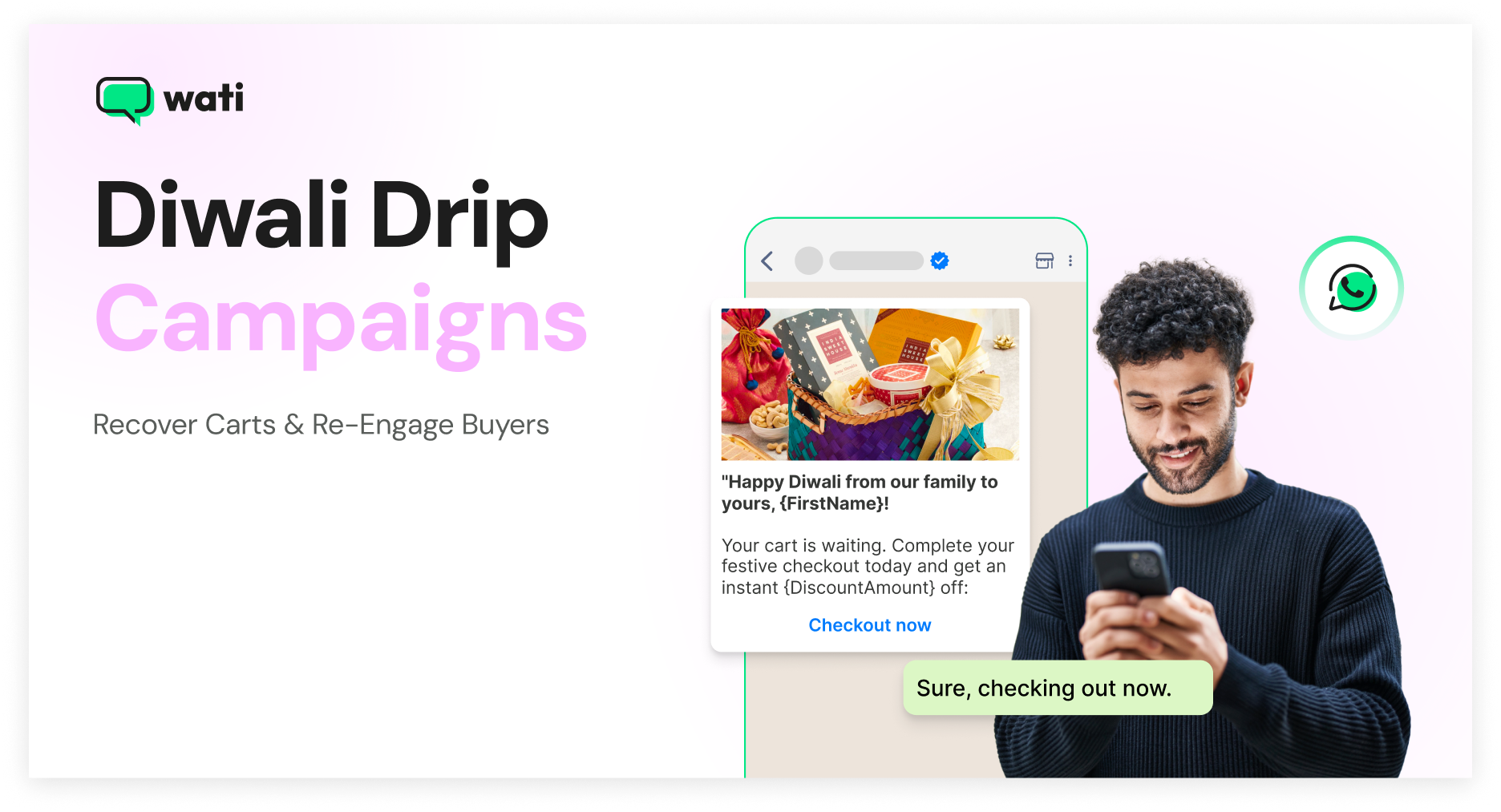
Diwali drip campaigns are automated, multi-message WhatsApp sequences, triggered by a customer action like an abandoned cart or a placed COD order, that stop instantly the moment a customer replies or converts.
During Diwali, every e-commerce brand runs a sale in the same two-week window, so speed and personalization decide who keeps the sale. This guide covers seven ready-to-use sequences built on Wati's Drip Campaigns engine.
These include abandoned cart recovery, COD confirmation, gifting education, guaranteed-delivery pre-order alerts, flash-sale urgency, post-purchase delight, and win-back for lapsed buyers, along with the segmentation and send-time data to run them well in India.
What are Diwali Drip Campaigns?
Diwali drip campaigns are automated WhatsApp message sequences, triggered by a customer action, that unfold over hours or days instead of firing as one broadcast. Each sequence stops automatically the moment the customer replies, confirms, or completes the action it was built for.
That auto-stop is what separates a drip campaign from a plain reminder: a customer who buys after message one never receives message two or three.
For e-commerce and retail brands, Diwali compresses an entire year's festive buying into a two-to-three-week window.
Every sequence below runs on the same underlying Drip Campaign engine.
7 Diwali Drip Campaigns to Run This Festive Season
Each sequence targets a different point in the funnel. So start with the two that touch the most orders, abandoned cart and COD confirmation, then layer in the rest as Diwali approaches.
Everyone uses the same drip logic: it stops the moment the customer replies or converts.
1. Abandoned Cart Recovery
Abandoned cart drips target the highest-volume leak in any Diwali sale: shoppers who add a product and never check out.
Baymard Institute puts the 2026 global average cart abandonment rate at 70.22%, and Growzai's India data shows Indian shoppers abandon carts at 68%, with mobile abandonment running even higher.
A working abandoned cart sequence for Diwali:
- 30 to 60 minutes after abandonment: A helpful nudge with a single button back to the cart, no discount yet.
- +24 hours: Address the likely hesitation. Show reviews or ratings for the exact product left in the cart, since social proof works harder here than a generic reminder, and cover sizing, delivery timelines, or return policy, since Diwali shipping windows are tighter than usual.
- +48 hours: A small, time-bound incentive, a modest discount, or free shipping, to close the remaining gap.
The sequence stops the instant the customer completes the purchase, so a buyer who converts after the first nudge never sees the discount message. This also protects the margin: you're not training every visitor to wait for a coupon.
2. COD Confirmation
For India specifically, a COD confirmation drip is the single highest-leverage sequence on this list because it attacks RTO directly.
The sequence:
- Instant confirm-order ask right after checkout.
- On confirmation, ask for a delivery-time preference.
- If there's no response within 2 hours, send one re-confirmation before the order ships.
Plain text is the right call here. It clears Meta approval fastest, delivers most reliably, and a COD confirmation needs to land, not look good. Submit API templates for approval well before the sale window opens, since even plain text needs sign-off.
3. Product and Gifting Education
Product education drips reduce returns after delivery, which matters more during Diwali because gifting orders and first-time buyers spike together. The canonical sequence:
- Day 0: A setup or usage guide for what they bought.
- Day 1: One practical tip that increases the odds they actually use and like the product.
- Day 7: A cross-sell offer, sent only once real value has been delivered, not immediately after purchase.
The same education logic applies before a purchase, not just after. Diwali shoppers often don't know what to buy for extended family or corporate gifting, and that indecision is where sales stall.
Wati's Astra AI agent already handles this as a live conversation rather than a broadcast.
A shopper messages in asking for gift hampers under a budget. Astra recommends bestsellers, then asks whether it's personal or corporate.
For a bulk corporate order, it collects the shopper's email and delivery date, then hands off to sales, with the budget, quantity, and contact synced automatically to the CRM.
Wire the same intent into your product education drip's early message, corporate gifting or personal gifting, and it directs the rest of the sequence toward the right catalog segment instead of guessing.
4. Pre-Order and Guaranteed-Delivery Drip
Late delivery is the fear that kills Diwali gifting purchases outright. A shopper who isn't confident a gift will arrive before the festival simply won't order, no matter how good the discount is. This sequence runs ahead of the sale rather than after a cart is abandoned:
- 2 to 3 weeks out: announce early access to the Diwali collection.
- Mid-window: a clear "last date to order for guaranteed Diwali delivery" message, with the actual cutoff date, not a vague "order soon."
- Final days: a low-stock warning for the specific items the customer viewed or added, to convert remaining hesitation into a decision before the cutoff passes.
This sequence should run as its own send, separate from the abandoned cart and COD flows, since its trigger is a calendar date rather than a customer action. Schedule it against Wati's Campaign Calendar, which already flags upcoming festive dates so the cutoff messaging goes out on time.
5. Flash-Sale Urgency with a Countdown
Diwali sales are built around short, high-intensity windows: Dhanteras morning, a 48-hour mega sale, the final day before Diwali.
A Limited-Time Offer (LTO) template carries a built-in countdown timer that updates dynamically inside the message itself, which is what makes urgency legible instead of just claimed in copy.
A simple urgency drip:
- Sale opens: LTO template with the countdown and the headline offer.
- Midway, to non-converters: a reminder that leads with time remaining, not the product again.
- Final hours: a last-call message to anyone who engaged with the sale ad or clicked through but didn't buy.
LTO templates are available only for the Marketing category and are not supported for Utility messages, so this sequence should stay separate from your COD or shipping-update flows.
6. Post-Purchase Delight, Review, and Referral
Once a Diwali order is delivered, a delight-and-loyalty drip turns a one-time festive buyer into a repeat customer and a source of new ones.
This sequence layers on top of standard shipping updates rather than replacing them:
- Day of delivery: a warm delivery confirmation that invites the customer to share a photo with their purchase, useful both as a goodwill touch and as social content you can reuse with permission.
- +3 days: a simple star-rating request, framed as a quick tap rather than a long review form.
- +7 days: a "refer a friend" code for their next purchase, which compounds acquisition without another ad spend.
Treat this drip like VIP treatment rather than a generic receipt. Build the rating tap and referral capture as a WhatsApp Flow rather than a plain text ask, since it keeps the response inside the chat instead of linking out to a form.
7. Win-Back for Lapsed Festive Buyers
Not every Diwali shopper from last year is still active.
A win-back drip specifically targets the segment "bought during last year's Diwali sale, hasn't ordered since," which is only buildable with signal-to-signal comparison across two dated events, not static fields like location or age.
WhatsApp win-back programs reactivate roughly 25 to 35% of dormant customers reached this way, a range corroborated across several 2026 industry benchmarks and meaningfully higher than a standalone discount blast to the full list.
The sequence:
- An opener that references their past purchase category, not a generic "we miss you."
- A dormant-user incentive, exclusive voucher or free shipping, sized larger than your standard abandoned-cart discount since the gap is longer.
- A soft catalog nudge showing what's new since their last order, if there's no response.
Pair this with a click-based retarget for anyone who engaged with this year's Diwali ads but never converted, since both audiences share the same underlying problem: interest without a recent purchase.
How Do You Segment Your Audience Before Sending Diwali Drips?
Sending the same Diwali drip to your entire WhatsApp list is the fastest way to get ignored or blocked.
Segmented campaigns show roughly 30% higher click-through rates than one-size-fits-all sends. Set up your segments before turning any of the seven drips above live, built on:
- Pre-built activity segments: Active in last 24 hours, Highly Engaged, At Risk, Winback.
- Purchase history and demographics: category affinity, past spend, gender, so your abandoned cart drip for a men's apparel cart doesn't get sent to someone who's only ever bought skincare.
- Profile Signals: 32 tracked behavioral signals, campaign engagement, link clicks, message activity, call history, and last CTWA ad source, filterable individually or compared signal-to-signal for cohorts like the Diwali win-back segment above.
- Shopify sync: auto-built VIP, at-risk, and category-affinity segments plus Product Viewed and Page Viewed triggers, with no manual tagging required.
What's the Best Time to Send Diwali WhatsApp Drips in India?
Send timing shifts, drip performance as much as the copy does. For India specifically:
- Best days: Tuesday through Thursday, and Saturday.
- Best times: 8 to 10 AM, 12 to 1 PM, 6 to 9 PM.
- Avoid: before 8 AM, after 10:30 PM, and on Mondays.
For e-commerce and retail as an industry vertical, the best send window narrows further to Thursday through Saturday, 10 to 11 AM, 12 to 1 PM, or 6:30 to 8 PM, at a frequency of 2 to 4 sends per month outside drip sequences.
Two delivery safeguards matter more during a Diwali spike than at any other time of year:
- SMS, RCS, or email fallback for any WhatsApp send that fails, so a COD confirmation doesn't just silently not arrive.
- Auto-retries for failed sends, which continue for up to 7 days if a customer has hit Meta's frequency cap. For time-bound offers like the flash-sale drip, make sure retries are capped so they don't fire after the offer has already ended.
Measuring What's Working
Track these through the sale window, not just after it ends, inside Campaigns Overview.
- Delivery vs. engagement funnel: sent, delivered, read, engaged, with a failure-reason breakdown so you can see whether a drip is underperforming because of delivery or because of content.
- Template-performance leaderboard: which specific template inside a drip is converting, so you can retire the weakest step mid-week instead of waiting until Diwali is over.
- Conversation-to-purchase rate: the number that actually reflects revenue, not just opens, visible under Ads Conversion Insights if any of the seven drips are fed by CTWA traffic.
If a drip's read rate is low, test the send time first. If read rate is fine but click-through is low, the fix is usually the first line and the button text; "Shop Now" against "Claim Offer" against "Get 20% Off" is a real A/B test worth running before Diwali week, not during it.
Get Your Diwali Drips Live This Week
Don't try to launch all seven sequences on day one. Sequence the build instead:
- Ship COD confirmation and abandoned cart first. These two touch the most orders and the most revenue leakage, and both are pre-built inside Wati's Drip Campaigns, so they're the fastest to configure.
- Layer in the pre-order and guaranteed-delivery drip at least two to three weeks before Diwali, since its trigger is a calendar date, not a customer action, and it needs to run ahead of the sale to matter.
- Turn on flash-sale urgency only for your actual sale windows. Dhanteras, the mega-sale days, the final 48 hours, rather than running it continuously and burning out the countdown's urgency.
- Add product and gifting education, post-purchase delight, and win-back once the first three are live and measured, so you're building segmentation and send-time data from real Diwali traffic instead of guessing.
Every sequence above should sit on Wati's Drip Campaign engine so each one stops automatically the moment a customer replies or converts.
Manually tracking who's mid-sequence across seven drips at Diwali volume isn't a task a team can do reliably by hand, which is the actual reason to automate this now rather than after the season's first sale spike.
If your team already lives in Claude or ChatGPT, Wati MCP lets you check contact counts, draft a campaign, or pull your numbers in plain English instead of clicking through every dashboard above.
Diwali Drip Campaigns: Start Building Today
Diwali drip campaigns aren't a nice-to-have this season; they're the difference between a sale that converts and one that gets lost in the noise.
Start with abandoned cart and COD confirmation, the two that touch the most revenue, then build out the rest as the festival approaches.
Book a demo with Wati to see these seven sequences set up on your own catalog before Diwali traffic hits.
Frequently asked questions
What is a Diwali drip campaign?
A Diwali drip campaign is an automated, multi-message WhatsApp sequence triggered by a customer action, like abandoning a cart or placing a COD order, that stops the moment the customer replies or converts.
What is a COD confirmation message flow on WhatsApp?
It's a short automated sequence that asks a cash-on-delivery customer to confirm their order right after checkout, captures a delivery-time preference, and sends one re-confirmation if there's no response, reducing the chance of a refused delivery.
How many messages should a drip campaign have?
Most effective drips run 3 steps: an initial nudge, a mid-sequence message that addresses hesitation or confirms an action, and a final message with either an incentive or a re-confirmation, spaced across hours or days depending on the use case.
Do drip campaigns work for COD-heavy stores in India?
Yes. COD orders return to origin at 20 to 40% depending on category, against under 8% for prepaid orders, and a confirmation drip directly targets the point where that failure happens, before the order ships rather than after it's refused at the door.
Should abandoned cart and pre-order drips use the same trigger?
No. Abandoned cart drips trigger off a specific customer action, leaving checkout with items in the cart, while a pre-order and guaranteed-delivery drip triggers off a calendar date ahead of Diwali. Keep them as separate sequences with separate schedules.
Related posts
- Instagram Comment Automation: How It Works and How to Set It Up in Wati
Instagram comment automation auto-replies to comments and DMs commenters within seconds via Meta's API. Covers strategy, use cases, and Wati setup.
- Shared Team Inbox for Instagram: A Buyer’s Checklist for 2026
Use this fastest checklist to evaluate any shared team inbox for Instagram, which covers DMs, comments, automation, and multi-channel support.
- How to Send Bulk Messages on WhatsApp Without Getting Blocked
Learn how to send bulk WhatsApp messages without getting blocked. Compare the WhatsApp Business app and API, messaging limits, costs, templates, and best practices for safe, compliant bulk messaging.
- How to Set Up a TikTok Business Account: Step-by-Step Guide
Set up a TikTok Business Account step by step: switch from personal, pick a category, add your profile, and unlock ads and analytics.