
Too Long? Read This First
- WhatsApp campaign ROI tracking measures revenue attributed to a campaign against its cost, not opens, reads, or clicks.
- Read rates and CTR tell you if people saw your Diwali campaign. They don't tell you if it made money.
- Revenue attribution needs to be switched on before a campaign sends. You can't recover it after the fact.
- Wati's Delivery vs. Engagement Funnel diagnostic shows exactly where a campaign leaks, before it reaches the sale.
- Campaign ROI tracking is a Business-plan feature, with a configurable 2-10 day attribution window.
You sent out thousands of Diwali greeting messages, festive catalogs, and flash sale alerts. Your dashboard shows a 90% delivery rate and a spike in read receipts. It feels like a win.
However, once the season's dust settles, nobody in finance is going to ask how many green ticks you got. They're going to ask if it drove sales.
The stakes are real: RedSeer Strategy Consultants tracked roughly 90 million shoppers in just the first 11 days of India's 2025 festive season, driving ₹60,000-62,000 crore in GMV, a 20-22% jump over the year before. That's the volume moving through your WhatsApp campaigns during Diwali. Read rate alone won't tell you how much of it you actually captured.
WhatsApp campaign ROI is the revenue a campaign generates, minus what it costs to run, expressed as a percentage. It answers one question: did this campaign make money, or did people see it.
Read rate, click-through rate, and reply volume are engagement metrics. They measure who reads. ROI measures who bought.
If your Diwali WhatsApp reporting stops at "80% read rate, great engagement," you're one dashboard short of the number that matters: how much revenue actually traced back to that send.
What is WhatsApp Campaign ROI Tracking?
WhatsApp campaign ROI tracking is the process of attributing store revenue to the specific WhatsApp campaign that drove it, then comparing that revenue against the cost of sending the campaign.
It's different from campaign analytics in general. A standard campaign report tells you how many messages were sent, delivered, and read.
ROI tracking goes one step further: it connects a contact who received a campaign to an order they placed afterward, within a defined time window, and reports the revenue, order count, and return on the money spent.
The same principle applies on the ad side too. If click-to-WhatsApp ads are feeding your Diwali funnel, revenue attribution works the same way: a purchase gets traced back to the ad that started the conversation, not just counted as a generic "conversion."
Without this connection, "engagement" and "revenue" stay two separate stories that never meet.
Vanity Metrics vs Revenue Metrics: What's the Difference?
Vanity metrics tell you a campaign was seen. Revenue metrics tell you a campaign was worth sending.
Metric | What does it tell you |
Read rate | Shows how many people opened your message. Says nothing about whether they bought anything. |
Click-through rate (CTR) | Shows interest. A high CTR with no follow-through purchase is a leak, not a win. |
Reply rate | Shows engagement. Replies don't deposit into your bank account. |
Revenue attributed to the campaign | The actual order value traced back to that specific send. |
Return on investment (ROI) | Revenue attributed is measured against the campaign cost. |
Average order value (AOV) | What buyers from this campaign spent per order, useful for comparing Diwali offers against each other. |
A campaign can have a 90% read rate and a 40% CTR and still lose money if nobody converts. That's the gap vanity metrics hide.
It's also why the channel itself matters. WhatsApp's own 2026 State of Business Messaging report, based on a Kantar survey of over 11,000 consumers across 22 markets, found that 72.4% of consumers are more likely to buy from a brand that offers messaging.
That's a reason to invest in the channel. It's not a substitute for checking whether a specific campaign actually converted.
How Do I Know If My Diwali WhatsApp Campaign Made Money?
You know a Diwali WhatsApp campaign made money when the revenue attributed to it, within your tracking window, exceeds what you spent sending it. That's the ROI calculation:
WhatsApp Campaign ROI (%) = [(Revenue Attributed to Campaign − Campaign Spend) ÷ Campaign Spend] × 100
Say you run a "Diwali Dhamaka" flash-sale broadcast to 10,000 contacts. Template and messaging costs come to ₹18,000. Within a 5-day attribution window, orders traced back to that campaign total ₹1,26,000 in revenue.
ROI = [(₹1,26,000 − ₹18,000) ÷ ₹18,000] × 100 = 600%
That's the number worth reporting, not the read rate. A campaign with a mediocre 45% read rate but a 600% ROI beat a campaign with a 90% read rate and a 50% ROI. Read rate alone would have told you the opposite story.
The Delivery vs. Engagement Funnel: Where Revenue Actually Leaks
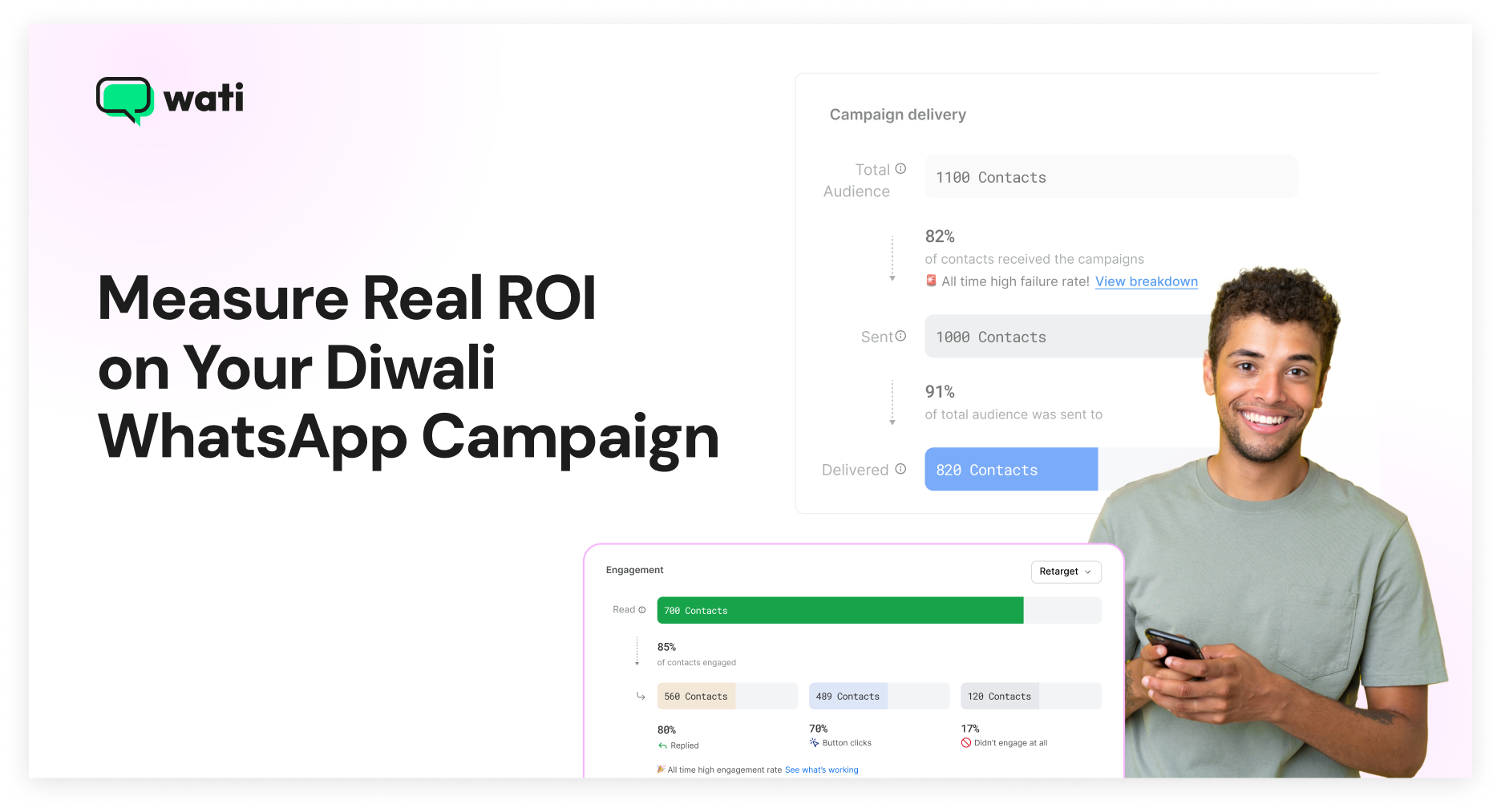
Before revenue shows up, a campaign passes through five stages: audience, sent, delivered, read, and engaged. Wati's Delivery vs. Engagement Funnel diagnostic breaks down every stage of a campaign, with an exportable failure-reason breakdown, so you can see exactly where contacts drop off instead of guessing.
This matters during Diwali because volume is high and small leaks compound. If delivery is strong but "engaged" drops sharply, the send worked, but the message didn't land. If delivery itself is weak, no amount of copywriting fixes the funnel.
How to Set Up Revenue Attribution for WhatsApp Campaigns
Revenue attribution for WhatsApp campaigns has to be switched on before you send, not after. Here's the setup:
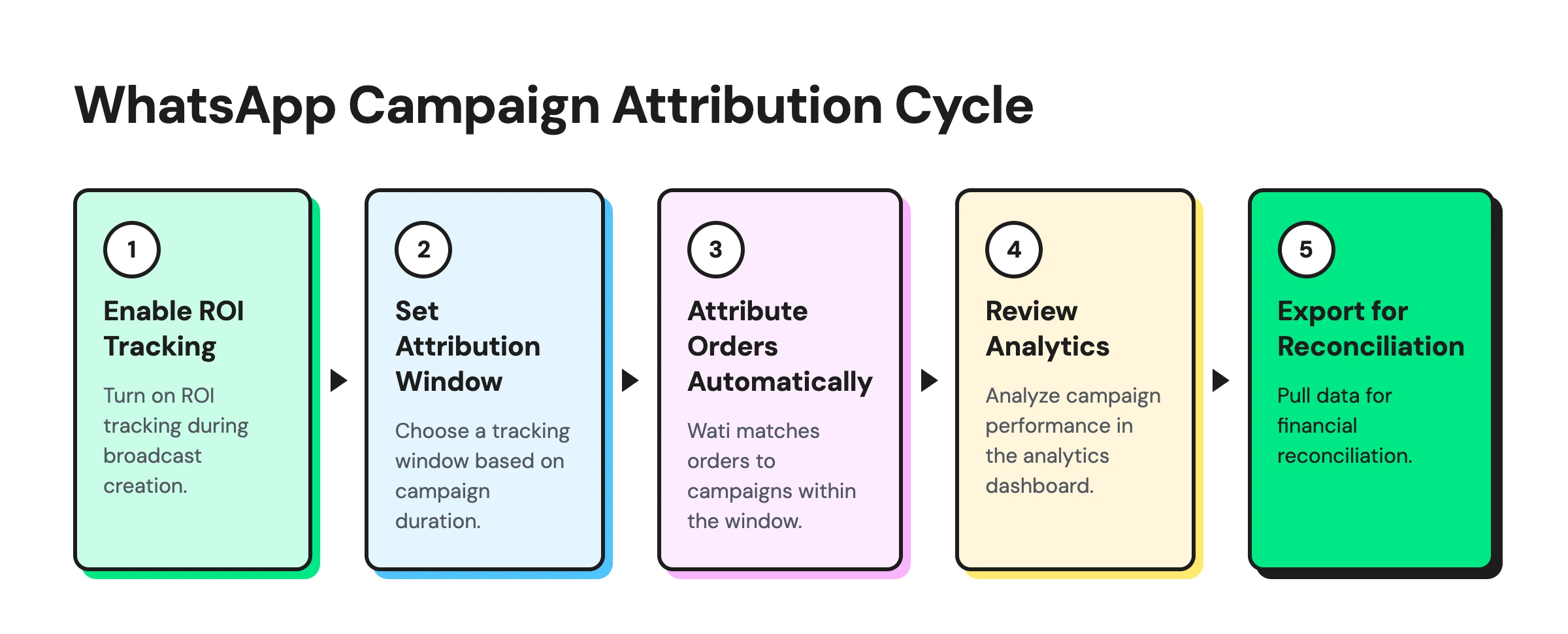
- Enable ROI tracking at broadcast creation. In the broadcast creation modal, turn on the "Enable ROI tracking" toggle. If it's off when you send, that campaign's attribution data is gone for good. There's no retroactive fix.
- Set your attribution window. Choose a tracking window between 2 and 10 days. A flash sale with a same-day countdown needs a short window. A multi-week Diwali gifting campaign with a longer consideration cycle needs a longer one.
- Let orders attribute automatically. As orders come in from your connected Shopify store, Wati matches them to the campaign a contact last received, within your chosen window.
- Review the numbers in Analytics. Head to Shopify integration → Analytics to see Revenue, Orders, Spend, ROI, and Average Order Value for each campaign.
- Export for reconciliation. Pull a CSV with order number, product details, revenue, discount code, order date and time, unsubscribe status, and campaign name, useful for matching against your finance team's own numbers.
Campaign ROI tracking is a Business plan feature. If you're on a lower plan, you'll see an upgrade prompt in place of the dashboard.
What a Good WhatsApp Campaign ROI Dashboard Should Show
A WhatsApp campaign ROI dashboard should show revenue-first metrics, not delivery-first ones. At minimum, look for:
Metric | What does it tell you |
Revenue attributed per campaign | The direct link between a send and the orders it produced. |
Spend per campaign | What the campaign cost, so ROI isn't viewed as revenue in isolation. |
ROI percentage | Revenue against spend—the single number that answers, “Did this work?” |
Average order value (AOV) | Helps compare which festive offer generated bigger baskets. |
Order-level export | Let's you reconcile individual orders instead of relying only on a dashboard summary. |
If you're running Click-to-WhatsApp Ads into the same festive push, pair this with Wati's Ads analytics dashboard (Ads → Click to WhatsApp Ads → Ads analytics), which tracks ad spend, CPC, qualified leads, qualified purchases, cost per qualified lead, cost per purchase, and ROAS, plus funnel insights like overall conversion rate and average time to convert.
Common Mistakes That Inflate Vanity Metrics
- Reporting read rate as success. A high read rate with no attributed revenue is a campaign that got seen and ignored.
- Turning on ROI tracking after the send. Attribution can't be recovered retroactively. If it's not on before you hit send, that data never existed.
- Using a tracking window that doesn't match the buying cycle. A 2-day window on a campaign promoting a considered purchase (like gifting sets) will under-report revenue that arrives on day 4 or 5. If your Diwali push is a multi-touch drip campaign rather than a single send, scheduling the window around your last touchpoint, not your first, gives a truer read.
- Judging templates by CTR alone. A template with a strong CTR but weak conversion-to-purchase rate is generating clicks, not sales.
- Ignoring the delivery stage. A campaign that never gets read can't convert, but the fix there is deliverability, not creative. Diagnosing the wrong stage wastes the next iteration.
Did Your WhatsApp Campaign Drive Revenue- or Just Engagement?
WhatsApp campaign ROI is the only number that tells you whether a Diwali campaign was worth running. Read rate, CTR, and reply volume describe attention.
Revenue attributed against spend describes outcome. Turn on ROI tracking before your next send, pick an attribution window that matches how long your customers actually take to buy, and let the Delivery vs. Engagement Funnel show you where the campaign leaks before revenue ever gets counted.
Engagement numbers make a campaign look good. Revenue numbers tell you if it actually was.
Ready to see what your Diwali campaigns really earned? Log in to your Wati Business dashboard and check your Campaign ROI metrics before you plan the next send. You can schedule a free demo if you haven’t started with Wati yet.
Frequently asked questions
What is WhatsApp campaign ROI tracking?
It's the process of attributing store revenue to a specific WhatsApp campaign and comparing it against what the campaign cost to send. It answers whether a campaign made money, not just whether people saw it.
How do I know if my Diwali WhatsApp campaign made money?
Compare revenue attributed to the campaign, within your chosen tracking window, against what you spent sending it. If revenue exceeds spend, the campaign made money. The formula is (Revenue − Spend) ÷ Spend × 100.
What's the difference between engagement metrics and revenue metrics?
Engagement metrics like read rate and CTR measure attention. Revenue metrics like attributed revenue and ROI measure outcomes. A campaign can score high on one and low on the other.
How long should my attribution window be for a Diwali campaign?
It depends on your buying cycle. Flash sales with same-day urgency suit a short window (2-3 days). Considered purchases like gifting sets need a longer window, up to 10 days, so you don't undercount revenue that arrives later.
Is campaign roi tracking available on every wati plan?
No. Campaign ROI tracking is available on the Business plan and higher. Lower plans see an upgrade prompt instead of the dashboard.
What should a WhatsApp campaign roi dashboard include?
At minimum: revenue attributed per campaign, spend per campaign, ROI percentage, average order value, and an order-level CSV export for reconciliation.
Related posts
- Instagram Comment Automation: How It Works and How to Set It Up in Wati
Instagram comment automation auto-replies to comments and DMs commenters within seconds via Meta's API. Covers strategy, use cases, and Wati setup.
- Shared Team Inbox for Instagram: A Buyer’s Checklist for 2026
Use this fastest checklist to evaluate any shared team inbox for Instagram, which covers DMs, comments, automation, and multi-channel support.
- How to Send Bulk Messages on WhatsApp Without Getting Blocked
Learn how to send bulk WhatsApp messages without getting blocked. Compare the WhatsApp Business app and API, messaging limits, costs, templates, and best practices for safe, compliant bulk messaging.
- How to Set Up a TikTok Business Account: Step-by-Step Guide
Set up a TikTok Business Account step by step: switch from personal, pick a category, add your profile, and unlock ads and analytics.