
Too Long? Read This First
- WhatsApp API errors happen when something is wrong with your request, your setup, your phone number configuration, or the limits defined by the WhatsApp Business Platform.
- You can understand most issues by reading the error code, the error_data.details field, and the fbtrace_id in the response, then confirming your request parameters, access token, and template message structure.
- Common errors include rate limits, phone number registration issues, template mismatches, invalid parameters, payment account problems, and quality/restriction errors.
- Errors arrive in two different places: the immediate API response when you call Meta, or later inside a statuses[].errors[] object on an asynchronous message-status webhook.
- Knowing which one you're looking at changes how you debug it.
- WhatsApp is rolling out usernames as an identifier alongside phone numbers. This changes what a few recipient and parameter errors look like, and it's covered in a new section below.
- When errors persist, reviewing logs, retrying with delays, and validating data in WhatsApp Manager usually resolves them quickly.
You send a message through the WhatsApp API, and suddenly something fails. The delivery stops, a strange code pops up, and the team has no idea what went wrong.
It feels frustrating and random, but most WhatsApp API errors follow simple patterns. You just need a straightforward way to understand them. WhatsApp API errors are coded responses from the WhatsApp Business Platform that tell you exactly why a message or API call failed -a rate limit, an expired token, a template mismatch, a registration problem, or a billing issue. Each code maps to a specific root cause and a specific fix.
This guide from Wati, a WhatsApp Business API provider, decodes the most common 2026 error codes and shows the exact steps to resolve each one.
If you want to understand how the WhatsApp API works at a deeper level, take a look at our full guide on its features and advantages.
What Causes WhatsApp API Errors?
WhatsApp API errors happen for many reasons. Most issues start with missing data, wrong request parameters, or limits set by WhatsApp to maintain a healthy ecosystem engagement.
Sometimes the API fails because of a simple typo in variable parameters. Other times, it can be a configuration issue inside WhatsApp Manager or your WhatsApp Business Account.
Some common triggers include:
- The sender’s phone number is not registered correctly.
- The access token expired or was never added.
- Too many previous messages were sent to the same recipient phone number.
- The message template was disabled.
- The recipient’s WhatsApp version is old.
- A media file failed due to file size, unsupported MIME type, or an invalid or expired URL.
- A required parameter value is missing in the message body.
Before diving into the WhatsApp API codes below, two structural things are worth understanding, because every error in this guide falls into one of them:
1. Errors are grouped into named categories: Authorization, Throttling, Integrity, Message Template, and Message Delivery. Knowing the category tells you which part of your system to check first.
2. Not every error shows up the same way. A request Meta rejects outright returns an error object immediately, in the API response itself. A message Meta accepts but later fails to deliver reports that failure asynchronously, inside a statuses[].errors[] object on your status webhook.
How to Read WhatsApp API Error Codes?
Every WhatsApp API error includes a code, a short description, and additional context that helps you understand why a message failed and how to fix it. These details appear directly in the API error response when you send a request.
WhatsApp Manager does not show full API error responses; it mainly shows quality indicators, approvals, and phone number status. To see full error details, you must check your API logs or your BSP dashboard.
When reviewing an error, start by checking where it originated. Cloud API returns standard Graph API error fields, while On-Prem returns similar structured error responses. The normal error responses are listed here.
- An error code
- A short title or reason
- A detailed message describing what went wrong
- Relevant parameter information (e.g., variable mismatches)
- Occasionally, suggested corrective steps.
Focus on two key areas: the error code and the detail message. The code identifies the type of issue, while the detailed message explains exactly what the system expected, helping you quickly pinpoint the fix.
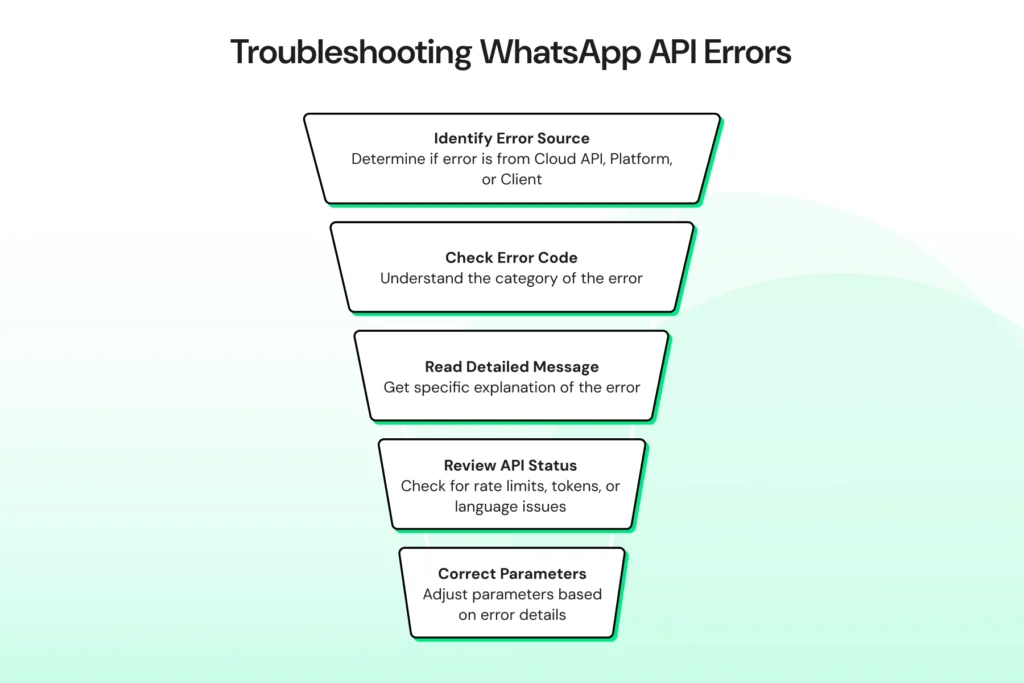
For example, you may see an invalid request if the request parameters do not match the template message format, or an unknown error when the system cannot verify data included in a variable parameter.
The error response object often includes extra context, such as rate limits, missing tokens, or unsupported language codes. It may indicate whether you reached the API call rate limit, whether the access token is missing, or whether the message body uses an unsupported language.
Some error responses even list required parameter names so you can correct them fast. Error titles and error_subcode are being phased out by Meta as stable identifiers. Build your parsing logic around the numeric code and error_data.details instead, so your error handling doesn't break when a title wording changes.
The goal is simple. Read the code, understand what the system wanted, and adjust your next attempt. With practice, you can scan an error message, locate the problem, and retry sending messages in seconds. |
Common WhatsApp API Errors & Fixes for 2026
Most WhatsApp API errors fall into a small number of categories: rate limits, template issues, phone number registration problems, permission failures, or missing parameters.
This section will walk you through the most common error codes in each category so you can quickly identify root causes and apply the right fix.
The table below maps every code in this guide to its category, so you can jump straight to the one that matches what you're seeing.
Error code | What it means | Category | Quick fix |
|---|---|---|---|
4 | API too many calls: app hit its API call rate limit | Rate limit | Cache responses; batch and space out non-critical calls |
130429 | Cloud API message throughput limit reached | Rate limit | Queue/schedule sends; improve quality to raise tier |
131048 | Quality restriction: too many negative user signals | Quality | Pause campaigns; send only to explicit opt-ins |
131056 | Pair rate limit: too many messages to one recipient | Rate limit | Add per-recipient limits; combine messages |
131047 | Re-engagement: 24-hour window passed | Messaging window | Send an approved message template |
131045 | Incorrect certificate: phone registration error | Registration | Re-run registration; remove consumer WhatsApp app |
131042 | Business eligibility: payment issue | Billing | Attach a valid payment method in Business Manager |
131008 | Required parameter missing | Parameter | Add all required fields (to, type, template.name, language) |
131009 | Parameter value not valid | Parameter | Fix format/values to match the template |
190 | Access token expired or invalid | Auth | Regenerate a system-user token |
200–299 | Permission not granted or revoked | Auth | Re-grant whatsapp_business_messaging / _management |
1 | API unknown/server error | Server | Check Platform status; retry |
2 | API service temporarily unavailable | Server | Retry after a short delay |
131026 | Recipient cannot receive message | Client | Ask recipient to update WhatsApp |
131051 | Unsupported message type | Content | Switch to a supported type/media |
1. Error 4: API Too Many Calls (API Call Rate Limit)
What it means:
Your app made too many API calls in a short period. The app hit its API call rate limit for the WhatsApp Business Account.
Typical signs:
- Error mentions “API Too Many Calls” or “The app has reached its API call rate limit.”
- Multiple API calls start failing at the same time.
Why does this error occur:
- Your system is sending frequent API calls to manage templates, phone numbers, or your WhatsApp Business Account.
- You call the API repeatedly in a loop or for unnecessary checks.
How to fix it (quick steps)
1. Log in to your Meta App Dashboard and check the Application Rate Limit section for your app and WhatsApp Business Account.
2. Review how many API calls your app sends per hour (for example, for template syncs or status checks).
3. Add caching so you do not call the same endpoint again and again.
4. Space out non-critical API calls or run them in batches.
5. Graph API rate limits cannot be increased manually, so the best fix is to reduce or optimize your API call frequency.
2. Error 130429: Rate Limit Hit (Cloud API Message Throughput)
What it means:
You reached the Cloud API message throughput limit. The app is sending too many messages per second from the same WhatsApp Business phone number.
Typical signs:
- Error mentions “Rate limit hit” or “Cloud API message throughput has been reached.”
- A broadcast or automation flow suddenly stops, and messages fail.
Why does this error occur:
- You send a high volume of marketing messages or notifications in a short burst.
- The app does not respect the per-second throughput for that registered business phone number.
How to fix it (quick steps)
1. Check how many messages per second your app sends for that sender phone number.
2. Slow down sends by using a queue or scheduler so the app sends messages in smaller batches.
3. If your volume is consistently high, improve your message quality, and compliance throughput increases automatically as your phone number moves to higher tiers.
4. Avoid sending duplicate or wrong message content that triggers retries.
5. This helps you stay within the API’s throughput limit and still deliver messages reliably.
3. Error 131048: Quality Restriction Triggered (Too Many Negative User Signals)
What it means:
WhatsApp restricted your business phone number because your recent messaging activity received negative feedback from users. This happens when many people block, report, or disengage with your messages, which lowers your quality rating in WhatsApp Manager.
The restriction protects the WhatsApp ecosystem and ensures users receive relevant, expected communication.
Typical signs:
- Error text: “Message failed to send because there are restrictions on how many messages can be sent from this phone number.”
- Broadcasts and marketing messages fail even though your templates are active and approved.
Why does this error occur:
- Your quality rating dropped to Low in WhatsApp Manager.
- Your business phone number entered the Flagged state.
- A high number of users blocked, muted, or reported your messages.
- You sent marketing messages to users who did not clearly opt in.
How to fix it (quick steps)
1. Open WhatsApp Manager and review your quality status and messaging limits for the affected WhatsApp Business Account.
2. Pause broad campaigns and reduce sends to cold or unengaged audiences.
3. Clean your broadcast list. Only send messages to users who provided explicit, WhatsApp-compliant opt-in through a clear, non-WhatsApp communication method.
4. Switch to high-value, user-friendly templates such as order updates, reminders, or alerts instead of heavy promotions.
5. Give your number time. When message quality improves, WhatsApp gradually restores your messaging limits, and the error usually disappears.
4. Error 131056: Pair Rate Limit Hit (Too Many Messages to the Same Recipient)
What it means:
You sent too many messages from one business phone number to the same recipient phone number in a short time. WhatsApp limits this to protect users from spam.
Typical signs:
- Error mentions “Too many messages sent from the sender phone number to the same recipient phone number.”
- Conversations with one specific user fail, but messages to other users still go through.
Why does this error occur:
- A bot or workflow sends frequent follow-ups or repeated template messages to the same WhatsApp user.
- You retry sending messages too quickly after a message failed.
How to fix it (quick steps)
1. Add rate limits per recipient phone number so your app sends fewer messages in a short window.
2. Combine details into one message instead of sending many small ones.
3. If you must send multiple messages, spread them out over a longer period.
4. If the error persists, wait for a while before you retry sending messages to that same phone number.
5. If messages are promotional, ensure users are opted in. This doesn’t fix the pair-rate error directly, but prevents other quality and block issues.
5. Error 131047: Re-Engagement Message (24-hour Window Passed)
What it means:
More than 24 hours have passed since the WhatsApp user’s last message. You are trying to reply with a free-form message instead of a message template.
Typical signs:
- Error text: “More than 24 hours have passed since the recipient last replied to the sender number.”
- Free-form replies fail, but template messages in the same conversation work.
Why does this error occur:
- The standard 24-hour customer care window is closed.
- Your agent or system tries to send a normal text instead of a pre-approved template message.
How to fix it (quick steps)
1. Switch to a message template (for example, a follow-up, reminder, or re-engagement template) for that WhatsApp account.
2. Make sure the template is approved, active, and uses the correct specified language and variable parameters.
3. Verify that all variable parameter values included in the template match the format and maximum character limit defined in WhatsApp Manager.
4. After you send a valid template message and the user replies, you can send free-form messages again within the next 24 hours.
6. Error 131045: Incorrect Certificate (Phone Number Registration Error)
What it means:
The message failed to send due to a phone number registration error. The certificate or registration data for your WhatsApp phone number is not correct.
Typical signs:
- Error mentions “Incorrect certificate” or “Message failed to send due to a phone number registration error.”
- You cannot deliver message content from that sender’s phone number at all.
Why does this error occur:
- The phone number was not fully registered on the WhatsApp Business Platform.
- A previous deregistration attempt failed or the number is still linked to a WhatsApp client (normal app).
- The certificate or key used during phone number registration is wrong or expired.
How to fix it (quick steps)
1. Open WhatsApp Manager and confirm the number is a registered business phone number and linked to the correct WhatsApp Business Account.
2. Make sure the consumer WhatsApp app has been removed from that phone number if you are migrating from the app to the WhatsApp Business API.
3. Re-run the phone number registration flow and upload the correct certificate if your setup requires it.
4. If the error persists, contact your BSP or Meta support and share the full error response and request parameters.
7. Error 131042: Business Eligibility – Payment Issue
What it means:
There is a payment issue on your WhatsApp Business Account. You may have exceeded the free tier without adding a valid payment method, or your payment account has problems.
Typical signs:
- The error mentions a business eligibility payment issue or a missing valid payment method.
- New conversations or marketing messages fail even though templates and phone numbers look fine.
Why does this error occur:
- The payment account is not attached to the WhatsApp Business Account.
- The credit line is over the limit or inactive.
- Billing settings such as timezone, currency, or business details are incomplete or not configured properly.
- The WhatsApp Business Account is deleted or suspended.
- You exceeded the free conversation tier and have no valid payment method.
How to fix it (quick steps)
1. In Meta Business Manager, go to your WhatsApp Business Account and open Payment settings.
2. Attach a payment account and make sure you have a valid payment method (card, credit line) set for WhatsApp conversations.
3. Check that timezone, currency, tax info, and business details are filled correctly.
4. If you send messages on behalf of another account, confirm the MessagingFor request is approved.
5. Once billing is correct, retry sending messages.
8. Errors 131008 and 131009: Parameter Missing or Not Valid
What they mean:
These errors relate to your request parameters and variable parameters:
- 131008: Required parameter is missing.
- 131009: Parameter value is not valid (for example, wrong format, unsupported value, or invalid phone number).
Typical signs:
- Error mentions “Required parameter is missing” or “Parameter value is not valid.”
- The error response points to a specific field in the message body or request.
Why do these errors occur:
- You forgot a required parameter, such as to, type, template.name, or language.
- Variable parameters defined in the template do not match the variable parameter values included in the API request.
- You exceeded the maximum character limit or sent a malformed media file URL.
- The recipient phone number is invalid, incorrectly formatted, or not registered on WhatsApp, or the sender phone number is not correctly added to your WhatsApp Business Account.
How to fix them (quick steps)
1. Check the endpoint documentation and list all required fields for that API call.
2. Compare the template message structure in WhatsApp Manager with the request parameters in your API call.
3. Make sure variable parameters follow the template order, type, and character limits.
4. Verify that the registered phone number and recipient number are in the correct format with the country code.
5. Fix any misspelled parameters and retry the request.
9. Error 190 and 200–299: Access Token and Permission Issues
What they mean:
- Error 190: Access token has expired or is invalid.
- Errors 200–299: Permission not granted or revoked for the API.
Typical signs:
- Error mentions “Access token has expired” or “Permission is either not granted or has been removed.”
- All API calls fail, not just specific templates or phone numbers.
Why do these errors occur:
- The access token used in your Cloud API calls is old or revoked.
- The app no longer has WhatsApp permissions like whatsapp_business_messaging or whatsapp_business_management
How to fix them (quick steps)
1. Use Meta’s Access Token Debugger to inspect your token and check scopes and expiry.
2. Generate a new system user token with the required WhatsApp permissions.
3. Update your backend so all API calls use the new token.
4. If using a BSP, check their panel for any token or permission changes.
10. Other Useful Errors: Unknown, Client, and Content Issues
A few more error codes are helpful to recognize because they guide your next steps:
Error 1: API Unknown
- Generic unknown error or server error.
- Check WhatsApp Business Platform status, then review your request format.
Error 2: API Service
- Temporary service issue or overloaded servers.
- Check API status information and retry after some time.
Error 131026: Recipient cannot receive message
- The recipient uses an old WhatsApp version that does not support the message type.
- Ask them to update their WhatsApp client and retry.
Error 131051: Unsupported message type
- The message type or media file is not supported on the recipient’s WhatsApp version.
- Switch to a supported message type or adjust the media file to meet WhatsApp’s requirements.
For these WhatsApp API errors, your best move is to: Check WhatsApp Business Platform Status for outages. Review the error message and response details value. Retry sending messages after a short delay, or adjust message type and content.
WhatsApp Usernames and What They Change About These Errors
WhatsApp is rolling out usernames as a way for customers to message a business without ever sharing a phone number. This matters for two error categories above:
- Parameter errors (131008/131009) that check phone-number format now need to account for username-based conversations that were never tied to a number in the first place.
- OTP/authentication and SMS/RCS fallback templates still require a phone number. If a customer only has a username, request the number explicitly inside a template rather than assuming the recipient field will resolve one.
If you're on Wati, update your mobile app to version 3.43.0 or later so username-based conversations don't get dropped from inbox, CRM, or automations.
Your Path to Fewer WhatsApp API Errors
WhatsApp API errors can disrupt conversations, slow down support, and create unnecessary stress for your team.
However, once you understand what the error codes mean and how to respond to them, troubleshooting becomes faster and far more predictable.
With the right setup, most issues can be solved in minutes.
If you want a platform that simplifies this even further, Wati helps you manage WhatsApp Business API operations without the usual guesswork.
You get clear error insights, reliable delivery, stable infrastructure, and automations that reduce manual fixes. It keeps your messaging smooth, so you can focus on conversations instead of debugging.
Sign up for a free trial to get started today.
Frequently asked questions
1. What are WhatsApp API errors?
WhatsApp API errors are system responses that tell you why a message failed or why an API call did not go through. They usually appear with an error code, a short explanation, and details about the missing or incorrect request parameters.
2. Why do message templates fail on the WhatsApp Business API?
Template messages fail when the template is disabled, the specified language is wrong, or the variable parameters included do not match the format defined in WhatsApp Manager. They can also fail if you exceed the maximum character limit or use unsupported media.
3. How do I fix “message failed to send” errors?
Start by reviewing the error message and response details value. Check the sender phone number, access token, and request parameters to confirm everything is valid. If the error persists, verify that the recipient phone number is active on WhatsApp and retry sending messages after a short wait.
4. What causes “too many previous messages” or rate-limit errors?
These errors occur when you send too many messages in a short period or exceed the API’s throughput limit. It can happen at the business phone number level or for the same recipient phone number. Using queues, slowing down sends, and monitoring your WhatsApp API throughput helps prevent these issues.
5. What should I do if I get an unknown error?
Unknown errors are often temporary. Check your API status information, confirm your request format, and retry the call after a brief pause. If the error continues, inspect your server setup, media file URLs, and access token.
6. What's the difference between an API response error and a webhook status error?
An API response error means Meta rejected your request immediately, and you'll see it in the same call. A webhook status error means Meta accepted the message but couldn't deliver it, and reports the failure later inside statuses[].errors[] on your message-status webhook. Build handling for both, since a request can pass the first check and still fail delivery.
7. Do WhatsApp usernames change how I troubleshoot recipient errors?
Yes, for accounts on the newer WhatsApp username rollout. A customer without a shared phone number will still message you successfully, but flows that assume a phone number, like OTP templates or SMS/RCS fallback, need to request the number explicitly rather than pull it from the conversation.
8. How long does a WhatsApp quality restriction (error 131048) last?
Restrictions ease automatically as your quality rating recovers, usually within a few days of consistently sending high-quality, opted-in messages. There is no manual override; reducing sends to unengaged users is the fastest path back.
9. What's the difference between error 4 and error 130429?
Error 4 is an API call rate limit (too many management/API requests). Error 130429 is a message throughput limit (too many messages per second from one number). One is fixed by caching/batching calls; the other by queueing sends.
10. Can I manually increase my WhatsApp API rate limit?
No. Graph API rate limits can't be raised on request. Messaging throughput tiers increase automatically as your phone number maintains high quality and volume.
Related posts
- WhatsApp API for Enterprise: Designing Intelligent End-to-End Workflows for 2026
Build scalable workflows using the WhatsApp API for enterprise. Connect CRM, ERP, ticketing, and RPA tools to automate enterprise sales operations.
- WhatsApp For Gyms And Fitness Center: Boost Your Subscription and Renewals
Fitness centers run on constant communication, and WhatsApp is the one channel members never ignore. But as your gym grows, the basic WhatsApp app cannot handle bookings, reminders, renewals, and daily inquiries. This blog breaks down how fitness centers use the WhatsApp Business API and Wati to automate class scheduling, support, payments, and marketing while keeping every interaction fast, personal, and organised.
- The Top 7 WhatsApp API Providers in 2026: Achieve Conversational Success
Find the best WhatsApp API providers by comparing features, reliability, and support to improve business messaging and engagement.
- 20+ WhatsApp API Templates: Types, Pricing, and Best Practices
learn how to improve engagement with pre-built whatsapp api templates to hook prospects and build an exceptional brand experience.