

-

-
-
Solutions
-
Soluções
-
Soluciones
-
解决方案
-
解決方案
-
الحلول
-
Product
-
Produto
-
Producto
-
产品
-
產品
-
المنتج
-

-
-


 Wati for Marketing
 Wati for Support
 Wati for Sales
 eLearning
 E-commerce
 Marketing Agencies
 Healthcare
 No Code Chatbots
 WhatsApp Business API
 Instagram and Facebook messenger
 Click to WhatsApp ads
 Campaigns
 Team Inbox
 WhatsApp Business Calling
 Wati AI
 Overview
 Library
 Agente de suporte de IA
How To Launch WhatsApp Marketing Campaign For More Sales
Written by:
 Ashwin Suthanthiraraj
|
Last updated on:
February 12, 2026
|
Fact Checked by :
Ashwin Suthanthiraraj
|
Last updated on:
February 12, 2026
|
Fact Checked by :
 Namitha Sudhakar
|
According to: Editorial Policies
Namitha Sudhakar
|
According to: Editorial Policies
 Table of Contents
Too Long? Read This First
- WhatsApp Marketing Campaigns Work When It’s Structured: Opt-ins, approved templates, and clear segmentation turn outbound messages into optimized campaigns.
- Campaign Goals Drive Outcomes: Defining one objective and metric per campaign keeps optimisation focused and measurable.
- Segmentation Improves Relevance: Activity, behaviour, and attribute-based segments reduce opt-outs and protect delivery quality.
- Templates Control Scale and Compliance: Marketing templates define what can be sent, how it’s approved, and how performance is measured.
Running drag and drop WhatsApp marketing campaign is a system to automate sales conversations based on prior audience action. With a WhatsApp marketing campaign, you can tailor your outreach and solve prospect demand on a larger scale.
But a WhatsApp marketing campaign isn’t just about bulk messaging for a large database. It is a controlled outbound system. Every campaign follows predefined rules, approved templates, and audience logic.
Brands have to be careful about technical aspects like user opt-ins, approved marketing templates, clearly defined audience segments, and ROI metrics to ascertain success.
When any one of these breaks, delivery, engagement, or compliance does too.
This guide walks through how WhatsApp marketing platforms like Wati serve as an execution layer to run campaigns, handling delivery control, compliance checks, and ongoing optimisation.
What Qualifies as a WhatsApp Marketing Campaign?
Not every outbound message on WhatsApp qualifies as a marketing campaign. Meta draws a clear line between service conversations and business-initiated promotions.
A WhatsApp marketing campaign is a business-initiated outbound message. Because it starts from the business side, every message must use an approved marketing template and be delivered only to a predefined audience that has already opted in.
A WhatsApp marketing campaign includes:
- A marketing-category template approved by WhatsApp
- A fixed audience selection rule
- Controlled delivery through broadcasts or automation

Agent replies inside an open support conversation are not campaigns. Group messages are not campaigns. Cold outreach without consent is not encouraged.
These distinctions exist because WhatsApp enforces different policies and quality scoring depending on how a message is initiated.
Common WhatsApp Marketing Campaign Examples
- Product or feature announcements sent to existing users
- Limited-time offers shared with a relevant segment
- Re-engagement messages for inactive contacts
- Event or webinar reminders triggered before a date
In Wati, these campaigns are created explicitly using approved templates.
This ensures that every campaign is treated as a compliant outbound message, not ad hoc communication that can be tracked and optimised.
Prerequisites for Sending WhatsApp Marketing Campaigns
To send marketing campaigns, businesses need three foundational components in place.
WhatsApp Business API Access
First, access to the WhatsApp Business API. This is the only channel that supports outbound messaging to a large number of users. Second, approved message templates. Every marketing message must be reviewed and approved before it can be sent.
Wati covers this infrastructure layer end-to-end. It provides official WhatsApp Business API access, a built-in flow for creating and submitting message templates, and a WhatsApp broadcast score calculator to help you get insights and optimize your campaign.
User Opt-In
Every WhatsApp marketing campaign starts with consent. Without an opt-in, messages should not be sent. This is a platform requirement enforced by Meta.
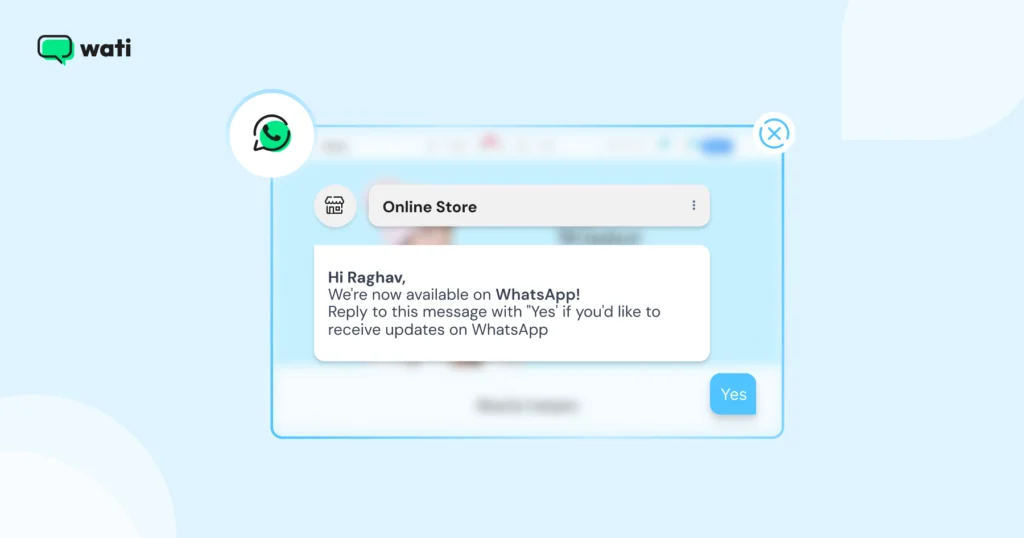
WhatsApp supports multiple opt-in methods, provided the user agrees to receive messages.
Opt-In Strategies:
- Website or landing page forms
- Consent during purchase
- In-chat keyword opt-ins initiated by the user
Operational Requirements for Opt-In Compliance:
- Consent must be explicit and unambiguous
- Opt-out must be immediate and easy to trigger
- Messages must stop the moment a user opts out
How Wati Supports Opt-In enforcement?
- Stores opt-in status at the contact level
- Supports opt-out keywords such as STOP
- Automatically blocks campaigns to opted-out users
Further Reading: Ways to Collect WhatsApp Opt-ins from Customers
User Information
To start a WhatsApp marketing campaign, we would need the correct contact details. Without it, the entire campaign can misfire.
Minimum data required:
- Phone number with country code
- Verified opt-in status
- First name
Beyond the basics, richer data enables better targeting. Recommended additional data:
- Tags or custom attributes
- Language preference
Wati supports tagging, custom attributes, and full conversation timelines at the contact level. This data later powers audience segmentation, automation triggers, and exit conditions, keeping campaigns relevant while avoiding over-messaging.
WhatsApp Marketing Campaign Objective and Metrics
Every WhatsApp marketing campaign should be built to drive clicks, collect replies, and close transactions simultaneously.
Start by defining the outcome the campaign is meant to produce, such as:
- Drive traffic to a specific page
- Collect replies or leads
- Reactivate inactive users
- Complete a transaction
Once the objective is clear, it must be mapped to a measurable metric. Without this mapping, campaign performance becomes subjective, and optimisation turns reactive.
Campaign Objective vs Primary Metrics
| Objective | Primary Metrics |
| Traffic | Open Rate |
| Replies | Reply Rate |
| Reactivations | Replies |
| Transactions | Conversion Event |
Wati tracks campaign performance across multiple layers to present you with valuable feedback.
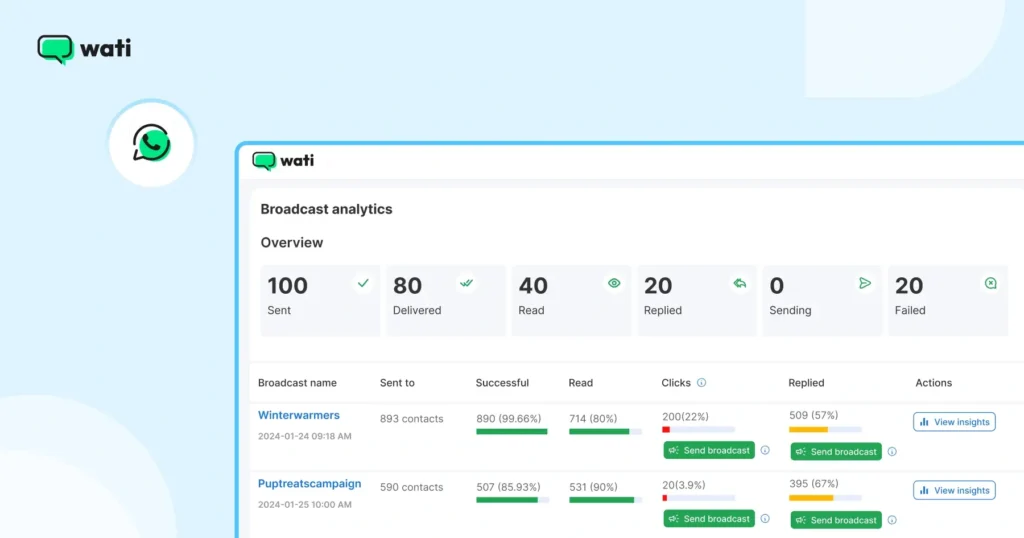
Success should be defined before a campaign is sent. Optimisation only works when the target outcome is known in advance, not when it is inferred from results as they come in.
Audience Segmentation
Segmentation is one of the strongest levers in a WhatsApp marketing campaign. It determines who receives the message and how relevant it is to users. Campaigns sent without segmentation often result in higher opt-outs even when the message itself is well-written.
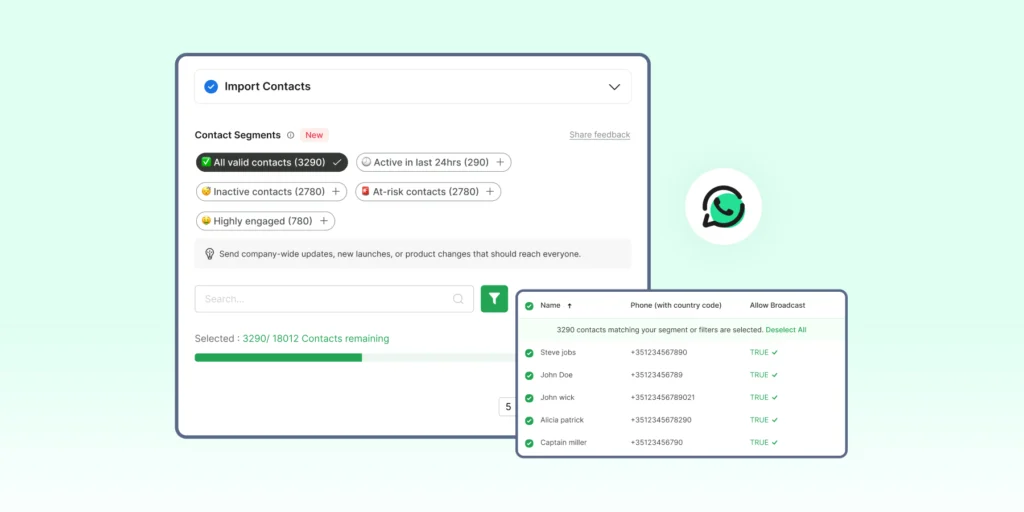
Segmentation allows teams to align message intent with user behaviour and context.
Common Segmentation Models
- Activity-based segmentation using last interaction windows
- Behaviour-based segmentation based on clicks, replies, or abandoned actions
- Transaction-based segmentation using purchase or refund history
- Attribute-based segmentation using tags, language, or region
These segmentation rules help campaigns stay focused and intentional rather than broad and repetitive.
Examples of Segmentation
- Users inactive for the last 45 days
- Users who abandoned a cart within the last 24 hours
- Users tagged with a specific product or interest
Read more on: Wati Segments: Smarter WhatsApp Campaigns for Higher Traction
Choose the Right Campaign Model
Once your audience and message are ready, the next decision is how the campaign should run. On WhatsApp, execution is not a one-size-fits-all approach.
Wati supports two distinct execution models. Each solves a different problem and is suited to a different type of campaign.
WhatsApp Bulk Campaigns
Campaigns work best when you want to send a single message to a defined group of users at a specific point in time. They are straightforward, controlled, and easy to measure.
Campaigns are used for:
- Announcements or updates
- One-time offers or promotions
- Messages sent to a fixed audience
How do Campaigns Work in Wati?
- Select the audience using filters or saved segments
- Add an approved marketing template
- Choose whether to send immediately or schedule the campaign
- Track delivery, reads, clicks, and replies
Once the message is sent to the selected audience, the campaign ends. This makes campaigns ideal for campaigns where timing matters more than user behaviour.
Further Reading: How to Get 100% Delivery Rates on Your Blended Messaging Campaigns?
Automation-Based Campaigns
Automation is used when the message should respond to user behaviour or timing rather than a fixed send date. Instead of sending one message to everyone at once, the campaign adapts to each user individually.
Automation-based campaigns are best suited for:
- Behaviour-driven follow-ups
- Time-based reminders
- Ongoing lifecycle messaging
In Wati, automations are built as workflows.
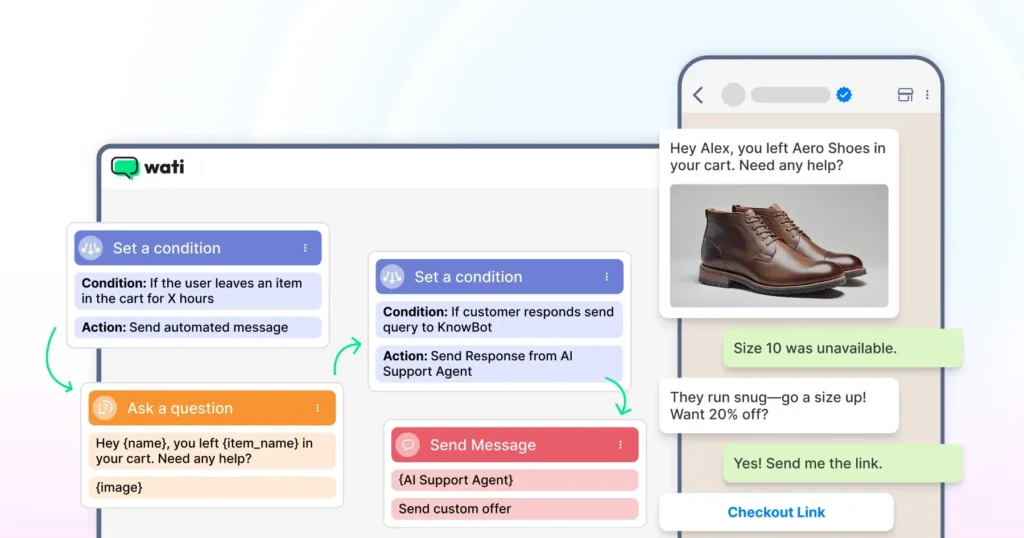
How automation works in Wati:
- A trigger starts the workflow
- Delays control when messages are sent
- Exit rules stop the flow when the goal is achieved
A simple example helps clarify this.
- Trigger: Cart created
- Delay: 2 hours
- Message: Abandoned cart reminder template
- Exit: Order placed
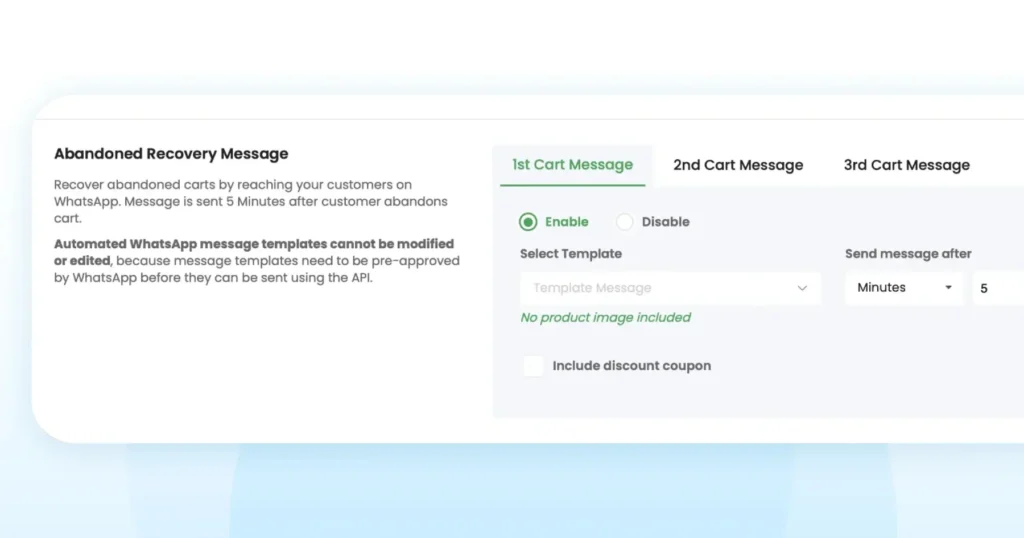
Unlike broadcasts, automations run continuously and adapt to each user’s actions. A user who completes the goal exits the flow, while others continue through it.
This makes automation the preferred model for campaigns where relevance and timing matter more than reach.
Also Read: Abandoned Cart Recovery: Easy Ways to Win Back Customers
WhatsApp Template Creation and Approval
Every WhatsApp marketing message starts with a template. Templates are not optional. They are a platform requirement for any business-initiated marketing messages.
A template defines both what you can send and how WhatsApp evaluates it for policy compliance.
Templates have a few constraints:
- Every template is reviewed and approved by WhatsApp before use
- The template category must be set as marketing for promotional campaigns
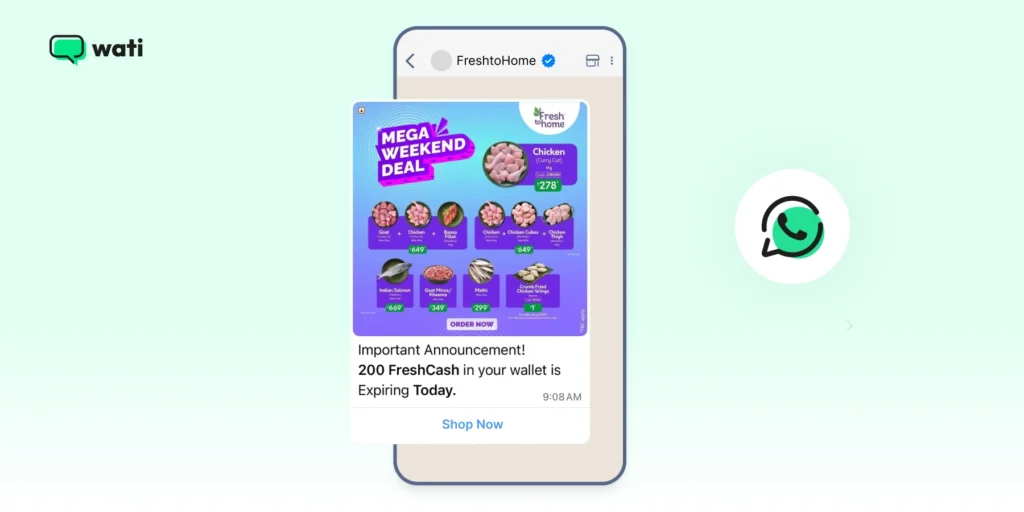
Once approved, templates follow a standard structure.
- Header, which is optional and can be text or media
- Body, which contains the main message
- CTA, which can be a button or a link
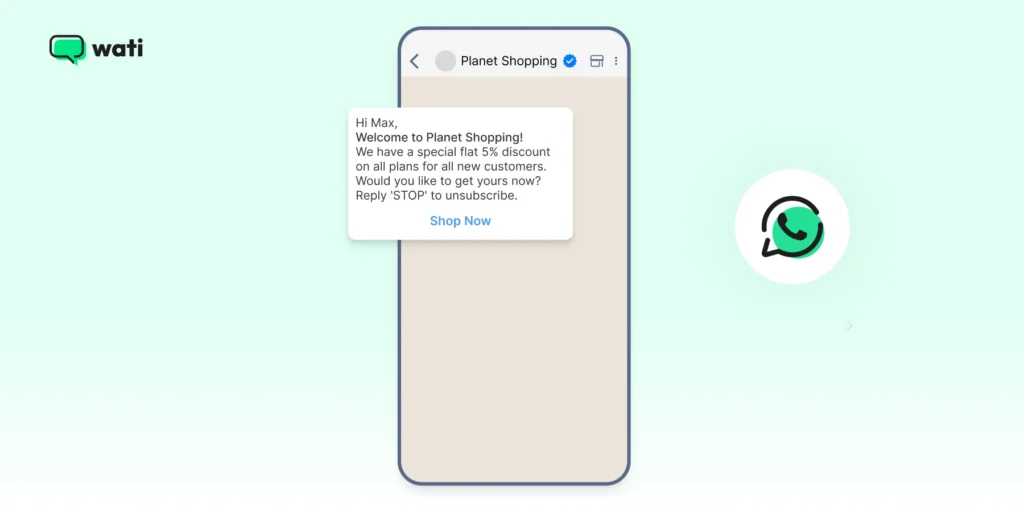
How a template is written impacts both approval speed and performance.
- State the purpose clearly in the first line
- Use one primary CTA to avoid confusion
- Keep variables limited and predictable
- Avoid misleading or exaggerated language
What Wati allows you to do:
- Create and submit templates directly from the dashboard
- Track approval status
- Reuse approved templates across multiple campaigns
This keeps campaign setup consistent and reduces friction when running multiple WhatsApp marketing campaigns at once.
Further Reading: 60 Best Greeting Messages for WhatsApp Templates That Actually Work
Timing and Frequency Control
When it comes to WhatsApp marketing campaigns, the timing of your message is just as important as what you send.
Messages sent at the wrong time are likely to be ignored. Messages sent too often are more likely to get you blocked if they look spammy. There are a few factors that need to be controlled at the system level.
Considerations:
- Timezone-based sending so messages reach users at the appropriate hours
- Avoid late-night campaigns
- Batch size control for large audiences to manage delivery load
Frequency needs equal attention. Here are some guidelines to follow:
- Avoid sending repeated campaigns to the same set of audience in a short span
- Use cooling-off periods between marketing messages
- Exclude users who were recently messaged
Over-messaging has clear consequences. When users block or opt out, WhatsApp records those signals and uses them to assess message quality. A rise in blocks reduces future delivery and can limit the reach of your campaigns.
Campaign Monitoring
WhatsApp marketing campaigns should not be set and forgotten. Performance signals start appearing the moment a campaign goes live, and early intervention can prevent long-term damage to your quality rating.
Monitoring campaigns while they run allows teams to spot issues before they blow up.
Key metrics to monitor:
- Delivery failures
- Read trends that show whether messages are being opened or not
- Click rates that reflect intent
- Reply rate that signals engagement
- Opt-out events that highlight negative feedback
Specific patterns require immediate attention. Here are some warning signs to watch for:
- Sudden spikes in opt-outs
- Consistently low read rates
- Unexpected drops in delivery
When these signals appear, action should be immediate. Corrective actions to consider:
- Pause the campaign to stop further impact
- Narrow the audience segment to improve relevance
- Review and adjust template wording before resuming
Post-Campaign Optimization
Every WhatsApp marketing campaign produces data that should be considered before planning the next campaign. Teams that overlook this data often repeat the same mistakes and see performance plateau over time.
Post-campaign review starts with understanding where engagement came from and where it dropped. Here are some areas to review:
- Segment performance to see which audiences responded best
- Template engagement to identify copy patterns that worked
- CTA interaction to understand user intent
Wati makes this analysis practical by tying performance data back to segments and templates. Once the review is complete, optimisation should be deliberate and controlled.
Optimisation ideas worth considering:
- Duplicate and edit existing templates to refine messaging
- Refine audience filters to tighten relevance
- Adjust delays in automation to improve timing
- Test different CTA formats, such as buttons versus links
Change one variable at a time. This makes it clear which adjustment led to an improvement and prevents guesswork from driving future campaigns.
Common Mistakes to Avoid
Most WhatsApp marketing issues do not come from poor copy or weak offers. They come from operational mistakes that compound over time and hurt delivery, engagement, or compliance.
These are some of the most common mistakes teams make when running WhatsApp marketing campaigns.
Frequent mistakes to avoid:
- Sending messages without a verified opt-in
- Using broad, unsegmented contact lists
- Repeating the same template across multiple campaigns
- Ignoring opt-out signals or delays in stopping messages
- Running campaigns without clearly defined KPIs
Each of these issues increases the risk of being blocked, experiencing opt-outs, and having a lower quality rating.
WhatsApp Marketing Campaign Goals
Putting all the pieces together helps clarify how a WhatsApp marketing campaign works in practice. This example shows how a simple, well-structured campaign can be set up in Wati using automation and segmentation.
In this scenario, the goal is to re-engage inactive users without overwhelming them with repeated messages.
Campaign setup overview:
| Objective | Reactivate inactive users and restart conversations |
| Segment | Contacts with no inbound chat activity in the last 60 days |
| Template | Short, clear message with a reply button |
| Follow-up | Triggered after 48 hours if there is no response |
| Primary metric | Reply rate |
The automation ensures that users who respond exit the flow immediately, while only non-responsive users receive the follow-up.
By combining segmentation, automation, and clear success metrics, Wati allows you to run reactivation campaigns that scale without increasing opt-outs or harming delivery quality.
Check out the best 12 WhatsApp Marketing Campaign Examples in 2026 for Businesses
Build Campaign Strategy Today!
WhatsApp marketing campaigns work when structure comes before scale. Clear message logic and defined success metrics keep campaigns effective and compliant as volume grows.
Wati handles the infrastructure that makes this possible. Template approval, opt-in enforcement, segmentation, automation, and reporting run in the background, so your team can focus on intent, timing, and outcomes rather than operational risk.
If you want to see how this works in practice, book a demo with Wati and walk through a real campaign setup with the team.
FAQs
A WhatsApp marketing campaign is a business-initiated outbound message sent using approved templates to a predefined, opted-in audience. These messages must follow WhatsApp Business API policies.
No. The WhatsApp Business App does not support bulk messaging, approved templates, or automation. Marketing campaigns can only be run using the WhatsApp Business API through an official provider.
Yes. All business-initiated marketing messages must use approved message templates.
High opt-out or block rates negatively affect your WhatsApp quality rating. This can lead to reduced delivery or temporary restrictions on outbound messaging.
Segmentation ensures messages are sent only to relevant users based on activity, behaviour, or attributes. This reduces opt-outs, improves engagement, and protects long-term delivery quality.