

-

-
-
Solutions
-
Soluções
-
Soluciones
-
解决方案
-
解決方案
-
الحلول
-
Product
-
Produto
-
Producto
-
产品
-
產品
-
المنتج
-

-
-


 Wati for Marketing
 Wati for Support
 Wati for Sales
 eLearning
 E-commerce
 Marketing Agencies
 Healthcare
 No Code Chatbots
 AI Support Agent
 Instagram and Facebook messenger
 Click to WhatsApp ads
 Campaigns
 Team Inbox
 WhatsApp Business Calling
 Wati AI
 Overview
 Library
WhatsApp Marketing KPIs Explained: What to Track Beyond Opens and Clicks
Written by:
 Ashwin
|
on:
January 9, 2026
|
Fact Checked by :
Ashwin
|
on:
January 9, 2026
|
Fact Checked by :
 Namitha
|
According to: Editorial Policies
Namitha
|
According to: Editorial Policies
 Table of Contents
Too Long? Read This First
- Outcome-Focused KPIs: Delivery and read rates show reach, not performance.
- Conversations > Clicks: Conversations started are stronger indicators of intent than CPC.
- Clicks and Replies Signal Intent: CTR and reply rate show movement inside the chat.
- Lead Quality Wins: Qualified leads matter more than raw conversations.
- Revenue Proves Value: Purchases, CAC, and ROI validate WhatsApp as a growth channel.
A lot of teams measure their WhatsApp marketing KPIs by visible metrics such as messages sent, delivery rates, and open rates. These numbers may look reassuring on dashboards, but they rarely explain the complete performance of your campaign.
A strong WhatsApp Marketing KPI captures what happens inside the conversation. It reflects interest, qualification, or conversion. A weak metric adds volume without insight and creates noise instead of clarity.
This blog article focuses on WhatsApp Marketing Metrics that are important when WhatsApp is treated as a growth channel. It explains how each metric is calculated and how it can be tracked inside WhatsApp API platforms like Wati. With every KPI tied back to outcomes, you can measure and defend.
Why WhatsApp Marketing KPIs Are Different?
WhatsApp marketing differs from email marketing. The channel is built around permission, identity, and conversations, which changes how performance should be measured.
Every WhatsApp interaction is opt-in. Messages arrive in a personal inbox. In most cases, user decisions happen inside the chat itself, not on external landing pages.
WhatsApp Marketing KPI focuses on what users do inside the conversation. How they respond, how far they move, and whether the interaction leads to qualification or conversion.
Core WhatsApp Marketing Metrics You Should Track
These metrics are how you can engage and progress within the WhatsApp API, and together they form the foundation for measuring intent and outcomes.
Opt-In Rate
What is it?
Opt-in rate measures the percentage of users who consent to receive WhatsApp promotional messages after coming across an entry point such as a Click to WhatsApp ad, website widget, form, or QR code.

- Without opt-in, campaigns cannot move forward.
- Every other WhatsApp Marketing Metric, including read rate, reply rate, lead qualification, and revenue attribution, depends on this step.
- A weak opt-in rate limits the number of users you can reach out to and affects the quality rating.
Opt-In Rate = (Total Opt-Ins/Total Recipients) × 100
How Does it Affect the Campaigns?
Improving the opt-in rate is largely an alignment problem. Users should know exactly what they are opting into before they tap. Ad copy, creative, and call-to-action must convey what the customer can expect to receive from the brand. The value must be explicit, whether it is product announcements, updates, personalised recommendations, or priority access.
Further Reading: Ways to Collect WhatsApp Opt-ins from Customers
Read Rate
What is it?
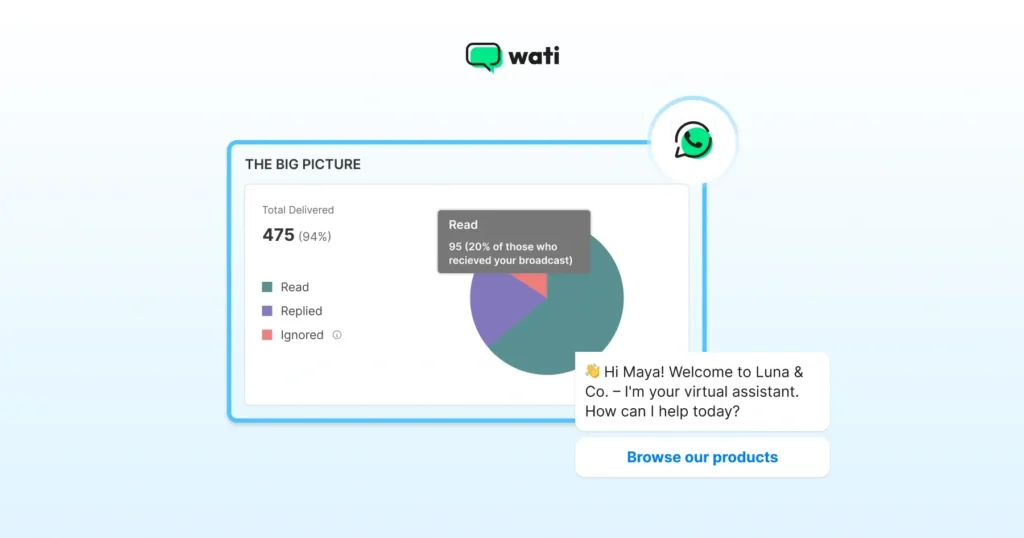
Read rate measures the percentage of delivered messages that are opened by users. WhatsApp API platforms like Wati provide clear delivery and read rates, which makes this WhatsApp marketing metric reliable.
Why is This Important?
Read rates on WhatsApp are usually high because messages trigger push notifications by default. When read rates drop, it usually indicates a deeper issue, such as poor timing, reduced trust, irrelevant content, or excessive frequency. It is rarely a technical problem.
Read Rate = (Messages Read/Messages Delivered) × 100
How Does Read Rate Matter?
Across industries, average WhatsApp read rates are typically around 98%, compared to 20% for email. Rates below this range suggest misalignment in how or when messages are being sent.
Wati tracks open rates at the campaign level. This allows teams to compare performance across campaigns, templates, and time windows.
- Messages should be sent when users are likely to be active, not when it is convenient for the team.
- Over-messaging quickly reduces attention.
- Using the correct template category also matters, since misuse can affect both quality rating and user trust.
Click-Through Rate
What is it?
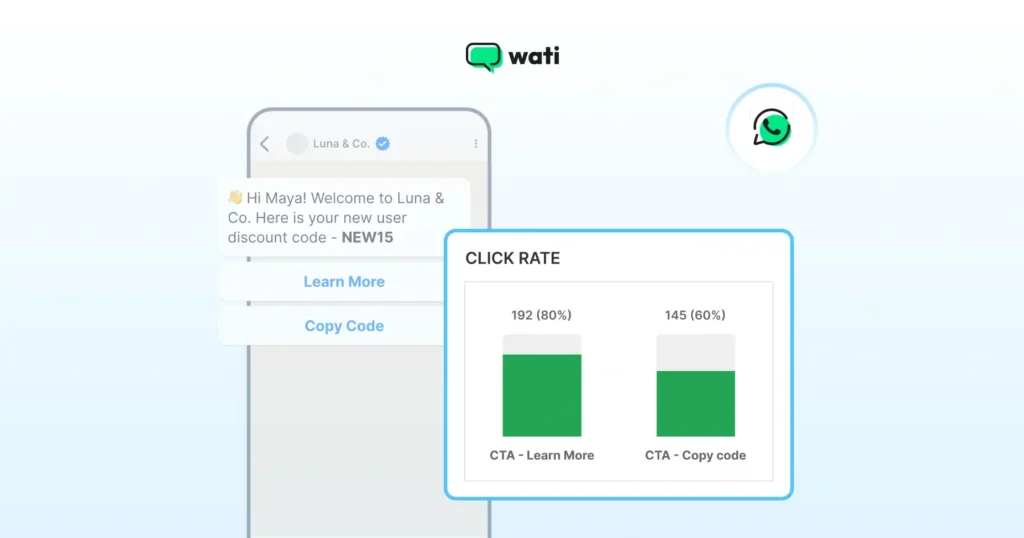
Click-through rate measures the percentage of users who click a link or button inside a WhatsApp message. On WhatsApp, CTR is a strong signal of intent because users must engage within a one-to-one conversation, not a passive feed.
CTR = (Total Clicks/Messages Delivered) × 100
Why is This Important?
Unlike impressions or read rates, CTR reflects a deliberate action. It shows whether the message moved the user toward the next step, such as viewing a product, confirming an order, or continuing a sales flow. This makes CTR a core WhatsApp Marketing Metric for sales, remarketing, and mid-funnel journeys.
How Does CTR Matter?
Improving CTR requires nudging the users to take an action quickly.
- Use buttons instead of URLs
- Focus on one clear CTA per message
- Remove unnecessary steps between the message and the action
When CTR drops, it often signals unclear intent, weak CTA framing, or messages that ask users to do too much at once.
Reply Rate
What is it?
Reply rate measures the percentage of users who respond to a WhatsApp message. This metric denotes whether a message invited participation rather than remaining a one-way communication.
Reply Rate = (Total Replies/Messages Delivered) × 100
Why is This Important?
Replies are where WhatsApp campaign shifts from messaging to conversation. Once a user responds, the interaction can move into qualification or sales. For this reason, reply rate is one of the practical WhatsApp Marketing Metrics for brands focused on outcomes rather than reach.
Why Does This Matter?
Improving reply rates depends on reducing the user’s cognitive load.
- Use quick replies to guide responses
- Avoid open-ended prompts that require typing or decision-making
When reply rates fall, it means the message did not signal what action was expected or required, or that responding required too much effort.
Opt-Out Ratio
What is it?
The opt-out ratio measures the percentage of users who unsubscribe after receiving WhatsApp messages. It reflects how your messaging strategy aligns with user expectations and tolerance.
Why is This Important?
High opt-out rates signal poor relevance and can negatively affect account quality. Over time, this can restrict messaging capabilities and reduce overall reach.
Opt-Out Ratio = (Total Opt-Outs/Total Recipients) × 100
Why Does This Matter?
Reducing opt-outs is a targeting problem.
- Strengthen audience segmentation
- Reduce message frequency, especially for broadcasts
- Send only messages that are well-timed and relevant to your users
A rising opt-out ratio is an early warning signal. Addressing it quickly protects both performance and long-term account health.
Click to WhatsApp Ads KPIs in Wati
Click to WhatsApp ads change how performance should be measured. Instead of optimising for traffic or clicks, they optimise for conversations. This shifts the focus from surface engagement to real intent.
Wati connects Click to WhatsApp ad data directly to WhatsApp Marketing KPIs, allowing teams to evaluate ad performance based on what happens after the chat opens.
Further Reading: How to run and optimize click-to-WhatsApp campaigns?
Conversations Started
Conversations started measure the number of WhatsApp chats initiated as a direct outcome of Click to WhatsApp ads.
Each conversation represents a user who has moved beyond interest and chosen to engage in a one-to-one interaction.
This metric replaces clicks as the primary signal of intent. A conversation indicates higher commitment than a website visit and provides immediate context for qualification or conversion.

When this metric is low, the issue usually lies in ad messaging, audience quality, or a mismatch between the ad promise and the first WhatsApp message.
Cost per Conversation Started
Cost per conversation started measures the ad spend required to initiate a single WhatsApp conversation via Click to WhatsApp ads.
It reflects real engagement. A conversation requires the user’s intent and may not lead to any follow-up action.
Cost per Conversation = Ad Spend/Conversations Started
Cost per conversation increases, often indicating weaker audience targeting, declining creative relevance, or friction between the ad and the first WhatsApp interaction.
Qualified Leads Captured
Qualified leads captured measures the number of WhatsApp conversations that meet predefined qualification criteria. It separates casual inquiries from users with clear intent, making it a vital WhatsApp Marketing Metric for sales-led teams.
Qualification criteria reflect business readiness, such as
- Budget confirmation
- Use case or product fit
Tracking qualified leads prevents teams from overvaluing raw conversation volume and keeps performance reporting aligned with sales reality.
Cost Per Lead
Cost per lead measures the ad spend required to acquire one qualified lead via WhatsApp.
Cost per Lead = Ad Spend/Qualified Leads
This metric feeds directly into cost per acquisition. A low cost per conversation is meaningless if those conversations never qualify. Cost per lead ensures that WhatsApp Marketing KPIs reflect lead quality, not just engagement volume.
When the cost per lead increases, the issue is usually qualification friction, weak intent targeting, or slow response times inside the conversation.
Conversion Metrics That Prove Impact
Purchases
Purchases measure the number of completed orders that can be directly linked to WhatsApp conversations.
This metric moves WhatsApp reporting beyond engagement and into revenue, making it one of the most defensible WhatsApp Marketing KPIs.
Tracking purchases proves whether WhatsApp is influencing buying decisions rather than just assisting with discovery or support when conversations lead to confirmed orders.
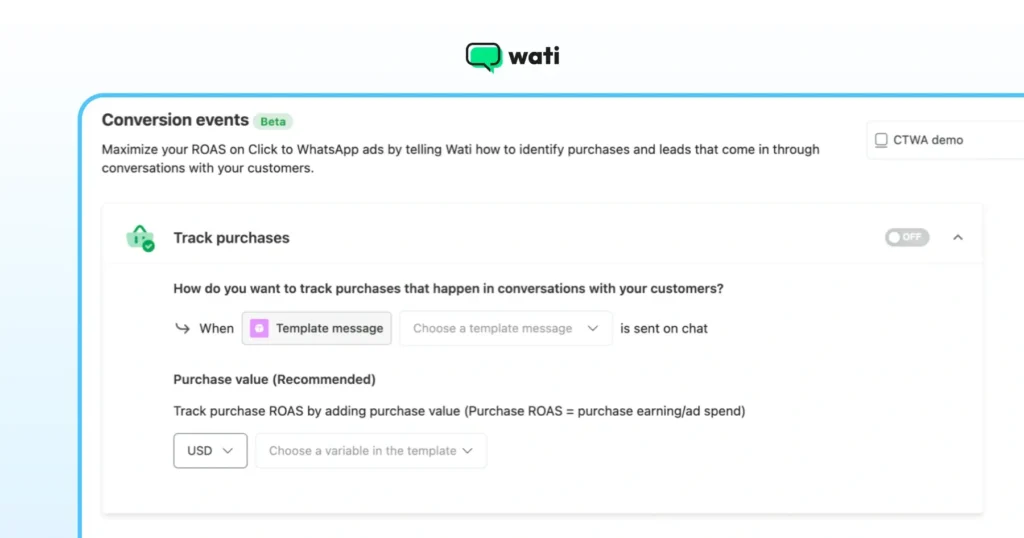
You can track purchases through multiple integration points, including
- Shopify integration for e-commerce order events
- CRM events tied to closed or won deals
- Order confirmation templates are sent after successful transactions
When purchase volume is low despite high engagement, it often signals gaps in follow-up, qualification, or handoff between automation and sales teams.
Cost Per Purchase
Cost per purchase measures the amount of ad spend required to generate a single completed order on WhatsApp. It directly links marketing spend to revenue outcomes, removing ambiguity from performance analysis.
Cost per Purchase = Ad Spend/ Purchases
While clicks, conversations, and leads indicate progress, the cost per purchase confirms whether WhatsApp marketing is financially viable. It allows businesses to compare WhatsApp against other channels using the same conversion benchmark.
When the cost per purchase increases, the cause is often friction within the conversation flow or misalignment between ad intent and the buying journey.
Facebook Ads Context Metrics Inside Wati
Wati also displays Facebook Ads metrics to provide context around WhatsApp performance. These metrics explain what happens before a conversation starts, but they should never be used as primary indicators of success.
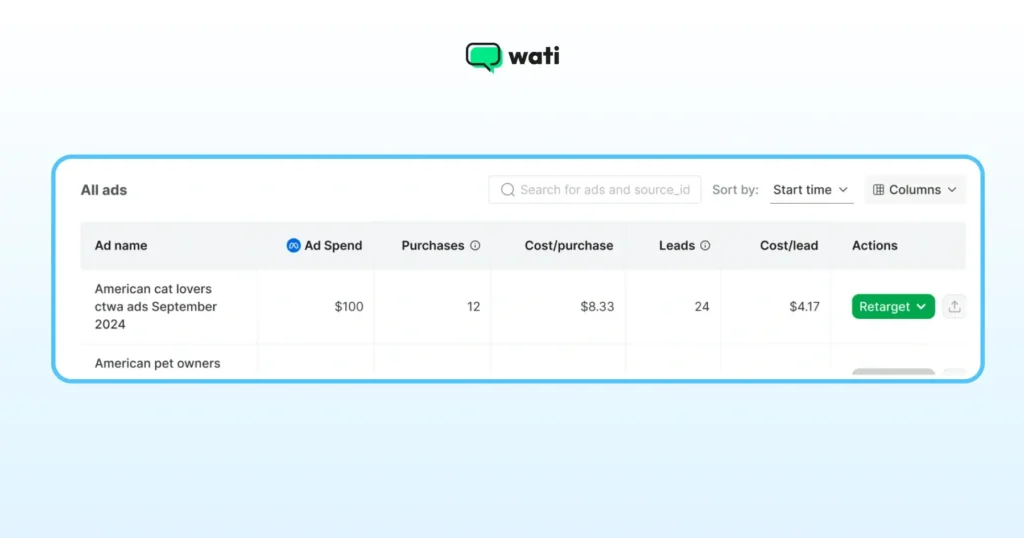
The metrics available inside Wati include
- Ad spend
- Clicks
- Impressions
- Reach
- Ad ID
- Ad URL
These metrics help diagnose performance shifts, such as creative fatigue or audience saturation. They explain why WhatsApp Marketing KPIs move up or down, but they do not define success.
Cost and Revenue WhatsApp Marketing Metrics
These metrics connect WhatsApp activity to financial performance, helping you evaluate efficiency and business impact beyond engagement.
Cost Per Acquisition
Cost per acquisition measures the total cost required to acquire a single customer through WhatsApp. It consolidates media spend, messaging costs, and operational effort into one outcome-focused metric.
CAC = Total Marketing Spend/Customers Acquired
CAC (Customer Acquisition Cost) reflects true efficiency. A channel can generate conversations and leads at scale, but if those efforts do not translate into customers at a sustainable cost, performance breaks down.
WhatsApp often delivers lower CAC compared to traditional channels because
- Response times are faster, which reduces drop-offs
- Conversations capture higher intent earlier in the journey
- Automation reduces agent workload without slowing follow-up
When CAC rises, the cause is usually delayed responses, poor qualification, or inefficiencies in the automation-human handoff.
Revenue Attribution
Revenue attribution measures revenue directly linked to WhatsApp conversations. It connects messaging activity to business results and allows businesses to evaluate WhatsApp as a revenue-driving channel.
Revenue attribution closes the loop between marketing effort and financial impact. Without attribution, WhatsApp performance remains unreliable and difficult to defend in planning or budget discussions.
Accurate attribution helps teams identify which journeys, campaigns, and conversation flows consistently contribute to revenue, and which ones require optimisation.
Return on Investment
Return on investment measures the profitability of WhatsApp marketing by comparing the revenue attributed to WhatsApp against the total spend required to generate it. It is the final metric that determines whether WhatsApp deserves continued or increased investment.
ROI = (Revenue Attributed − Total Spend)/Total Spend × 100
ROI matters because it translates WhatsApp performance into a language that leadership understands. Engagement metrics may indicate momentum, but ROI confirms sustainability. It shows whether conversations, leads, and purchases are creating measurable value after costs are accounted for.
When ROI weakens, the issue is rarely messaging alone. It is usually driven by inefficiencies in targeting, qualification, response speed, or conversion flows within the conversation.
Metrics You Should Stop Prioritising
Some metrics create the illusion of progress without showing real performance. They are easy to track and easy to optimise, but they mostly don’t correlate with outcomes.
Messages sent and broadcast volume measure output, not impact. Conversations without outcomes inflate engagement numbers while masking inefficiencies in qualification or follow-up.
These metrics grow as your business grows, which makes them feel reassuring. In reality, they often hide performance gaps and distract from WhatsApp Marketing KPIs that reflect progress and revenue.
Final Thoughts
An effective WhatsApp marketing campaign is measured by outcomes, not activity. High delivery and read rates are expected on the channel. They do not explain intent, qualification, or revenue impact.
Wati provides visibility across your entire WhatsApp marketing journey. The advantage does not come from having more data. It comes from tracking the right metrics and acting on them consistently.
If you want to see how these WhatsApp Marketing KPIs can be tracked and applied in your own account, book a demo with Wati and review your performance at the conversation level.
FAQs
WhatsApp Marketing KPIs are metrics that measure user behaviour in WhatsApp conversations. They focus on intent, qualification, and conversion rather than message volume or delivery.
WhatsApp KPIs track conversation-level actions. Email focuses on opens and clicks. Ads focus on impressions and CPC. WhatsApp measures replies, conversations started, qualified leads, and purchases.
Start with the opt-in rate. Without opt-ins, no other WhatsApp Marketing Metric can scale or remain compliant.
Conversations started. It replaces clicks as the primary intent signal, showing whether your campaigns are driving engagement.
Yes, but only as an intent signal. CTR shows movement within the chat, not success on its own. It should be evaluated alongside reply rate and conversions.
Track qualified leads captured. Use automation rules, lead tags, or agent qualification steps to separate intent from noise.
Cost per conversation measures engagement efficiency. Cost per lead measures qualification efficiency. Cost per lead is more useful for sales forecasting and CAC.
Messages sent, broadcast volume, and total conversations without outcomes. These inflate activity but hide performance.
Weekly reviews work best. Daily checks create noise and lead to reactive decisions.