

-

-
-
Solutions
-
Soluções
-
Soluciones
-
解决方案
-
解決方案
-
الحلول
-
Product
-
Produto
-
Producto
-
产品
-
產品
-
المنتج
-

-
-


 Wati for Marketing
 Wati for Support
 Wati for Sales
 eLearning
 E-commerce
 Marketing Agencies
 Healthcare
 No Code Chatbots
 AI Support Agent
 Instagram and Facebook messenger
 Click to WhatsApp ads
 Broadcasts
 Team Inbox
 WhatsApp Business Calling
 Overview
 Library
WhatsApp vs. Email Marketing: Choosing the Best Channel for Growth in 2026
Written by:
 Shreya
|
on:
January 22, 2026
|
Fact Checked by :
Shreya
|
on:
January 22, 2026
|
Fact Checked by :
 Namitha
|
According to: Editorial Policies
Namitha
|
According to: Editorial Policies
 Table of Contents
Too Long? Read This First
- Engagement Gap: WhatsApp boasts a massive 98% open rate compared to email’s average of 21%, ensuring your message is actually seen.
- Speed & Automation: WhatsApp provides instant, two-way communication and real-time support, while email often suffers from 24-hour response delays.
- Security & Trust: WhatsApp offers end-to-end encryption and "Green Tick" verification, reducing the phishing and spam risks common in email.
- Functionality: Use WhatsApp for interactive CTAs, frictionless payments, and hyper-personalization; use email for long-form narratives and formal records.
- Scaling with Wati: Wati elevates WhatsApp marketing with AI-powered bots, omnichannel SMS fallback, and deep CRM integrations for seamless sales.
It’s not new for businesses to personalize online campaigns via channels like emails and messages.
Be it a B2B or a B2C business, email marketing has been one of the longstanding customer acquisition and organic marketing channels.
As modern-day marketing evolves, WhatsApp is also stepping up the game and emerging as an instant messaging medium for brands. While emails remained an effective lead generation channel, that impact has been multiplied with WhatsApp messaging broadcasts.
Many brands are considering WhatsApp marketing solutions to automate bulk messaging, driving customer journeys and building brand awareness and loyalty.
In this guide, I’ve listed down core differences between WhatsApp marketing and email marketing, their benefits, their applications, and examples to help you understand when to use what. Let’s get started.
What Is WhatsApp Marketing?
WhatsApp marketing is the process of engaging with potential customers through WhatsApp to sell your products and services.
With WhatsApp marketing, you can target high-intent customers or repeat customers with quality content and unique propositions to convert again and scale revenue.
It allows you to send bulk broadcast messages, automate and scale campaigns, and respond instantly to high-potential conversations.
Brands can send bulk notifications, automate FAQs, provide product shipping updates, manage ads and catalogues, and even streamline payments, all on a single platform.
What Is Email Marketing?
Email marketing is a form of organic marketing that helps target customer engagement via product emails.
share alerts and promotions, float announcements, sell products and services, and promote packages via trusted email and authorized email signatory to fuel demand and scale brand growth.
While email marketing is a legacy channel, it is still used for long-form updates, formal business proposals and delivering complex and crucial updates and attachments that users might want to reference for future.
WhatsApp Marketing vs. Email Marketing: Core Differences
Earlier, most B2B and B2C brands relied on emails as a part of their overall go to market (GTM) strategy for customer outreach and revenue.
But, as digitization took over, consumers expect more instant service out of brands. While emails still have a decent open rate of 42.35%, WhatsApp promises 98% open rates for brands.
Despite the quality of an email campaign, most emailers end up in customers’ junk folders. While emails were once the primary choice, WhatsApp is now an engine for better marketing campaigns, brand trust, and ROI.
Below are the core differences between WhatsApp marketing and email marketing.
1. High Open Rates vs. Lower Visibility
The open rates for WhatsApp messages are drastically higher than those for email marketing, making the difference stark.

WhatsApp boasts a 98% open rate and a 45-60% CTR, while emails average between 40-42% open rate and 3-5% CTR.
Also read: How to track customer journey analytics with WhatsApp API and improve your e-commerce operations digitally.
Bonus read: How to deploy WhatsApp for E-commerce to track order, shipments, and payments with ease for maximum customer retention.
2. Instant Conversational Automation vs. Delayed Responses
For most brands, emails are a slower channel for customer engagement. After you send an email newsletter to a prospect, you might get a response or two, significantly reducing the number of MQLs acquired.

Even if a consumer reaches out via email inquiry, they receive a standard autoresponder, e.g., “We will get back to you in 24 hours,” but hardly anyone responds with any customer support.
With WhatsApp marketing, customer service teams can provide instant support for consumer queries and optimize resolution turnarounds.
By deploying support agents via WhatsApp, customers can instantly get the information they need, i.e., delivery update, product inquiry, maintenance, or store assistance, without waiting for a longer haul of 24 hours.
Also read: How does Wati use Gemini 3.0 to power inbound automation and convert better and faster from customer inquiries.
3. High-Visibility Notifications vs. Promotional Graveyard
Most brand emails that might appear as “spam” are buried in the prospect’s “promotion” or “social” folder, where no one opens or prioritizes them.
WhatsApp messages, however, land directly in the user’s personal chat list with push notifications. If prospects have subscribed or “opted in” to receive communication, they receive broadcast messages instantly and, in turn, help improve campaign performance for the brand.
Also read: 12 standout WhatsApp marketing examples that might turn heads in 2026
Bonus read: Check out 20+ best WhatsApp broadcast tools to convey your brand value proposition to multiple prospects and fuel growth.
4. Interactive CTA Buttons vs Static Interlinking
In email marketing, prospects can only respond to email either by clicking the text link that opens in a separate browser, or simply replying to the email.
In contrast to this, WhatsApp provides interactive call to actions (CTAs) that entices prospects to move forward in their purchase journey.
For example, Wati’s Click to Ad (CTWA) feature allows prospects to instantly initiate conversations from an online enquiry, even book appointments, make payments via WhatsApp pay and browse product catalogues.
With traditional email newsletters, brand marketers can integrate interactive call to actions, but it takes at least 24 hours for the brand to get back to them, in contrast with digital shopping of WhatsApp.
Also read: How to create WhatsApp newsletters and promote products effectively for higher sales this year.
Need inspiration? Check out top WhatsApp API providers in 2026 to set WhatsApp infrastructure and optimize sales interactions better.
3. Pre-Defined API Templates vs Generic Emailers
Running email campaigns is a tedious task. It is a constant juggle for email marketers, from writing email copies to coding emails in the backend to design to A/B testing. However, there isn’t much creativity or variation involved that make email marketing ambiguous for customers.

Also, while emails were and are one of the most effective ways to distribute content, people just don’t check them that often.
A study by Luisa Zhou showed that 60% of people open emails on mobile devices, however, it is hard to keep track of email analytics, or show creativity for mobile users.
WhatsApp Business API platforms like Wati offer pre-defined API templates that can be used throughout the consumer journey, from pre-purchase to post purchase.
Using creative and appealing multimodal templates (inclusive of audio, video, text and images) instantly creates a buzz and empowers the customer to open and go through your content.
Also read: How to create WhatsApp messages using WhatsApp template to engage customers.
Bonus read: Learn how to build appealing product catalogues for WhatsApp users for seamless browsing, cart adding and seamless checkouts.
6.Verified Brand Trust vs. Phishing or Spam Risks
Emails are always at the risk of data breaches and data risks. Email marketing-related cyberattacks, primarily phishing, is the most common cause of breaches, with 90% of all breaches coming from a phishing email.
According to a study, the average cost of a data breach originating from phishing is around $4.88 million dollars. Email is at a greater security risk than a WhatsApp message.
BSP tools like Wati provide end-to-end WhatsApp encryption via their API platform to protect customer privacy, prevent data breaches and adhere to Meta’s compliance and GDPR policies.
Sending messages via WhatsApp relatively is safe due to stringent privacy policies of Meta that makes hacking near to impossible. This means, prospects trust you more and feel more open.
On WhatsApp, brands can also obtain official business account green tick verification, which serves as a badge of authenticity. This builds instant customer confidence, letting customers know they are chatting with a genuine brand.
Bonus read: How to set up a virtual number for WhatsApp Business to optimize customer interactions across various regions.
7. Personalized Human Connection vs. Corporate Formality
Emails tend to be formal, curiosity building, binded with facts and new buzzwords, which might feel like a one long monologue.
The “stiff” style of emails makes it difficult for modern brands to build a genuine connection with their audience. Email personalization may help, but it’s not possible to tailor each campaign according to individual preferences.
With WhatsApp Business API platforms like Wati, you can offer personalization at scale, to meet customers where they are in the purchase journey.
It offers features like predefined segments, SMS marketing and fallback, WhatsApp Business in-app calling, WhatsApp Flows and drag and drop campaigns to design lead nurturing workflow as per past interactions with the customer.
By using Wati’s intelligent automation, you can filter the audience, personalize messages at scale, and assist instantly to amp up conversion potential.
What Are the Benefits of Whatsapp Marketing?
Using WhatsApp marketing for brand building is a great way to come in instant contact with high quality prospects and generate leads
Here are some of the top benefits of WhatsApp marketing in 2026
1. High Open and Read Rates
WhatsApp broadcast messages have a higher open rate and read rate than emails as customers trust brand authenticity and credibility. With a 98% open rate, your message just doesn’t sit in the inbox; it gets delivered to the right destination at the right time.
Also read: How Wati’s shared inbox empowers you to track sales productivity, manage multiple conversations and maintain the flow for customers.
2. Instant, Two-Way Communication ROI:
By pre-segmenting customers and feeding intent-driven broadcast, you fuel two way communication, leading to direct sales ROI.
By using interactive WhatsApp templates, you allow customers to engage with a single tap. The intelligent conversation intelligence lowers the barriers to purchase, moving prospects through the funnel in minutes rather than days.
Bonus Read: Learn how Wati integrates social media ads directly into WhatsApp conversations with WhatsApp marketing automation.
3. Frictionless Automation for Growth
WhatsApp Business software like Wati provide drag and drop marketing automation to know prospects better.
With drag and drop campaign builders, also known as WhatsApp flows, you can capitalize on contextual contact history to improve lead generation tactics.
With WhatsApp marketing, you can scale automation intelligently to tailor brand messaging.
Tools like Wati’s no-code chatbots allow you to handle thousands of simultaneous product inquiries or support tickets without losing the personal touch that builds brand loyalty.
With API platform, you can run these marketing automation campaigns to drive traction without overwhelming customers. Mapping consumer intent with content delivery fuels smart brand growth.
Also read: How to ensure seamless cart recovery for abandoned carts on WhatsApp in 2026.
Bonus read: Learn how to power smart automation within WhatsApp API. Check our guide on WhatsApp API compliance to ensure pre-campaign checks.
4. High Trust, Green Tick Credibility
Brands can also authenticate their WhatsApp Business WABA accounts by getting green tick verification.
Getting a green tick verification bolsters consumer trust and adds credibility to your brand. Having a verified WhatsApp Business API profile gives you an immense badge of authenticity.
Green tick verification makes customers feel safe sharing the details or making payments, which is a massive leap over generic “spray and pray” marketing emails.
Before you apply for a WhatsApp Business Account, check out the WhatsApp API pre-requisites to follow a proper API registration process.
5. Multiple Broadcast Campaigns at Scale
With WhatsApp, you can broadcast multiple messages across various geographical locations to more than one lead cluster.
Not only does it bring sales efficiency, but also ease of lead management for your sales and marketing teams.
By launching diverse WhatsApp marketing campaigns, you can broadcast content in a way your consumer wants to hear. Diverse broadcasting also allows you to maintain DEI principles, empathy and cultural or linguistic nuances that makes you unique in the market.
Also read: How to build your personal brand on WhatsApp to build appealing outlook and establish a leading message.
6. Seamless Customer Support and 24×7 Service
Creating a WhatsApp Business Account also is a getaway to provide instant customer service to customers.
Opposite to the email customer support strategy that isn’t too functional, it allows you to send instant responses and provide personalized suggestions to your customers.
From virtual demos to inbound calling, WhatsApp for customer service really raises your standards and positions you as an empathetic brand.
With WhatsApp Business API platforms like Wati, you can cut down on customer queues and expedite resolution for customers faster and smarter.
Also read: How to use WhatsApp Business API for customer support in 2026
What Are the Benefits of Email Marketing?
As a content distribution medium still going strong, brands have really uplifted their email marketing strategy for effective lead generation and customer engagement.
Below are the benefits of email marketing for brands that want to curate resonating email campaigns for garnering better engagement.
- Ideal for narrative and detail: If your message requires the reader to sit down, and digest 1000 words, email is the right choice. With email, you can frame a narrative in accordance with the ideal customer persona or segment and influence buyers better.
- Permanent digital archive: Email acts as a searchable record. While WhatsApp provides a high open rate, emails provide a complete record of client communication. When a customer needs to find a receipt from three years ago or a specific contract, they go to their email.
- Low cost massive outreach: Email marketing is a foolproof way to bulk reach low intent prospects. If you are launching a wide GTM strategy, email is a cost-effective channel to promote products and share content.
- Educational nurturing and thought leadership: Brands use email to deliver value over time. For example, “a 30-day fitness challenge” works well in an email format where each day contains a detailed workout plan, a video link or nutritional advice. Emails work significantly well with high-intent leads that genuinely progress the sales funnel.
- Formal documentation and compliance: Emails store sensitive information and transactional data. Invoices, booking confirmations with attached PDFs, and legal terms of service are best delivered via email so the user can easily file them away.
- Monthly content curation: Email is the perfect channel to send monthly review newsletters. It offers a unique blend of creative storytelling and user experience testing (UX testing) to help interested prospects and keep them updated.
Also read: How does Wati help strengthen affiliate marketing through WhatsApp API to build revenue channels
How does Wati elevate WhatsApp marketing in 2026?
With Wati, you can scale conversational growth, build e-commerce engines and drive the entire purchase and post purchase journey with real-time alerts.
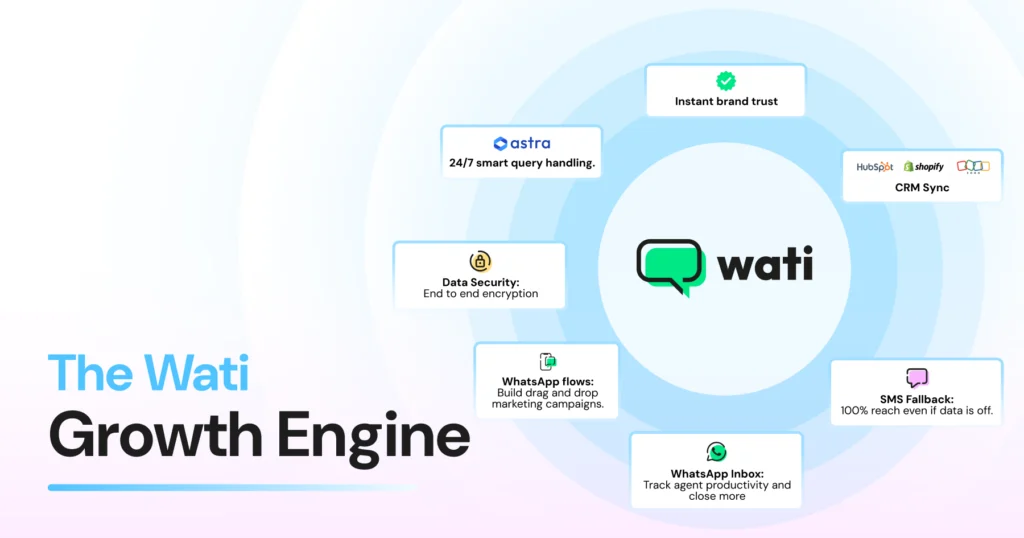
Wati’s API solution is packed with features like team inbox, WhatsApp flows and intelligent automation to supercharge marketer productivity and give a wholesome experience to customers.
By bridging the gap between official WhatsApp Business API capabilities and user friendly automation, Wati ensures that your brand doesn’t just “send messages”, but actually builds a seamless digital e-commerce experience. Below are the top features of Wati for WhatsApp marketing.
1. AI-Powered Inbound Automation (Astra & KnowBots):
Scaling a business often means being overwhelmed by inquiries.
Wati’s Astra AI and KnowBots act as 24/7 digital employees that provide human touch to query resolution.
These bots don’t just give canned responses; they understand intent, qualify leads, and provide instant product information, ensuring no prospect is left waiting.
Read more about AI Astra by Wati and how it helps your business.succeed and retain customers.
2. Omnichannel Reliability with SMS/RCS Fallback
Generally, you can try to design WhatsApp campaigns for everyone, but, all users might not be on WhatsApp.
Wati now features Intelligent SMS Fallback. If a high-priority WhatsApp broadcast fails to deliver due to connectivity issues, the system automatically triggers an SMS or RCS message, ensuring your reach remains at 100%.
3. Seamless Ad Attribution (TikTok & Google CTM):
Marketers can finally achieve the sales ROI by targeting across social media apps.
Wati integrates directly with TikTok and Google Click-to-Message (CTM) ads.
When a lead clicks your ad, they are instantly routed into your Wati inbox, and the platform tracks the entire journey from that first click to the final payment.
4. Direct Voice Escalation (WhatsApp Calling):
Sometimes, a text isn’t enough to close a high-ticket deal.
Wati now supports WhatsApp Business Calling, allowing your sales team to transition from a chat to a voice call within the same interface.
This human touch is a proven game-changer for building trust in complex sales cycles.
5. Hyper-Personalized CRM & Shopify Sync
Wati doesn’t work in a silo. By syncing in real-time with Shopify segments and CRMs like HubSpot and Zoho, you can launch laser-targeted broadcasts.
Imagine sending a personalized discount to a customer the moment they hit a certain spend threshold on your store; that is the power of Wati’s deep integration.
Also link: How to integrate WhatsApp with HubSpot for seamless data transitions between the two platforms.
Bonus read: The ultimate WhatsApp API integration checklist to strengthen marketing workflows in 2026.
6. Collaborative Shared Team Inbox
Wati’s Shared Team Inbox allows you to standardize texts and help sales teams track progress.
It allows multiple agents to manage thousands of conversations simultaneously.
With the new Sales Analytics Dashboard, managers can track operator performance and lead stages in real-time
7. AI-Driven Content Optimization
Wati’s AI Support Agent helps you craft messages that get results.
It suggests high-converting copy based on Meta’s best practices and uses an AI CX Score to analyze your existing conversations, helping you refine your tone to maximize customer satisfaction.
By leveraging these best-in-industry updates, Wati’s API manages and controls all marketing operations intelligently. Wati transforms WhatsApp from a simple chat app into a business conversations operating system.
For campaign managers looking to outpace email ROI, Wati provides the data, the automation, and the human touch needed to dominate the 2026 market.
Choose Your Content Medium Carefully!
Be it WhatsApp marketing or email marketing, at the end of the day refining your customer targeting and building genuine conversations is the success key.
While emails are still going strong, modern marketing focuses more on WhatsApp sales-drivens strategies to build instant interactions and reinforce credibility.
By choosing a BSP platform like Wati, you can create a complete digital customer e-commerce lifecycle, even if you are an SMB owner or a solopreneur, to trigger events and scale revenue.
Get a free trial of Wati today to see it live in action!
Frequently Asked Questions: WhatsApp vs. Email Marketing
Have more questions? Refer below!
While email is cost-effective for long-form newsletters, WhatsApp is generally more effective for driving immediate sales. With higher visibility and instant response capabilities, small businesses can close deals faster and provide more personalized service compared to emails that may land in a “Promotions” folder.
Yes, the most successful brands use an omnichannel approach. Use email for formal documentation, long-form educational content, and monthly archives, while leveraging WhatsApp for time-sensitive alerts, flash sales, and real-time customer support.
WhatsApp messages trigger instant push notifications on a user’s mobile home screen, a space typically reserved for personal communication. Unlike email inboxes, which are often cluttered with thousands of unread marketing messages, WhatsApp offers a direct, less crowded path to the consumer.
Wati uses the official WhatsApp Business API, which requires brands to adhere to Meta’s strict opt-in policies. By using pre-defined templates and personalized segments, Wati ensures your communication is relevant and expected, which maintains your brand’s “Green Tick” credibility.
Brands typically see a significant jump in Click-Through Rates (CTR), often moving from email’s 3% average to WhatsApp’s 45–60%. This higher engagement usually results in faster lead qualification and increased conversion rates, especially when using Wati’s automated checkout and flow features.