

-

-
-
Solutions
-
Soluções
-
Soluciones
-
解决方案
-
解決方案
-
الحلول
-
Product
-
Produto
-
Producto
-
产品
-
產品
-
المنتج
-

-
-


 Wati for Marketing
 Wati for Support
 Wati for Sales
 eLearning
 E-commerce
 Marketing Agencies
 Healthcare
 No Code Chatbots
 AI Support Agent
 Instagram and Facebook messenger
 Click to WhatsApp ads
 Campaigns
 Team Inbox
 WhatsApp Business Calling
 Wati AI
 Overview
 Library

Not Every Visitor Deserves the Same Attention: How AI Pre-Qualifies D2C Customers?
Written by:
 Musa Bhat
|
on:
November 27, 2025
|
According to: Editorial Policies
Musa Bhat
|
on:
November 27, 2025
|
According to: Editorial Policies
 Table of Contents
Your D2C site may attract thousands of visitors each month, but only a small percentage arrives with real buying intent. The challenge isn’t traffic but the lack of visibility into who is ready to purchase and who is simply browsing. Most brands treat every visitor the same, relying on identical forms, pop-ups, and chat prompts. That uniform approach creates noise: teams spend time on low-intent interactions while high-intent buyers move through the site without meaningful engagement.
Static tools can’t expose intent. They react late, capture limited information, and surface only a fraction of the signals buyers leave behind.
This is where conversational AI pre-qualification changes the equation. And before we get into how AI solves it, it’s important to understand why traditional D2C engagement breaks down long before a real buyer ever reaches sales.
The Problem with Traditional D2C Customer Engagement
Most D2C teams face the same visibility gap: they can’t distinguish buyers from browsers early enough to act on it. Website traffic looks healthy, but intent remains buried. As a result, engagement becomes reactive, not strategic.
The Browser–Buyer Blind Spot
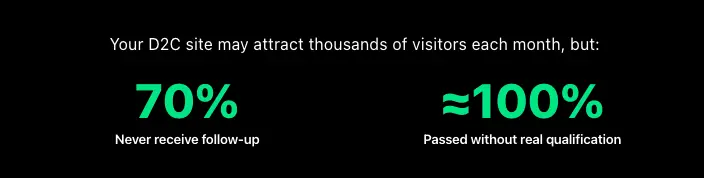
D2C sites treat a first-time visitor the same way they treat someone returning for the fifth time and comparing products. That lack of differentiation creates a simple but costly problem: high-intent visitors blend in with casual traffic.
The data reflects this:
- A majority of prospects are passed to sales without any real qualification.
- Nearly 70% never receive follow-up because no one can determine whether they’re worth pursuing.
- Conversion rates stagnate because teams spend time on low-intent conversations.
Without visibility into intent, even strong traffic cannot translate into predictable revenue.
Why Traditional Qualification Fails?
Forms Miss Intent
Static forms capture contact details and not readiness to buy. They rely on manual review and often come too late in the journey. High-intent visitors won’t wait for callbacks, and low-intent visitors submit forms with no purchase timeline.
Rule-Based Chatbots Lack Context
Most chatbots follow fixed scripts. They answer simple questions but can’t interpret behavior or conversation patterns. They treat every question with equal weight, missing the signals that separate serious buyers from passive browsers.
Signals Arrive Too Late
Brands often rely on proxies like time on site, page depth, or cart value. These indicators surface intent only after buyers have already done most of their evaluation, leaving little room for effective engagement.
The outcome is predictable: teams focus on volume, not value, and high-intent prospects move through the site without the timely interaction that could convert them.
Next, we’ll look at how conversational AI pre-qualification replaces guesswork with real-time visibility into buyer intent, long before a visitor ever reaches checkout.
How Conversational AI Transforms D2C Pre-Qualification?
Most D2C teams are still qualifying visitors with tools that were built for a slower, more linear buying journey. Forms, static scoring models, and post-hoc analytics try to infer intent after the fact. By the time the data says “this person looks serious,” the moment has usually passed.
Conversational AI pre-qualification flips that model. It doesn’t wait for a lead record or a completed form. It watches behavior as it happens, listens to what visitors actually say, and updates its assessment on the fly. Instead of reacting to past activity, it decides in real time who deserves attention and what kind of attention they should get.
Beyond Traditional Lead Scoring
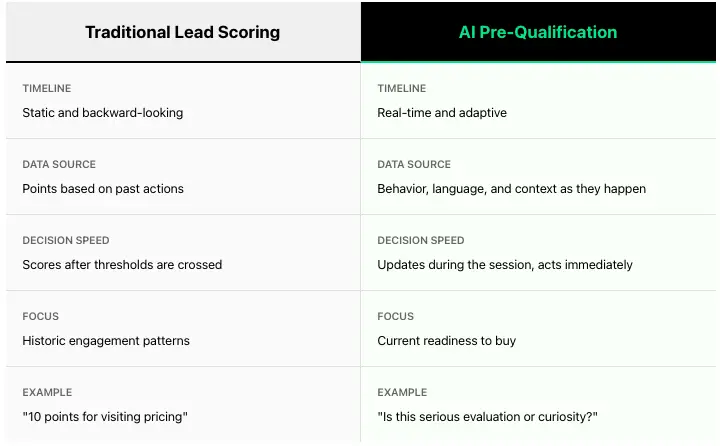
Traditional lead scoring has one big flaw: it scores people based on what they’ve already done, not what they’re doing right now. It’s fundamentally retrospective. Someone visits pricing, opens three emails, and downloads a guide, and eventually the score crosses a threshold and they’re labeled “qualified.” But in D2C, that decision window is often measured in minutes, not weeks.
Conversational AI pre-qualification works on a different timeline and a different input set:
- It runs real-time behavioral analysis instead of relying on historical aggregates. The moment someone lands on a product page, the system starts reading their navigation, scroll depth, click path, and focus areas.
- It applies intent detection through conversation patterns. Two visitors may both ask about pricing, but “Do you offer monthly billing?” is very different from “What’s included in the enterprise package, and how does it compare to X?” AI understands that those questions live in different stages of the buying journey.
- It can analyze multiple data points at once: engagement pattern, interaction depth, decision speed, return visits, and more, to build a coherent, in-session picture of intent.
Traditional scoring might award “10 points for visiting pricing.” Conversational AI asks a better question: Is this behavior part of a serious evaluation, or just curiosity? And it answers it using dozens of signals instead of one.
The Three Pillars of AI Pre-Qualification
This shift from reactive scoring to proactive, conversational AI pre-qualification rests on three core pillars: behavioral signal detection, conversational intent mining, and dynamic prioritization. Together, they give D2C brands a live view of who matters right now.
1. Behavioral Signal Detection
D2C visitors leave digital breadcrumbs throughout their sessions. The value isn’t in any single breadcrumb; it’s in the pattern.
AI looks at:
- Page visit patterns and session duration
Not just “five minutes on site,” but how those five minutes were spent. Did the visitor move logically from discovery to comparison to pricing, or did they bounce randomly across categories? - Product comparison behavior
Using comparison tools, toggling between similar SKUs, digging into spec tables or review filters, these are classic evaluation behaviors. AI flags them as stronger intent than a quick glance at a hero banner. - Price sensitivity indicators
Jumping between pricing tiers, re-checking discount pages, or only engaging with entry-level SKUs says a lot about budget fit and timeline. - Policy and logistics review
Clicking into shipping, warranty, or returns is a late-stage behavior. People don’t study return windows for things they have no intention of buying.
Rather than treating these as disconnected events, AI threads them into a narrative: Is this person moving closer to a decision or just browsing? That narrative is what powers reliable pre-qualification.
2. Conversational Intent Mining
Behavior shows what visitors do. Conversation shows why they’re doing it.
With modern NLP, AI doesn’t just match on keywords. It understands the difference between:
- “I’m just checking what this does”
- “I’m choosing between your model and [competitor] for an upgrade this month”
The first belongs to an early-stage explorer. The second belongs to someone in active decision mode.
Over time, clear patterns emerge:
- Early-stage visitors ask broad capability questions.
- Mid-stage visitors ask about fit, compatibility, and use case.
- Late-stage visitors ask about implementation, timelines, and terms.
AI watches question patterns across the conversation and uses them as strong indicators of buying stage and readiness. It can probe gently where it detects unspoken requirements (e.g., integration needs, physical constraints, or usage volume) without turning the chat into an interrogation.
The net result: the system doesn’t just answer questions; it qualifies the buyer while answering them.
3. Dynamic Prioritization
The final pillar is where the operational impact shows up: dynamic prioritization.
In a static model, a visitor gets scored once and dumped into a bucket. In reality, intent changes over the course of a single visit. Someone who arrives looking like a low-intent browser can switch into high-intent mode after comparing a few products and clarifying one or two constraints.
AI pre-qualification updates in real time:
- Scores adjust as behavior and conversation deepen. A visitor who starts with casual browsing but then begins asking price, timeline, and fit questions is treated very differently from one who stays shallow.
- Routing changes automatically. High-intent visitors are pushed into priority flows: faster responses, access to a specialist, or the option to talk to a human. Early-stage visitors stay in a lower-friction, educational path that doesn’t waste sales capacity.
- Lag disappears. There’s no “wait for the data to sync and the score to update.” The system sees the change and acts on it while the visitor is still present.
Over time, conversion outcomes feed back into the model. The AI learns which signal combinations consistently produce buyers and which are false positives. That feedback loop tightens qualification accuracy and further reduces wasted effort on non-buyers.
How Astra Detects Buying Signals and Prioritizes High-Value Prospects?

Most chatbots treat every visitor the same. Astra doesn’t. Its AI evaluates intent continuously, adapting its engagement based on what each visitor does and says.
Multi-Signal Analysis in Real Time
Astra builds a complete intent profile by combining multiple signal types as they happen:
- Behavioral: pages viewed, time spent, comparison activity, pricing checks, cart behavior
- Conversational: urgency language, question depth, clarity of requirements
- Engagement: response speed, number of exchanges, follow-up consistency
Instead of relying on isolated metrics, Astra synthesizes these signals into a dynamic intent score far more accurate than any single indicator.
Intelligent Prioritization and Routing
When intent crosses a threshold, Astra moves instantly:
- Connects high-intent visitors to the right sales reps
- Prioritizes them in response queues
- Surfaces targeted incentives only when the buyer is ready
This eliminates the typical lag where real buyers wait behind low-intent inquiries.
Context-Rich Handoffs That Keep Momentum High
If a human rep needs to step in, Astra provides complete context:
- Pages and products explored
- Questions and objections raised
- Budget or timeline hints
- Real-time intent score and reasoning
Reps skip basic qualification and go straight to consultative selling, buyers notice the difference.
Adaptive Conversation Strategies
Astra modulates its engagement based on readiness:
- High-intent: deeper guidance, comparisons, accelerated pathways to humans
- Explorers: educational content, lighter support, no pressure
- Browsers: quick, low-friction assistance without consuming sales cycles
Every visitor gets what they need without forcing everyone through the same funnel.
Continuous Learning That Improves Accuracy
Every interaction, conversion or not, feeds Astra’s models. The system learns:
- Which behaviors actually predict purchase
- Which question patterns signal readiness
- Which signals are false positives
- Which “quiet” behaviors correlate with high-value customers
Qualification becomes sharper and more precise over time.
The Core Insight
Not every visitor deserves the same attention. Astra allocates effort where it moves revenue, giving real buyers fast, informed engagement and automating support for everyone else. The result is higher conversions, shorter cycles, and a better experience across the board.
Ready to stop treating every visitor the same?
Astra shows you exactly who’s ready to buy and engages them with precision. If you want your sales team focused on real opportunities instead of guessing who to prioritize, it’s time to see Astra in action.
Get started for free or book a demo to watch Astra identify high-intent buyers on your site in real time.
Frequently Asked Questions
It evaluates three signal types at once:
Behavioral: product comparisons, pricing checks, cart activity, return visits, shipping/returns research.
Linguistic: urgency (“how fast can you ship”), budget cues (payment plans, discounts), and specific requirement questions.
Engagement: response speed, depth of questions, willingness to share context, and clear objections.
AI combines these signals into a real-time intent score and improves continuously based on conversion outcomes.
Yes. Effective systems analyze behavior passively and engage only when context makes it helpful. Conversations feel like guidance—not interrogation. Buyers volunteer details naturally, and high-intent visitors simply receive faster, more relevant support. No pressure, no aggressive qualifying.
Lead scoring is static and backward-looking: it assigns points based on past actions.
Pre-qualification is real-time and adaptive, reading behavior, language, and context as the visitor engages. It focuses on current readiness to buy, not historic engagement.
Most brands use both: AI pre-qualification for instant routing and lead scoring for longer-term nurturing.