

-

-
-
Solutions
-
Soluções
-
Soluciones
-
解决方案
-
解決方案
-
الحلول
-
Product
-
Produto
-
Producto
-
产品
-
產品
-
المنتج
-

-
-


 Wati for Marketing
 Wati for Support
 Wati for Sales
 eLearning
 E-commerce
 Marketing Agencies
 Healthcare
 No Code Chatbots
 AI Support Agent
 Instagram and Facebook messenger
 Click to WhatsApp ads
 Campaigns
 Team Inbox
 WhatsApp Business Calling
 Wati AI
 Overview
 Library
What is an AI Chatbot? Complete Business Guide for 2026
Written by:
 Musa Bhat
|
on:
November 21, 2025
|
According to: Editorial Policies
Musa Bhat
|
on:
November 21, 2025
|
According to: Editorial Policies
 Table of Contents
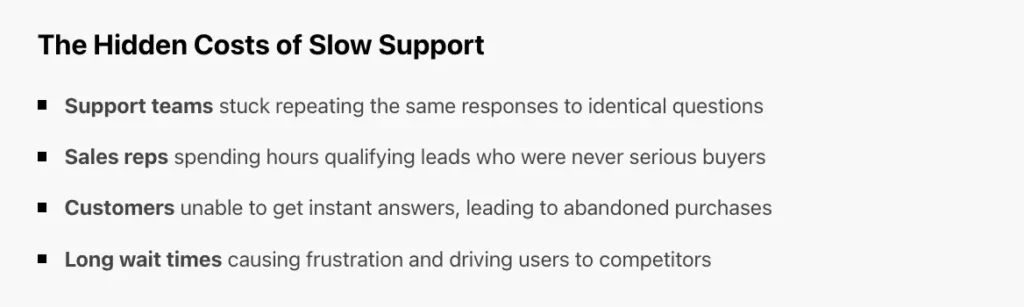
Most businesses don’t lose customers because of pricing. Tthey lose them because people can’t get answers quickly. In 2026, nearly all website visitors drop off without interacting, often because support isn’t available when questions arise. Meanwhile, your team is stuck repeating the same responses, and your sales reps spend hours qualifying leads who were never serious buyers.

That’s why AI chatbots have shifted from optional to essential. Not the rigid, rule-based bots of 2015, but modern conversational systems that understand context, learn from interactions, and deliver instant, accurate support around the clock.
This guide breaks down what AI chatbots are, how they actually work, and where they create measurable business impact. You’ll also see how platforms like Astra elevate these capabilities with smarter, real-time conversational intelligence.
What is an AI Chatbot?
An AI chatbot is software that can have human-like conversations through text or voice. Instead of relying on fixed scripts or rigid decision trees, an AI chatbot understands what a person is asking, interprets intent, and responds instantly with relevant information.
At its core, a modern AI chatbot uses three major technologies:
1. Natural Language Processing (NLP)
This allows the chatbot to understand real human language, including slang, misspellings, shorthand, and context-based meaning. NLP helps the bot grasp what the user is trying to say, not just the words they type.
2. Machine Learning (ML)
Every interaction teaches the chatbot something. Over time, it learns patterns, improves accuracy, and adjusts its responses based on what users actually mean, not what they should mean.
3. Large Language Models (LLMs)
These models generate natural, conversational responses and maintain context across longer conversations. They help the chatbot “think” more like a human, making conversations feel intuitive instead of robotic.
Modern AI chatbots handle follow-ups, understand nuances, and adapt to different tones and emotions.
Platforms like Astra take this a step further. Astra’s conversational engine is trained on real business communication patterns, so it distinguishes urgent issues from casual queries, understands industry terminology, and personalizes responses based on context. In practice, this creates support experiences that feel far more accurate and helpful from the very first interaction.
Types of AI Chatbots
Not all chatbots are built the same. Most businesses start with rule-based bots because they’re simple to deploy, but as customer expectations evolve, these systems quickly hit their limits.
1. Rule-Based Chatbots
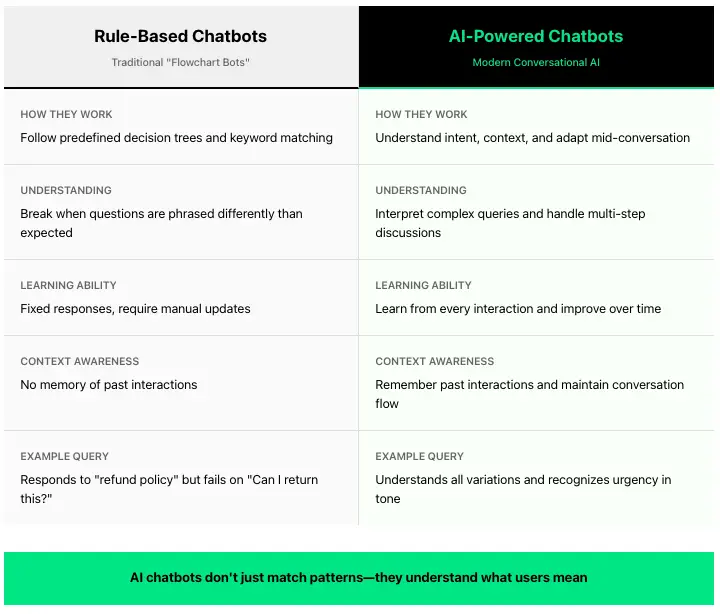
These are the traditional “flowchart bots.” They follow predefined decision trees and respond only when a query matches specific keywords. They work fine for very simple tasks like sharing store hours or directing users to a page, but they break the moment someone asks a question differently than expected.
For example: If the bot is taught to respond to “refund policy,” it may fail on:
- “Can I return this?”
- “What if the size doesn’t fit?”
- “How long do refunds take?”
Rule-based bots don’t understand context. They just match patterns.
2. AI-Powered Chatbots
These go beyond keyword matching. AI chatbots understand intent, infer meaning, remember past interactions, and adapt mid-conversation. They interpret complex queries, handle multi-step discussions, and identify emotions like urgency or frustration.
For example: When a user types, “This is urgent. I was charged twice,” an AI chatbot recognizes both the billing issue and the urgency, responds appropriately, and escalates if needed.
Platforms like Astra focus exclusively on conversational AI because users in 2025 expect natural, intelligent, frictionless interactions, not decision trees. Astra’s models even understand industry-specific terms and conversation patterns, helping businesses resolve far more queries without human support.
How AI Chatbots Actually Work?
Most people imagine AI chatbots as complicated systems, but the real magic happens in just a few milliseconds. Here’s what really happens when someone types a message into an AI chatbot.
First, the chatbot breaks the message into pieces it can make sense of. It looks for:
- Intent: What does this person want?
- Entities: What specific things are they talking about?
- Context: Have we already discussed this earlier in the conversation?
Then it checks what it knows: your product docs, pricing, FAQs, help articles, policies, and builds a response. A fresh, context-aware answer that fits the exact question.
Machine learning kicks in behind the scenes. Every conversation teaches the chatbot something: Which answers help, which confuses people, which edge cases need improvement.
Here’s how fast this happens about two seconds:
User: “Can I use this with my existing CRM?”
AI chatbot:
- Spots the intent: integration question
- Extracts the entity: CRM
- Checks knowledge: supported integrations
- Looks at context: did they mention a tool earlier?
- Generates a clear reply: “Yes, we support Salesforce, HubSpot, and Pipedrive. Which CRM are you using?”
It feels like magic, but it’s not. It’s just really good pattern recognition, training, and context handling working together to give your users instant answers.
Business Benefits of AI Chatbots
AI chatbots aren’t just a “nice upgrade.” They solve real, expensive problems that slow businesses down. Here’s what they actually deliver.
1. Immediate Cost Reduction
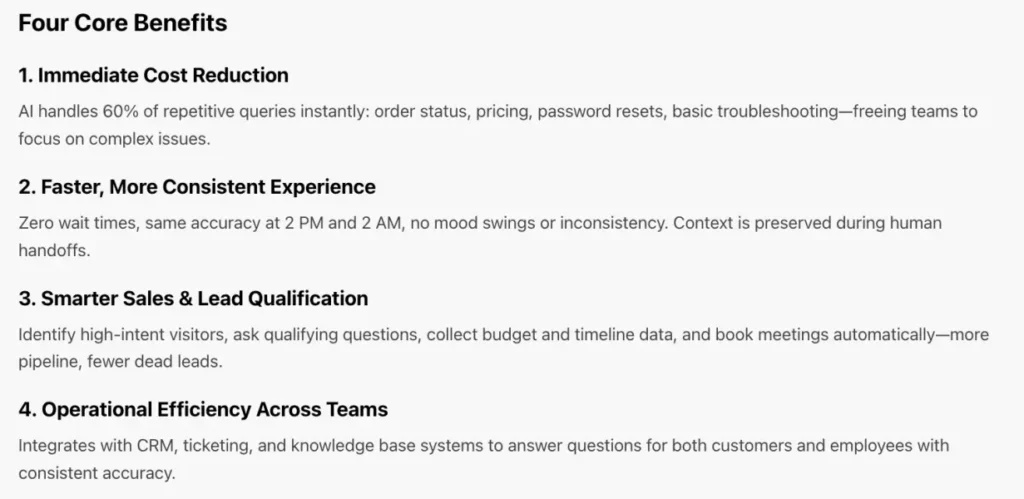
Most customer questions are repetitive: order status, pricing, password resets, basic troubleshooting—the same things asked 50 different ways. AI chatbots take over those conversations instantly and at scale.
The impact is simple math: If your support team spends 60% of their time on low-complexity queries, AI wipes out that volume. That means fewer tickets, fewer escalations, and fewer hours spent on tasks that never needed a human in the first place.
Brands using conversational AI typically see 40–60% fewer support requests hitting their human team within the first few months.
2. Faster, More Consistent Customer Experience
Customers hate waiting. They hate repeating themselves even more.
AI chatbots fix both:
- Instant responses
- Zero wait times
- Same accuracy at 2 PM and 2 AM
- No mood swings, no inconsistency
And when a question does need a human, the chatbot hands off context so the customer doesn’t have to start over—a small detail that massively improves satisfaction.
3. Smarter Sales and Lead Qualification
AI chatbots don’t just help support teams. They help sales teams avoid wasting time.
They can:
- Identify high-intent visitors
- Ask the right qualifying questions
- Collect budget, timeline, and use-case data
- Book meetings automatically
Your team only steps in when someone is genuinely ready to talk.
Result: more pipeline, fewer dead leads, and sales reps who spend time closing.
4. Operational Efficiency Across Teams
AI chatbots plug into your CRM, ticketing system, knowledge base, and product data so information is consistent everywhere.
Internally, teams use them for:
- Pulling product info
- Answering policy questions
- Retrieving documents
- Onboarding support
One system answering everyone, customers and employees, with the same accuracy.
Common Use Cases Across Industries
AI chatbots have become versatile enough to support almost every part of the customer journey, and the way businesses use them today looks very different from the early “FAQ bot” era. Most companies start with support automation, but the real value becomes clear when chatbots begin improving sales, onboarding, and even internal operations.
Customer Support and Self-Service
Support teams feel the immediate impact. AI chatbots handle high-volume, repetitive questions about orders, accounts, billing, passwords, or troubleshooting. Instead of customers waiting for an agent or navigating support pages, the chatbot provides accurate answers instantly and hands off to a human only when necessary. For complex tickets, it gathers the right details upfront, which shortens resolution time for both sides.
Sales and Lead Qualification
On the sales side, AI chatbots act as the first touchpoint for website visitors. They recognize buying signals, ask qualifying questions naturally, and surface pricing or product information in real time. When a prospect is ready to talk, the chatbot can route them to the right rep or book a meeting directly on the calendar. Businesses see fewer dropped leads and more high-intent conversations reaching the team.
E-commerce and Product Discovery
Retail and e-commerce brands rely on chatbots to guide shoppers toward the right products. Whether a customer is looking for a laptop with specific specs or a dress for a particular occasion, the chatbot narrows down options, checks inventory, and provides suggestions based on preferences and budget.
Industry-Specific Applications
AI chatbots are now embedded across sectors.
Healthcare teams use them for appointment scheduling and basic symptom guidance.
Financial services rely on them for account information, loan queries, and fraud alerts.
SaaS companies use them for onboarding, billing assistance, and technical support.
The underlying idea is the same: faster answers, fewer bottlenecks, and a better experience for customers and teams.
But Here’s What AI Chatbot Can’t Do (Yet)
AI chatbots aren’t magic. They can’t:
- Handle genuinely complex, nuanced situations that require judgment and empathy
- Make exceptions to policies (they follow rules, they don’t break them)
- Understand extremely vague or poorly articulated questions
- Read minds when someone types “help” with zero context
And honestly? That’s fine. You don’t need them to do everything. You need them to handle the 70-80% of repetitive, straightforward interactions so your humans can focus on the 20-30% that actually requires a human brain.
What to Look For in an AI Chatbot Solution?
Not all AI chatbots are created equal. Some are glorified FAQ search bars. Others are genuinely sophisticated.
Here’s what actually matters:
Integration with Your Existing Stack
If your AI chatbot can’t talk to your CRM, help desk, and e-commerce platform, you’re going to be manually copy-pasting information. That defeats the whole purpose.
Look for native integrations with the tools you actually use. Zapier connections are fine for simple stuff, but deep integrations are where the magic happens.
Customization and Training
Can you teach it about your specific business? Can you update its knowledge base when policies change? Can you adjust its tone to match your brand?
Generic AI chatbots that give generic answers won’t cut it. You need something you can mold to your business.
Handoff to Humans
The goal isn’t to replace your team—it’s to amplify them. Your AI chatbot should know when it’s in over its head and seamlessly transfer to a human. And when it does, that human should get the full context of the conversation so far.
Nothing frustrates customers more than explaining their problem twice.
Analytics and Improvement
What questions is it struggling with? What topics come up most often? Where are people getting frustrated?
Good platforms (like Astra and similar AI orchestration systems) go beyond simple chatbots. They coordinate multiple specialized agents that can handle different types of conversations while learning from every interaction. That’s the difference between a single-purpose tool and a system that grows with your business.
Ready to See What AI Can Do for Your Business?
If you’re exploring AI chatbots, the next step is simple: try one in a real environment and see how it fits your workflows. Start with a focused use case, measure the impact, and expand once you see results. Most teams realize very quickly which tasks the chatbot should own and which ones still need human attention.
Astra makes this process easier with fast setup, intuitive customization, and models trained specifically for business conversations. Whether you want to automate support, qualify leads, or improve internal efficiency, you can get a working chatbot live in days, not weeks.
If you’re ready to see it in action, book a demo or start with a free trial. The difference becomes clear fast.