

-

-
-
Solutions
-
Soluções
-
Soluciones
-
解决方案
-
解決方案
-
الحلول
-
Product
-
Produto
-
Producto
-
产品
-
產品
-
المنتج
-

-
-


 Wati for Marketing
 Wati for Support
 Wati for Sales
 eLearning
 E-commerce
 Marketing Agencies
 Healthcare
 No Code Chatbots
 WhatsApp Business API
 Instagram and Facebook messenger
 Click to WhatsApp ads
 Campaigns
 Team Inbox
 WhatsApp Business Calling
 Wati AI
 Overview
 Library
 Agente de suporte de IA

How AI is Transforming B2B Lead Generation in 2026?
Written by:
 Rohan Chaturvedi
|
Last updated on:
March 11, 2026
|
According to: Editorial Policies
Rohan Chaturvedi
|
Last updated on:
March 11, 2026
|
According to: Editorial Policies
 Table of Contents
B2B lead generation used to be a volume sport. Scrape lists, blast sequences, hope a few stuck. In 2026, that playbook breaks down fast. Buyers leave signals everywhere: web activity, product usage, hiring patterns, competitor interactions, and no human team can track or interpret all of it.
This is why AI lead generation has shifted from optional to foundational. Modern systems analyze millions of micro-behaviors in seconds, spot early buying intent, and tailor outreach automatically. What once took SDRs days now happens instantly.
A few shifts define the new reality:
- AI can predict purchase intent months before a prospect reaches out
- Personalization runs automatically across every channel
- Lead qualification accuracy is 40–50% higher than manual methods
- Speed-to-lead is measured in seconds, not hours
The teams winning today aren’t louder. They’re simply using artificial intelligence for lead generation to work smarter and move first.
Now that the shift is underway, the real question is: How exactly is AI reshaping B2B lead generation, and how can your team plug into that advantage?
What’s Broken With Traditional B2B Lead Generation?
Most B2B teams don’t have a lead-gen problem; they have a waste problem. Too much effort goes into the wrong leads, the wrong timing, or the wrong follow-ups.
The Volume vs. Quality Dilemma
Traditional systems reward volume: bigger lists, more sequences, more ads. But high volume rarely equals high intent. Reps spend hours chasing contacts who downloaded a whitepaper with no intention to buy. The result is predictable: burnout, bloated pipelines, and conversion rates that barely move.
Speed to Respond Challenges
Every study confirms the same truth: responding within minutes multiplies your conversion chances. Yet most teams still rely on humans to triage form fills and inbound emails. By the time someone replies, hours later, the prospect is already talking to a competitor or has lost momentum entirely.
How Does AI Actually Fix These Problems?
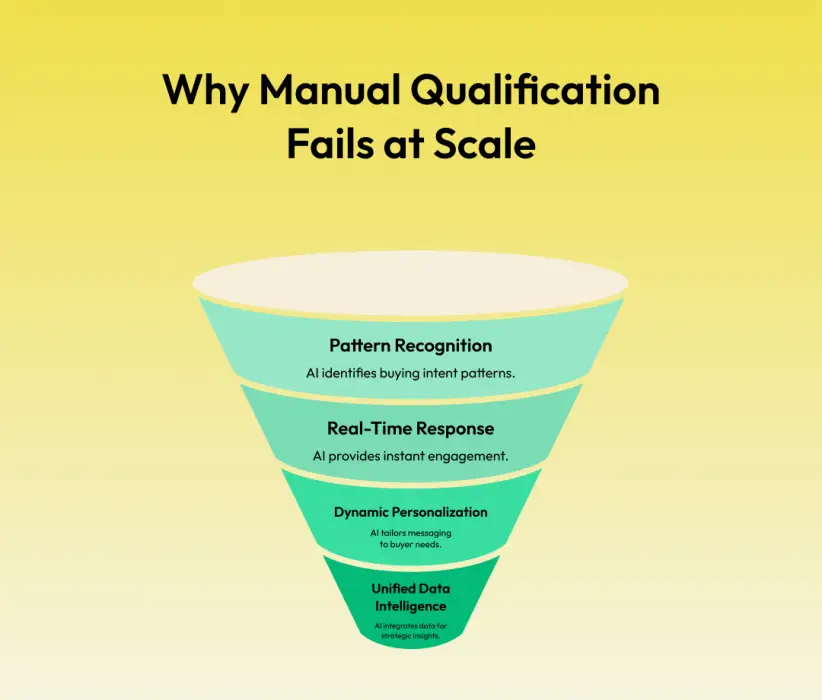
AI lead generation works because it addresses the root issues: timing, insight, and relevance.
Personalization Doesn’t Scale
B2B buyers expect tailored messaging, but manual personalization consumes too much time. Reps default to templates, marketing leans on broad personas, and the “personalization” ends up being a name merge tag. It’s not enough anymore.
Data Sits in Silos
Marketing tools track behavior. Sales tools track conversations. Success tools track adoption. None of these systems talk to each other in real time. So no one gets a complete view of the account, resulting in misaligned outreach, wrong timing, and noisy pipelines.
Traditional lead generation is expensive, slow, and inconsistent. Teams aren’t failing because the system they’re working in can’t keep up.
Pattern Recognition at Scale
Human-led scoring looks at isolated actions: a whitepaper download, one webinar registration, or a LinkedIn engagement. AI reads the buyer’s entire digital footprint. It tracks repeat pricing-page visits, depth of content consumption, sequence of actions, multi-stakeholder activity at the same account, hiring spikes, technology replacements, industry research cycles, and news events like funding or leadership changes.
Because the model compares these patterns against thousands of historical conversions, it learns what real intent looks like for your specific business. It can flag buying activity weeks, sometimes months, before a prospect makes themselves visible.
Real-Time Response Capability
The fastest teams win, but humans can’t respond instantly or 24/7. AI closes that gap. The moment someone hits a high-intent page, opens a pricing asset, or asks a qualifying question, the system reacts. It can answer basic queries, surface relevant resources, ask clarifying questions, or hand the conversation straight to a rep.
This eliminates the handoff delay that kills pipelines. The prospect stays engaged at the moment their intent is highest.
A Dynamic Personalization Engine
Artificial intelligence lead generation doesn’t rely on canned messaging. It adapts tone, content, cadence, and channel based on real buyer behavior. A CFO researching cost-efficiency gets ROI framing. A CTO reading integration docs receives technical depth. A VP of Sales returning to the pricing page sees proof points tied to revenue lift.
The personalization is invisible but precise. Buyers feel like the outreach understands their priorities without reps spending hours tailoring messages manually.
Unified Data Intelligence
The strongest advantage is behind the scenes. AI stitches together CRM activity, marketing behavior, conversation intelligence data, product usage signals, enrichment sources, and third-party intent data. Instead of fragmented tools each telling a different story, teams get a unified view of which accounts are heating up and why.
This makes outbound more strategic, inbound more qualified, and follow-up more relevant. Every decision is informed by reality.
Which AI Lead Generation Capabilities Matter Most?
Not all AI features move the needle. The systems that actually improve pipeline quality share four core capabilities. Together, they form the foundation of modern AI lead generation and determine whether your investment will deliver meaningful lift or become another unused tool in the stack.
Intent Scoring and Prediction
This is the engine that separates artificial intelligence lead generation from old-school scoring. Instead of assigning points for job title or company size, AI evaluates hundreds of signals simultaneously: content depth, multi-visitor activity from the same account, pricing-page behavior, hiring trends, funding events, product research patterns, and technographic changes.
Every new deal, won or lost, sharpens the model. It learns which patterns consistently precede a purchase and which ones rarely matter. Instead of your team guessing who might be a good fit, the system surfaces accounts that are actually moving into an active buying cycle. Prioritization becomes grounded in probability, not assumptions.
Conversational Intelligence
Today’s buyers don’t wait. They want clarity the moment they show intent. Conversational AI handles that demand across chat, in-app messages, and even early qualification flows. It can answer questions, route prospects, and gather context before a rep steps in.
Beyond real-time conversations, it listens to sales calls and extracts information humans would otherwise forget to capture: recurring objections, competitor mentions, buying criteria, urgency cues, and sentiment shifts. These insights automatically refine scoring models and messaging frameworks. Nothing gets lost in a call log.
Automated Enrichment
Manual research is one of the biggest hidden drains in lead generation. AI removes it completely. As soon as a lead enters your system, through form fill, chatbot, or outbound, AI enriches it with the details reps need: company size, revenue, tech stack, hiring velocity, recent news, funding updates, and known decision-makers.
It also maps the buying committee automatically. Instead of guessing who else is involved, reps get a ready-made hierarchy of influencers, users, blockers, and signers. Outreach becomes context-rich from day one.
Multi-Channel Orchestration
Rigid sequences don’t reflect how real buyers behave. AI adjusts touchpoints dynamically. If a prospect engages heavily on LinkedIn, the system leans on social. If another responds to late-evening emails, cadence timing shifts. If pricing content triggers interest, the next step becomes ROI framing.
The system doesn’t just choose channels; it coordinates them. Email, chat, LinkedIn, phone, retargeting, and nurture workflows move together based on actual behavior, not a predefined calendar.
Challenges of AI Lead Generation
Even the strongest AI lead generation systems come with operational realities. Teams that plan for them early see faster rollouts and fewer surprises.
Data Quality Requirements
AI models rely on clean, consistent information. If your CRM is filled with duplicates, missing contacts, outdated firmographics, or inconsistent activity logs, predictive accuracy drops immediately. Most companies need a basic cleanup: standardized fields, deduplication, and updated account hierarchies, before AI recommendations are reliable.
Integration Complexity
AI shines only when it can access every relevant signal. That means bringing together your CRM, marketing automation system, enrichment tools, call intelligence platform, and analytics stack. The technology can handle it; the challenge is ensuring your internal systems are ready. Clear ownership, IT coordination, and a phased integration plan prevent slowdowns.
Privacy and Compliance
Regulations like GDPR, CCPA, and newer regional privacy laws influence how AI collects, processes, and stores data. You need compliant consent flows, defined retention windows, audit-friendly documentation, and transparent communication around automated decision-making. Companies that ignore this face legal risk and customer trust issues.
Team Adoption Curve
AI changes how sellers work. Reps must learn to interpret intent scores, adjust outreach based on model insights, and trust prioritization logic over intuition. Managers must shift from manual reporting to insight-driven coaching. Without a structured enablement plan, adoption lags and performance gains stall.
Why Addressing These Early Matters?
Organizations that invest a few weeks upfront in cleanup, integration readiness, compliance checks, and team training see smoother deployments and stronger long-term ROI. Those that skip these steps often end up blaming the AI when the real issue is lack of operational readiness.
How Do You Measure AI Lead Generation Success?
Strong AI lead generation programs are measured through early signals, qualification accuracy, and long-term revenue impact.
Leading Indicators to Track
These are the first signs your system is working:
- Increase in predicted-intent accounts entering active cycles
- Faster first-touch responses across inbound channels
- More qualified conversations reaching your sales team
- A noticeable decline in manual research and data entry
If these indicators don’t move within the first 60–90 days, the model may need tuning or your data foundation needs work.
Quality vs Quantity Metrics
AI lead generation should compress volume and expand accuracy. The goal is better leads.
Key metrics to monitor:
- SAL and SQL acceptance rates
- Opportunity creation rate by intent level
- Conversion rates segmented by predicted intent tier
If overall lead volume drops while qualification improves, the system is doing its job.
ROI Calculation Method
The simplest formula is: (Revenue lift + time saved) – AI costs
Time savings usually represent 40–60% of the total ROI because AI cuts hours of manual research, enrichment, qualification, and follow-up tasks every week. Teams should quantify this monthly.
Realistic Timeline Expectations
AI compounds over time. A healthy rollout looks like:
- Months 1–2: Setup, integrations, data alignment
- Months 3–4: Faster responses, cleaner qualification
- Months 5–6: Noticeable improvements in conversion and pipeline velocity
- Month 12: Clear revenue impact supported by historical data
AI lead generation isn’t instant. The gains build steadily as models learn, pipelines strengthen, and teams adapt.
Should You Build, Buy, or Wait?
AI isn’t a default upgrade for every team. It delivers the strongest results when your pipeline depends on speed, consistency, and timely insight. If your buyers research quietly and expect fast, relevant follow-up, AI becomes a force multiplier almost immediately.
When AI Makes Sense
Teams handling high lead volume, multi-role buying committees, or tightly timed sales cycles see value quickly. These motions benefit the most because timing and relevance directly influence conversion.
When it Doesn’t
If your lead flow is small, your sales cycle is short, or your data quality is inconsistent, the lift will be modest. AI models rely on meaningful patterns. When the signals are thin or scattered, the impact shrinks.
Vendor vs Custom Considerations
Custom AI sounds appealing but demands engineering support, structured datasets, frequent retraining, and ongoing security oversight. Most companies don’t need that level of ownership. Vendor platforms typically provide faster time-to-value, predictable costs, and far less operational overhead.
A Practical Minimum Viable Approach
The most efficient starting point is simple:
- Predictive intent scoring
- Automated enrichment
- Conversational AI for inbound qualification
These three components create visible wins in weeks. Once the foundation is stable, expanding into multi-channel orchestration or outbound automation becomes a low-risk next step.
This is the point where companies stop “experimenting with AI” and start running an AI lead generation engine that compounds.
Get started for free with Astra or book a demo to see how AI-powered lead generation is transforming B2B sales pipelines right now.
FAQs
AI lead generation uses artificial intelligence technologies like machine learning, predictive analytics, and natural language processing to identify, qualify, and engage potential customers automatically. Unlike traditional methods that rely on manual research and generic outreach, AI analyzes thousands of data points to predict which prospects are most likely to convert, personalizes messaging at scale, and automates repetitive tasks—resulting in 40-50% higher conversion rates and 50-60% time savings.
Traditional lead generation relies on manual research, static forms, generic email sequences, and basic demographic targeting. AI-powered lead generation uses predictive analytics to identify high-intent prospects before they engage, automatically enriches lead data, personalizes every touchpoint based on behavior and preferences, scores leads with 85-90% accuracy, and adapts strategies in real-time. For example, traditional methods might treat all website visitors the same, while AI identifies visitors from target accounts and triggers personalized engagement instantly.
AI improves lead quality by analyzing behavioral signals, firmographic data, technographic information, and historical patterns to predict buying intent with remarkable accuracy. Instead of relying on surface-level criteria like job title, AI considers hundreds of factors including content engagement, website behavior, buying committee composition, and timing signals. This results in sales teams spending time on leads that are 3-5x more likely to convert, reducing wasted effort on unqualified prospects and improving conversion rates by 40-50%.
The core AI technologies include predictive analytics and machine learning for lead scoring and forecasting, natural language processing (NLP) for personalized content creation and conversation analysis, computer vision for social intelligence and visual content analysis, intent data algorithms that track buying signals across the web, and automation engines that orchestrate multi-channel campaigns. These technologies work together to identify prospects, understand their needs, predict behavior, and engage them with the right message at the right time.
Most B2B companies see 400-800% ROI within the first year of implementing AI lead generation tools. Typical results include 30-40% reduction in cost per lead, 40-50% improvement in lead-to-opportunity conversion rates, 50-60% time savings on manual tasks, 20-30% shorter sales cycles, and 10-20% increase in average deal size. Companies usually reach break-even within 4-6 months as efficiency gains and improved conversion rates offset the initial investment in AI tools and implementation.