

-

-
-
Solutions
-
Soluções
-
Soluciones
-
解决方案
-
解決方案
-
الحلول
-
Product
-
Produto
-
Producto
-
产品
-
產品
-
المنتج
-

-
-


 Wati for Marketing
 Wati for Support
 Wati for Sales
 eLearning
 E-commerce
 Marketing Agencies
 Healthcare
 No Code Chatbots
 WhatsApp Business API
 Instagram Automation
 Click to WhatsApp ads
 Campaigns
 Team Inbox
 WhatsApp Business Calling
 Wati AI
 Overview
 Library
 Agente de suporte de IA
Voice AI Agents vs. Chatbots: Which Works Better for Customer Engagement?
Written by:
 Rohan Chaturvedi
|
Last updated on:
March 11, 2026
|
According to: Editorial Policies
Rohan Chaturvedi
|
Last updated on:
March 11, 2026
|
According to: Editorial Policies
 Table of Contents
Customer expectations moved faster than most support stacks did. People now want instant answers, context-aware help, and a conversation that sounds human.
That’s where the choice between voice AI agents and chatbots gets real. Voice AI brings empathy, tone, and natural flow. Chatbots deliver reach, consistency, and scale. Both work, until they don’t.
With 73% of customers expecting companies to understand their needs, choosing between voice AI vs chatbots, is a financial decision. This guide cuts through the hype with data, benchmarks, and real outcomes so you can decide when to lead with voice AI, when to rely on chat, and when a hybrid model drives the best engagement.
What are Voice AI Agents?
Voice AI agents are the natural evolution of automated conversations. Instead of forcing people through robotic menus or scripted responses, they use AI-driven speech recognition and natural language understanding to hold real, human-like interactions.
They pick up intent, tone, and emotion — not just words. They remember context from past interactions, ask clarifying questions, and adapt to how customers actually speak. Over time, they learn and improve, just like a seasoned support rep.
Modern systems like Astra’s Voice AI take it further. They combine deep learning with business logic, so your voice agent resolves instead of just “responding”. It can route calls, qualify leads, troubleshoot issues, or complete transactions, all without losing the human touch.

Voice AI fits best where nuance matters: customers explaining complex issues, making high-value decisions, or needing reassurance that someone’s really listening.
What Are Chatbots (and How They’re Different)
Chatbots are the other half of conversational AI—the text-based engines behind website chat widgets, WhatsApp messages, and in-app conversations. They’ve evolved far beyond keyword triggers.
Modern chatbots can interpret natural language, access CRM data, share images or links, and hand off to human agents when needed. With tools like Astra’s unified AI layer, chatbots now operate as part of a connected system, managing thousands of conversations simultaneously while keeping context intact across channels.
Chatbots excel in scale, speed, and accessibility. They’re always on, handle multiple languages, and work flawlessly even with limited connectivity. They’re ideal for high-volume use cases like FAQs, lead capture, or onboarding.
In essence, Voice AI listens and empathizes. Chatbots guide and execute.
Voice AI vs. Chatbots: The Real Comparison
Voice AI and chatbots each offer unique advantages in customer engagement, with their real-world performance shaped by the conversation’s complexity and user needs. Here’s how they differ, supported by concrete examples and industry benchmarks.
1. User Experience and Engagement
Voice AI shines in emotionally charged or high-stakes conversations.
Banks like HSBC use it to detect stress in caller tone — helping agents prioritize urgent cases like fraud or account freezes. Retailers such as Falabella rely on voice assistants to manage delivery queries in multiple languages, adapting tone based on frustration or satisfaction.
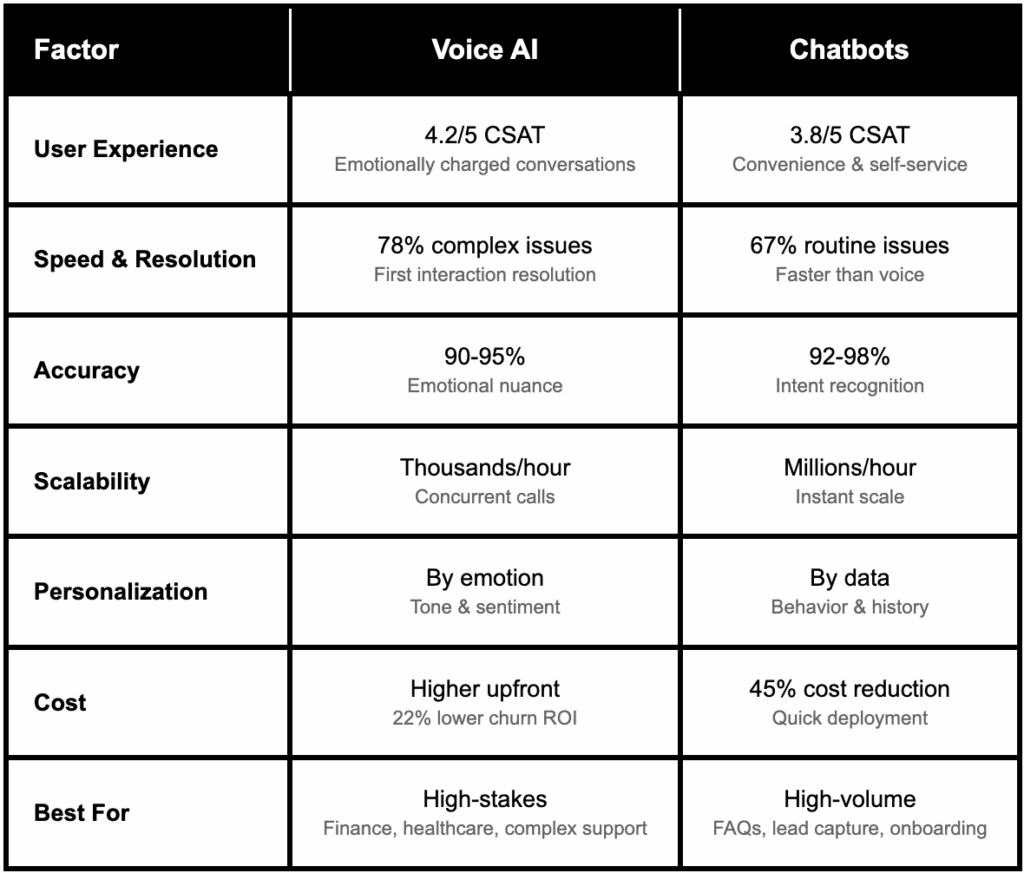
That’s why voice AI averages 4.2/5 in CSAT, compared to 3.8/5 for chatbots. It listens, reacts, and builds trust.
Chatbots, on the other hand, dominate convenience. Airlines like Lufthansa let travelers reschedule flights or retrieve boarding passes in-thread. Retailers such as Zalando use chatbots for instant returns and order tracking, perfect for customers multitasking on the go.
When both work together: chat handling triage and voice taking over for emotional or complex issues, satisfaction peaks at 4.5/5.
Verdict: Voice AI for empathy and nuance. Chatbots for speed and self-service.
2. Speed and Getting Things Done
Chatbots are built for instant wins. They resolve 67% of routine issues faster than voice, perfect for high-volume environments like telecom or banking, where customers just want a quick status update or billing clarification. Vodafone and ICICI Bank both report major time savings with chat-based automation.
Voice AI shines in the messy, layered stuff. It handles 78% of complex issues: insurance claims, technical troubleshooting, loan discussions, in the first interaction. Companies like Telstra use it to guide customers through multi-step billing support in under five minutes.
Teams using both cut total handle times by 41% because customers never wait for the “right” channel as the system routes them instantly.
Verdict: Chatbots for rapid resolution; voice AI for layered problem-solving.
3. Accuracy and Understanding
Voice AI has evolved fast. Top enterprise systems now reach 95%+ accuracy, even across accents or dialects, when background noise is managed. Orange in Europe uses it to handle multilingual support, maintaining high precision in real-time calls.
Chatbots still edge ahead in pure consistency — they achieve 92–98% intent recognition with no risk of misheard audio. Platforms like Booking.com or H&M leverage chat AI to interpret slang, typos, and multilingual queries seamlessly.
Verdict: Chatbots edge ahead for reliability; voice AI leads in emotional nuance.
4. Handling Volume
Voice AI demands more computing power, but cloud-based providers like BT Group can now manage thousands of concurrent voice calls with near-human fluency.
Chatbots scale instantly. Platforms such as WhatsApp and Facebook (now Meta) Messenger power millions of automated conversations every hour, giving enterprises unmatched reach at low cost.
Verdict: Chatbots for massive scale; voice AI for one-to-one engagement depth.
5. Personalization
Both personalize well — just differently.
For instance, in the US, telecom chatbots recommend plan upgrades based on browsing and account history. In APAC, voice agents adjust recommendations and tone mid-conversation, even offering personalized payment plans based on emotional cues.
Verdict: Voice AI personalizes by emotion; chatbots personalize by data.
6. Cost and Setup
Voice AI requires a heavier setup: training data, integration with telephony, and sentiment calibration, but it pays off. Financial services brands like American Express report 22% lower churn after implementing AI-powered voice engagement because customers feel genuinely heard.
Chatbots win on scalability and cost. They can cut support expenses by 45% and deploy in weeks with minimal dev time. That’s why retailers like IKEA and Asian fintech companies roll them out first.
Verdict: Chatbots for cost-efficiency. Voice AI for long-term CX value.
7. Integration and Tech Requirements
Voice AI integrates deeply with CRMs, contact-center systems, and analytics platforms to unify voice interactions under a single data layer.
Chatbots are easier to embed across websites, mobile apps, and social channels—ideal for omnichannel accessibility.
Verdict: Chatbots for quick deployment; voice AI for unified customer intelligence.
When to Use Voice AI vs. Chatbots
Choosing between voice and chat isn’t about preference but context. The right fit depends on what your customers need and how complex the conversation is.
Use Voice AI When:
- Conversations are emotionally charged or high-stakes — e.g., finance, healthcare, or support escalations.
- You need hands-free interactions for mobile-first or accessibility use cases.
- Queries involve multi-step reasoning or troubleshooting that benefits from back-and-forth dialogue.
- Customer experience and brand tone are top priorities. Voice builds trust faster than text.
For example: A lending platform uses voice AI for loan negotiations, cutting call times by 30% while improving retention by 20%.
Use Chatbots When:
- You’re handling high-volume, repetitive questions (order status, password resets, FAQs).
- Customers expect instant responses — retail, travel, or telecom.
- You need low-cost scalability with multilingual, 24/7 coverage.
- Visual assets (links, receipts, screenshots) help explain answers better than speech.
For example: A SaaS company uses chatbots for lead qualification, boosting demo bookings by 150% while halving SDR workload.
Use Both When:
- You want speed and empathy in one flow — chat for triage, voice for resolution.
- Your audience spans time zones or device types.
- You’re aiming for maximum CSAT and conversion lift (4.5/5 satisfaction, +35% AOV in hybrid setups).
For example: Astra customers pair chat and voice AI for global onboarding: leads qualify in minutes, convert in hours, and stay loyal longer.
The Smart Approach: Use Both
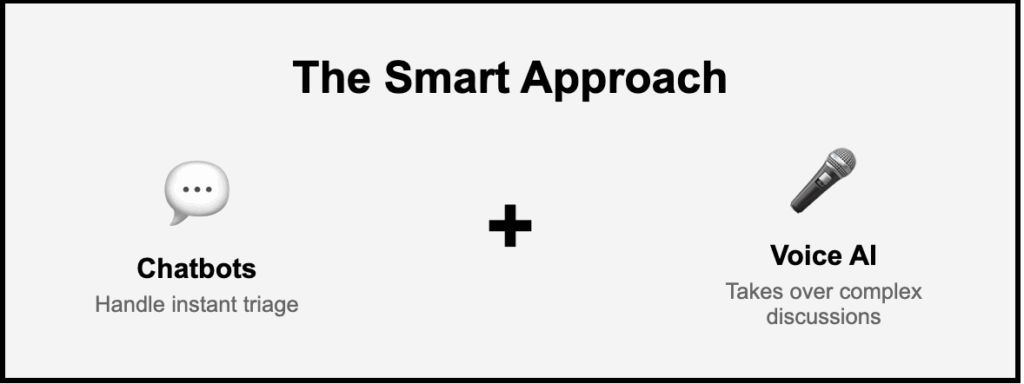
The best customer experiences don’t force a choice between voice AI and chatbots; they combine both in one seamless flow.
When chat handles instant triage and voice takes over for complex discussions, customers get the best of both worlds: speed and empathy. Businesses see the difference in their numbers: 4.5/5 CSAT, 35% higher order values, and 41% faster resolution times on average.
Hybrid setups also improve operational efficiency. Chatbots filter low-value queries; voice agents deepen high-value relationships. Together, they create a scalable, emotionally intelligent system that grows with every interaction.
| Hybrid in Action: Astra’s Edge A global SaaS company using Astra’s unified voice + chat AI cut its average response time from 18 minutes to 6, doubled lead qualification efficiency, and improved retention by 22%. Customers now move from first contact to resolution in a single, context-aware thread, without ever repeating themselves. |
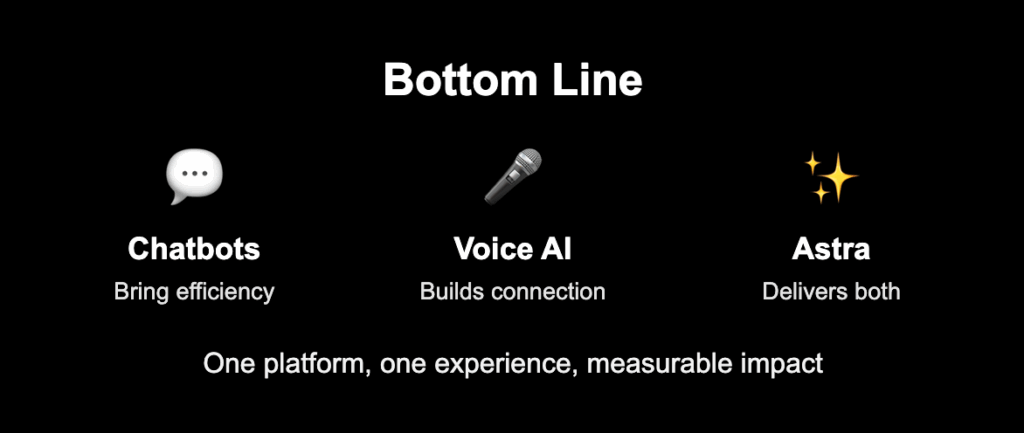
Bottom line:
- Chatbots bring efficiency.
- Voice AI builds connection.
- Astra delivers both: one platform, one experience, measurable impact.
Book a demo to see Astra in action
Frequently Asked Questions
Yes. Voice AI generally has higher upfront and operating costs because it relies on advanced speech recognition and processing power. But the cost gap is shrinking as cloud infrastructure becomes more efficient.
For businesses managing complex or high-value interactions, the ROI justifies the spend: voice AI reduces churn by up to 22% and drives stronger retention than text-only systems.
Chatbots usually get higher accuracy rates because they don’t deal with audio processing issues. Modern chatbots can hit 95%+ intent recognition accuracy, while voice AI systems typically achieve 90-95% in good conditions. However, voice AI is better at understanding context and emotional nuance that text systems might miss.
Absolutely. The best setups use both technologies strategically, sending customers to the most appropriate channel based on their needs, preferences, and question complexity. Modern platforms like Wati’s Astra keep conversation context across channels, so customers get smooth experiences no matter how they choose to interact.