

-

-
-
Solutions
-
Soluções
-
Soluciones
-
解决方案
-
解決方案
-
الحلول
-
Product
-
Produto
-
Producto
-
产品
-
產品
-
المنتج
-

-
-


 Wati for Marketing
 Wati for Support
 Wati for Sales
 eLearning
 E-commerce
 Marketing Agencies
 Healthcare
 No Code Chatbots
 WhatsApp Business API
 Instagram Automation
 Click to WhatsApp ads
 Campaigns
 Team Inbox
 WhatsApp Business Calling
 Wati AI
 Overview
 Library
 Agente de suporte de IA
Customer Journey Analytics: Easiest Analysis Framework
Written by:
 Shreya
|
Last updated on:
February 27, 2026
|
Fact Checked by :
Shreya
|
Last updated on:
February 27, 2026
|
Fact Checked by :
 Namitha Sudhakar
|
According to: Editorial Policies
Namitha Sudhakar
|
According to: Editorial Policies
 Table of Contents
Too Long? Read This First
- Customer Journeys Need Clarity: Users switch between ads, websites, WhatsApp, and email. You need one timeline to understand their movement and intent.
- Behaviour Beats Assumptions: Real actions show where people drop off, what they revisit, and what drives them to convert.
- Unified Data Removes Blind Spots: Connecting CRM, website, chat, and support data gives your team a complete view of every touchpoint.
- Analytics Improves Outcomes: Funnels, cohorts, and drop-off insights help you fix friction, speed up replies, and personalise communication.
- AI Pushes Journeys Forward: Intent prediction, dynamic routing, and behaviour-based triggers help teams act at the right moment.
- WhatsApp Journeys Need Visibility: Wati tracks templates, broadcasts, flows, and chats so you understand real intent across WhatsApp.
The secret of successful WhatsApp marketing isn’t pushing sales, but nurturing the customer throughout their purchase journey.
Whether your customer clicked an ad, navigated a website, or opened WhatsApp, your job is to evaluate these consumer journey analytics and decide the next course of action.
With customer journey analytics, you can improve your future WhatsApp marketing campaigns, better serve consumers when they’re stuck, and automate messaging with greater accuracy.
Customer Journey Analytics connects every click and conversation into a single, actionable timeline.
You can track customer journey analytics via ROI dashboards to learn which campaigns worked in your favor or which didn’t.
What is Customer Journey Analytics?
Customer journey analytics is the process of tracking and integrating customer behaviour across every digital and offline touchpoint, including websites, mobile apps, WhatsApp, CRMs, and support helpdesks, into a unified timeline.
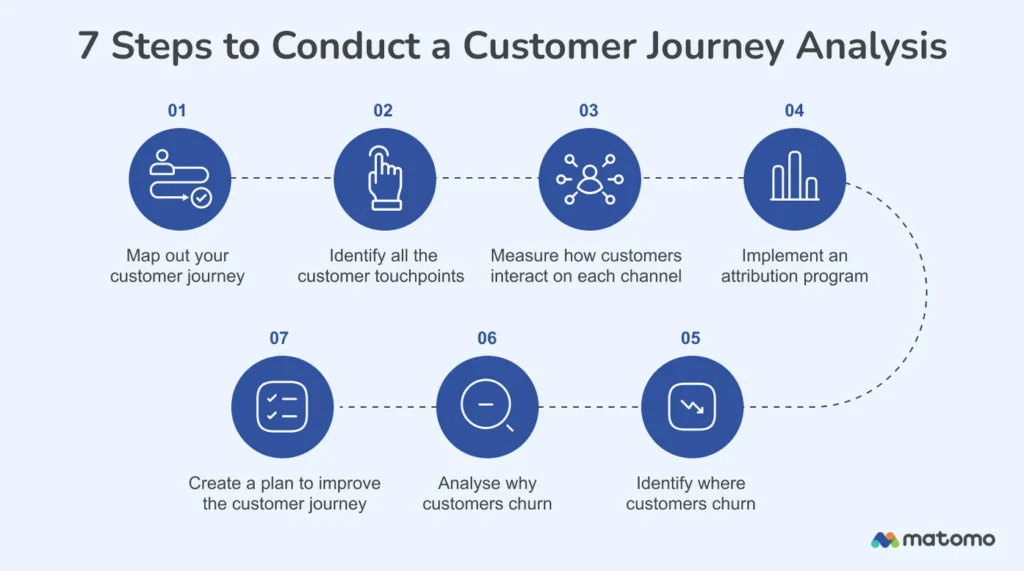
Unlike traditional analytics, which show what happened (e.g., 100 people bounced), customer journey analytics explains why it happens by connecting the dots across channels.
- Which specific channels drive high-intent leads?
- Where is the friction causing customers to drop off?
- How does a WhatsApp conversation influence a website purchase?
- What customer behaviour has churn possibility?
This gives your team a clear, real-time view of behaviour instead of isolated dashboards.
Why do Brands Lose Track of Customer Behaviour?
Most businesses see data in silos. They see a “website visitor” or a “WhatsApp lead”, but they do not realise that it’s the same person. This lack of visibility leads to slow replies, redundant questions, and lost revenue.
1. Website Signals Made By a Potential Buyer
When users land on your website, they poke around product pages, scroll a bit, and decide whether to stay or bounce.
Average time on page and bounce rates are other metrics that indicate buyer behaviour. Using data from tools like Google Analytics can also help you track engagement and expand your presence across the most standout pages.
If someone viewed your pricing page twice but didn’t buy, that’s a warm lead with zero follow-up.
2. WhatsApp Lead Management
This is real, high-intent engagement. But brands often fail to capture the source campaign, user intent, or the journey that led them there. A visitor clicks a CTWA ad, asks “Is COD available?”, and your team just answers, without tagging that lead to the campaign they came from.
3. Instagram Shoppers Clicking on Ads
On Instagram, users watch your reel, like your post, or swipe through your stories. However, brands rarely trace these micro-interactions back to future purchases.
Example: Someone watches a product demo reel today, and buys three days later, but you never know, Instagram played a role.
Learn about Instagram automation and how it enables fast lead generation for brands.
4. Search Engine High-intent Repeat Traffic
People Google you to compare prices, check availability, or read reviews.
Brands usually see the first click, but miss the return visits, which are often a strong buying signal. Example: A user searching “your brand + discount” twice in a week is basically raising their hand, but no system captures that interest.
5. Checkout Behaviour Signaling Customer’s Interest
At checkout, users drop off for tiny reasons, confusion, delivery doubts, and payment issues.
What brands miss: there’s rarely a follow-up trigger, even though this is the strongest buying intent. Imagine a user abandons the cart after entering their address, and the brand doesn’t send a WhatsApp message: “Need help completing your order?”
Also read: 20+ WhatsApp API templates to trigger relevant messages and provide a timely experience to customers.
| Channel | What Users Do | What Brands Usually Miss (The Gap) |
| Website | Browsing specific pricing/feature pages. | Silent Intent: High scroll depth on a pricing page is a warm lead, yet most brands let them bounce without a follow-up. |
| Asking specific questions (e.g., “Is COD available?”). | Attribution: Brands answer the question but fail to link the query to the specific ad campaign that triggered it. | |
| Engaging with Reels or Stories. | Micro-Interactions: A user may watch a demo today and buy in three days; without customer journey analytics, Instagram gets zero credit for the sale. | |
| Search | Comparing prices or reading reviews. | Retention Signals: A user searching “Brand Name + Discount” twice in a week is a “hand-raiser” ready to close. |
| Checkout | Abandoning the cart at the final step. | Friction Points: Missing the chance to send a real-time WhatsApp nudge to resolve payment or delivery doubts. |
Customer journey analytics brings all these actions into a single timeline so you can understand what people do, why they stop, and what moves them forward.
| Example: Someone sees your Meta ad at 10.32 AM, clicks to WhatsApp, asks for product details, visits your website at 11.05 AM, compares two products, and places a COD order at 11.16 AM. Customer journey analytics shows this entire sequence with timestamps, sources, and actions. |
You understand what users do, where they hesitate, and what helps them complete the next step.
How to Turn Consumer Journey Analytics into Real-time ROI?
To really derive ROI from consumer journey analytics, you need to evaluate consumer metrics based on consumer behaviour.
To get the most ROI, you need to focus on these 4 key action areas:
- Fix onboarding gaps: Identify where new users stall. If users drop off after signing up but before their first “aha!” moment, trigger a personalized WhatsApp guide or a tutorial video to pull them back in.
- High-velocity conversion tracking: Stop treating all traffic the same. Use customer journey analytics to identify “Fast-Track” users, those who move from an ad to a product page in under 60 seconds, and route them to a live sales agent on WhatsApp immediately.
- Proactive customer support: By seeing a user’s entire history (past orders, website clicks, and previous chats) before you even reply, your support team can provide “context-aware” help, leading to high chances of conversion.
- Behavioral retention: Do not send “we miss you” emails. Use “segmentation” to identify customers who left midway. Trigger personalized a WhatsApp campaign to convert them better.
How does Customer Journey Analytics Make a Difference?
As per the industry data,
- 70.22 % of online shoppers abandon their carts (Baymard Institute)
- 79% of consumers expect consistent interactions across channels (Salesforce)
- 73% percent say experience influences buying decisions (PwC)
- 60% stop engaging with a brand after poor service(Microsoft)
Customer journey analytics helps you fix these gaps by showing the complete path. You see what users do, where they stop, and what actions improve their experience.
It helps teams zoom into the customer interaction patterns, lead sources, and traffic behaviour to improve conversions. Utilizing customer insights can help speed up replies, personalize future messages, and eliminate any roadblocks in the purchase journey.
Understanding and quantifying WhatsApp interactions helps build accurate future funnels and predict next steps in your campaign.
When you understand the whole journey, you make better decisions at every stage.
Customer Journey Analytics vs. Customer Journey Mapping: Key Differences to Remember
Customer journeys involve both planning and measurement. Teams often confuse journey mapping and journey analytics, but they solve different problems.
Mapping helps you outline how you want customers to move through each stage. Analytics shows how they actually move. When you combine both, you design better experiences and improve them with real data.
| Aspect | Customer Journey Mapping | Customer Journey Analytics |
| Purpose | Creates a planned view of the ideal experience | Tracks real behaviour across channels |
| Usage | Workshops, planning, alignment | Daily decisions, optimisation, reporting |
| Output | Visual flow or diagram | Dashboards, funnels, cohorts, timelines |
| Focus | Expectations, emotions, touchpoints | Actions, drop-offs, patterns, outcomes |
| Strength | Helps teams design better experiences | Helps teams improve experiences based on data |
| Best Used For | Identifying opportunities and planning improvements | Validating assumptions and fixing friction |
Mapping sets your plan. Analytics show if the plan works. When both align, your teams make faster decisions, improve key moments, and reduce friction across the entire journey.
How Customer Journey Analytics Works?
Customer journey analytics (CJA) serves as a “single source of truth,” connecting fragmented data from every touchpoint into a single continuous timeline.
Removing the silos between marketing, sales, and support, it allows you to see exactly how customers move across your entire ecosystem.
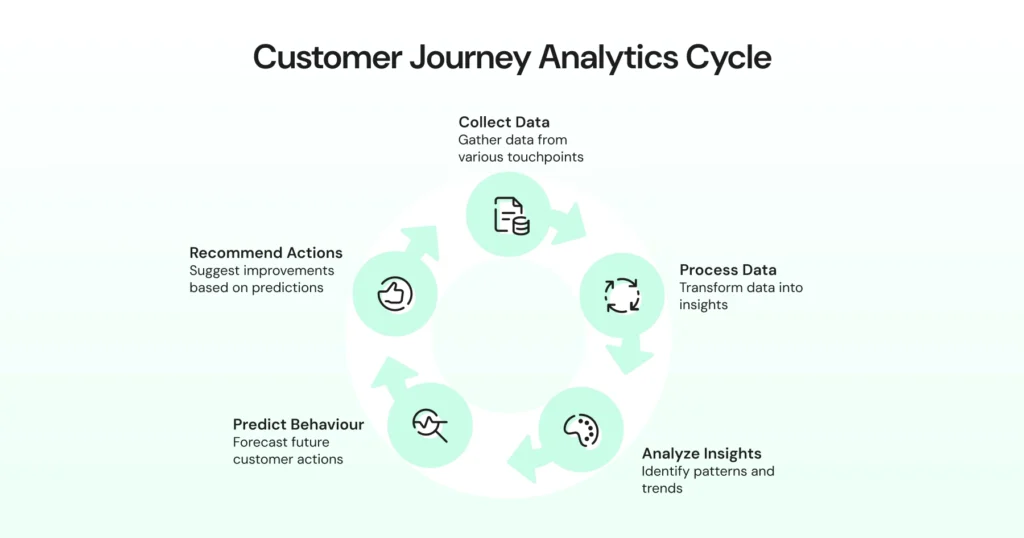
Phase 1: Data Integration (The Inputs)
You can pull real-time events from various sources to build a comprehensive map of user activity:
- Conversational Data: WhatsApp chats, message responses, and WhatsApp Calling logs.
- Web & App Behavior: Page views, button clicks, scroll depth, and product feature usage.
- Marketing & Ads: Click-to-WhatsApp ad sources, email opens, and SMS engagement.
- Sales & Support Records: CRM lead status, past purchase history, and support ticket resolution times.
- Offline Touchpoints: Data from POS systems or retail interactions.
Phase 2: Intelligence & Visualization (The Outputs)
Once the data is connected, the software processes it into actionable insights using AI and behavioral modeling:
- Unified Customer Profiles: Every interaction is stitched to a single identity, so you recognize the same user whether they are on your website or in a Wati chat.
- Visual Conversion Funnels: Maps the path from start to finish, highlighting exactly where “drop-off” points are slowing down your revenue.
- Friction Identification: Automatically flags hurdles in the onboarding or checkout process that cause users to abandon their journey.
- Predictive Intent: Uses tools like Wati AI to predict what a customer is likely to do next, allowing you to trigger a proactive “nudge” before they leave.
- Behavioral Cohorts: Groups users by their actions (e.g., “Frequent Browsers” vs. “One-Time Buyers”) to help you create better campaigning strategies.
This results in a single, living timeline that replaces scattered dashboards.
Instead of seeing isolated metrics, you see the story of your customer: where they start, why they pause, and exactly what moves them toward a final sale.
What are the Key Benefits of Customer Journey Analytics?
Implementing journey analytics allows your team to move beyond static reporting to a dynamic, high-growth strategy. By synthesizing cross-channel data, you unlock:
- Increased Customer Interactions: You can track silent signals such as website visits, page views, sessions, and clicks, and use them to frame nudges or run automated flows for your customers.
- Data-Driven Better Campaigning: Brands can avail multi-touch attribution to trace back to lead sources or initiatives that bought traffic. This, in turn, helps optimize the budget for future campaigns and increase ROI.
- Accelerated Conversion Velocity: Ensure customers receive smooth assistance and tighten your customer service process. Uninterrupted customer service reduces friction points and increases the probability of conversions.
- Personalization at Scale: Instead of generic broadcasts, you can send behavior-based messages that resonate with consumers, insinuate their desire and action, and lead to direct purchase.
Read more about personalization at scale in detail to tailor messaging for huge volumes of customers without any compromise.
What Challenges Might You Run into While Evaluating Customer Journey Analytics?
While the advantages are clear, bridging the gap between data and action often comes with a set of standard hurdles:
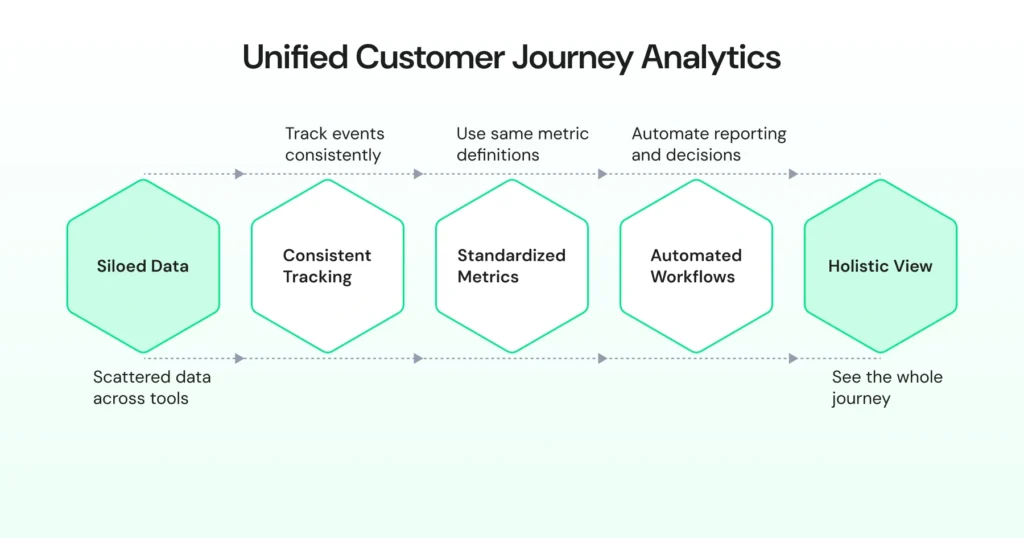
- Siloed Data Fragments: Valuable customer behavior is often trapped in separate tools, making it difficult to see the full path from an initial click to a final WhatsApp chat.
- Delayed Actionability: Without real-time analytics, follow-up messages often reach the customer too late, missing the window of peak interest and intent.
- Measurement Inconsistency: Discrepancies between ad platform data and CRM records can lead to “broken” attribution, making it hard to prove which campaigns truly drive revenue.
- Technical Integration Gaps: Manually stitching together web events with messaging data is time-consuming and error-prone without a unified system to automate the workflow.
How Does Customer Journey Analytics Elevate Consumer Experience?
Customer journey analytics is moving toward deeper automation, smarter predictions, and connected experiences.
As customer behaviour becomes more complex, teams will rely on systems that adapt in real time.
- AI Will Predict Customer Intent in Real Time
Tools will study actions as they happen and identify whether a user is ready to buy, needs more information, or is losing interest. This helps teams act faster and with more precision. (Gartner)
- Journeys Will Adjust Based on Signals
Instead of fixed flows, journeys will switch paths when users show new behaviour. A user who hesitates may get a reminder. A high-intent user may get routed to an agent instantly. (McKinsey)
- Support Will Become Proactive
Systems will flag issues before customers reach out. You will know which users are likely to face problems, delay payments, or churn, and reach out before the issue grows. (Forrester)
- Marketing Will Shift to Behaviour-Based Triggers
Campaigns will no longer run on fixed schedules. Messages will go out when users show clear intent signals, such as viewing a product multiple times or revisiting a cart. (McKinsey)
How Wati Improves WhatsApp Customer Journeys?
Wati gives teams a clear view of WhatsApp interactions and helps automate the steps that matter across the customer journey.
By evaluating the performance metrics of WhatsApp marketing campaigns, you can clearly view the improvement or decline in traffic. clicks or conversions.
With Wati’s ROI analytics dashboard, you can access a centralized dashboard to track conversion metrics and quantify the direct revenue impact of your WhatsApp campaigns and automated workflows.
These real-time insights let you easily demonstrate the clear financial value of your messaging strategy to stakeholders.
This eliminates the need for manual data entry and ensures your lead records are always up to date with the latest interaction data.
Also read: How to supercharge your sales strategy with WhatsApp+HubSpot integration.
Do What “Sales” Your Boat!
By prioritizing customer journey analytics, you can strengthen your lead generation and prevent customer churn. Judging and reflecting on those intent signals across the consumer journey will determine what worked for you and what has never been a success for your customer strategy.
By using tools like Wati, you can instantly integrate Click to ads and run high-quality conversations, with CRM backend data integration to optimize your consumer journey and scale more effectively.
Get to know your customer with Wati today.
You understand what users do, where they hesitate, and what helps them complete the next step.
Frequently Asked Questions: Consumer Journey Analytics
Have more questions? Refer Below!
Customer journey analytics tracks customer behaviour across all touchpoints, such as the website, ads, WhatsApp, CRM, and support tools. It connects these actions into one timeline so you can see where people drop off, what influences their decisions, and how they move through the journey.
Journey mapping is a planned, visual version of an ideal journey. Journey analytics tracks real behaviour using data. Mapping shows what you expect users to do. Analytics shows what they actually do.
Customers move between channels more often than before. If you cannot track these movements, you miss intent signals, send generic messages, and create slow experiences. Journey analytics gives you clarity to improve conversions, support, and retention.
It tracks events, builds unified profiles, shows funnels, runs cohorts, highlights friction, predicts intent, and recommends next steps. The software turns scattered data into clear insights your team can act on.
It solves issues such as siloed data, slow responses, broken handoffs, generic personalisation, and a lack of visibility across channels. It also helps reduce drop-offs by showing where friction occurs.
Marketing, sales, support, product, and CX teams benefit. Each team gets visibility into behaviour so they can improve their part of the journey without guessing.