

-

-
-
Solutions
-
Soluções
-
Soluciones
-
解决方案
-
解決方案
-
الحلول
-
Product
-
Produto
-
Producto
-
产品
-
產品
-
المنتج
-

-
-


 Wati for Marketing
 Wati for Support
 Wati for Sales
 eLearning
 E-commerce
 Marketing Agencies
 Healthcare
 No Code Chatbots
 AI Support Agent
 Instagram and Facebook messenger
 Click to WhatsApp ads
 Campaigns
 Team Inbox
 WhatsApp Business Calling
 Wati AI
 Overview
 Library
Lower Customer Acquisition Costs and Increase ROI with WhatsApp Marketing
Written by:
 Shreya
|
on:
December 26, 2023
|
Last updated on:
February 25, 2026
|
Fact Checked by :
Shreya
|
on:
December 26, 2023
|
Last updated on:
February 25, 2026
|
Fact Checked by :
 Namitha
|
According to: Editorial Policies
Namitha
|
According to: Editorial Policies
 Table of Contents
Too Long? Read This First
- Customer Acquisition Cost (CAC) measures the total spend required to acquire a new customer, including marketing and sales efforts.
- Rising ad costs and reliance on paid channels are making customer acquisition more expensive for businesses.
- Using conversational channels like WhatsApp can help reduce CAC by improving engagement and speeding up conversions.
- Automation, personalized messaging, and faster response times play a key role in lowering acquisition costs.
- Integrating WhatsApp into sales and marketing workflows helps nurture leads more efficiently.
- Tracking CAC-related metrics regularly ensures better ROI and long-term acquisition efficiency.
Marketing teams do not have it easy with budget planning.
From advertising to content generation to pre-sales service, brands’ maximum budget goes in customer acquisition.
Instead of investing in paid marketing or search marketing agencies, switching to WhatsApp lowers customer acquisition cost (CAC).
Brands have switched to WhatsApp Business API to automate customer communication, personalize marketing campaigns, and optimize e-commerce journeys with real-time ROI benchmarking.
This, in turn, lowers CAC, the total cost you spend to acquire a customer, as you strategize purchase funnels.
So let’s explore how WhatsApp marketing can reduce CAC and make your efforts more cost-effective.
Understanding Customer Acquisition Costs (CACs)
Let’s understand what portion of your marketing spend goes to customer acquisition and how you can reduce it.
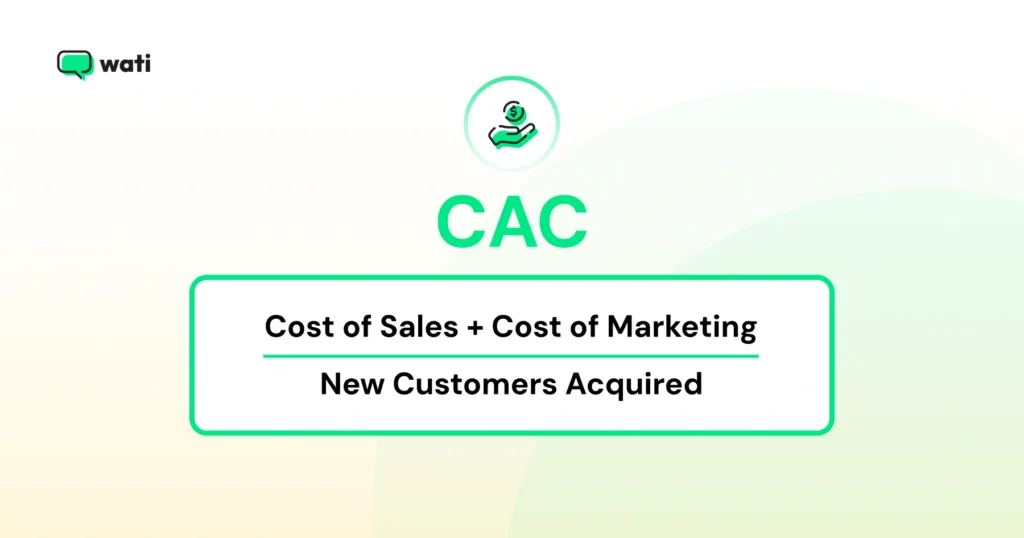
In 2026, a “healthy” CAC isn’t just a low number; it is a number that impacts your net profit and average contract value (ACV). If your CAC is climbing and ACV and net profit decline, your business isn’t spending money. It is losing its competitive advantage and opportunity cost.
Let’s now understand the direct factors influencing customer acquisition cost.
Factors Influencing Customer Acquisition Costs in Marketing
Both offline and online marketing strategies directly influence your customer acquisition cost.
This includes getting visibility in Google search results, improving organic traffic, search queries, advertising ROI, below-the-line (BTL) marketing, and more.
Below are the key factors that drive the CAC.
Spending too much on performance marketing campaigns, deploying third-party tools to monitor analytics, and investing more in lower ROI are factors that negatively impact your CAC.
Let’s check more such marketing blunders that wreak havoc on CAC cost.
- Ad Platform Saturation: High competition on Google and Meta has pushed bidding costs to record highs. You aren’t just paying for the lead; you’re paying to outbid every competitor in your niche.
- Targeting Blindness & Privacy Laws: With the death of third-party cookies and increased data regulations (GDPR/CCPA), ad platforms are forced to use “broader” audiences. This results in wasted ad spend on users who have zero intent to buy.
- The “Link Click” Leak: Traditional ads redirect users to a website. Every second of page load time and every additional click required to find a product result in a 5–10% drop-off rate, significantly increasing the cost of the final acquisition.
- Low-Engagement Channels: Standard WhatsApp, SMS, and Email marketing are plagued by spam filters. With email open rates often hovering around 20%, you have to spend 5x more on “Top of Funnel” traffic just to get a single conversion.
- High Manual Labor Costs: Traditional lead nurturing requires human agents to call or email prospects. The cost of a 10-person sales team adds a massive “overhead” to your CAC that digital automation could otherwise eliminate.
WhatsApp Marketing’s Impact on Customer Acquisition Cost
With WhatsApp marketing, you can run all GTM and promotional activities on a single platform.
Starting with conversational messages and integrating WhatsApp with your preferred CRM, APIs act as a bridge between your marketing and promotional activities, reducing operational and customer acquisition costs. Let’s take it one by one.
WhatsApp marketing software features a range of capabilities, from built-in WhatsApp automation and catalog management to WhatsApp newsletters and, potentially, payment support.
WhatsApp APIs provide pre-approved templates for sending messages on different occasions. Pre-approved templates for order delivery, shipping updates, shopping, or transactional alerts. This helps you reduce dependence on third-party marketing agencies. You reduce dependency on third-party marketing agencies and lower CAC costs.
WhatsApp is not for personal conversations anymore. It’s for businesses that want to spend their marketing dollars wisely with an end-to-end sales API integration to step into the next era of marketing.
According to a recent study, 80% of small business owners use WhatsApp to expand their business and communicate with customers. Further, 65% of WhatsApp business API users send marketing messages in multimedia format, such as images or videos.
Role of Wati’s WhatsApp Marketing Stack in Reducing CAC
To combat rising costs, Wati offers an end-to-end “AI-powered Commerce” stack to fuel revenue growth.
Instead of just “sending messages,” Wati transforms your WhatsApp Business profile into a high-conversion sales engine using these features.
1. Click to WhatsApp Ads
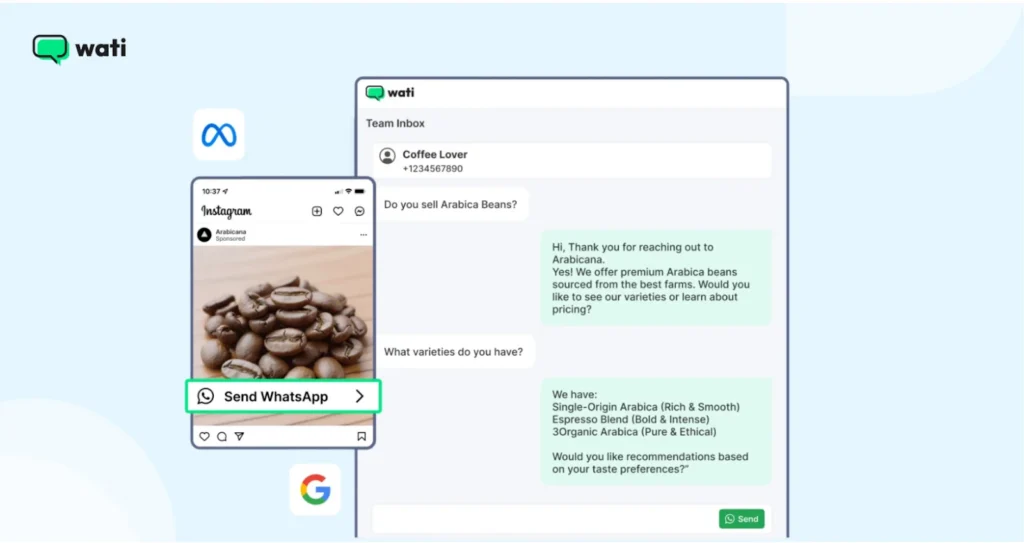
Wati connects directly with Meta Ads so users can start chatting in one tap, eliminating landing page drop-offs and reducing CPL by up to 40%.
2. AI Support Agents
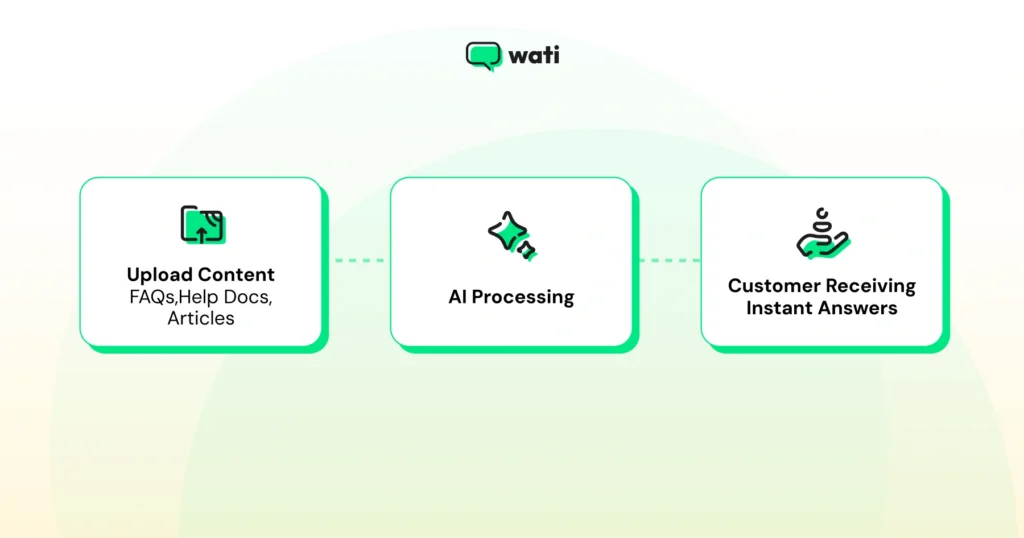
Wati’s advanced AI “Co-pilots” handle 24/7 lead qualification. They understand natural language, answer FAQs, and “warm up” leads before they ever reach a human, reducing your headcount costs.
3. WhatsApp Flows for Native Conversion
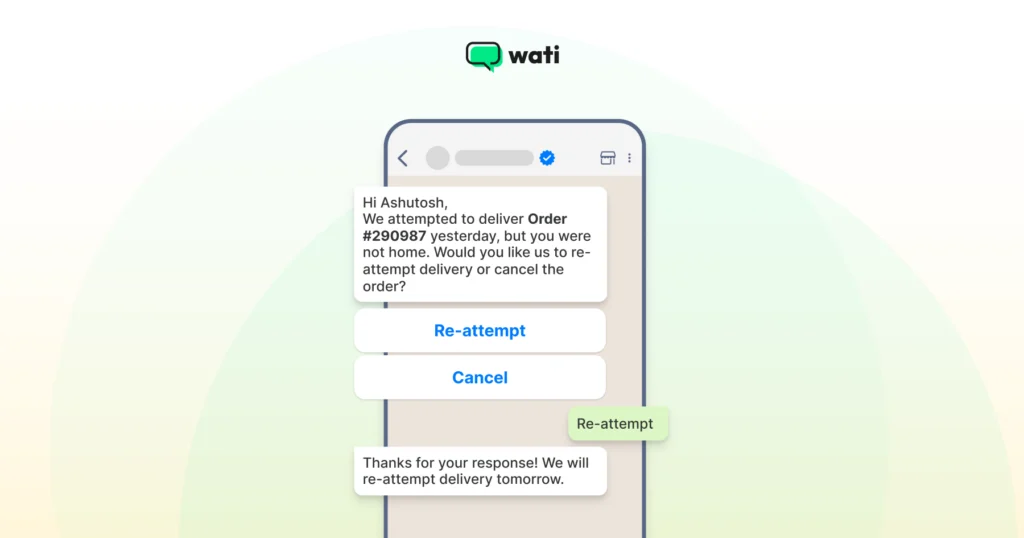
Links are a thing of the past. WhatsApp Flows allows you to build custom forms, booking calendars, and “Mini-Apps” inside the chat. Customers can book a demo or sign up without leaving WhatsApp. Automation also makes it easy to trigger order updates, tracking data, or payment confirmation.
4. Abandoned Cart Recovery
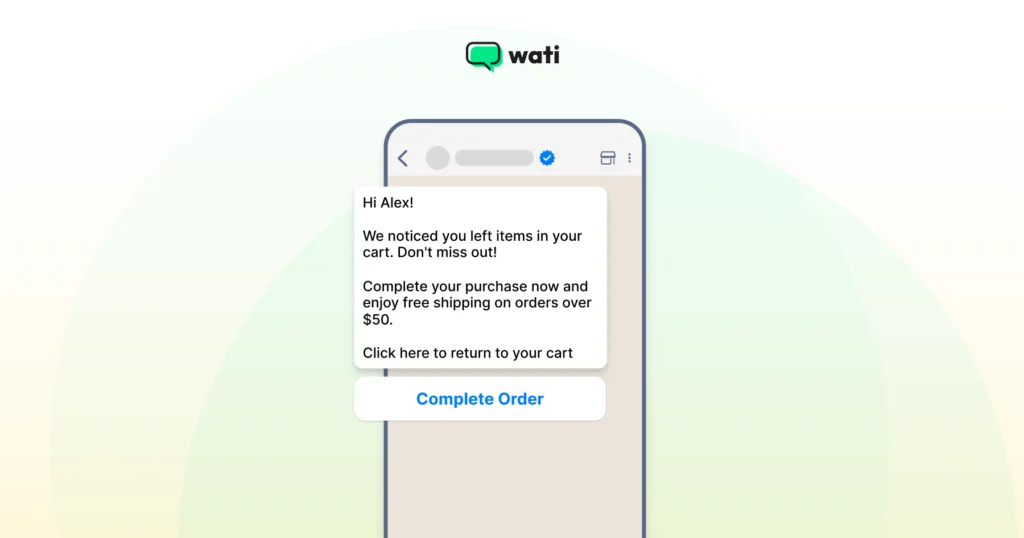
Automatically trigger personalized abandoned cart recovery messages with product images and direct checkout links when a shopper leaves your site. Wati’s recovery flows can reclaim 20–30% of lost revenue at zero additional ad cost.
5. WhatsApp Payments
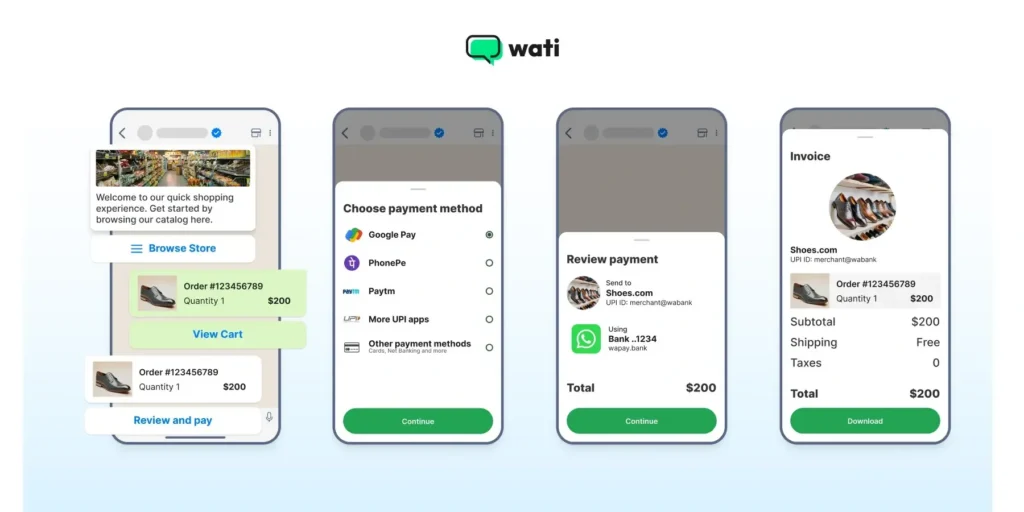
With WhatsApp Payments, you can facilitate “one-tap” transactions directly in the chat window. By integrating with payment gateways, you can offer an end-to-end ecommerce experience without breaking it by sending an external payment link.
6. RCS & SMS Fallback
With RCS and SMS fallback, you can float announcements, updates, or discounts via SMS campaigns. If a customer isn’t on WhatsApp, SMS Fallback ensures the message still delivers. For Android users, RCS (Rich Communication Services) provides a branded, app-like experience with 7x higher CTR than standard SMS.
7. WhatsApp Calling
Apart from deploying conversational templates, relying on in-app WhatsApp calling also lowers your CAC. Because of this plugin, you don’t need to invest in inbound marketing software or CRM tools to track lead progress.
8. Full API and CRM Integration
With seamless integrations with Shopify, Zapier, HubSpot, and WooCommerce, Wati offers an extensible productivity infrastructure. Brands can manage their automated e-commerce workflows without paying for yet another license, further lowering customer acquisition costs.
6 Top Benefits of Using WhatsApp for Customer Acquisition
Because of the growing popularity of WhatsApp, it is the best platform to connect with your leads. Having a swift, quick touchbase with your customers personalizes their journey and gives you a centralized tech stack to control outreach.
Below are the top benefits of WhatsApp that’ll potentially help lower your consumer strategy.
- Quick and proficient: Building an omnichannel platform via WhatsApp is an effective way to handle all marketing operations. With WhatsApp marketing, you can build a reliable consumer outreach strategy across apps to reduce marketing costs.
- Cost-effective communication channel: WhatsApp marketing tools like Wati offer pre-approved messaging templates for every stage of your marketing cycle. Brands do not need to invest in dedicated content-creation agencies; they can automate intelligent conversational workflows via WhatsApp.
- Real-time updates: WhatsApp Business provides real-time updates to marketing teams, enabling them to take specific actions. For example, if a customer inquires outside business hours, you’ll receive an email update so you can adjust your nurturing strategy accordingly.
- Chance to build a more personal connection with customers: WhatsApp marketing offers a bulk campaign list and smart messaging templates that allow you to build quick and effective connections with customers.
- Enhanced ROI benchmarking: Because of options like click to WhatsApp (CTWA), abandoned cart recovery, newsletter, and CRM automation, you can easily track lead generation metrics and focus on specific high ROI campaigns. This, in turn, reduces your customer acquisition cost.
- End-to-end lead nurturing: Instead of managing multiple lead pipelines via marketing channels, you can trigger personalized content via WhatsApp to meet your customers in the middle. While most brands treat live chat or inbound as warm leads, you can instantly capture high-intent leads with a one-click WhatsApp chat.
Strategies to Lower Customer Acquisition Costs with WhatsApp Marketing
Lowering your consumer acquisition is about increasing the efficiency of every touchpoint.
By leveraging WhatsApp’s high open rates (exceeding 98%) and click-through rates (ranging between 45-60%), brands can reduce traditional ad spending and high-friction email funnels:
1. Build a High-Intent Opt-in Pipeline
Instead of casting a wide, expensive net, focus on building a “VIP” audience. Use website pop-ups, QR codes on packaging, or “Click-to-WhatsApp” ads to move prospects from social media into a direct chat.
Because WhatsApp is an opt-in environment, you are only marketing to people who have already signaled high intent, drastically reducing wasted ad spend.
2. Drive Conversions with Hyper-Personalization
Generic marketing is expensive because it’s easy to ignore. By using the WhatsApp Business API to pull customer data (like first names or past browsing history), you can send personalized template messages that resonate.
Personalised messages delivered at the right time peak consumer interest, thereby optimising the lead pipeline and lowering customer acquisition costs.
3. Shorten the Sales Cycle with In-Chat Commerce
Every additional step in a customer’s journey is an opportunity for them to drop off. Use WhatsApp Opt-ins not just for newsletters, but for immediate sales.
By integrating catalogs and payment links directly into the chat, you transform a conversation into a checkout, reducing the friction that often leads to abandoned carts.
4. Proactive customer support to remain active for resolution
Imagine solving an issue for a customer before they even realize it. Proactive support on WhatsApp is like being a step ahead. It shows your customers that you care. It also creates a positive image and possibly turns them into loyal customers.
Happy customers are more likely to stay, contributing to more cost-effective Customer Acquisition.
5. Leverage Integrations for a Unified Ecosystem
By integrating WhatsApp with your CRM or e-commerce platforms (like Shopify), you ensure data flows seamlessly.
This prevents duplicate effort and enables automated retargeting based on real-time behavior, making your marketing efforts leaner and more effective.
How to Measure and Analyze WhatsApp Marketing ROI
Below are the steps you can take to measure and analyse customer acquisition via WhatsApp marketing to ensure you don’t override your budget:
1. Setting Measurable Goals for WhatsApp Marketing
Setting measurable goals for your WhatsApp marketing is the same. It’s your roadmap, helping you know if you’re heading in the right direction.
Want more sales, engagement, or new customers? Define it, and let’s see how it affects your Customer Acquisition Cost.
2. Tracking Key Performance Indicators (KPIs) Related to CAC
In WhatsApp marketing, focus on KPIs tied to Customer Acquisition Cost. How many new customers did you gain? What did it cost you? These metrics are like a magnifying glass, giving you a closer look at the impact of your efforts.
3. Tools and Techniques for Analyzing WhatsApp Marketing Efforts
To monitor consumer acquisition costs, businesses can use advanced analytics dashboards within the WhatsApp marketing platform.
By utilizing UTM-tagged links and tracking web analytics, businesses can attribute specific revenue metrics to current WhatsApp marketing campaigns.
With the help of metrics, businesses can also use techniques such as A/B testing, message flows, and AI-driven sentiment analysis.
Ultimately, success is measured by balancing CTR with Service Window efficiency, ensuring that automated interactions move customers through the purchase funnel. Low metrics may suggest that some message isn’t resonating with them.
What are the WhatsApp API Analytics To Monitor Consumer Acquisition Cost?
Below are the types of analytics integration that WhatsApp provides to track CAC:
1. Google Analytics Integration
- What: Integrate Google Analytics with your WhatsApp campaigns to comprehensively view user behaviour.
- How: Track website visits from your WhatsApp messages by connecting to Google Analytics. This helps you understand how your WhatsApp marketing efforts drive traffic to your website. It also allows you to measure conversions and adjust your strategy accordingly.
2. Link Tracking Tools
- What: Use URL shorteners to track the performance of links shared via WhatsApp.
- How: Shortened URLs or link tracking tools provide detailed statistics on click-through rates. This helps you identify links popular among your audience. It also allows you to tailor your content to their preferences.
3. CRM Systems
- What: Customer Relationship Management (CRM) systems help you track customer interactions across channels, including WhatsApp.
- How: Integrate your CRM system with WhatsApp to consolidate customer data. This enables you to analyze the entire customer journey, from initial contact through conversion. Understanding this journey helps refine your approach to improve CAC efficiency.
4. Surveys and Feedback Tools
- What: Implement surveys and feedback tools to gather insights from your WhatsApp audience.
- How: Use polls & surveys within WhatsApp to understand customer satisfaction and pain points. This data helps refine your messaging strategy & ensure it aligns with customer expectations.
5. A/B Testing
- What: Test different variations of your messages to see which performs better.
- How: Send similar messages with slight variations to different segments of your audience. Analyze the response rates to identify the most effective messaging approach. A/B testing helps you optimize your content for maximum impact and minimal CAC.
6. Customer Feedback and Chat Logs
- What: Regularly review customer feedback and chat logs for valuable insights.
- How: Actively monitor customer interactions, complaints, and compliments within WhatsApp. Analyzing these conversations provides a qualitative understanding of customer experiences. It also helps you tailor your strategies to meet their needs and expectations.
Success Story of Increasing Customer Acquisition Using Wati
Let’s look at some winning success stories of increasing consumer acquisition cost with Wati
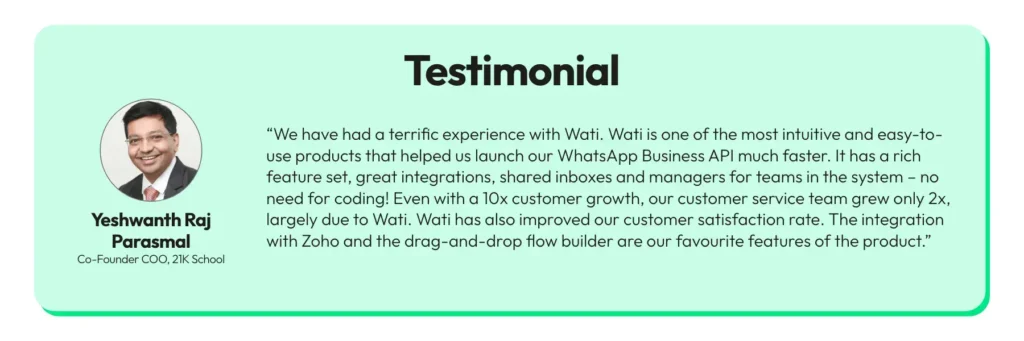
21K School faced the challenge of providing personalized and responsive support to parents.
To address this, they turned to Wati’s WhatsApp API. 21K School automated several processes using Wati, including:
- Lead broadcasts
- Admission facilitation
- Student onboarding
- Enrollment follow-ups
- Fee payment notifications.
What are the Key Outcomes of Improving CAC Using Wati?
Here are the impressive outcomes of switching marketing workflows on Wati.
- 40% increase in revenue
- $10k saved on customer support
- 200% boost in agent productivity,
- 85% increase in sales over a span of 10 months.
Wati’s integration played a pivotal role in 21K school’s success. It showcased the impact of WhatsApp marketing to enhance customer acquisition & business performance.
Spend Less, Convert More
Customer acquisition is a vital metric, and there is no single way to achieve it.
It’s the result of a conjoined effort between sales and marketing, but with tools like WhatsApp, you can centralise all marketing activities on a single platform.
Your business can thrive by staying ahead of the curve and utilizing WhatsApp marketing to its full potential. The key? Keep experimenting, keep connecting, and watch your Customer Acquisition Costs take a dip while your business soars. Here’s to your success!
To know how the WhatsApp Business API platform eases marketing stress, register for a free demo and self-discover the magic.
Frequently Asked Questions: How to Lower Consumer Acquisition Costs with WhatsApp Marketing
Still confused? Refer to FAQs below!
Traditional ads lose 50-70% of traffic during the “click-to-landing-page” transition. Click-to-WhatsApp ads move users directly into a chat, maintaining momentum and often reducing Cost-Per-Lead (CPL) by 30-40% because you aren’t paying for “bounce” traffic.
While there are subscription and message fees, the ROI often exceeds 15x. By automating FAQs and lead qualification, you significantly reduce human resources costs (headcount) and third-party marketing agency fees, lowering the net acquisition cost.
WhatsApp is an opt-in-first platform. By using smart segmentation and personalized templates, you ensure messages are relevant rather than “spammy.” High relevance leads to lower block rates and higher conversion rates, keeping your overall acquisition strategy healthy.
Integrations prevent “data silos.” When your WhatsApp tool knows exactly where a customer is in the funnel, it prevents you from spending money to target them with “Top of Funnel” ads. Instead, it triggers a low-cost automated message to close the sale.
If a customer is offline or doesn’t have WhatsApp, SMS Fallback ensures your high-value offer still reaches them. This prevents your marketing “investment” in that lead from being wasted, ensuring every dollar spent on acquisition has the maximum chance of converting.