
Too Long? Read This First
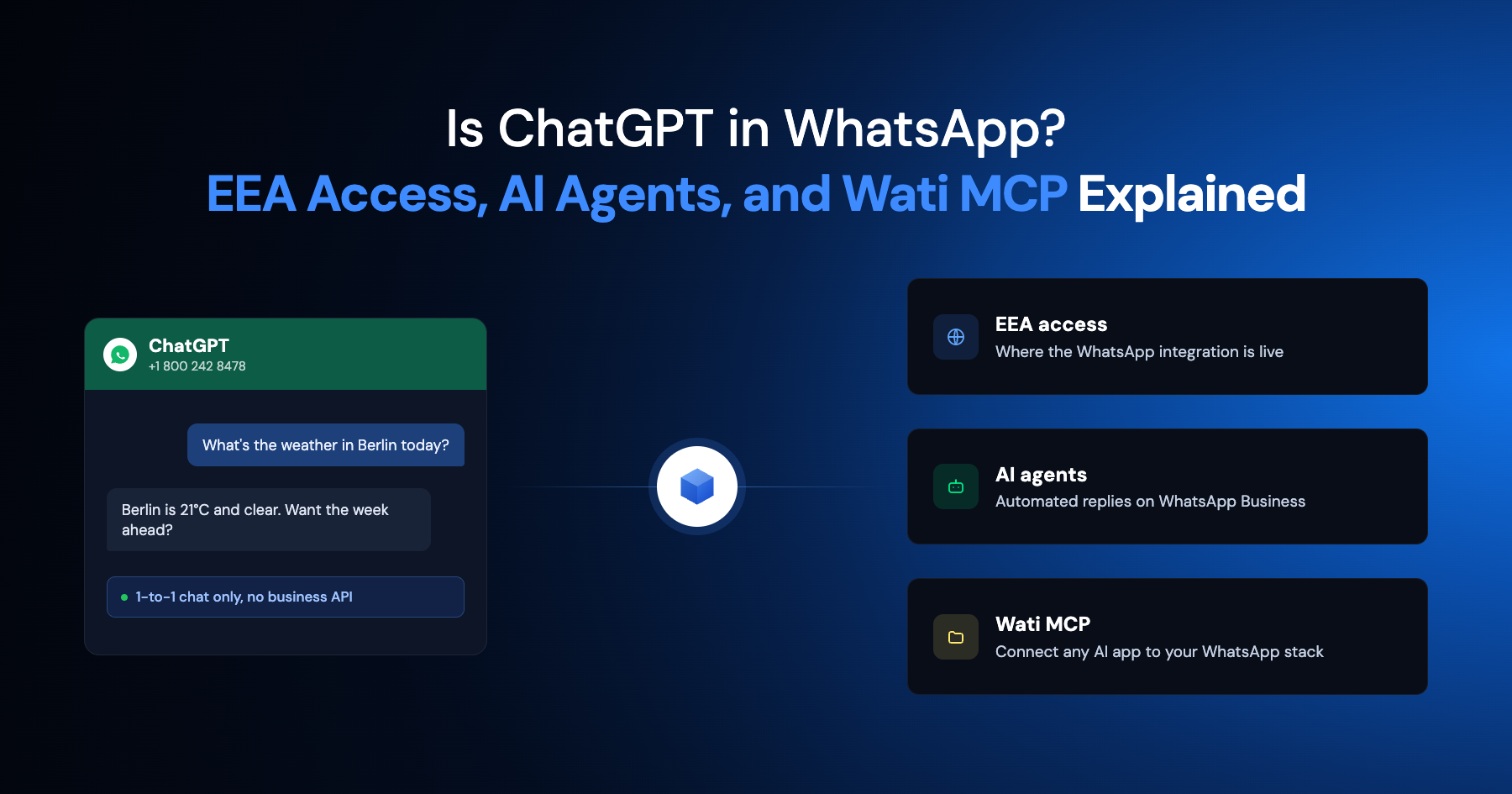
- ChatGPT is in WhatsApp, but only for numbers with an EEA country code, since July 13, 2026.
- ChatGPT left WhatsApp on January 15, 2026, after Meta changed its WhatsApp Business Solution Terms. It came back after the European Commission ordered Meta to reverse course.
- Availability depends on your WhatsApp number's country code, not a single global switch.
- Meta AI and any business's own AI agents (chatbots you build for your number) are separate products from ChatGPT-in-WhatsApp.
- Wati MCP is a different thing entirely: it lets you connect Claude or ChatGPT to your own Wati workspace so an AI assistant can build, test, and manage your WhatsApp AI agents. It does not put ChatGPT inside your customers' chats.
Search "is ChatGPT in WhatsApp" and you will find answers pulled from three different months this year, because the product genuinely moved three times. It left. It came back for one region. It's still absent everywhere else. None of that is a rumor: it's the result of an active EU antitrust fight, detailed below.
For a business running WhatsApp as a sales or support channel, the confusion is expensive. "AI on WhatsApp" now covers several separate things, and only one of them is something you actually control.
This guide covers what OpenAI announced, why WhatsApp's rules keep shifting, and where a tool like Wati MCP fits when you want an AI agent to run your own WhatsApp operations rather than chat with your customers directly.
Is ChatGPT Actually in WhatsApp Right Now?
Yes, as a specific verified contact, in one region, with usage limits attached. ChatGPT in WhatsApp is not a feature that quietly appeared inside everyone’s app; it’s a contact you have to message.
What OpenAI Announced for ChatGPT in WhatsApp
OpenAI’s release notes confirm ChatGPT is available again in WhatsApp across the European Economic Area (EEA), the 27 EU member states plus Iceland, Liechtenstein, and Norway, as of July 13, 2026. You reach it by messaging the verified 1-800-CHATGPT contact at +1-800-242-8478, and you don’t need a ChatGPT account to start the conversation.
Whether the contact appears for you depends on your WhatsApp number’s country code, and OpenAI is upfront that the rollout is gradual, with usage limits in place.
Once you’re chatting with it, the WhatsApp version holds up well against the app: you can send text, upload images, record voice notes, ask for generated images, and work across many languages inside the same thread. Linking a ChatGPT account stays optional; do it for higher usage limits, or skip it and stay on the free tier’s caps.
Why ChatGPT Left WhatsApp in January 2026
The EEA comeback only makes sense against the exit that preceded it. Meta updated its WhatsApp Business Solution Terms on October 15, 2025, barring general-purpose AI assistants, including ChatGPT, Microsoft Copilot, and Perplexity, from the WhatsApp Business API.
That policy took effect on January 15, 2026, and from that date, Meta AI was the only assistant left accessible on WhatsApp. That wasn’t downtime; it was a platform-level policy change that removed every general-purpose assistant that wasn’t Meta’s own.
If your number sits outside the EEA, that January cutoff is still closer to your reality than the July return. This is a regional fix, not a global one, and OpenAI has not announced a return date for any other region.
ChatGPT in WhatsApp vs. Meta AI vs. Your Own WhatsApp AI Agent
Several different things get lumped under “AI on WhatsApp,” and mixing them up leads to bad assumptions about what your customers actually see.
What it is | Who runs it | Where it lives | What it does |
ChatGPT contact | OpenAI | 1-800-CHATGPT, EEA numbers only, rolling out gradually | General chat, images, voice notes, many languages |
Meta AI | Meta | Built into the WhatsApp chat list in supported markets | In-app assistant, no business context |
Your own AI agent | Your business | Your own WhatsApp Business number, built via a platform like Wati's Astra AI Agent | Custom, trained on your knowledge base, answers and automates for your customers |
Business automation via Wati MCP | Your team | Your own Wati workspace, directed through Claude or ChatGPT | Build, test, deploy, and manage the AI agent above through plain language |
The first two rows depend on decisions OpenAI and Meta make about rollout, region, and policy. The last two rows are the ones a business actually owns end-to-end, and that distinction matters more than any feature comparison, because a business built on WhatsApp automation needs a channel it controls, not one that might disappear in a policy update.
Conversational commerce depends on that kind of stability. If you’re running abandoned-cart messages or a multi-step drip campaign, you’re relying on your own WhatsApp Business number staying predictable, not on a third-party assistant’s regional availability.
The Regulatory Fight Behind ChatGPT in WhatsApp
The back-and-forth over ChatGPT in WhatsApp isn’t a product decision alone; it’s sitting inside an active EU antitrust case against Meta.
The European Commission’s June 2026 Order
On June 9, 2026, the European Commission ordered Meta to restore free WhatsApp Business API access for rival general-purpose AI assistants, giving Meta five working days to comply and requiring the access to stay open until the Commission’s antitrust investigation concludes.
It was only the second time the Commission has used its interim-measures power under Regulation 1/2003, after a 2019 order against Broadcom, a sign of how urgently regulators viewed the risk to competition in the AI assistant market.
The order specifically restores access “under the same terms and conditions that were in place before 15 October 2025,” the date Meta’s original restriction began. That’s almost certainly why the EEA got its ChatGPT contact back within weeks: it’s a regulatory remedy, not a policy reversal Meta chose on its own. Meta has said it will appeal the decision.
What WhatsApp’s Business Solution Terms Say About AI Providers
WhatsApp’s terms treat large language model providers, generative AI platforms, and general-purpose assistants as a distinct category, often referred to as AI Providers. The WhatsApp Business Solution Terms restrict how these providers can use the WhatsApp Business API when general-purpose AI is the primary functionality being offered, subject to applicable regulatory requirements.
Read plainly: Meta reserves the right to restrict a standalone AI assistant like ChatGPT in WhatsApp, but regulators can force exceptions, as the EEA case shows. That tension is exactly why a single answer to “is ChatGPT in WhatsApp” doesn’t hold up everywhere. It depends on your region, the date, and which regulator is currently active.
What does Wati MCP do?
Wati MCP connects an AI assistant, Claude or ChatGPT, to your own Wati workspace, so your team can build, configure, test, and manage your WhatsApp AI agents through plain-language instructions instead of clicking through a dashboard.
Those agents are Astra AI Agents, Wati's autonomous AI layer, and Wati MCP is simply how you build and operate them without leaving Claude or ChatGPT.
This is a meaningful distinction from the consumer ChatGPT-in-WhatsApp contact described above. Wati MCP isn’t OpenAI’s assistant talking to your customers on your behalf; it’s your own AI tool, authenticated into your own workspace, doing the configuration and admin work your team would otherwise do by hand.
How the Connection Works
Wati MCP runs on the Model Context Protocol (MCP), an open standard Anthropic introduced that lets an AI model discover and call real tools instead of just generating text.
Point Claude or ChatGPT at the Wati MCP server (it connects at astra-mcp.wati.io/mcp through standard OAuth), and the model gets a defined set of actions it’s allowed to take inside your account, nothing more.
Setup takes about five minutes and requires no code.
Wati is the first WhatsApp Business Solution Provider to ship a purpose-built MCP server built around the full agent lifecycle, rather than just a messaging wrapper.
What You Can do With Wati MCP
Most WhatsApp MCP servers on the market today are limited to basic operational tasks. Wati’s goes further, covering the complete lifecycle of an AI agent:
- Build and configure an agent from a plain-language brief: describe the agent’s purpose, tone, escalation rules, and knowledge base, and the assistant builds it and brings it to a testable state.
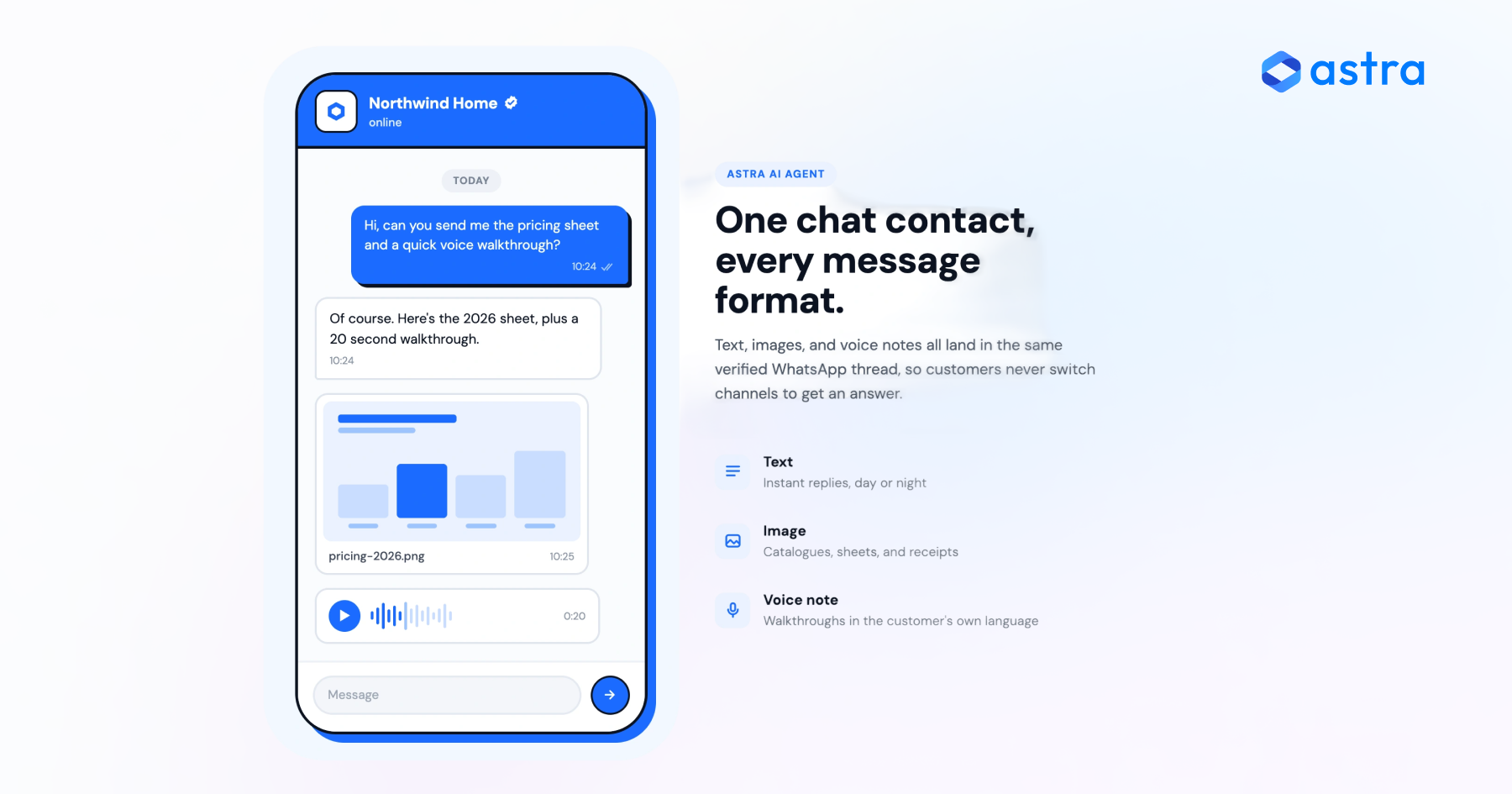
- Test before it goes live: ask Claude or ChatGPT to run an evaluation against an agent for intent match, response quality, hallucination risk, and escalation handling, without scripting a single test manually.
- Diagnose and fix issues in conversation: describe a problem with a live agent and ask the assistant to investigate, propose a fix, apply it, and confirm the fix with a fresh evaluation.
- Handle day-to-day operational tasks: send messages, manage contacts, and retrieve conversation history without leaving the chat window.
- Pull reporting and analytics: ask which templates performed best last week or where conversations dropped off, and get the answer directly instead of exporting a dashboard report.
Custom MCP connectors are available on Claude's Free, Pro, Max, Team, and Enterprise plans (Free is limited to one connector). On ChatGPT, custom MCP connectors are available on Plus, Pro, Business, and Enterprise/Edu plans
How does Wati MCP Keep Sends Inside WhatsApp’s Rules?
Wati MCP does not bypass Meta’s messaging rules or the WhatsApp approval process. Every action still runs through the same permission and template system your account already uses, and because Wati is a Meta-authorized Business Solution Provider, everything runs on compliant Business API infrastructure with approved templates.
Why Approved Templates Still Matter
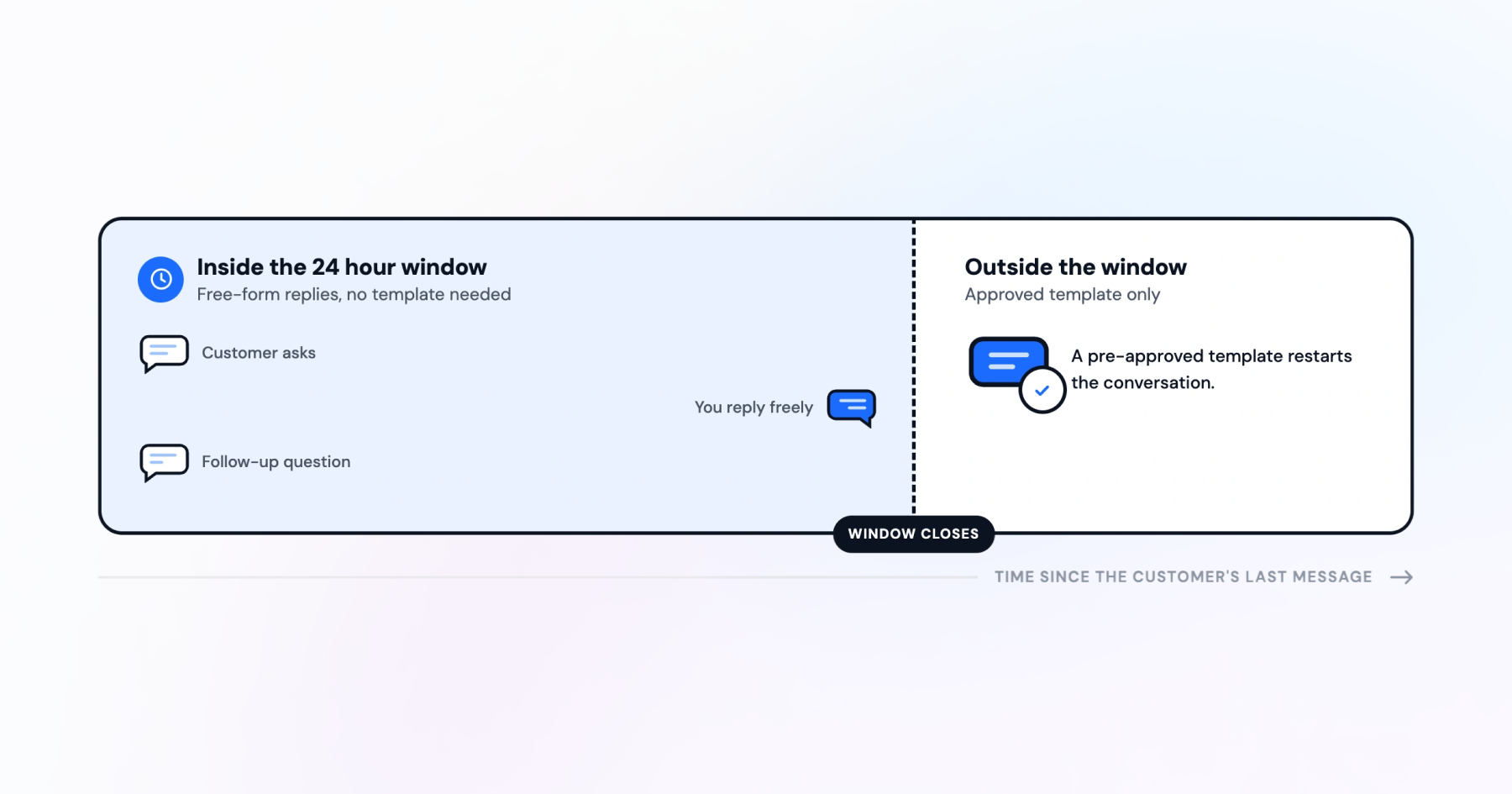
Any message that opens a new conversation outside the 24-hour session window has to use an approved WhatsApp message template, and that rule doesn’t change because an AI assistant is involved.
Wati MCP can help your team configure and test an agent, but it can’t invent a template or route around Meta’s approval process; a new template still goes through the same review Meta requires of every business on the platform.
This is also where it helps to know the difference between free-form replies inside an open session and paid, pre-approved templates that start new ones. An AI agent built and managed through Wati MCP operates inside that same split, not around it; the platform enforces the distinction regardless of whether a human or an AI assistant configured the agent.
Is Putting ChatGPT in Your Customers’ Chats the Same as Using Wati MCP?
No, these solve different problems and sit on opposite sides of the conversation.
The consumer ChatGPT-in-WhatsApp contact is an assistant anyone in an eligible region can message directly, with OpenAI deciding its availability, limits, and rollout schedule. Wati MCP is a build-and-manage layer: it lets your team direct Claude or ChatGPT to construct, test, and monitor an AI agent inside a WhatsApp workspace you already own.
Put another way: one is a product you might message. The other is a tool you use to build and run your own AI-powered messaging operation. Wati MCP never claims to make ChatGPT globally available on WhatsApp, because that availability isn’t Wati’s to grant; it belongs to OpenAI and to whichever regulator is currently deciding the terms.
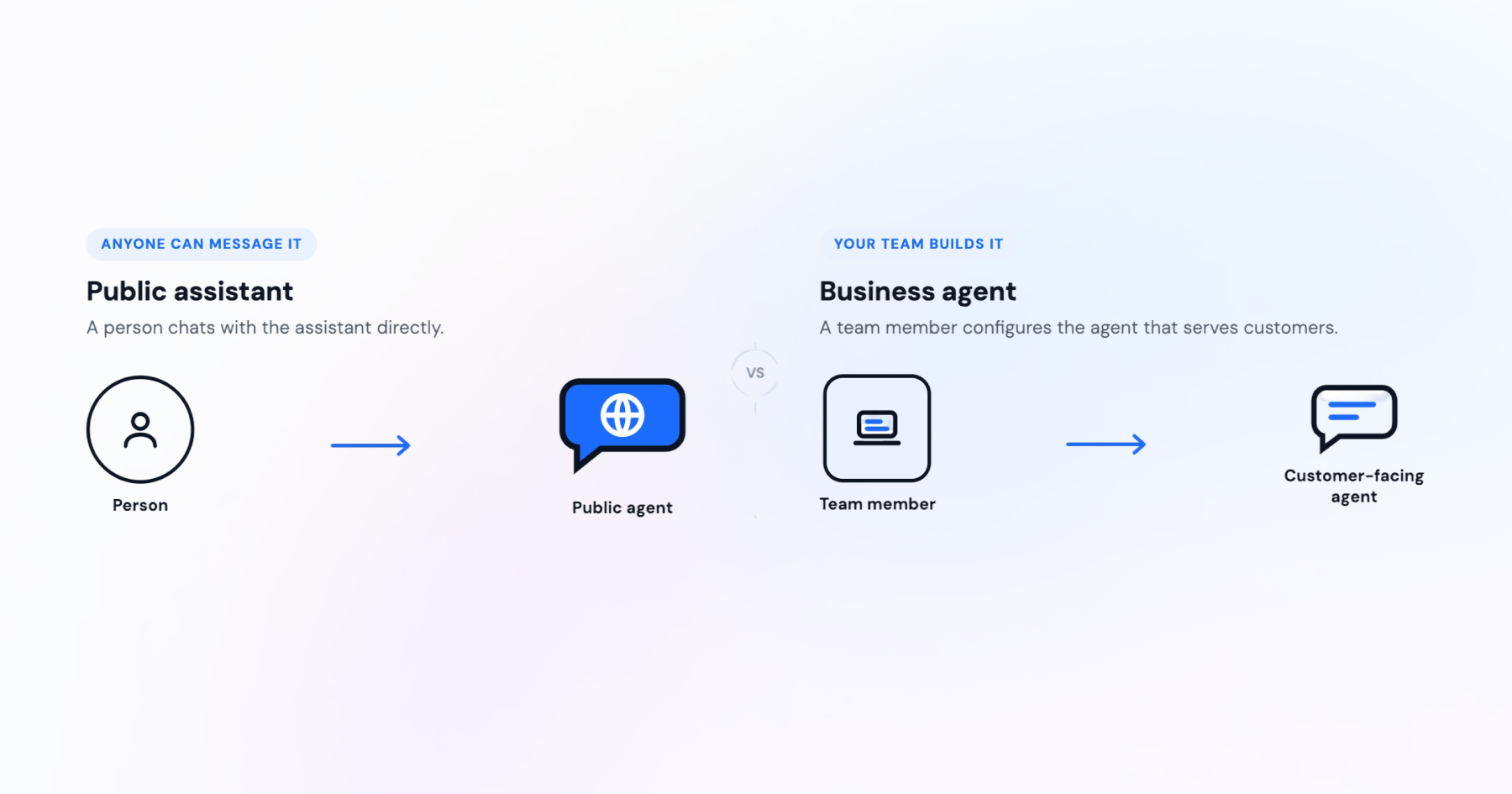
If your business runs on WhatsApp for sales or support, the practical question isn’t whether ChatGPT-in-WhatsApp reaches your customers directly. It’s whether your own team can build and manage a better AI agent, faster, with an AI assistant sitting on top of the process.
Run Your WhatsApp AI Agent Through Claude or ChatGPT
Wati MCP puts agent building, testing, monitoring, and day-to-day WhatsApp operations behind a natural-language interface your team already knows how to use.
Book a demo to see Wati MCP connected to Claude or ChatGPT in action.
Frequently asked questions
Is ChatGPT available in WhatsApp right now?
Yes, for numbers with an eligible country code in the European Economic Area, since July 13, 2026. You message the verified 1-800-CHATGPT contact (+1-800-242-8478) without needing an account. Outside the EEA, availability is not guaranteed, and OpenAI describes the rollout as gradual with usage limits attached.
What’s the difference between ChatGPT in WhatsApp and Meta AI?
ChatGPT is OpenAI’s assistant, reached through a specific verified contact number. Meta AI is Meta’s own assistant, built directly into the WhatsApp chat list in supported markets. They’re separate products from separate companies, governed by separate rules about where and how they appear.
Why did ChatGPT leave WhatsApp in January 2026?
Meta changed its WhatsApp Business Solution Terms on October 15, 2025, barring general-purpose AI assistants from the WhatsApp Business API, effective January 15, 2026. ChatGPT returned to the EEA in July 2026 after the European Commission ordered Meta to restore access, but that return did not apply everywhere.
Does Wati MCP put ChatGPT inside my customers’ WhatsApp chats?
No. Wati MCP connects Claude or ChatGPT to your own Wati workspace so your team can build, test, and manage your own WhatsApp AI agents through natural language. It does not send messages to your customers on OpenAI’s behalf or make ChatGPT available as a public contact.
What can I actually do with Wati MCP and Claude or ChatGPT?
You can build and configure an AI agent from a plain-language brief, test it before it goes live, diagnose and fix issues in an existing agent, send messages and manage contacts, retrieve conversation history, and pull reporting and analytics, all through natural-language requests.
Does WhatsApp allow general-purpose AI assistants on its Business Platform?
WhatsApp’s Business Solution Terms classify large language model and general-purpose AI providers separately and restrict their use of the platform when AI is the primary functionality offered, subject to regulatory requirements. A June 9, 2026 European Commission interim-measures order forced an exception for rival assistants across the EEA.
Related posts
- AI Customer Support in 2026: What It is, How It Works, and Why Smart Teams are Quietly Switching Over
Learn how AI in customer support manages ticket escalations, automates ticket tagging and routing, and improves customer satisfaction. See how Astra does it.
- How to Automate Business Conversations With a WhatsApp AI Agent in 2026
Learn how to build a WhatsApp AI agent to engage, qualify, and convert prospects round the clock without any delays in 2026.
- Voice-First Web Experiences: Navigating with Voice Commands
learn how voice first web experiences enable you to power personalized, human-like conversations to have a competitive advantage in today’s market.
- How Voice AI Agents Qualify Leads: A Sales Team’s Guide to Hands-Free Pipeline
know how does voice ai qualifies leads for an effective sales action and potential conversion and where does astra 2.0 stand when it comes to pre-configured lead qualification