

-

-
-
Solutions
-
Soluções
-
Soluciones
-
解决方案
-
解決方案
-
الحلول
-
Product
-
Produto
-
Producto
-
产品
-
產品
-
المنتج
-

-
-


 Wati for Marketing
 Wati for Support
 Wati for Sales
 eLearning
 E-commerce
 Marketing Agencies
 Healthcare
 No Code Chatbots
 AI Support Agent
 Instagram and Facebook messenger
 Click to WhatsApp ads
 Campaigns
 Team Inbox
 WhatsApp Business Calling
 Wati AI
 Overview
 Library
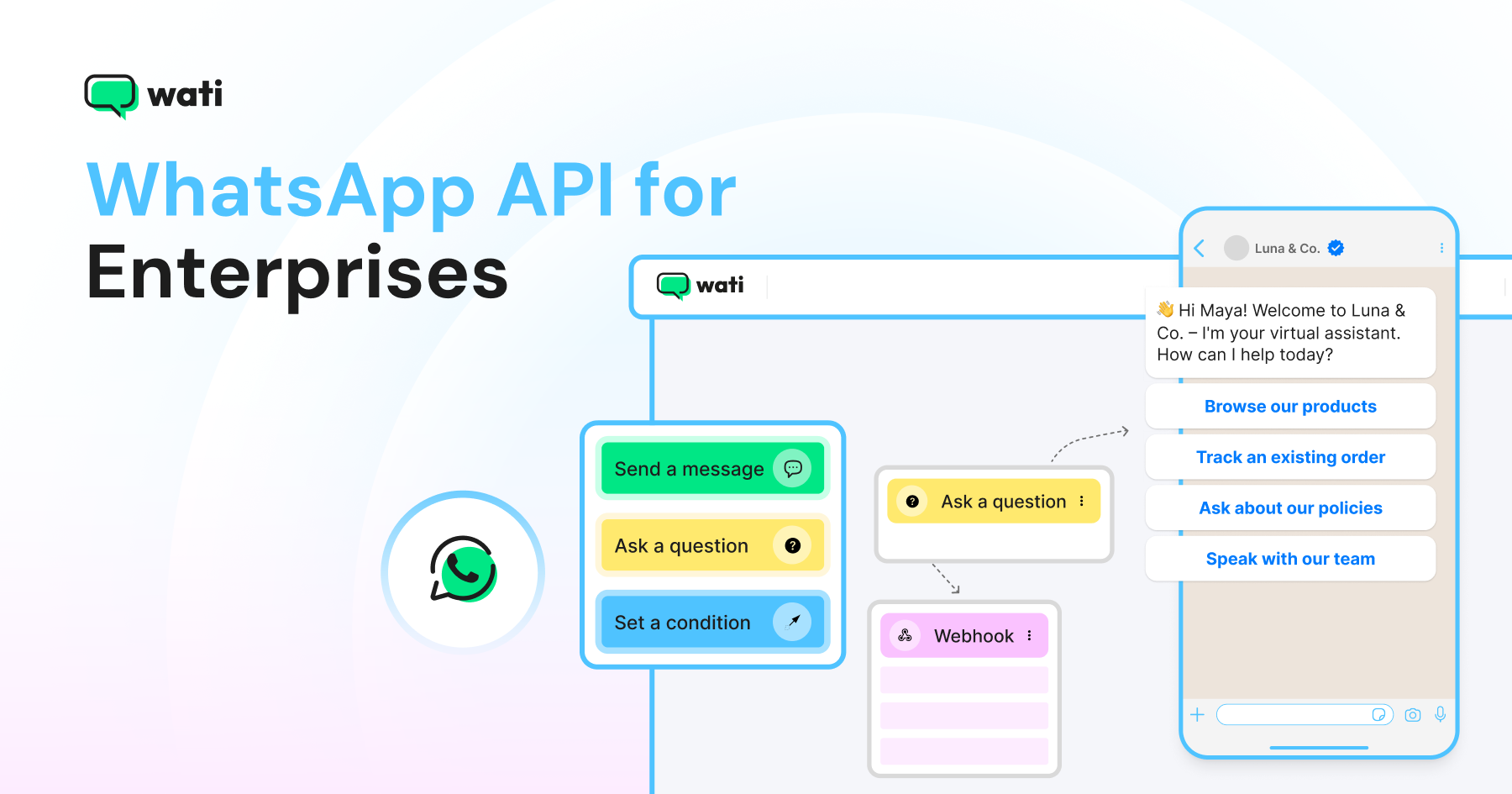
WhatsApp API for Enterprise: Designing Intelligent End-to-End Workflows for 2026
Written by:
 Shreya
|
on:
December 30, 2025
|
Last updated on:
February 13, 2026
|
Fact Checked by :
Shreya
|
on:
December 30, 2025
|
Last updated on:
February 13, 2026
|
Fact Checked by :
 Namitha
|
According to: Editorial Policies
Namitha
|
According to: Editorial Policies
 Table of Contents
Too Long? Read This First
- Scale with Intelligence: Move beyond siloed legacy systems by integrating the WhatsApp Business API directly into your CRM, ERP, and RPA stacks.
- Automate Complex Ops: Digitally transform field operations, workforce management, and logistics with no-code workflows and automated business templates.
- Drive Conversational Commerce: Reduce friction in the purchase journey using Click-to-WhatsApp ads, in-chat Product Catalogs, and supported WhatsApp payment options in eligible regions.
- Protect message content with end-to-end encryption in transit, supported by Meta-managed endpoints and secure authentication mechanisms.
- Future-Proof Growth: Transition from reactive support to proactive engagement using Wati’s shared inbox, AI chatbots, and SMS fallback for maximum reach.
No matter which enterprise segment you cater to, failure to meet customer expectations negates every other business progress.
To stand out as an industry leader, you have to bridge operational challenges such as fragmented data, high operational costs, and low-quality customer interactions within your enterprise.
If your CRM operations, ticketing systems, or supply chain notifications are siloed, it can be a reason for reduced customer trust.
Whether it’s managing complex field operations or recovery of abandoned carts in quick commerce, you need to stand by customers at every stage of the purchase journey. But with legacy systems, this isn’t possible.
By using a WhatsApp Business API solution, enterprises gain a centralized tool to digitize operations, improve engagement, and drive sales efficiency.
But how exactly does this fit into a high-scale marketing and ops workflow?
In this guide, we’ll design a blueprint for 2026 that integrates WhatsApp automation directly into your enterprise stack to track productivity and achieve global scale.
Why Do Enterprises Need a WhatsApp Business API Solution?
Customers just don’t rely on traditional media channels like email anymore. Email open rates are stagnating, and SMS is often plagued by spam filters and high costs.
Compared to the generic open rate of 20%, WhatsApp boosts an average open rate of 98-99%, with over 150 messages handled every day.
Research from Route Mobile suggests that as we head toward 2026, the pivot to conversational commerce is no longer optional; it’s a survival metric.
If you are evaluating a WhatsApp API for a 2026 enterprise release, these are the primary reasons why you would get the technical compatibility you wanted.
1. Increased Security and Compliance
For global enterprises, data integrity is paramount. Wati’s API infrastructure provides:
- End-to-End Encryption (E2EE): Ensuring that sensitive data like OTPs, bank alerts, or personal records is only readable by the sender and the recipient.
- Authentication & Access Control: Native support for secure access tokens and OAuth 2.0, allowing you to manage who in your organization has authentication and access control over customer data.
- Regulatory Alignment: Built-in tools to manage GDPR and other local, state, and federal regulations for enterprise convenience.
Also read: How does Wati provide end-to-end API encryption to Enterprises?
2. Managed Meta Endpoint Support
Directly managing the Meta Cloud API is resource-intensive. Partnering with a WhatsApp API provider like Wati gives you:
- Meta Endpoint Reliability: Wati manages the functional container “pipes,” ensuring high uptime and handling the heavy lifting of server maintenance and version updates.
- API Rate Management: Seamlessly handle high-volume bursts, which is crucial for global WhatsApp marketing software campaigns, without hitting TPM (Transactions Per Minute) throttles.
Also read: How to create a WhatsApp broadcast list to automate customer conversations in 2026.
3. Intelligent Automation & Compatible Plugins
Enterprises rarely use a single tool. Wati offers compatible plugins to fetch and push data across your stack:
- Birectional CRM Data Sync: Pull real-time lead information from Salesforce or HubSpot into the WhatsApp account to personalize interactions.
- ERP Webhooks: Trigger automated e-commerce chain updates (e.g., “Package Out for Delivery”) the moment your warehouse system updates. It covers order confirmation, delivery status, purchase confirmation, discounts, out-of-stock messages, and so on.
- SMS Fallback: Ensure 100% delivery for critical notifications by automatically sending an SMS if the WhatsApp bulk message campaign fails to deliver for specific numbers.
WhatsApp Business API for Enterprise: End-to-End Design Workflow
To achieve WhatsApp for enterprise, you need features that scale with your complexity. Wati’s platform is designed to turn conversations into a revenue-generating engine.
1. Personalized Broadcasting at Scale for Consumer Engagement
With Wati, you can send Personalized Broadcasts to thousands of users simultaneously.
By using contact attributes, every message can dynamically include the customer’s name, their last purchased item, or a custom discount code, leading to significantly higher engagement than traditional email.
2. Click-To-Whatsapp (CTWA) & Attribution for Sales Productivity
With Wati’s Click to WhatsApp ads, you can customize Facebook and Instagram ads that open a WhatsApp chat immediately.
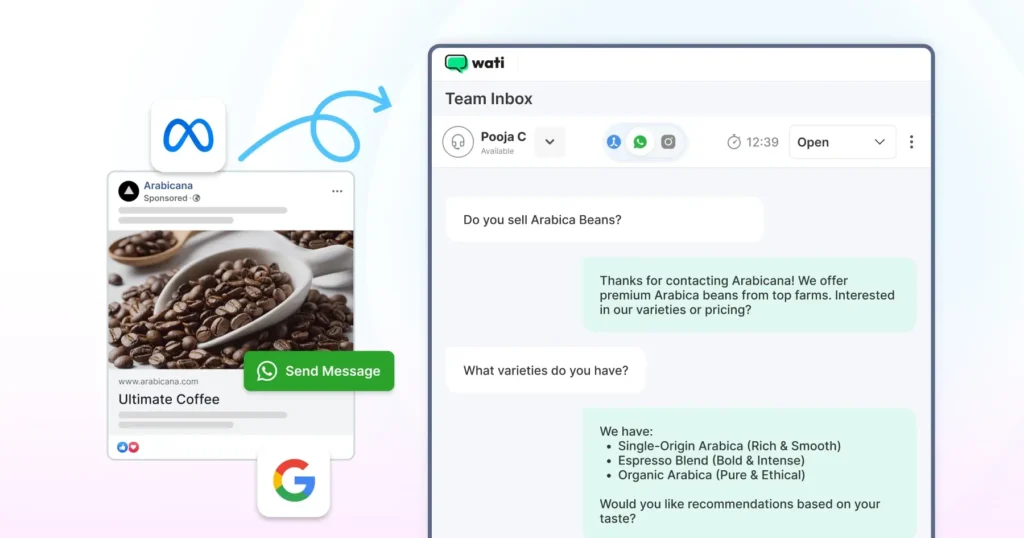
If you are running high-end marketing campaigns, this feature helps unify sales automation workflows in one window and track inbound leads.
Further, it helps streamline or improve your WhatsApp CRM operations for HR, field service, workforce management, event management, or any other industry domain.
Learn more: How to map customer journeys via WhatsApp for enterprises in 2026.
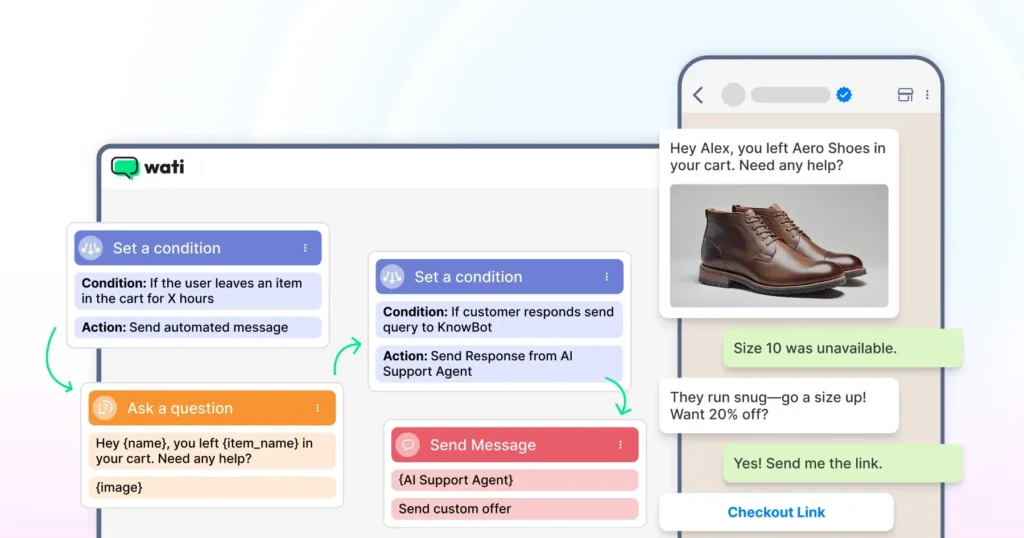
3. Abandoned Cart Recovery for Quick E-Commerce Operations
With Wati’s abandoned cart recovery functionality, you can target recovery mechanisms for shoppers leaving the transaction midway.
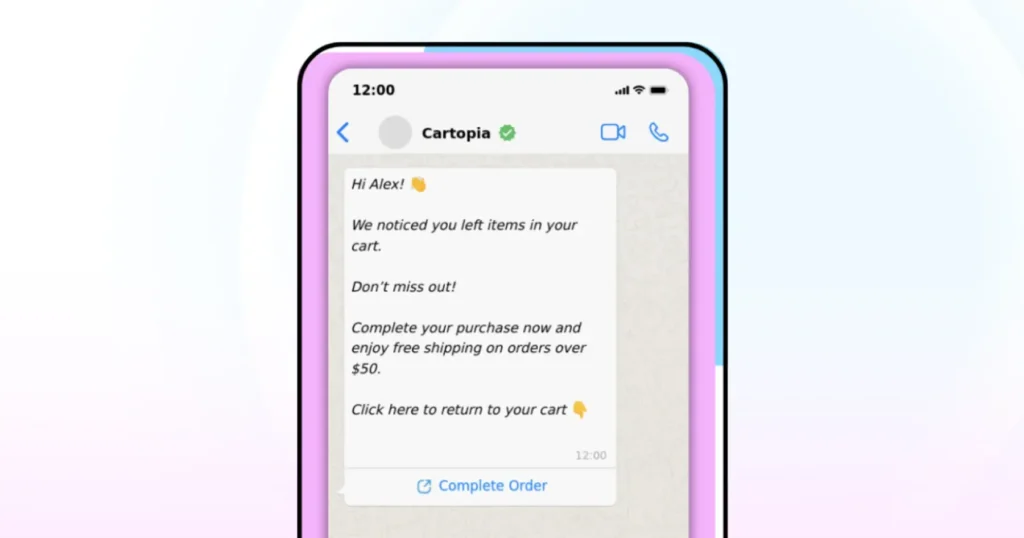
Wati’s WhatsApp for e-commerce integration tracks when a shopper leaves your site without completing a purchase and automatically triggers a recovery message with a direct checkout link and product image.
Also read: How to set up abandoned cart recovery messages on WhatsApp.
4. WhatsApp Flows for Event Ticketing and Reservation
If you haven’t updated a customer with event details or marked them in attendance planner, what are you even doing with an event registration setup?
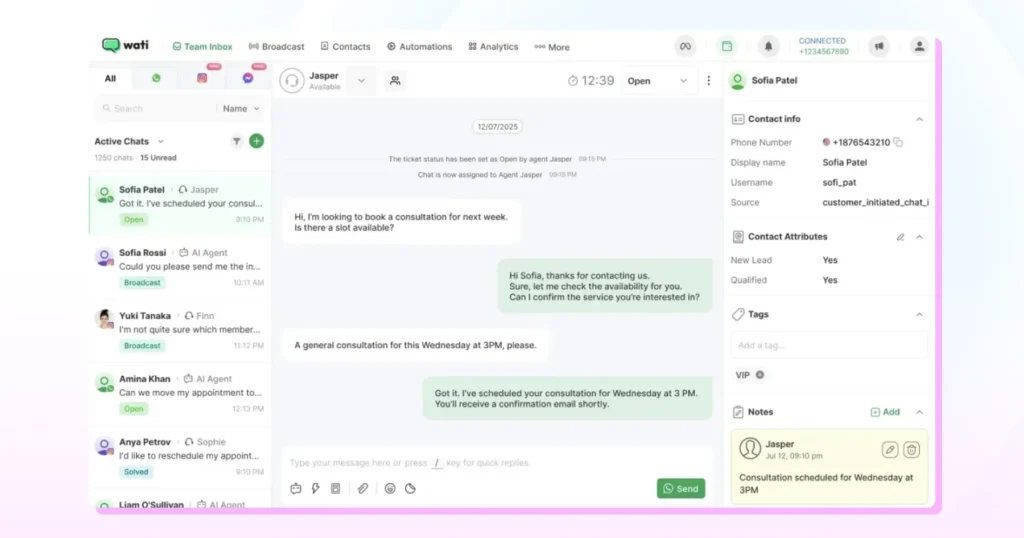
Wati WhatsApp Flows allow you to build rich, in-app forms for event management and ticketing registration.
Instead of sending users to an external site where they might drop off, they can complete registration, select meal preferences, and upgrade packages entirely within the chat.
5. Voice Automation and In-App Business Calling for Efficient Field Operations
Sometimes text isn’t enough for complex operations like field service, real estate, or workforce management.
Wati’s In-App Business Calling lets agents escalate a chat to a high-quality voice call directly in the Wati dashboard.
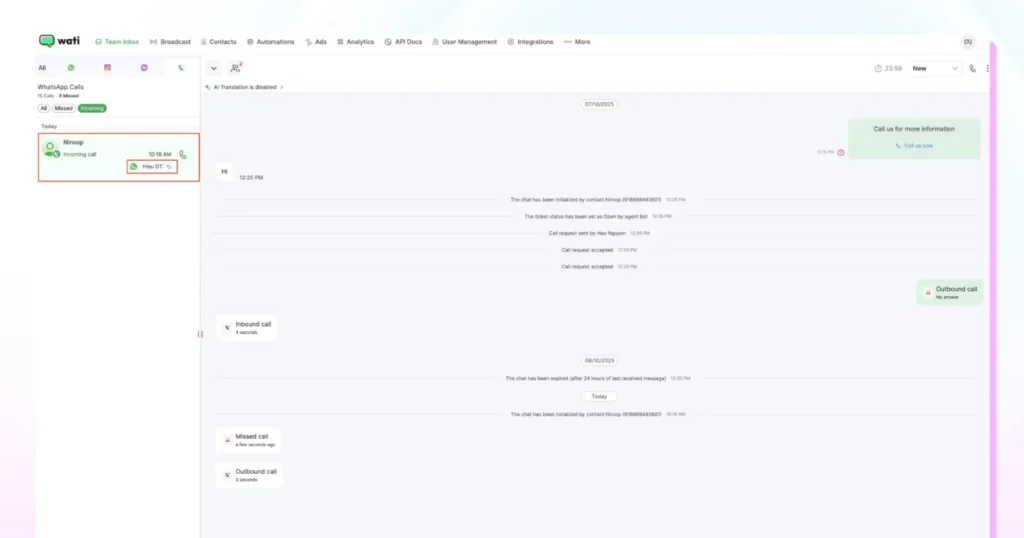
This keeps the entire history, text, and call logs in one unified thread for better audit trails. Having centralized repositories enables you to set up better practices, scale better, and achieve better engagement with decent operational costs.
Also read: How to build a WhatsApp chatbot for business in a convenient way to improve developer productivity.
6. Automated Business Templates for Conversational Intelligence
Efficiency in 2026 is driven by Automated Business Templates.
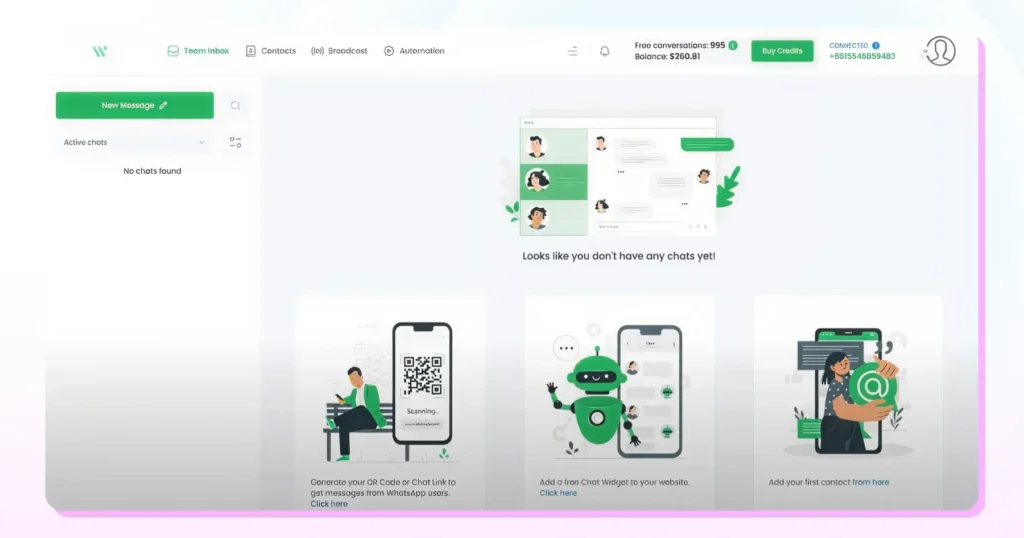
These are Meta pre-approved, interactive messages that trigger based on specific actions, such as an abandoned cart nudge or a “Technician Route” notification.
By using variables, these templates stay personal while remaining 100% compliant with Meta’s guidelines.
Businesses can power quick replies, automated greetings and away messages, promotional and discount messages, order shipment and delivery messages, and everything else with automated templates.
Also read: How to set up a WhatsApp Chatbot to power AI conversations with clients.
7. WhatsApp Pay for Native Transactions
The enterprise workflow completes the cycle within the app.
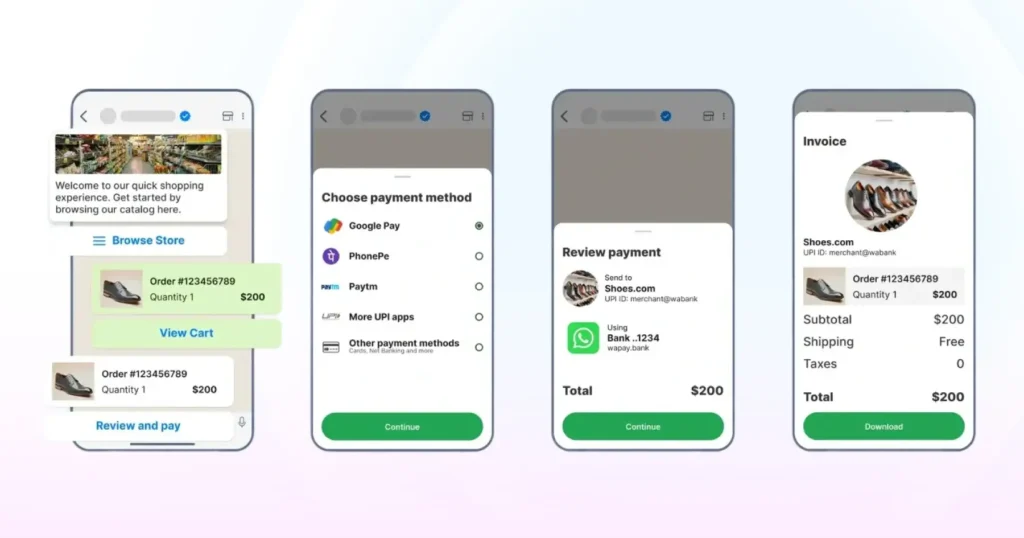
With WhatsApp Pay integration in supported regions, customers can browse your Product Catalog and make secure payments without ever leaving the conversation.
This “closed-loop” commerce is the gold standard for frictionless enterprise sales.
Also read: How to set up WhatsApp catalogs for enterprises in 2026.
Benefits of WhatsApp Business API for Enterprise
As we head into 2026, the API has evolved from a simple chat tool into a core operational necessity. For enterprises, the benefits are rooted in scalability and reliability:
- Reduced Customer Support Overhead: By automating up to 80% of FAQs through a WhatsApp chatbot for business, enterprises can significantly lower their cost-per-ticket while providing 24/7 service.
- Higher Conversion via CTWA and CTMA: Click-to-WhatsApp (CTWA) and click-to-message ads (CTMA) bypass traditional landing-page friction, moving users directly from an ad into a high-intent conversation, which has historically increased conversion rates.
- Frictionless Quick Commerce: With WhatsApp for e-commerce and WhatsApp Pay, the entire purchase journey, from catalog browsing to payment, happens inside a single window.
- Verified Brand Credibility: Official Business Account (OBA) status acts as a trust signal that can improve brand credibility and reduce the likelihood of spam perception.
- Fail-Safe Communication via SMS Fallback: For mission-critical logistics and supply chain updates, if a customer is offline, the system automatically triggers an SMS to ensure the message is delivered.
- Global Scalability: Unlike the standard app, the API supports Unlimited Agents and Devices, allowing distributed teams across the globe to collaborate from a single business number.
Complexities in Setting up WhatsApp API for Enterprise Stack
Below are the complexities enterprises might face when setting up their enterprise WhatsApp API stack in existing tech systems.
- Meta Business Verification: Navigating the 2026 requirements for Meta verification can be a bottleneck. Wati provides concierge support to ensure your business identity is approved without delay. Learn about WhatsApp API requirements in detail.
- Template Management & Compliance: Every proactive message must be an approved Automated Business Template. Categorizing these as Marketing, Utility, or Authentication is a complex dance to avoid account throttling.
- Data Fragmentation: Without a seamless CRM integration, chat history stays trapped in the messaging app. Wati bridges this gap by syncing all data back to Salesforce, Zoho, or HubSpot.
- Managing API Rate Limits: High-volume enterprises can hit Transactions Per Minute (TPM) limits during peak sales events. Managing these tiers requires a BSP that understands tier-scaling logic.
- Complex Logic Routing: Setting up “If/Then” routing (e.g., routing a Spanish-speaking customer to a specific agent) requires a robust WhatsApp automation engine rather than simple auto-responders.
Also read: How SMS Marketing Boosts Faster Delivery and Improves Marketing Campaign Success.
How Does Wati Supercharge Enterprise Operations?
Wati turns the complex WhatsApp Business API into a powerful operational hub through these ten core features:
- No-Code Workflow Builder: Design intricate, multi-step customer journeys (like abandoned cart recovery) using a visual drag-and-drop no-code builder without relying on developer programming skills.
- Shared Team Inbox: Centralize thousands of conversations in a single team inbox, enabling seamless agent handovers and collaborative support.
- WhatsApp Flows: Build interactive automation workflows in chat to achieve higher event registration completion rates than external links.
- In-App Business Calling: Turn your WhatsApp account into a full-fledged voice channel for field ops or high-stakes VIP sales. By integrating voice calling, you can attend to customer queries instantly.
- Personalized Broadcasting: Send multimedia updates to segmented lists with dynamic variables (e.g., customer name, delivery date).
- SMS Marketing Integration: Use SMS as a backup for critical notifications to ensure 100% reach regardless of data connectivity.
- Advanced Analytics Dashboard: Track agent performance, bot resolution rates, and ROI on WhatsApp marketing campaigns in real-time.
- Native CRM/ERP Plugins: Connect to your favorite tools (Zapier, HubSpot, Shopify) to fetch data and automatically trigger messages.
- AI-Powered Lead Qualification: Deploy a no-code chatbot that qualifies inbound leads before they even reach a human agent.
- Multi-Language Support: Automatically detect and respond to users in their native language, essential for global enterprise operations.
What Do Enterprises Need to Keep in Mind While Choosing the WhatsApp API?
Integrating a WhatsApp Business API into an enterprise stack is a sophisticated affair. It is not as simple as downloading an app; it requires a structured approach to approvals, compliance auditing, licensing, and business verification.
The Enterprise Pre-Requisite Checklist for 2026
Before you begin the integration, ensure your organization has the following “foundational pre-requisites” in place:
- Verified Facebook Business Manager: You must have valid business registration documents to pass Meta’s verification process.
- Unique Phone Number: A number that is not currently linked to a standard WhatsApp or Business App account. You can also set up a virtual number for your business.
- Proper Financing & Budgeting: A clear understanding of WhatsApp API pricing models, including conversation-based charges.
- Developer Resources or a BSP: A dedicated team or a WhatsApp BSP like Wati to manage the API endpoints.
- Line of Credit: A payment method linked to your Meta account to handle high-volume messaging fees without service interruption.
Choosing the Right Architecture: On-Premise vs. Cloud API
Meta supports Cloud API and partner-hosted API models, with most enterprises now choosing Cloud API via a BSP.
What to Keep in Mind When Choosing the Cloud API?
The WhatsApp Cloud API is hosted on Meta’s servers. It is the preferred choice for “no-fuss” industry operations where the focus is on rapid deployment and high-end WhatsApp marketing software campaigns.
It offers faster access to new features (like the latest WhatsApp Flows updates) and requires zero server maintenance from your IT team. Wati leverages this to provide a seamless, low-latency experience for global enterprises.
What to Keep in Mind When Choosing the On-Premise API?
The On-Premise API requires your company (or a BSP) to host the WhatsApp Business client on private servers.
This is often chosen by highly regulated industries (like banking or healthcare) that require total control over their data environment. However, it involves significant overhead in terms of server management, security, and encryption patching, and manual version updates.
Most modern enterprises are pivoting toward the Cloud API via a BSP like Wati. This hybrid approach gives you the security and data-fetching capabilities of a private setup with the reliability and scalability of Meta’s own infrastructure.
Learn more: WhatsApp Cloud API vs On-prem API: Which one suits best?
Orchestrating the Future With Wati’s WhatsApp API
By choosing a robust BSP platform like Wati, you meet your enterprise customers where they are while streamlining operations.
With WhatsApp Enterprise, you are installing an intelligent layer that makes your entire business more responsive, secure, and profitable.
With enterprises shifting to quick commerce for message delivery, building a foolproof intelligent sales framework with WhatsApp API is a recipe for growth!
Book a free demo of Wati to see it live in action.
Frequently Asked Questions
The Enterprise API is built for scale, supporting a large number of agents, multi-device access, and deep integration with CRMs like Salesforce. Unlike the app, it allows for advanced automation, higher messaging tiers (Tier 4), and managed security compliance.
Yes. Using Wati’s workflow builder and in-app business calling, enterprises can automate dispatching, track technician routes, and allow field agents to escalate chats to voice calls within a single, unified thread for better audit trails.
SMS Fallback is a fail-safe mechanism that automatically triggers a traditional SMS if a mission-critical WhatsApp notification (like a delivery update) fails to deliver due to poor data connectivity, ensuring 100% message reach.
WhatsApp Flows allow users to complete complex forms, select preferences, and book tickets entirely within the chat interface. This eliminates the need for external links, significantly reducing drop-off rates and increasing registration completions.
Absolutely. The API through Wati features End-to-End Encryption (E2EE), secure OAuth 2.0 access controls, and strict regulatory alignment with GDPR, making it safe for transmitting OTPs, financial alerts, and personal records.