

-

-
-
Solutions
-
Soluções
-
Soluciones
-
解决方案
-
解決方案
-
الحلول
-
Product
-
Produto
-
Producto
-
产品
-
產品
-
المنتج
-

-
-


 Wati for Marketing
 Wati for Support
 Wati for Sales
 eLearning
 E-commerce
 Marketing Agencies
 Healthcare
 No Code Chatbots
 WhatsApp Business API
 Instagram and Facebook messenger
 Click to WhatsApp ads
 Campaigns
 Team Inbox
 WhatsApp Business Calling
 Wati AI
 Overview
 Library
 Agente de suporte de IA
12 Winning WhatsApp Marketing Campaign Examples for 2026
Written by:
 Shreya Mattoo
|
Last updated on:
March 4, 2026
|
Fact Checked by :
Shreya Mattoo
|
Last updated on:
March 4, 2026
|
Fact Checked by :
 Namitha Sudhakar
|
According to: Editorial Policies
Namitha Sudhakar
|
According to: Editorial Policies
 Table of Contents
Too Long? Read This First
- WhatsApp Marketing Campaign enables businesses to engage with customers, build brand value and influence quick decision-making.
- Successful WhatsApp Marketing campaigns fall into two types: creative lead generation (using interactive bots) and customer support (providing utility).
- Brands like Hellman, Adidas, and Absolut Vodka launched innovative WhatsApp campaigns resulting in viral buzz, high engagement and new leads.
- Brands like KLM Airlines, BookMyShow, and Delhi Transport Corp use WhatsApp for top notch customer service, which improves customer satisfaction.
- WhatsApp Business API platforms like Wati can help power campaigns, enabling automation, chatbot integration, CRM connections and messaging.
Marketing campaigns are a savvy way to build product relatability with customers.
From OOH advertising campaigns to quirky creative agency copy to spins on everyday life challenges, brands love creating the perfect WhatsApp marketing campaign to reach a large customer base.
Whether you are an early adopter or a seasoned marketer aiming to lower customer acquisition costs and improve ROI, you can nurture website prospects with the best campaign.
In this guide, we will outline how to run WhatsApp campaigns, build brand trust, and drive consumer loyalty.
To make the experience even more seamless, you can integrate your sales CRM with WhatsApp marketing platforms to schedule drip campaigns, set up instant chatbot replies, and reduce response times.
Let’s dive into understanding the key WhatsApp campaigns shaping the B2B and B2C world in 2026.
Best WhatsApp Marketing Campaign Examples for Lead Generation
One of the biggest advantages of using WhatsApp for marketing is the ability to create personalized messages for your audience. The platform’s one-on-one messaging capability allows for a more intimate connection between a business and its customers.
Brands that aim to build the right marketing value proposition don’t just focus on securing deals; they run a WhatsApp marketing campaign to create a whole customer journey.
Creating targeted B2B or B2C WhatsApp marketing campaigns with proper segmentation helps personalize outreach and drive engagement.
Below are examples of how leading brands across industries launched their marketing campaigns via WhatsApp and achieved significant ROI.
1. Hellman’s WhatsCook: Sparked 13,000 Recipe Requests in Week One
Hellman, a well-known food and beverage brand famous for spreads, mayonnaise, and dips, launched a WhatsApp campaign to curb food waste.
To combat food wastage and promote product sales, Hellman launched a campaign in Brazil where users could send their picture of the leftover ingredients to a “WhatsCook” WhatsApp number.
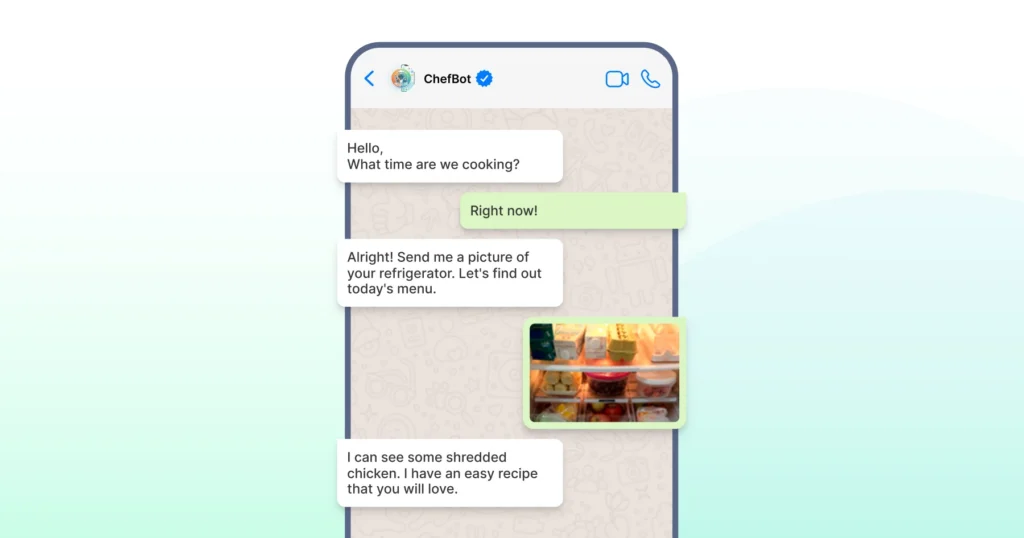
A team of real chefs would then analyse the ingredients and reply in real-time with personalized recipe suggestions using Hellman’s mayonnaise.
Through this WhatsApp marketing campaign, Hellman not only educated customers about how to minimize waste but also helped them turn leftovers into amazing meals.
The target audience for Hellman’s team was mostly Brazilian consumers who live independently and cook at home. It aimed at providing recipe inspirations to individualistic people.
Also read: How to build a WhatsApp broadcast list to run brand announcements and build awareness.
Outcome and End Result Metrics of Hellman’s Whatscook Whatsapp Marketing Campaign
- Content reach: The campaign went viral and reached over 4 million households who were struggling with food waste and wanted a solution.
- Content distribution: The Hellman’s team was about to cook and share around 500+ dishes with consumers.
- Sign up: 1 out of every 2 website visitors signed up for the personalized chef service.
- Consumer interest: It generated over 13000 recipe requests in the first week alone.
- Earned Media: The campaign earned around $150K in earned media and gained national and international recognition.
Hellman’s WhatsApp marketing campaign is a classic example of accurate customer positioning and doubling down on customer behaviour with an efficient strategy.
2. Saffola’s “Beat the Crave”: Driving a 500%+ Increase in Product Sales
To promote “Saffola Active” slimming drink, the brand created a “digital audio buddy” on WhatsApp.
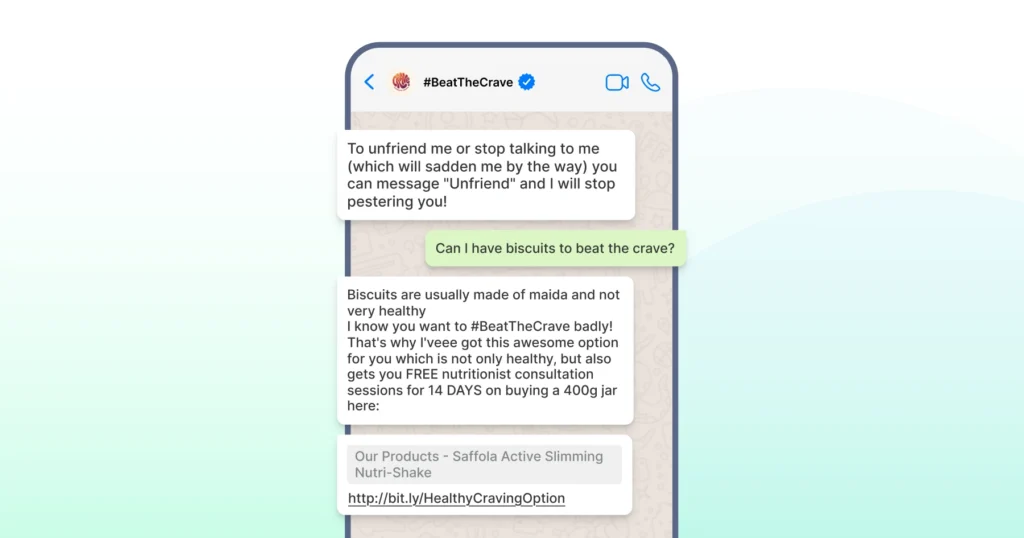
According to this campaign, users experiencing cravings for unhealthy food can message the number. In response, the chatbot would send engaging distractions like puzzles, rap songs, and motivational messages to help beat the cravings.
By distracting users’ minds, Saffola underlined the importance of healthy food choices, thus spreading the word about their slimming drink beverage.
The target audience for this marketing campaign was health-conscious consumers in India who are actively trying to manage their weight and diet.
Outcome and End-Result Metrics for Saffola’s Health Conscious Campaign
By spreading awareness about the dangers of overeating, Saffola could garner massive customer engagement and optimize its marketing spend. Below are the end result metrics of the campaign.
- Product sales: There was a 483% increase in product sales of Saffola’s slimming drink.
- Subscriber spike: Over 6000 WhatsApp subscribers joined the service.
- Consumer engagement: WhatsApp bots were able to beat unhealthy cravings of around 1,00,000 consumers.
Saffola’s campaign strategy brought the bigger problem into the limelight: the problem of calorie management. Their goal wasn’t to mislead customers into purchasing slimming drinks, but rather to highlight the dangers of overeating and offer alternatives.
Bonus Read: Explore Top WhatsApp API Providers to Build a smooth WhatsApp infrastructure to Send Large Broadcasts
3. Adidas “Rent a Pred”: Achieving a 92% Match Win Rate
Adidas, a well-known sports and lifestyle brand, promoted its line of “Predator boots” with a personalized WhatsApp marketing campaign.
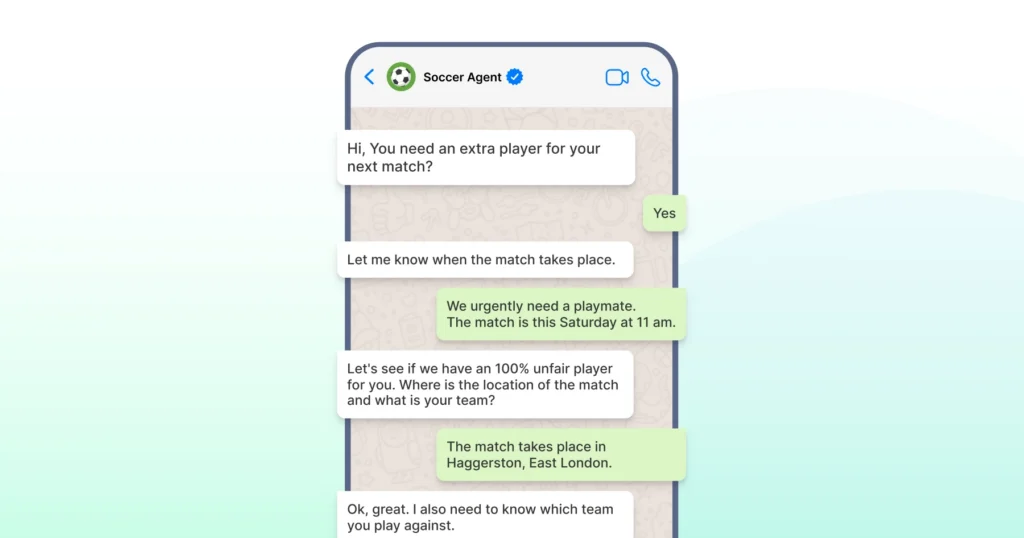
To land the “predator shoes” in the market in London, Adidas set up a WhatsApp hotline as part of their marketing campaign. Amateur football teams that were short a player for their game could message the team.
Adidas dispatched a “highly skilled, professional player” to fill the requirement and join the team.
By assigning a professional player (or Predator) for amateur games, Adidas created a brand message for its product. Having a “Predator” element was crucial for the success of the game.
The target audience for this campaign was amateur and local football players in London. The focus was on building customer engagement and initial brand buzz for the new shoe line
Outcome and End Result Metrics for Adidas’ Sports Campaign
By helping football teams get professional expertise on board, Adidas raked in good customer engagement and brand awareness.
According to the campaign source, below are the end campaign metrics for Predator shoes.
- Local awareness: The campaign generated huge buzz within the local football community and on social media.
- Match winback: Teams that used “Rent a Pred” had a 92% win rate.
- Predator goals: The “Predator” players contributed 29 goals across the games they joined
With the Predator campaign, Adidas established relationships within the local football community, which boosted product sales and revenue.
4. Flipkart’s “Personal Shopper”: Securing 3.5x Higher Conversion Rates
During its massive annual “Big Billion Days” sale, the Indian e-commerce giant integrated a WhatsApp chatbot personified to reply like the famous Bollywood celebrity, Amitabh Bachchan.
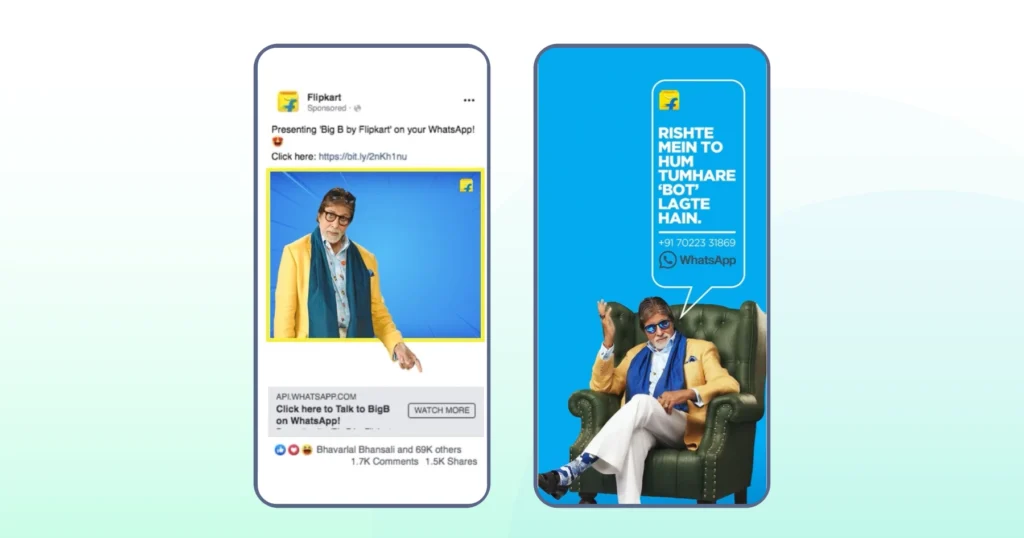
The brand launched a “Personal Shopper” campaign where they integrated a live WhatsApp bot to tackle consumer queries.
The bot acted as a “personal shopper”, guiding users through deals, answering queries, and providing a more interactive and entertaining shopping experience than a standard web interface.
The target audience for the campaign was existing and new e-commerce shoppers in India participating in the sales event.
Outcome and End Result Metrics of Flipkart’s Personal Shopper Campaign
The major goal of FlipKart’s personal shopper campaign was to drive revenue through unique customer experiences. Below are the outcome and end result metrics of Flipkart’s personal shopper campaign:
- Conversion: The campaign drove 3.5 times higher conversion rates compared to other marketing channels
- Lead quality: It generated 7 times more high-quality leads (users showing clear purchase intent).
- Customer interaction: The campaign successfully managed massive volumes of customer interaction during the peak shopping period.
5. Maggi Germany: Chef in Your Kitchen WhatsApp Campaign Floated to 20,000 customers
Maggi wanted to promote its product as a staple in daily household cooking. They launched the “Chef in Your Kitchen” campaign to suggest several personalized Maggi recipes to customers.
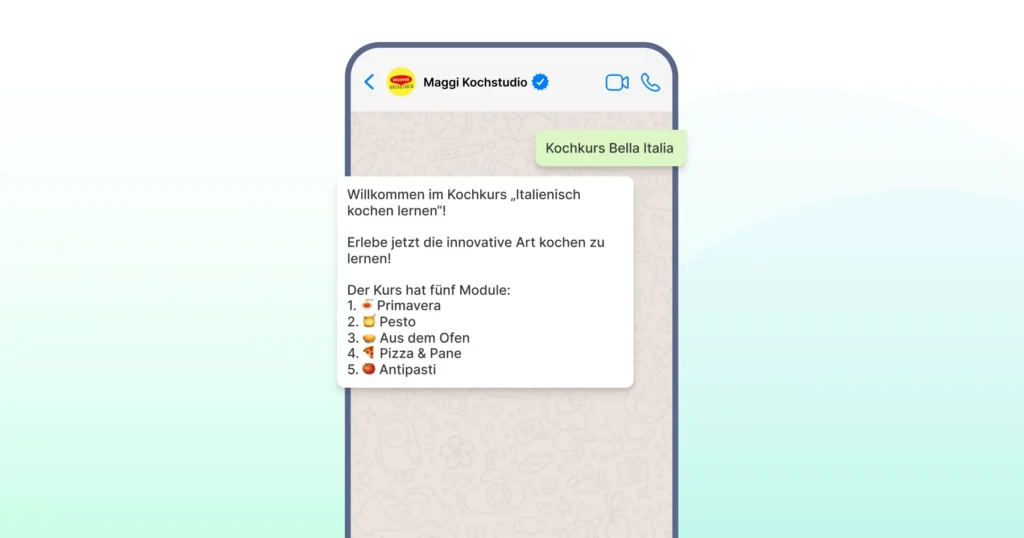
The WhatsApp bot curated a specific menu that customers can choose from and listed different recipes from that menu to give a restaurant-like feel to customers at home.
This 2017 Maggi Germany campaign leveraged an automated cooking course that used a WhatsApp chatbot to provide step-by-step video tutorials, a shopping list, and real-time cooking advice.
Outcome and End Result Metrics of Maggi Germany Chef in Your Kitchen
- High engagement rate: With over 20,000 messages exchanged and an average interaction time of more than 1 minute.
- 4.2 point lift in the standard ad recall.
- 3-point lift in campaign awareness.
6. Delhi Transport Corp (DTC): Selling 1.4 Million+ Tickets and Doubling User Satisfaction
With a mission to digitize public services, the DTC launched a WhatsApp chatbot that allows commuters in Delhi to book bus tickets.
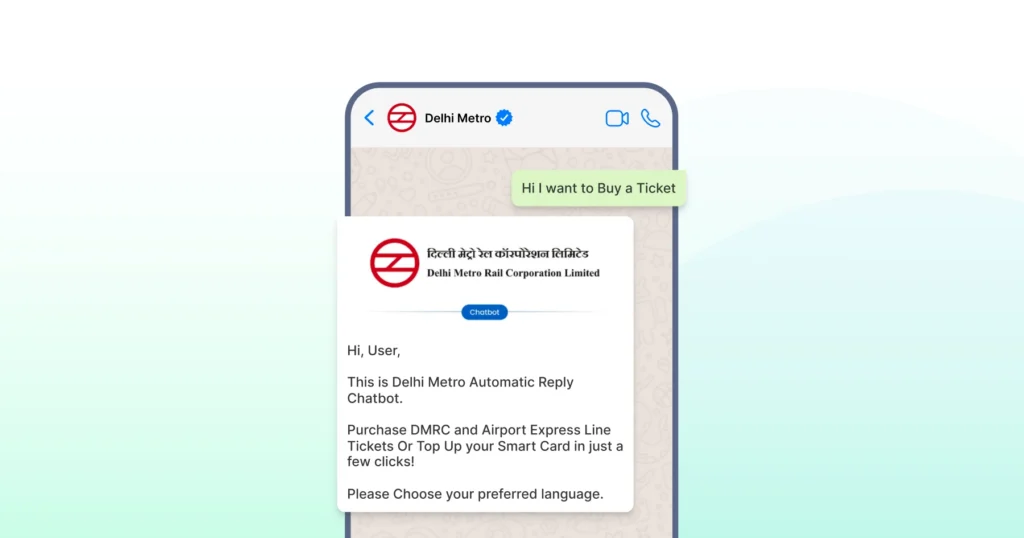
As per the WhatsApp marketing campaign, Users can simply send “Hi” to a designated number, and the chatbot guides (in English or Hindi) to select their route, choose a bus, pay, and receive their ticket via a QR code directly in the chat.
The target audience for DTC was millions of daily bus commuters, including those who might not be comfortable with complex apps.
Outcome and End Result Metrics of DTC’s WhatsApp Campaign
- Adoption: Over 1.4 million tickets were sold via the WhatsApp chatbot in its initial phase.
- User Satisfaction: The service led to a 2x increase in user satisfaction due to its speed and simplicity.
- Accessibility: The multilingual support made digital ticketing accessible to a much wider audience.
Also read: How to set up a virtual number to engage with Customers on WhatsApp for flexibility and convenience
Best WhatsApp Campaigns for Customer Support
Beyond lead generation and brand awareness, brands also use the WhatsApp Business API to run campaigns for existing customers.
Below are three examples of such WhatsApp campaigns.
1. KLM Royal Dutch Airlines: Scaling 24/7 Support Across 10+ Languages
Being one of the first global airlines to integrate a WhatsApp Business account, KLM Royal Dutch Airlines launched personalized, customer-specific messaging to provide uninterrupted support to passengers.
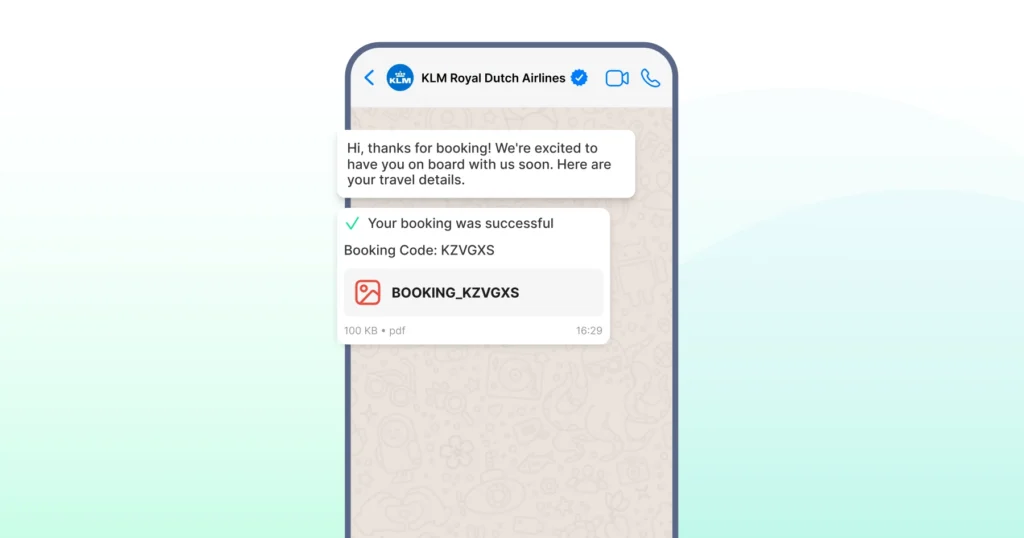
As per this campaign, passengers can opt in to receive their booking confirmation, boarding pass, flight status updates, and check-in reminders directly on WhatsApp.
It also functioned as a 24×7 customer service channel, offering support in multiple languages. By segmenting customers and initiating focused service automation, KLM could provide a consumer-first flying experience.
The main target audience for KLM Royal Dutch Airlines was international travellers and existing KLM customers seeking convenience and real-time updates.
Outcome and End Result Metrics of KLM Royal Dutch Airlines’ WhatsApp Campaign
KLM Royal Airlines supercharged the airline experience for its customers with targeted customer assistance and service. Below are the end metrics of this WhatsApp marketing campaign.
- Multilingual access: The service is available in over 10 languages, serving a global audience.
- Personalization: It has significantly improved customer satisfaction by providing a fast and personalized communication channel.
- Load reduction: It reduced the load on traditional customer service channels, such as toll-free helplines and email support.
Not only that. In some cases, KLM also triggered updates to passengers’ family members, thereby reducing panic and aiding peace of mind and broader brand awareness.
Providing real-time, white-glove service to passengers and sending real-time flight details increased brand loyalty, trust, and customer engagement manifold.
2. BookMyShow’s Ticketing: Slashing SMS Costs by Over 60%
Instead of relying on email and costly SMS marketing, BookMyShow integrated WhatsApp Business API to elevate customer experience and provide good service.
As a part of the campaign, whenever a customer books a ticket, they receive an opt-in to get the ticket and QR Code directly on WhatsApp.
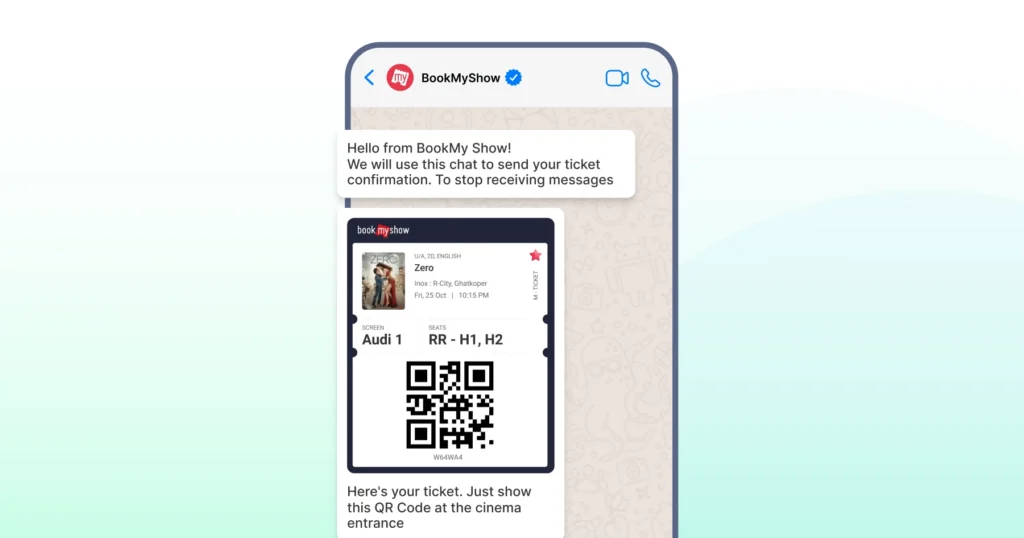
This serves as a digital, easily accessible m-ticket and also as a channel for post-movie feedback and future promotions.
The target audience for BookMyShow was all the customers in India booking tickets for movies, gigs, comedy skits, and plays.
Outcome and End Metrics of the BookMyShow Campaign
By implementing “consumer-friendly” conversational marketing on WhatsApp, BookMyShow received a surge in consumer interest. Below are the end metrics from the campaign.
- Cost Savings: The company cut its SMS and notification-related costs by over 60% by switching to WhatsApp.
- Delivery & Read Rate: Achieved an over 95% delivery and read rate, ensuring customers almost always received and saw their tickets.
- Reduced Support Queries: Saw a significant drop in customer service calls and emails related to “I didn’t receive my ticket.”
- Positive Feedback: The service received positive feedback from customers, saying that it helped them track events and not miss out on upcoming shows.
Best WhatsApp Marketing Campaigns for Creative Content and Maximum Impact
WhatsApp’s multimedia capabilities allow businesses to share a variety of content formats, including images, videos, and audio clips.
This opens up a world of possibilities for creative marketing campaigns.
Here are two WhatsApp marketing campaign examples that highlight the power of content sharing.
1. Colgate’s Oral Health Education Campaign
Colgate launched an oral health education campaign in India, using WhatsApp to share informative videos and images.
The content was not only educational but also entertaining, making it an effective way to engage their audience and promote their brand.
2. BBC News’ WhatsApp Ebola Updates
BBC News utilized WhatsApp to provide vital information about the Ebola outbreak in West Africa. They shared news updates, public health advisories, and audio clips to keep their audience informed and safe during the crisis.
How Wati Can Help Boost Your WhatsApp Initiative
With a WhatsApp Business API tool like Wati, you can use appealing WhatsApp message templates, integrate a low-code chatbot builder, and schedule automations to take WhatsApp broadcasts to another level.
A powerful platform like Wati provides automation, integration, segmentation, fallback, and scalability to handle everything from lead generation to e-commerce growth.
Below are three examples of how businesses are using Wati’s platform to achieve their goals.
1. Rocket Health: Achieving a 20X Increase in New Customer Registrations
The Ugandan healthcare provider, Rocket Health, used Wati to build an automated chatbot, “Roc.K.”
This bot handles patient intake, answers FAQs, and streamlines the process for doctor consultations, lab test bookings, and pharmacy orders. By integrating with their systems, Wati automates follow-ups for lab results and medication, creating a seamless patient journey.
The target audience for this campaign was patients in Uganda seeking convenient and reliable access to virtual healthcare services, pharmacy delivery, and lab appointments.
Outcome and End Result Metrics for Rocket Health’s Campaign
By integrating the WhatsApp Business API platform like Wati, Rockethealth could better track the patient conversations and provide instant responses to build good synergy. Below are the end metrics from the above-mentioned campaign.
- Customer Growth: Drove a 20x increase in new customer registrations.
- Efficiency: Reduced the time for new user registration by 60%.
- Sales: Led to a 2.5x increase in pharmacy orders by automating the process.
Click here to learn more about Wati’s role in Rockethealth’s campaign and the improvement in brand success metrics.
2. Habuild: Doubling Community Engagement While Reducing Workload by 30%
Habuild, an online yoga and wellness platform, utilizes Wati to manage its massive and growing community during its popular 21-day yoga challenges.
They use the platform to onboard thousands of users at scale, send daily class links, deliver motivational messages, and provide personalized updates, all without getting blocked or managing fragmented chats.
The target audience was a global community of over 10,000 individuals looking to build a consistent habit of yoga and wellness.
Outcome and End Result Metrics for Habuild’s WhatsApp Campaign
By providing yoga routines and wellness plans, Habuild managed to strike a chord with fitness enthusiasts and land itself well.
- Engagement: Saw a 2x increase in overall community engagement and retention.
- Operational Efficiency: Automated communications led to a 30% reduction in the team’s operational workload.
- Scalability: Successfully managed and scaled communications for a community of over 100,000 members.
Click here to know more about Habuild’s WhatsApp campaign powered with Wati chatbots for yoga awareness.
How Does Wati Accelerate Campaign Growth?
If you’re ready to start your own WhatsApp marketing journey, Wati can help you launch and manage bulk broadcasting to multiple contacts with ease.
Wati is a WhatsApp API integration tool that allows businesses to automate their messaging, manage customer interactions, and track campaign performance, all in one place.
By using Wati, you can:
- Scale with Broadcasts: Send bulk, personalized messages to thousands of opted-in customers simultaneously without risking account bans.
- Capture Leads via Click-to-WhatsApp Ads: Convert social media traffic instantly by directing users straight into a chat, capturing lead data at the peak of their interest.
- Recover Revenue via Automation: Deploy abandoned cart recovery nudges and automated festive offers to drive sales during high-traffic periods.
- Drive In-Chat Conversions: Use the product catalog and WhatsApp payments to let customers browse and buy without ever leaving the app.
- Ensure 100% Reach: Use SMS marketing as a fallback to deliver time-sensitive offers even when a user is offline or lacks data.
- Optimize Team Performance: Use a shared team inbox and WhatsApp business calling to collaborate on high-value leads and monitor agent response times.
- Sync with your Stack: Integrate with CRMs like HubSpot to fetch lead profiles and trigger automated workflows in real time.
- Refine Strategy with Analytics: Use detailed campaign data to identify peak engagement times and high-performing segments for fast brand recall.
With Wati by your side, you’ll have all the tools and support you need to make your WhatsApp marketing campaigns a resounding success.
Today for the Consumer, Tomorrow for Campaign Success
Looking at the examples above, one thing stands out. A successful campaign is directed first at consumers’ best interests, then at the brand’s interests.
To stand out in a crowded market, you need to double down on customer experience rather than on campaign strategy.
While strategy is crucial, delegating technical work to automation tools like Wati can give you more room to grow and connect with target customers.
Sign up for a free demo to learn how to run your first marketing campaign
WhatsApp Marketing Campaign: Frequently Asked Questions
The WhatsApp Business API is designed for this. It allows you to broadcast messages to thousands of opt-in users. If users have opted in for content, they’ll engage with your content. Worst case scenario, they still won’t block. This ensures high deliverability and compliance.
Using the API platforms like Wati, you can build a low-code chatbot. This bot can instantly answer common campaign queries, ask qualifying questions, and route high-intent leads directly to your sales team 24/7.
Yes, the API integrates directly with your CRM (say HubSpot or Salesforce). This allows you to retrieve customer data and personalize your message with name, background, past orders or loyalty status.
WhatsApp API platforms like Wati provide detailed analytics. You can track key metrics like message delivery rates, read rates, and click-through rates on your campaign links, giving you clear data on performance and conversions.