

-

-
-
Solutions
-
Soluções
-
Soluciones
-
解决方案
-
解決方案
-
الحلول
-
Product
-
Produto
-
Producto
-
产品
-
產品
-
المنتج
-

-
-


 Wati for Marketing
 Wati for Support
 Wati for Sales
 eLearning
 E-commerce
 Marketing Agencies
 Healthcare
 No Code Chatbots
 WhatsApp Business API
 Instagram Automation
 Click to WhatsApp ads
 Campaigns
 Team Inbox
 WhatsApp Business Calling
 Wati AI
 Overview
 Library
 Agente de suporte de IA
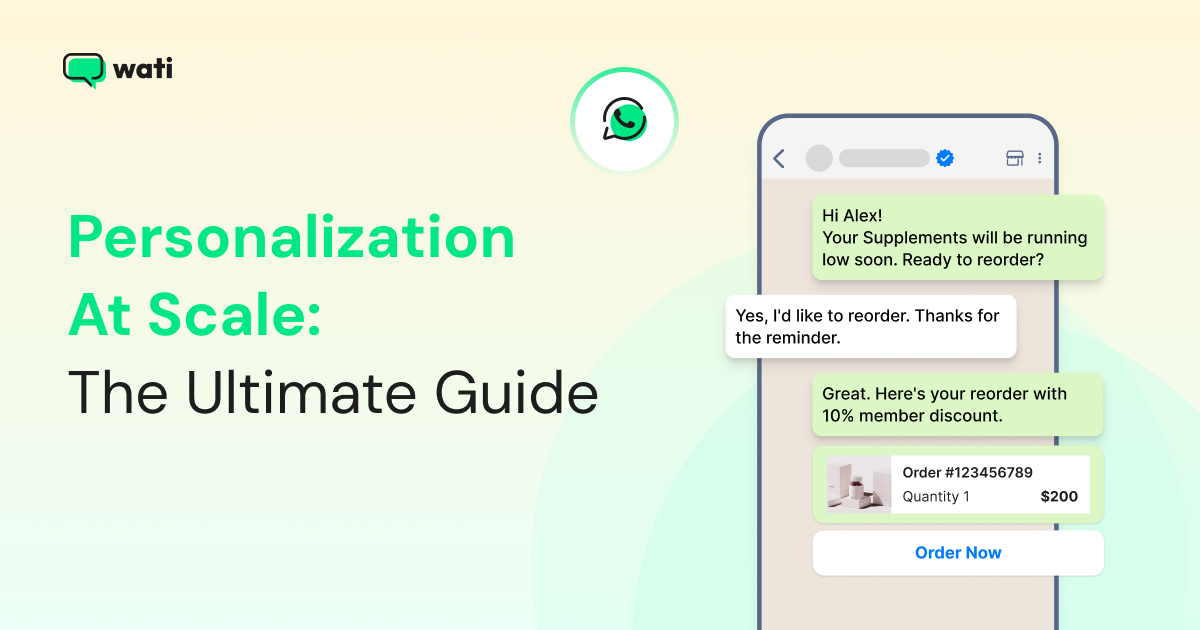
What is Personalization at Scale: What are You Missing Out on in 2026?
Written by:
 Shreya
|
Last updated on:
February 23, 2026
|
Fact Checked by :
Shreya
|
Last updated on:
February 23, 2026
|
Fact Checked by :
 Namitha Sudhakar
|
According to: Editorial Policies
Namitha Sudhakar
|
According to: Editorial Policies
 Table of Contents
Too Long? Read This First
- What It Is: Combining AI automation with deep customer context to deliver the right message, on the right channel, at the moment of intent.
- Why It Matters: Boosts loyalty, drives high conversions, and cuts acquisition costs by up to 50% via hyper-relevance.
- The Challenge: Requires unified customer data (no silos) and strict ethical practices to maintain customer trust and privacy.
- How To Do It: Use advanced platforms (like Wati with Gemini 3.0/WhatsApp API) for inbound intelligence and automated, context-aware messaging.
Don’t you also feel uneasy when random credit card companies call?
They call you and say you have filled out their form or booked an appointment? This is an ideal example of blind outreach.
Getting calls from companies you’ve nothing to do with contributes to a negative experience. Which is why, as brands, you might feel that personalizing communication is crucial.
When we talk about personalization at scale, it is a hybrid approach that considers other sales tactics and customer data.
In this article, we explore modern tools for personalization and how to use them effectively to achieve maximum output.
What is Personalization at Scale?
Personalization at scale enables businesses to dynamically create brand content to the requirements or intent of the end customer. Achieving personalization at scale requires access to real-time customer data at the individual level.
Personalized experiences are now a key differentiator for brand reputation as consumer expectations rise.
In 2026, scaling personalization is less about volume and more about relevance. It is the strategic combination of advanced AI-driven automation with deep customer context. Leveraging data and artificial intelligence enables organizations to analyze and act on customer information at scale, delivering relevant and timely experiences.
A personalization engine, combined with seamless integration of data sources, is essential to unify customer data and enable effective personalization at scale.
The “Why” of Personalization: Digging Deep Into Customer Intent
Just the way you don’t like surprises out of the blue, your customers are the same way.
When a business communicates in a generic way, it signals a fundamental lack of respect for the customer’s time and context. Meeting customer expectations requires delivering relevant and timely interactions.
Generic customer experiences- such as irrelevant ads or emails – can frustrate customers, harm conversions, waste budgets, and diminish brand differentiation.
The “why” is also rooted in customer psychology. Customers reward brands that hit the right nerve at the right time, when our satisfaction levels are high, and vice versa.
In a recent industry study, 71% of consumers expect companies to deliver personalized interactions, with 76% becoming frustrated when they receive spam or irrelevant messages. Hence, companies that excel at personalization generate 40 percent more revenue from those activities than average players.
Drives Customer Engagement at the Moment with Data
Finding the right balance between sales efficiency and consumer demand is a key principle in delivering supply.
Personalization uses real-time behavioral data (e.g., website browsing, abandoned cart events, recent searches) to trigger communications precisely when the customer is most receptive, not just on a fixed schedule.
AI algorithms analyze vast datasets, including browsing history, past purchases, and user behavior, to predict intent and customize interactions in real time. Data analytics enables businesses to deliver timely, individualized experiences by analyzing large datasets to understand customer behavior and preferences across multiple channels and send messages accordingly.
Also read: How to set up abandoned cart recovery messages via WhatsApp in 2026.
Reduces Acquisition Costs
Personalization should be a part of your overall marketing strategy. Marketing efforts across all channels should also be aligned.
The WhatsApp Business API can be an important channel for reaching customers as part of a holistic marketing strategy. Segment people, create messages, and announcements based on segments. This helps you increase your conversion rate.
Fosters Deeper Loyalty
When a brand shows that it remembers past preferences, purchases, and support history, it elevates the relationship from transactional to human.
Delivering meaningful customer experiences through tailored interactions connects more effectively with their audiences and fosters brand loyalty, encouraging repeat customers.
Cultivate Brand Trust
Tailored experience across websites, when done ethically and transparently, demonstrates a commitment to providing value.
Customers are more likely to share data and remain loyal to brands they trust not to bombard them with generic, irrelevant noise, especially given that 81% of consumers ignore irrelevant marketing messages.

Also read: Learn how you can create WhatsApp marketing messages in the right way to entice customers and promote action.
Drives High Value Conversions
Personalized CTAs, for instance, have been shown to convert much better than generic ones. Incorporating personalized recommendations and personalized messages. Suggesting products or content based on user data can drive conversions by addressing individual needs and preferences.
What are the Key Advantages of Personalization?
The shift from segmentation to true personalization at scale provides measurable, multi-faceted benefits across the entire customer journey.
| Key Advantage | The Business Impact | Data Metrics That Support |
| Increased revenue and conversion | Tailoring CTAs, product recommendations to customers’ real-time intent. | Personalized CTAs convert 200% better than default CTAs, thus driving 10-15% revenue. |
| Amplified customer loyalty | Transforming transactional relationships into partnerships. | Companies with advanced personalization report 71% more customer loyalty. |
| Operational efficiency | Intelligent automation handles | Maintain rapid, contextual responses while scaling sales pipelines. |
Platforms that allow for rich-media messaging and dynamic fields, like those found in the WhatsApp Business API, dramatically increase engagement and relevance.
Also read: How Wati’s AI Agent (Powered with Gemini) optimizes customer responses and boosts personalization to scale revenue generation in 2026
Need inspiration? Check out the most effective ways to tailor customer journeys using templates: 10 Updated WhatsApp Business API Message Templates for 2025.
What are the Key Disadvantages of Personalization?
One major challenge is that personalization at scale requires integrating customer data from multiple siloed sources, making the process complex and resource-intensive.
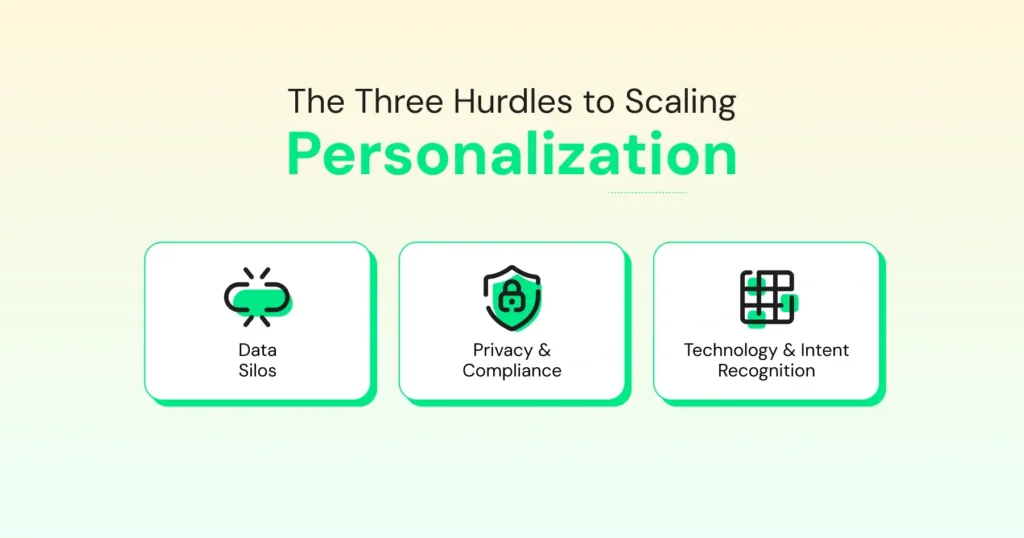
Generic marketing automation tools often lack the Inbound Intelligence needed to decipher unstructured chat data.
Implementing true intent recognition and dynamic personalization, requires advanced AI which with the right platform partners.
Imagine this,
A B2B lead clicks a “Request Demo” ad that links directly to WhatsApp. Wati’s AI support agent engages instantly, asking intelligent, context-driven questions (e.g., “What is your team size?” and “What is your primary use case?”) based on the lead source (the ad creative).
The AI continuously analyzes user behavior and predicts the next best action to deliver highly relevant responses. Continuous testing is essential to optimize these personalization strategies, ensuring that the AI adapts and improves based on performance metrics and customer feedback.
AI qualifies the lead as “High-Intent Enterprise,” provides a personalized case study link based on their industry, and books a meeting with the correct human sales rep who already has a complete summary of the conversation and the lead’s intent.
Also read: How to power AI-personalized chats via a WhatsApp Chatbot on Wati?
Foundations of Personalization
As mentioned earlier, Personalization at scale is only possible when businesses use customer data and machine learning. These two pillars work hand in hand to deliver highly relevant customer experiences across multiple channels, ensuring that every interaction feels tailored and meaningful.
Customer Data: The Raw Material of Personalization
A customer data platform (CDP) is essential for unifying this wealth of information, providing a single, comprehensive view that supports seamless personalization.
First-party data allows brands to create personalized experiences to exceed modern customer expectations. When businesses use insights from purchase history and behavioral data, they can deliver personalized experiences.
Machine Learning: The Engine Behind Scalable Personalization
Machine learning is the driving force that transforms raw customer data into actionable insights. By analyzing vast datasets, machine learning algorithms can identify patterns, predict customer behavior, and automate the delivery of personalized content.
Automated marketing campaigns powered by machine learning increase customer engagement, conversion rates, and customer retention.
Ultimately, this leads to sustained business growth as brands consistently deliver personalized content that resonates with each individual customer.
Also read: How sending bulk messages in 2026 (Free+Paid methods) is effective for mass communication.
Best Practices for Personalizing Conversation
As the landscape of personalization evolves, staying ahead means adopting the latest best practices to meet and exceed customer expectations.
Integrating customer interactions across touchpoints is crucial to delivering effective, real-time, personalized experiences.Here are the key strategies for achieving effective personalization at scale in 2026:
- Unify customer data: Use a customer data platform to integrate information from all sources, creating a single, accurate view of each customer.
- Deliver real-time personalization: Harness real-time data to provide tailored experiences that address customers’ immediate needs and preferences.
- Orchestrate personalized journeys: Utilize marketing automation to create seamless, personalized interactions across multiple channels and customer touchpoints.
- Continuously test and optimize: Regularly evaluate and refine your personalization efforts to ensure they remain effective and relevant in a changing market.
- Prioritize data accuracy: Maintain up-to-date, complete customer data to support the delivery of highly relevant and personalized experiences.
- Focus on customer loyalty: Use personalization to build strong, lasting relationships that drive repeat business and customer retention.
- Stay agile: Be ready to adapt your personalization strategy as customer expectations and market trends evolve.
By following these best practices, businesses can deliver personalized experiences, drive customer satisfaction and loyalty, and achieve significant business growth. The key to success in 2026 is a commitment to leveraging customer data, machine learning, and continuous optimization to meet the ever-rising bar of modern customer expectations.
Build That Human Touch!
With personalization, you can dive deep into cultural sensitivity, linguistic preferences, and emotional sentiment of your customer without selling things abruptly.
In 2026, using strategic and tech-focused API solutions like Wati’s WhatsApp Business API can help you turn customer data segments into high-intent customer journeys with a suite of features.
The goal is not just efficiency, but empathy. By deploying sophisticated inbound intelligence with tools like Wati, marketers and sales leaders can personify connections and focus more on sentiments rather than processes. This is precisely what leads to success.
Curious to know how Wati fuels Business Conversations? Get started with Wati and book a demo to Know More Today!
Frequently Asked Questions: Personalization At Scale
Got more questions? Find answers below!
It combines the immediacy and high engagement of a personal chat app with the robust automation, segmentation, and rich media capabilities of an enterprise platform, ensuring instant, contextual, and compliant communication at massive scale.
The key is transparency and utility. Brands must adhere strictly to clear opt-in consent and ensure personalization provides clear, helpful value to the customer (e.g., faster support, relevant offers), rather than intrusive, stalker-like messaging.
AI is the engine of personalization at scale. Models like Gemini 3.0 analyze natural language to determine customer intent and sentiment, allowing platforms to deliver accurate, real-time, and highly personalized responses to millions of users simultaneously.
Inbound Intelligence is the ability of a system (like Wati’s platform) to convert unstructured customer communication and behavioral data into actionable insights. It allows brands to understand why a customer is reaching out and automatically route them to the perfect response or agent.
Personalization is about customizing a message (e.g., using a customer’s name). Personalization at scale is about customizing the entire experience (channel, timing, content, offer) for millions of individuals simultaneously, requiring advanced AI and integrated data systems.