

-

-
-
Solutions
-
Soluções
-
Soluciones
-
解决方案
-
解決方案
-
الحلول
-
Product
-
Produto
-
Producto
-
产品
-
產品
-
المنتج
-

-
-


 Wati for Marketing
 Wati for Support
 Wati for Sales
 eLearning
 E-commerce
 Marketing Agencies
 Healthcare
 No Code Chatbots
 WhatsApp Business API
 Instagram Automation
 Click to WhatsApp ads
 Campaigns
 Team Inbox
 WhatsApp Business Calling
 Wati AI
 Overview
 Library
 Agente de suporte de IA
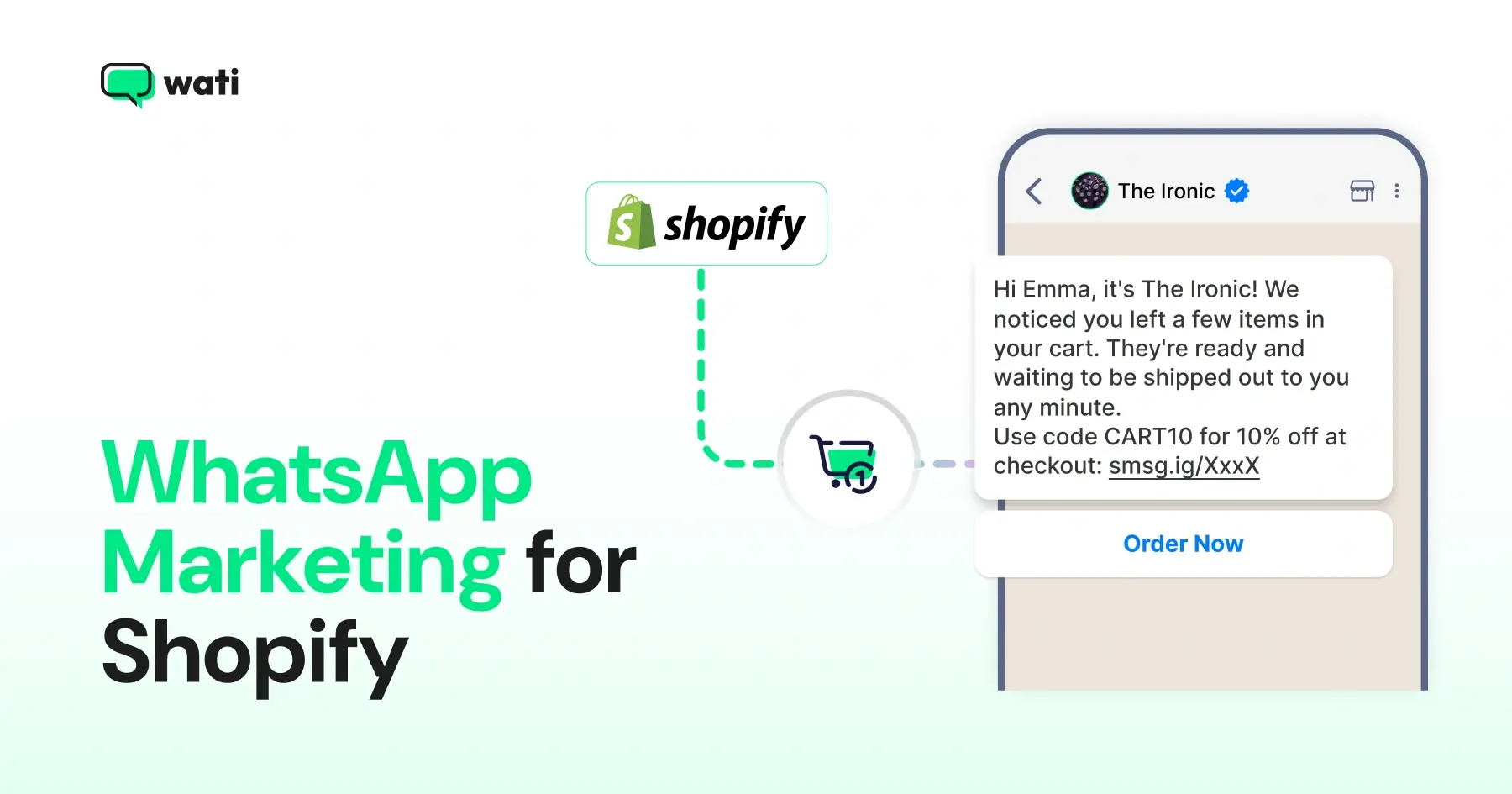
WhatsApp Marketing for Shopify: How to Turn Every Message into a Revenue Moment
Written by:
 Rohan Chaturvedi
|
Fact Checked by :
Rohan Chaturvedi
|
Fact Checked by :
 Namitha Sudhakar
|
According to: Editorial Policies
Namitha Sudhakar
|
According to: Editorial Policies
 Table of Contents
Too Long? Read This First
- WhatsApp marketing for Shopify is not just cart recovery. It is a full-funnel strategy that works from the first opt-in to the repeat order.
- WhatsApp is where your customers actually are. Messages get seen, opened, and acted on faster than any other marketing channel.
- A proper WhatsApp marketing strategy covers four stages: building your subscriber list, converting browsers into buyers, retaining customers, and building long-term loyalty.
- Broadcast campaigns work best when they are segmented, timely, and tied to a specific reason to buy. Generic blasts get ignored or blocked.
- The biggest mistake Shopify stores make is treating WhatsApp like email. It is a personal channel and needs to be treated like one.
- Wati connects WhatsApp directly to your Shopify store so every message is personalized, automated, and tracked back to revenue.
Two Shopify stores. Same products, ad spend, and email sequences.
One of them is running WhatsApp marketing. Abandoned carts come back. Repeat purchases climb. Support tickets drop. Campaigns go out to the right customers at the right time, and the revenue shows it.
The other store is still waiting for email open rates to improve.
The difference is neither budget nor team size. It is one decision: to meet customers on the channel they actually use every day, and to build a proper strategy around it.
That is what this guide is about. WhatsApp marketing for Shopify, done properly, from building your first subscriber list to running campaigns that drive real revenue.
WhatsApp Marketing is Not What Most Shopify Stores Think
WhatsApp marketing is not sending a discount code to everyone on your contact list and hoping for the best. That is how you get blocked.
Done right, it is a system. Every message is triggered by something your customer did, or did not do:
- They abandoned a cart
- They placed their first order
- They have not bought in 90 days
Each of those moments is an opportunity to send the right message, at the right time, to the right person.
This is what separates WhatsApp from email as a marketing channel. Email is a broadcast by default. WhatsApp is a conversation. When connected directly to your Shopify store, every interaction is personalized, timely, and relevant to where that customer is in their journey.
One thing you need to get right from the start: the WhatsApp Business API. Not the free WhatsApp Business app.
Here is why it matters.
| Feature | Free WhatsApp Business App | WhatsApp Business API |
| Broadcast limit | 256 contacts | Unlimited |
| Automation | No | Yes |
| Shopify integration | No | Yes |
| Scales with your store | No | Yes |
Why WhatsApp Outperforms Every Other Marketing Channel
Email open rates hover around 20% on a good day. SMS gets read, but it is expensive and feels impersonal. Paid ads cost more every quarter and deliver less every year.
WhatsApp sits in a different category entirely.
Messages land in a personal inbox, not a promotions tab. There are no spam filters to beat, no subject lines to optimize, and no competing with other brands for attention. Your customers check WhatsApp throughout the day, every day. When a message arrives, it gets seen.
For Shopify stores, this changes the math on every part of your marketing strategy.
| Metric | ||
| Open rate | ~20% | ~98% |
| Checked per day | 2x | 25x |
| Cart recovery rate | 0.34% | 11.7% |
| Campaign ROI | Varies | Up to 9.2x |
But the numbers alone do not tell the full story.
WhatsApp marketing for Shopify is powerful because it combines reach, timing, and personalization. A broadcast WhatsApp campaign goes out to your opted-in customers, lands as a private one-on-one message, and feels nothing like a mass marketing blast.
The result is a marketing channel that does not just drive clicks. It drives revenue.
The WhatsApp Marketing Playbook for Shopify: Full Funnel
Most WhatsApp for Shopify stores use it for one thing. Cart recovery, maybe a broadcast here and there. That is not a strategy. That is one play from a much bigger playbook.
WhatsApp marketing works across every stage of your customer journey. Here is what that looks like in practice.
1. Building Your Subscriber List
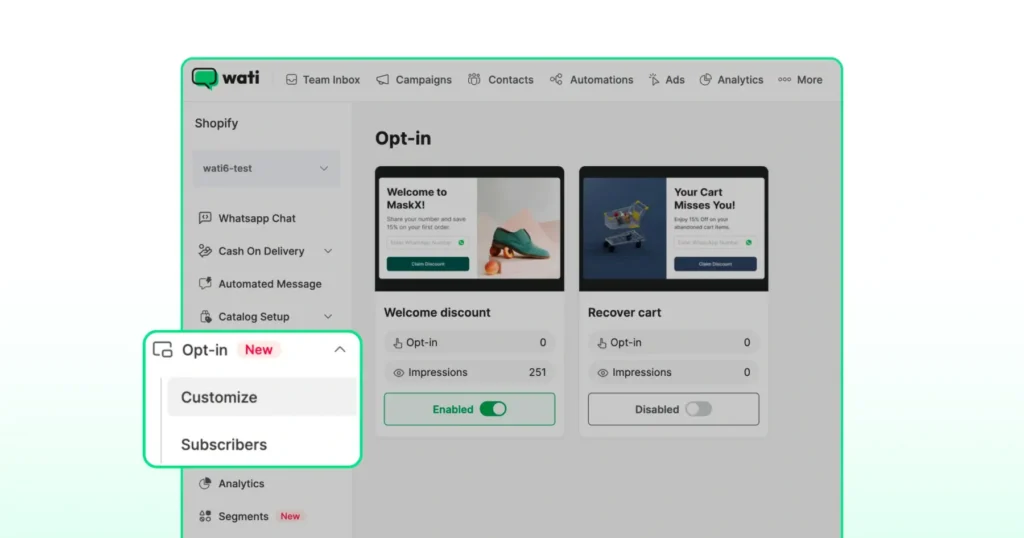
Before you can market on WhatsApp, you need people to market to. Growing a WhatsApp subscriber list is different from growing an email list. Every contact has to opt in explicitly. No importing, no assuming.
The most effective opt-in points for Shopify stores are:
- A checkbox at checkout asking customers to receive WhatsApp updates
- A chat widget on your storefront that captures interest before the first purchase
- Click-to-WhatsApp ads on Meta that open a conversation directly
The quality of your list matters more than the size. An opted-in WhatsApp subscriber is far more valuable than an email address collected through a generic pop-up. Start building it early.
2. Converting Browsers Into Buyers
This is where most people start with WhatsApp campaigns on Shopify, and for good reason. A shopper abandons their cart. A personalized message goes out 30 minutes later with exactly what they left behind and a direct link back to checkout.
However, conversion goes beyond cart recovery. Product recommendations based on browsing behavior, limited-time discount campaigns, and back-in-stock alerts all drive purchases from customers who are already interested but have not bought yet.
The key is personalization.
A generic “you left something behind” message performs far worse than one that names the product, shows the image, and makes it easy to complete the purchase in one tap.
3. Retaining Customers and Driving Repeat Purchases
Acquiring a new customer costs five times more than retaining an existing one. Yet most Shopify stores spend the majority of their marketing budget on acquisition and almost nothing on what happens after the first order.
WhatsApp changes that equation. A follow-up message after delivery builds trust. A replenishment reminder timed to a customer’s natural purchase cycle brings them back before they think to look elsewhere.
A winback campaign for customers who have not ordered in 90 days reminds them your brand exists, with an offer that makes returning easy.
This is where WhatsApp marketing for Shopify becomes a customer retention engine, not just a recovery tool. Stores running post-purchase sequences on WhatsApp see repeat purchase rates climb without spending a dollar more on ads.
4. Building Loyalty That Lasts
Repeat buyers are valuable. Loyal customers who refer others are worth even more.
WhatsApp gives you a direct line to your best customers. Exclusive early access to new products, tier-based rewards, personalized birthday offers, and referral programs delivered over WhatsApp feel personal in a way that email never quite manages.
Because they land in the same place where your customers talk to their friends and family, the bar for what feels genuine is higher, and the payoff when you get it right is bigger.
This is the full picture of WhatsApp marketing for Shopify. Not a single use case. A complete Shopify customer engagement strategy that works from the first opt-in to the fifth order
How to Run WhatsApp Broadcast Campaigns on Shopify
A WhatsApp broadcast is a message sent from your business number to a list of opted-in customers simultaneously. Every recipient gets it as a private, one-on-one conversation. From their perspective, it feels like a personal message from your brand, not a mass-marketing blast.
That distinction matters. This is why broadcast WhatsApp ecommerce campaigns consistently outperform email newsletters, and why stores using them attribute up to 50% of their same-period sales to the channel.
But broadcasts only work when they are done right. Here is the framework.
Segment Before You Send
Not every customer needs the same message. A first-time buyer should not get the same campaign as someone who has ordered five times. Use your Shopify customer data to segment by purchase history, order value, last purchase date, and product category.
The more relevant the message, the better it converts.
Match the Campaign to the Moment
The best-performing WhatsApp promotional messages on Shopify are tied to a specific reason to buy. A new collection launch. A flash sale is ending tonight. A back-in-stock alert for a product someone viewed last week.
Campaigns that feel timely and relevant get clicks. Generic promotions get ignored.
Keep Frequency in Check
WhatsApp is personal. Over-messaging is the fastest way to lose a subscriber you worked hard to acquire. Meta caps marketing messages at two per user per 24 hours.
In practice, the stores that see the best results send two to four campaigns per week, with the majority of messages offering genuine value rather than a straight promotion.
Track What’s Working
Every broadcast campaign should be tied to revenue. Which messages drove the most purchases? Which segments converted best? Without attribution, you are running campaigns blind. A proper Shopify marketing automation setup connects every WhatsApp message to the order it generated, so you always know your ROI.
When all of this comes together, a single well-crafted WhatsApp campaign can generate the kind of revenue that used to take a full week of social media ads.
Wati merchants running broadcast campaigns see up to 9.2x campaign ROI. That is not an outlier. That is what happens when the right message reaches the right customer on the right channel.
Common WhatsApp Marketing Mistakes Shopify Stores Make
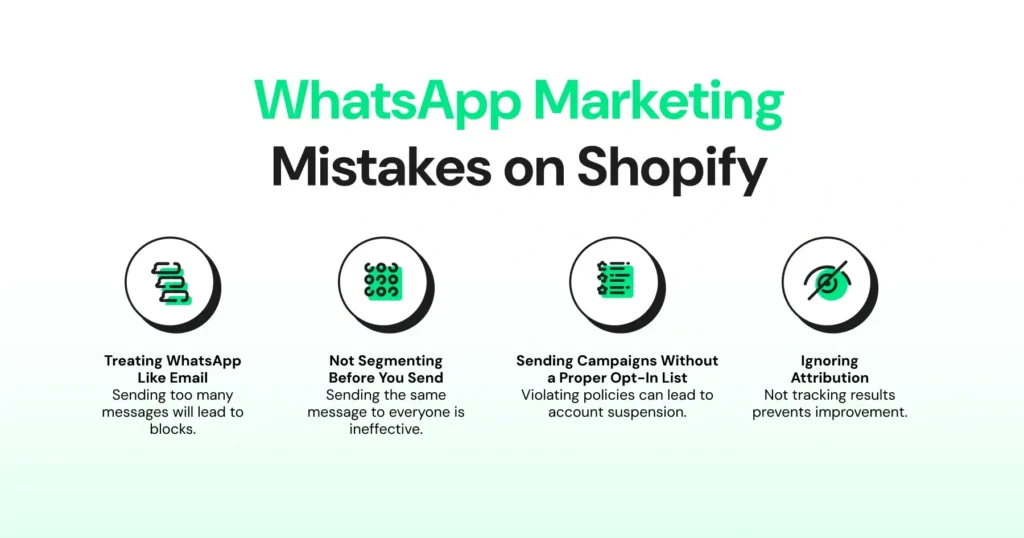
Most Shopify stores that try WhatsApp marketing and give up do so because they made one of these four mistakes. They are easy to avoid when you know what to look for.
1. Treating WhatsApp Like Email
Email marketing is built around volume. Send more, reach more, convert more. WhatsApp does not work that way. It is a personal channel. When a message arrives, a phone vibrates. If you are sending daily promotions, customers will not unsubscribe.
They will block you and a high block rate damages your sender quality score with Meta, which limits your ability to send campaigns at all.
The rule of thumb: two to four marketing messages per week, with most of them offering genuine value rather than a straight sell.
2. Not Segmenting Before You Send
Every WhatsApp message has a cost attached to it. Sending the same campaign to your entire customer list without segmentation is expensive, ineffective, and lazy. A customer who bought yesterday does not need a first-purchase discount.
A lapsed customer who has not ordered in six months needs a very different message than someone who ordered last week.
Your e-commerce messaging strategy should treat every segment as its own audience. The right message for the right person is always worth more than the same message for everyone.
3. Sending Campaigns Without a Proper Opt-In List
This one catches a lot of stores out. You cannot import a contact list and start sending WhatsApp marketing messages.
Every recipient must have explicitly opted in to receive them. Skipping this step does not just risk getting blocked. It violates Meta’s policies and can get your WhatsApp Business account suspended entirely.
Build your list the right way from day one. Checkout opt-ins, chat widget subscribers, and Click-to-WhatsApp ad leads are the cleanest sources.
4. Ignoring Attribution
If you do not know which WhatsApp campaigns are driving purchases, you are flying blind. A lot of stores send broadcasts, see a spike in revenue, and assume it worked without ever connecting the dots properly.
Proper attribution means tracking which message a customer received, when they received it, and whether they made a purchase afterward.
Without that data, you cannot improve. With it, every campaign gets a little sharper than the last.
How Wati Powers WhatsApp Marketing for Shopify Stores
Understanding the strategy is one thing. Having the right platform to execute it is another.
Wati is an official WhatsApp Business Solution Provider built specifically for businesses that want to use WhatsApp as a proper revenue channel.
It connects natively to Shopify, which means your store data, customer segments, order history, and product catalog sync directly into Wati without any third-party workarounds.
Here is what that looks like in practice for a Shopify store:
- Broadcast campaigns go out to specific Shopify customer segments, personalized with customer names, product details, and direct checkout links
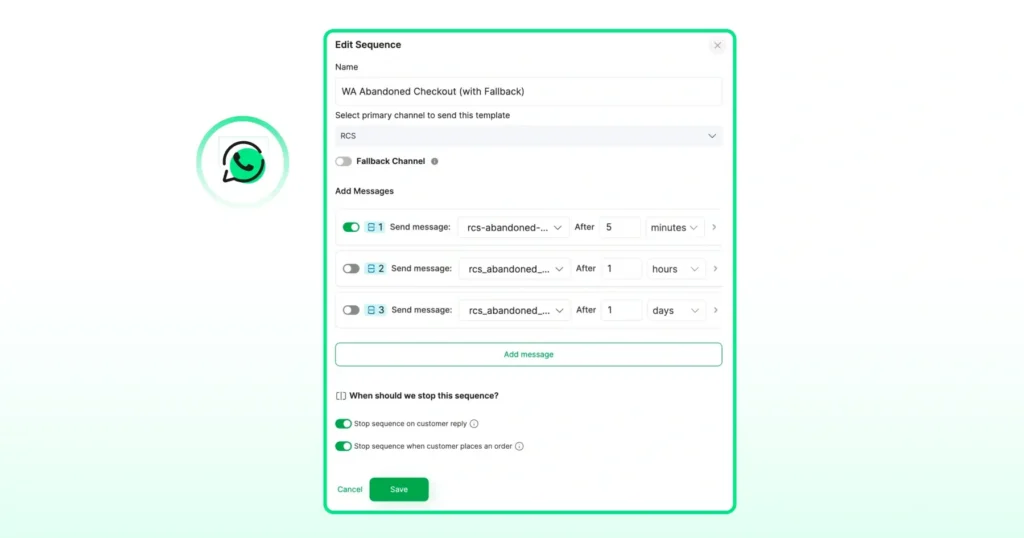
- Abandoned cart sequences trigger automatically, stop the moment a purchase is made, and never require manual intervention
- Post-purchase flows run in the background, turning one-time buyers into repeat customers without additional ad spend
- Astra, Wati’s AI agent builder, handles routine support questions around the clock so your team focuses on conversations that need a human
- The attribution dashboard connects every WhatsApp message to the order it generated, so you always know exactly what your campaigns are returning
Many Shopify merchants are already running their WhatsApp marketing through Wati. The ones seeing the strongest results are not the ones with the biggest budgets.
They are the ones who set up their sequences early, built their subscriber lists properly, and used Shopify segment targeting to make every campaign feel personal.
That is the difference between WhatsApp as a notification tool and WhatsApp as a revenue engine. Start your first campaign for free now.
Start Your WhatsApp Marketing for Shopify Journey Today
The stores winning on WhatsApp right now are not doing anything complicated. They picked a starting point, set it up, and let it run.
You do not need to build the full funnel on day one. Start with one campaign. A cart recovery sequence, a post-purchase follow-up, or a broadcast to your most loyal customers. Measure it, learn from it, and build from there.
The brands that hesitate are the ones that wait for the perfect strategy before sending a single message. The ones that grow are the ones that start.
Your customers are already on WhatsApp. The only question is whether your store is there too.
Start your first campaign today.
Frequently Asked Questions
It is the practice of using the WhatsApp Business API to send automated, personalized messages to customers at every stage of their journey. Cart recovery, post-purchase follow-ups, broadcast campaigns, and support automation, all connected to your Shopify store data.
You need a WhatsApp Business API account and a BSP like Wati. Once connected to Shopify, you can send broadcast campaigns to specific customer segments and track which messages drove purchases. Here is a guide on how to send hyper-targeted campaigns using Shopify segments.
For high-intent moments like cart recovery and time-sensitive promotions, WhatsApp significantly outperforms email. Most successful Shopify stores use both, with WhatsApp handling the moments that need immediate attention.
The three most effective opt-in points are a checkout checkbox, a storefront chat widget, and Click-to-WhatsApp ads on Meta. Read more on how to collect WhatsApp opt-ins at your Shopify checkout.
Track delivery rate, open rate, click rate, and revenue per campaign. Use the WhatsApp campaign ROI calculator to estimate your potential returns before you send your first message.