How Wellthy Therapeutics Achieved 80% Patient Retention with WhatsApp | Wati
🚀 Get TikTok DMs and Ads in Wati Team Inbox and convert social engagement into revenue See TikTok on Wati

Case Study
Wellthy Therapeutics Drives 80% Patient Retention by Powering Therapy Adherence Through WhatsApp
Company Overview
In healthcare, the hardest problem isn’t prescribing the right treatment — it’s keeping patients on it long enough to see results. Across chronic and lifestyle therapies, up to 70–90% of patients drop off within the first few months. The treatment works. The patient just doesn’t stay.
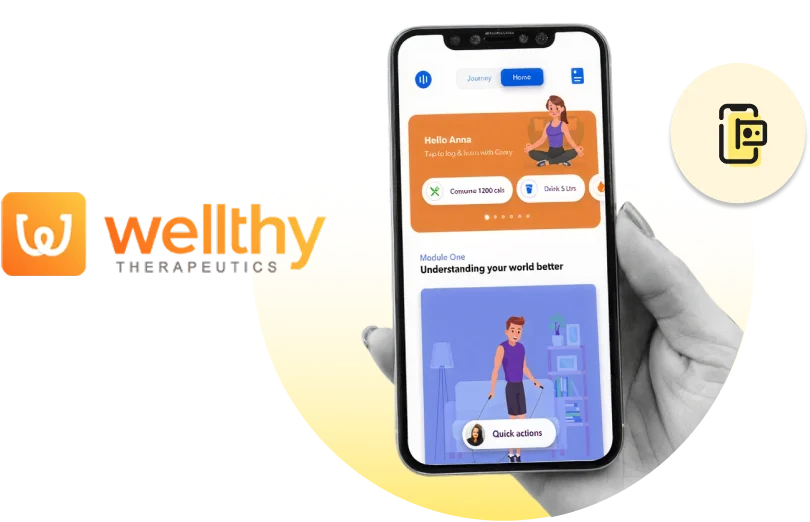
Wellthy Therapeutics is a digital health platform built to close that gap. Headquartered in Mumbai and now part of the TruDoc family, Wellthy combines behavioral science, automation, and human coaching to drive sustained therapy adherence. The company partners with pharmaceutical companies, insurers, and healthcare systems across India and the GCC, covering therapy areas including diabetes, obesity, cardiovascular health, and dermatology.
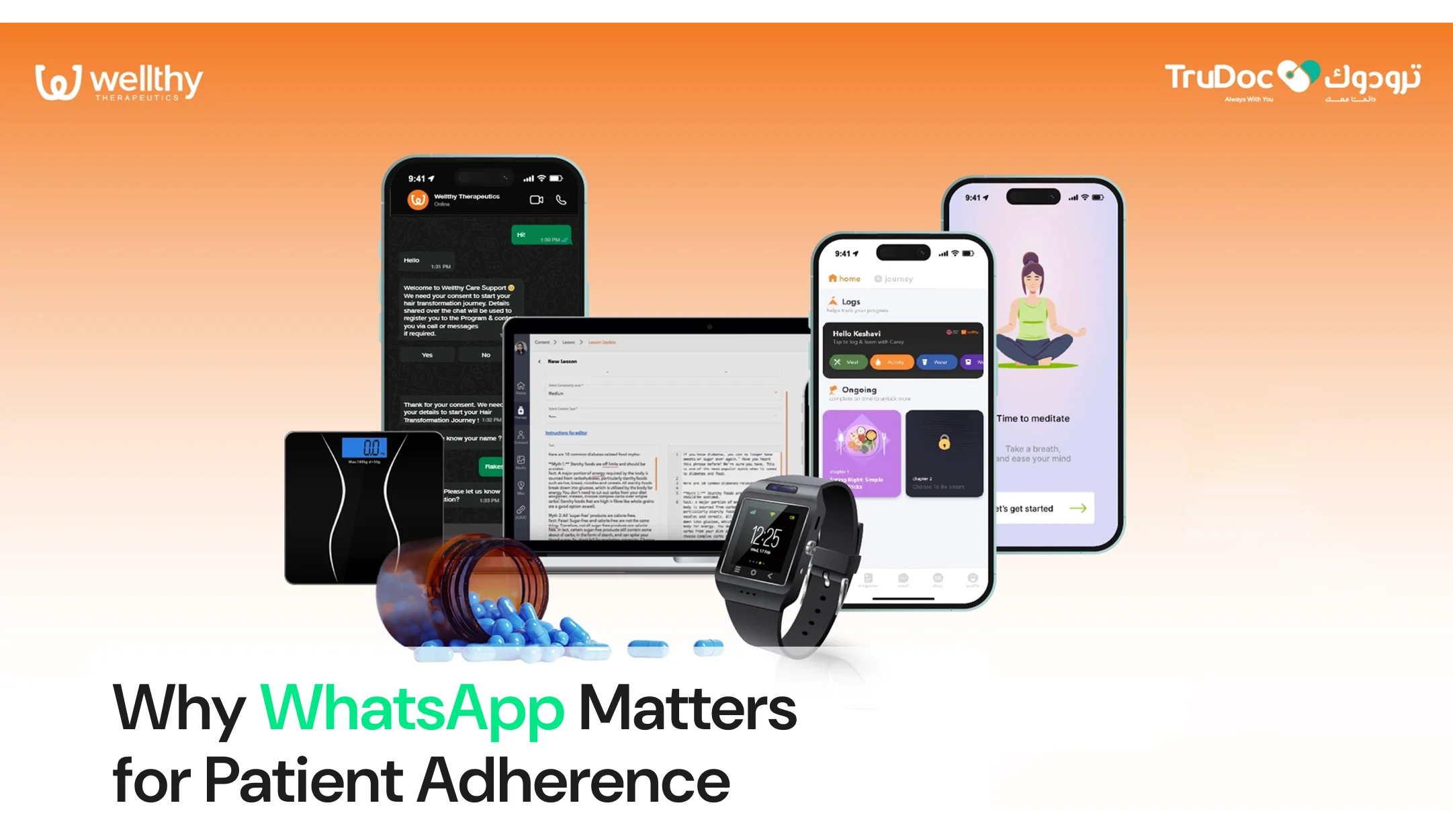
Over the last 18 months, Wellthy has onboarded 150K patients through its WhatsApp-led programs, adding over 15,000 new patients every month. The model runs on structured 120-day journeys powered by CRM-integrated automation and supported by 20+ dedicated health coaches.
Before and After: The Wati Transformation

Before Wati
50–70% of patients on chronic therapies don’t take medications as prescribed (WHO, 2003), with no scalable engagement post-prescription
Existing engagement channels — apps, calls, SMS — each reaching only a subset of the patient population
Manual follow-up calls resource-heavy and inconsistent, unable to scale across thousands of patients monthly
Pharma brands with zero visibility into whether patients were adhering to therapy or repurchasing

With Wati & WhatsApp
~80% of WhatsApp-enrolled patients completing their full 90–120 day therapy journey, with ~70% adherence at 90 days
WhatsApp channel reaching patients who wouldn’t download an app, with ~90% scan-to-onboarding conversion and zero install friction
~78 automated WhatsApp bot steps delivering day-wise nudges, with human coaches intervening at critical moments via Wati’s routing
~35% repurchase conversion with photo-verified proof collected via WhatsApp bots, driving $1.5M+ annualized revenue impact
“The biggest challenge in healthcare isn’t starting treatment — it’s staying on it. Across chronic conditions, outcomes don’t come immediately, and without the right support, most patients drop off before they ever see results. That’s the gap we set out to solve.”
— Shraddha Suman Dhal India Business Head, Wellthy Therapeutics
According to the WHO, approximately 50% of patients with chronic illnesses do not take medications as prescribed — leading to increased morbidity, mortality, and an estimated $100–300 billion in avoidable healthcare costs annually. The challenge intensifies for therapies where results take months: patients lose confidence, experience side effects, and disengage before the treatment has time to work.
Sources: WHO Adherence Report (2003); NIH/Mayo Clinic Proceedings; McKinsey ‘Improving Patient Adherence Through Data-Driven Insights’
Wellthy’s app platform addresses this for patients willing to download and engage through a dedicated experience. But the team recognized a significant segment of patients who would never install a health app for a temporary treatment. WhatsApp, already open on every phone, offered a way to reach this population with structured, behavior-driven programs at a scale and engagement level that no other single channel could match.
“At Wellthy, we’re not just building patient support programs — we’re building adherence engines at scale. The real challenge isn’t getting patients started, it’s keeping them on therapy long enough to see outcomes.”
— Shraddha Suman Dhal India Business Head, Wellthy Therapeutics
The Breaking Point: When Existing Channels Weren’t Enough
Wellthy’s app-based programs delivered strong outcomes for patients who adopted them. But reaching and retaining patients required a more convenient and available channel. The team needed a channel that combined always-on availability, two-way communication, automated sequencing, and human escalation — on a platform patients already use daily.
The problems were clear:
Reach gap beyond apps
A large patient segment that wouldn’t download a dedicated health app needed an alternative engagement channel
No scalable post-prescription touchpoint
Engagement ended at the doctor’s consultation, with no continuous support layer for non-app patients
Manual outreach unsustainable
Coaches spending time chasing patients rather than guiding them, with limited visibility into who needed attention
Zero adherence and repurchase tracking
No mechanism to verify if patients were continuing therapy, repurchasing, or even still using the product
Side effects driving early exit
Expected side effects causing premature abandonment without reassurance — addressable only through timely, interactive communication.
No real-world evidence loop
No structured way to collect before/after outcomes, testimonials, or satisfaction data from non-app patients
The hidden cost was significant — not just in lost patients, but in lost proof. Without adherence data from this population, pharma brands couldn’t quantify the revenue leakage from non-adherence or demonstrate that therapies work when patients stick with them.
What Wasn’t Working
Wellthy evaluated multiple approaches before building on Wati, including other WhatsApp API providers. The key challenges with most alternatives were higher dependency on technical teams for setup and changes, slower turnaround time for building and iterating journeys, and limited flexibility to quickly test and scale workflows. The team needed a platform that could move from pilot to production without adding engineering overhead at every step.
Why Wellthy Chose Wati
After evaluating WhatsApp Business API providers and in-house builds, Wellthy chose Wati for its no-code flexibility and ability to move from pilot to enterprise scale without engineering overhead. The team started with a small pilot, validated results, then scaled with deep CRM integrations.
The implementation focused on three core strategic areas:

No-code bot building and fast iteration
allowing teams to build 78-step patient journeys without engineering dependency

Speed from pilot to scale
concept to live WhatsApp pilot in days, validated before enterprise deployment

Multi-agent support with patient routing
15+ coaches managing WhatsApp conversations with clear ownership and care continuity

Deep automation for structured journeys
day-wise nudge sequences, repurchase bots, and drop-off prevention triggers — all configurable without code

CRM integration for real-time data flow
bi-directional sync powering coach assignment, repurchase verification, and patient-level analytics

Catalog feature repurposed as content library
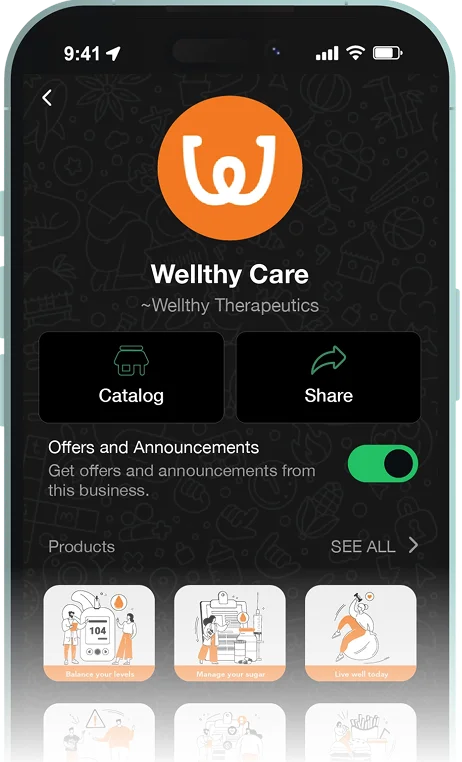
a creative WhatsApp-native education hub with therapy videos, FAQs, and tips accessible on demand
The Bottomline: Outcomes Unlocked with Wati
From Industry-Average
Drop-Off to 80% Retention
~70% adherence at 90 days vs ~35% industry benchmarks
• ~80% of WhatsApp-enrolled patients completing the full 90–120 day journey
• Behavioral nudges via WhatsApp templates timed to critical drop-off moments
• Before/after patient evidence collected through WhatsApp bots as real-world clinical data
From Zero Reach to
15,000+Patients/Month
~90% QR-to-WhatsApp onboarding conversion
• Patients scan QR codes on product packaging and onboard entirely within WhatsApp
• 1.5 lakh+ total patients enrolled via WhatsApp in ~18 months
• 60%+ monthly active engagement with 70%+ message open rates
From Manual Calls to
Automated Journeys
~78 WhatsApp bot steps powering a 120-day program
• Day-wise nudge templates, FAQ automation, and repurchase bots — all on WhatsApp
• Conditional routing connecting patients back to the same coach via Wati’s attribute logic
• 15+ coaches managing the full patient load through Wati’s multi-agent inbox
From Zero Visibility to
$1.5M+ Revenue Impact
~35% repurchase conversion with photo-verified proof
• WhatsApp bots nudge patients to reorder and collect photo evidence of purchase
• All data flows from Wati into CRM in real time — coach-level and patient-level analytics
• Revenue directly attributable to WhatsApp-driven adherence and repeat purchases
How Wellthy Uses Wati to Power Patient Adherence on WhatsApp
Wati isn’t just a messaging tool for Wellthy; it’s the infrastructure powering the entire WhatsApp-based patient adherence channel; it’s the operational backbone of the entire patient adherence ecosystem. Every interaction, from QR scan to Day 120 repurchase verification, runs through the platform.
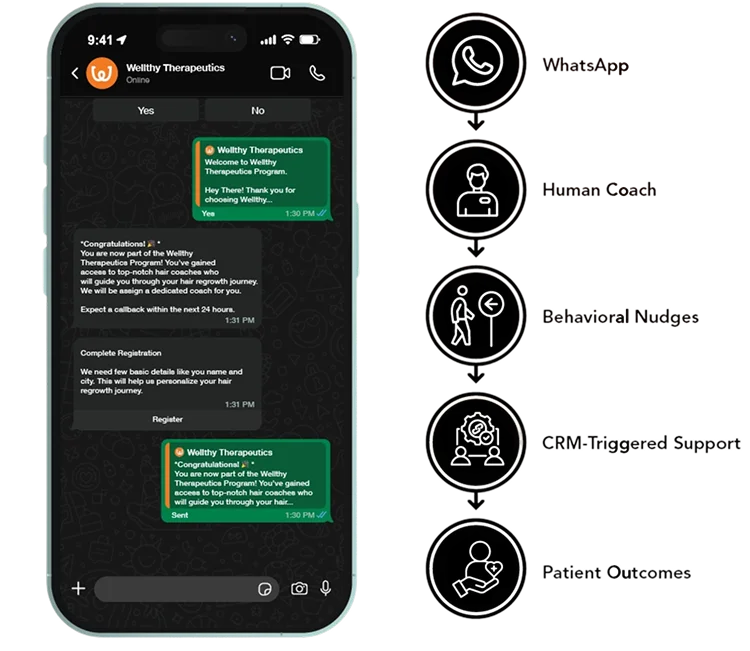

Patient Onboarding via QR Code
Scan, consent, and enroll on WhatsApp — no app, no account creation.
Automated Coach Assignment
Round-robin CRM assignment with personalized welcome from the dedicated coach.
120-Day Nudge Sequences
Day-wise automated messages on side effects, timelines, correct usage, and habit formation.
Repurchase Tracking
Photo-verified proof of purchase collected and logged in CRM for brand reporting.
Content Catalog as Education Hub
Catalog repurposed as self-serve library — videos, FAQs, tips accessible anytime.
Drop-Off Prevention
Automated re-engagement flows detect and recover inactive patients.
The Road Ahead: WhatsApp as a Core Adherence Channel
With the WhatsApp channel validated at scale, Wellthy is expanding this model across new therapeutic areas and pharma partners — complementing its app platform with WhatsApp-led programs wherever reach and engagement barriers exist.
What’s Next
AI-powered coaching alongside human coaches
Introducing AI-driven bots for first-line responses, with human escalation for complex interactions — scaling the program’s reach without losing the personal touch
WhatsApp + human coaching as a pharma service
Positioning the combination of automation and human support as a scalable patient engagement service for pharma brands — a new category of healthcare delivery
Building real-world evidence at scale
Leveraging the depth of patient interaction data, adherence metrics, and before/after evidence to publish clinical outcomes that validate the WhatsApp-first approach
Deeper analytics and advanced customization
Expanding reporting, journey optimization, and compliance tooling to serve increasingly complex enterprise requirements

“At Wellthy, we’re building adherence engines at scale. That’s where the combination of automation, human coaching, and platforms like WhatsApp becomes incredibly powerful.”
— Shraddha Suman Dhal, India Business Head, Wellthy Therapeutics