
Too Long? Read This First
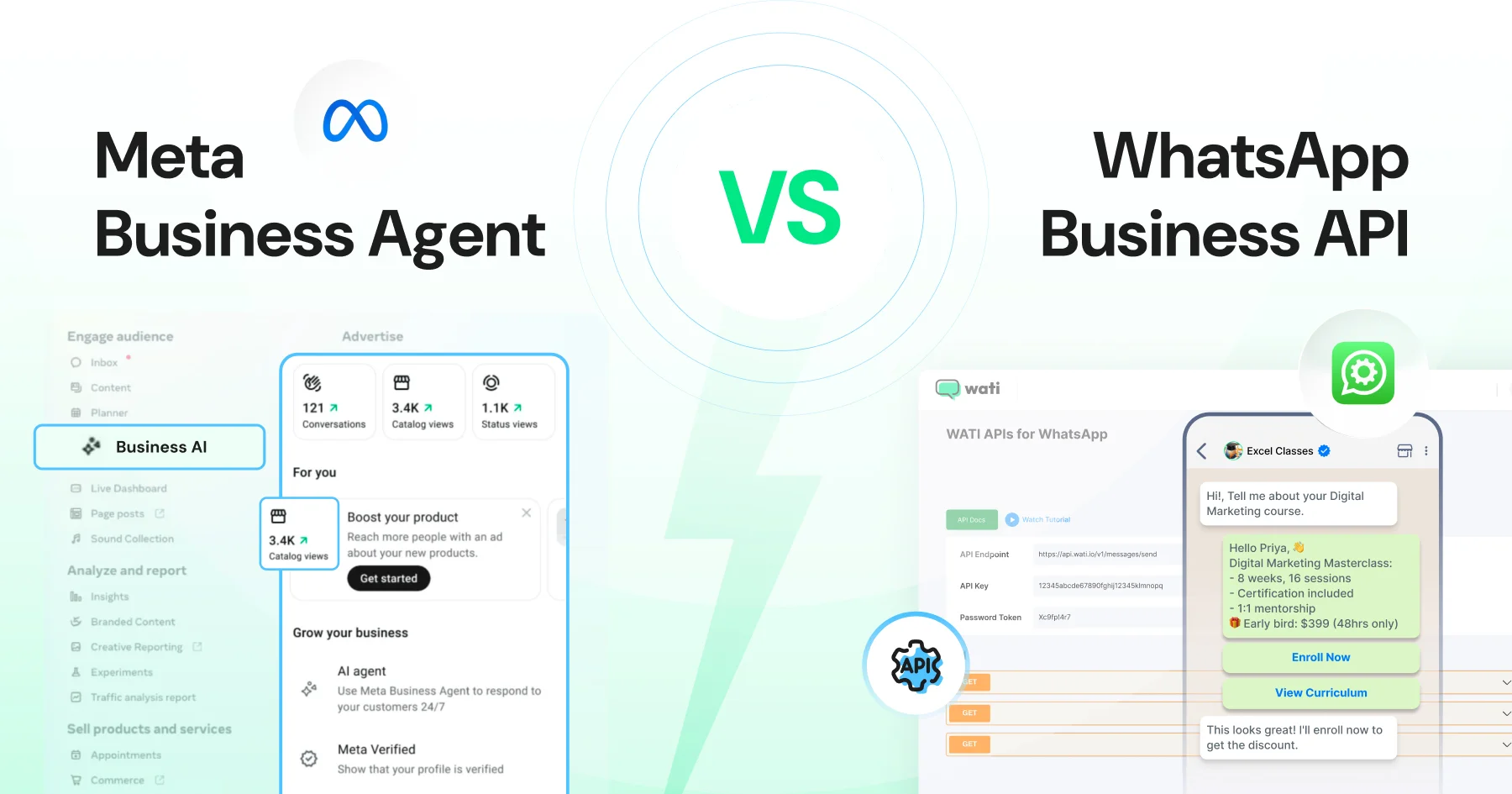
- Meta Business Agent vs WhatsApp Business API is not a competition; it is a scale decision. One is a free app feature, the other is the infrastructure layer beneath it.
- Meta Business Agent's self-serve tier caps broadcasts at 256 contacts and requires recipients to have your number saved. The API starts with 250 unique recipients per day and scales to unlimited recipients.
- The WhatsApp Business app supports 1 phone plus up to 4 linked devices by default. Meta Verified raises the linked-device cap to 11. The API supports unlimited agents with a proper shared inbox.
- Verification is no longer API-exclusive: the badge that was once the API-only green tick is now the blue tick under Meta Verified, available to Business App users too. It is now available on the app too. CRM integration, however, still only exists at the API tier.
- For teams, campaigns, and CRM-connected conversations at scale, the WhatsApp Business API, through a platform like Wati, is the infrastructure to build on.
Since the Meta Business Agent launched, this has become one of the most common questions in WhatsApp business circles. Both products run on WhatsApp, involve automation, and connect back to Meta’s infrastructure in some way.
So when people search for Meta Business Agent vs WhatsApp Business API, what are they actually trying to figure out?
The short answer is this: Meta Business Agent lives inside the WhatsApp Business app and is built for businesses managing day-to-day inbound conversations on their own.
The WhatsApp Business API is a separate platform layer that powers broadcast campaigns, CRM-connected conversations, shared team inboxes, and the infrastructure that larger businesses and BSPs like Wati build on.
They’re not competing for the same job. One is a feature inside an app. The other is the platform underneath a much wider ecosystem of WhatsApp business tools.
This post breaks down exactly where the two diverge, with specifics you can check for yourself.
Meta Business Agent vs WhatsApp Business API: What is the Core Difference?
The comparison is more nuanced than it first appears, because Meta Business Agent itself comes in more than one form. Self-Serve Version of Meta Business Agent
- The self-serve version of Meta Business Agent runs inside the WhatsApp Business app, the free app businesses install on a phone.
- Meta builds and runs the AI agent, and the business configures it with its knowledge, tone, and handoff rules.
- This is the version most people mean when they ask about Meta Business Agent, and it is free to start.
Meta Business Agent Platform
- An enterprise-grade layer that works alongside the WhatsApp Business API, not the app.
- It connects to third-party systems like Shopify and Zendesk and is built for larger businesses.
- As of now, it remains in limited access with no published pricing or country list.
WhatsApp Business API The WhatsApp Business API, officially called the WhatsApp Business Platform, is a separate, cloud-based product that businesses typically access through a Business Solution Provider like Wati. It’s different from the free WhatsApp Business App, which is built for simpler, manual messaging
It powers far more than just Meta’s own agent products. Broadcast campaigns, shared team inboxes, CRM integrations, and AI agents like Wati’s Astra AI Agent are all built on this same layer.
So the real comparison is not Meta Business Agent versus the API in the abstract. It is the free self-serve agent in the app versus everything the API platform enables, including Meta’s own enterprise agent tier and the broader ecosystem of tools, such as Wati, built on top of it.
How Do Broadcast and Messaging Limits Compare?
This is where the gap between the two becomes concrete and easy to verify.
The WhatsApp Business App: A Hard Cap, With a Catch
Meta Business Agent’s self-serve tier lives inside the WhatsApp Business app, which carries two real limitations:
- 256 contacts per broadcast list. That is the maximum.
- Recipients must have your number saved. If they have not, the message does not arrive, and the app does not tell you. It still shows as sent.
That second rule causes more lost reach than most businesses realize. A list of 256 contacts pulled from a CRM, where most customers never saved the business’s number, can end up reaching only a small fraction of that list, even though the app reports a clean send.
The WhatsApp Business API: No List Cap, A Different Model
The API removes the 256-contact ceiling entirely and replaces it with a 24-hour messaging window:
- New accounts typically start at 250 unique recipients per day
- Limits scale through tiers: 2,000, then 10,000, then 100,000, then unlimited, reached automatically as the account builds a track record of sending quality messages
- The API can reach recipients who have not saved your number, as long as they have opted in and the message uses an approved template
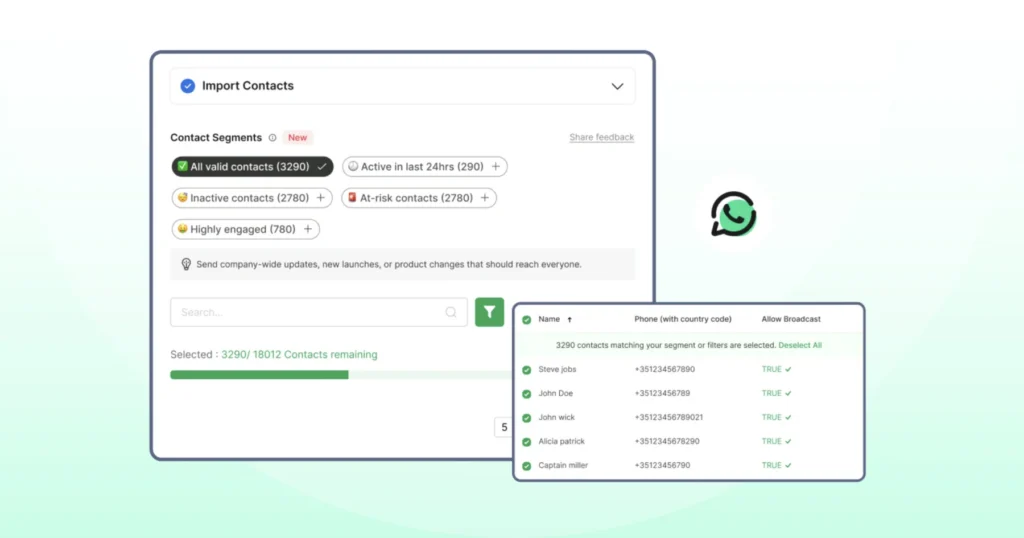
What This Means in Practice A business sending an update to a few hundred loyal customers will not notice the app’s limits. A business running a seasonal campaign to thousands of customers, or any business that cannot guarantee every customer has saved its number, is not looking at an upgrade. The API is the only way that the campaign reaches its audience at all. Habuild started with 400 customers using WhatsApp groups and mass messaging tools. Their groups kept getting blocked by Meta. After moving to the WhatsApp Business API through Wati, they scaled to 1 million+ customers across 172 countries, with over 90% of that growth driven by a single referral chatbot built on the API. Read the full story here. |
Which One Supports a Team: Meta Business Agent or the WhatsApp Business API?
The WhatsApp Business app supports 1 primary phone plus up to 4 linked devices, 5 total. Meta Verified raises the linked-device cap to 10, bringing the total to 11. But every linked device sees every conversation. There is no way to assign chats, route them, or see who replied to what.
The WhatsApp Business API removes the device model entirely. Through a platform like Wati, businesses get unlimited agents, a shared inbox, conversation routing, and full visibility into who handled what.
The Practical Threshold Once more than two or three people regularly need to respond to customer messages, the app’s linked-device model starts creating more confusion than it solves. That is the point where most businesses move to the API, not because the app is broken, but because it was never built for shared, accountable team workflows in the first place. |
Does Meta Business Agent Give You a Verified Badge, and Can it Connect to Your CRM?
Two common assumptions are worth correcting here.
On verification: It used to be true that WhatsApp’s verified badge, previously called the green tick and now the blue tick, was only available through the API. That changed.
The blue tick is now available through the WhatsApp Business app too, via a paid Meta Verified subscription, in eligible countries. A verified badge is no longer the deciding factor between these two products. What you actually need from your WhatsApp setup is the real question.
On integrations: Meta Business Agent’s self-serve tier does not connect to any external system. No HubSpot, Salesforce, or Shopify. Your customer conversations stay inside Meta’s ecosystem.
The WhatsApp Business API, through a platform like Wati, integrates with 100+ tools, including HubSpot, Salesforce, and Shopify, so your WhatsApp conversations and CRM data work together rather than live in separate systems.
For a business in a regulated industry, or one that treats customer data as a strategic asset, that distinction matters more than a badge ever will.
How does WhatsApp API Help Businesses Operate?
Imagine a skincare brand running a business on WhatsApp. It has to go through a different set of processes before converting a conversation into a customer.
- An ad click needs the lead capture tool to read intent, route it to sales, and update the CRM.
- A shipping question needs the commerce action tool to pull live order status from Shopify and respond.
- A product question needs the support resolution tool to answer first and escalate only if it’s genuinely complex.
- A quiet repeat customer needs the segmented nurture tool to bring them back on its own schedule.
The operational flow consists of different tools at different stages of the customer cycle. BSPs such as Wati actually provide this workflow so that customers don’t have to juggle between tools or connect an external tool to close a lead into a qualified customer.
Quick Comparison
Meta Business Agent (Self-Serve) | WhatsApp Business API | |
Runs on | WhatsApp Business app | Cloud infrastructure via a BSP like Wati |
Broadcast limit | 256 contacts per list, saved-number required | Starts at 250 unique recipients per day, scaling to 2,000, then 10,000, then 100,000, then unlimited |
Team support | 1 phone plus up to 4 linked devices by default. Meta Verified raises total to 11 | Unlimited agents, shared inbox, routing |
Verified badge | Available via Meta Verified subscription | Available via Meta Business Manager |
CRM integration | None at self-serve tier | 100+ tools including HubSpot, Salesforce, Shopify |
Cost | Free | Paid, based on BSP and usage |
Best for | Solo operators, low conversation volume | Teams, campaigns, automation at scale |
Meta Business Agent or WhatsApp Business API: Which One Does Your Business Need?
This was never really a competition. It is a scale decision.
If you are a solo operator answering 20 to 30 inbound messages a day, Meta Business Agent’s self-serve tier does exactly what it promises, for free.
If your business has a team, runs campaigns, needs CRM-connected conversations, or is approaching any of the limits covered above, the WhatsApp Business API is the infrastructure to build on.
Wati runs on that infrastructure for 16,000+ businesses across 190+ countries, with Astra AI Agent handling full conversations end to end, not just inbound replies, across WhatsApp, web, and voice.
If you have outgrown what the app can do, see how Wati works by booking a free demo.
Frequently asked questions
1. Is Meta Business Agent the same as the WhatsApp Business API?
No. Meta Business Agent is a free AI feature inside the WhatsApp Business app. The WhatsApp Business API is a separate cloud infrastructure layer that powers broadcasts, CRM integrations, and team inboxes.
2. Does Meta Business Agent replace the need for the WhatsApp Business API?
No. They serve different scales. Meta Business Agent suits solo operators with low message volume, while the API is built for teams, campaigns, and automation at scale.
3. Can I get a verified badge with Meta Business Agent?
Yes. The blue tick, formerly the green tick, is available through the WhatsApp Business app via Meta Verified, in eligible countries. It is no longer API-exclusive.
4. What is the broadcast limit difference between the two?
The WhatsApp Business app caps broadcasts at 256 contacts who must have your number saved. The API has no list cap and starts at 250 unique recipients per day, scaling as your account builds trust.
Related posts
- Instagram Comment Automation: How It Works and How to Set It Up in Wati
Instagram comment automation auto-replies to comments and DMs commenters within seconds via Meta's API. Covers strategy, use cases, and Wati setup.
- Shared Team Inbox for Instagram: A Buyer’s Checklist for 2026
Use this fastest checklist to evaluate any shared team inbox for Instagram, which covers DMs, comments, automation, and multi-channel support.
- How to Send Bulk Messages on WhatsApp Without Getting Blocked
Learn how to send bulk WhatsApp messages without getting blocked. Compare the WhatsApp Business app and API, messaging limits, costs, templates, and best practices for safe, compliant bulk messaging.
- How to Set Up a TikTok Business Account: Step-by-Step Guide
Set up a TikTok Business Account step by step: switch from personal, pick a category, add your profile, and unlock ads and analytics.