
Too Long? Read This First
- Unlike simple voice-to-text buttons, voice-first sites treat the entire user journey as a dynamic, two-way conversation.
- More than 1 in 4 internet users worldwide use a voice assistant every week, and voice-first websites make browsing easier for multitaskers and users with disabilities.
- Astra allows users to start a voice conversation on WhatsApp and pick up exactly where they left off on the website.
- AI voice agents with voice cloning can speak in your brand's voice, so conversations sound personal instead of robotic.
- Industries like ecommerce, healthcare, and logistics use voice for hands-free product discovery, patient check-ins, and multilingual onboarding.
More than 1 in 4 internet users worldwide now use a voice assistant every week. Talking to a device has become as normal as typing, yet most websites still only work with a keyboard and a mouse.
Voice-first web experiences change that. Visitors say what they need, and AI voice agents answer questions, find products, and complete tasks for them, with no typing and no menus.
In this guide, we cover what voice-first web experiences are, how they differ from basic voice search, where businesses use them today, and the benefits and challenges to plan for.
How Brands Are Adopting Voice-First Experiences
More brands are adding voice-first experiences to their websites, so visitors can speak instead of type.
It works simply. A visitor taps the microphone button, says what they need, and the voice agent completes the action, whether that's answering a question, finding a product, or booking an appointment. Visitors can browse, ask questions, and shop faster through a real-time conversation.
Voice-first experiences aren't limited to websites. They also work on WhatsApp, where many customers already reach out with questions about products and services.
Brands in ecommerce, healthcare, automotive, and banking are now adding voice AI agents to make their websites easier to use. For businesses, the opportunity is to meet customers wherever they are, because the same voice agent can work across websites, messaging apps, and phone calls.
Voice-Enabled vs. Voice-First Web Experiences: What's the Difference?
Voice is already part of how people search and browse, and users now expect to talk to websites as naturally as they talk to Alexa or Siri. But not every voice feature on a website delivers the same experience.
The difference comes down to two approaches: voice-enabled and voice-first.
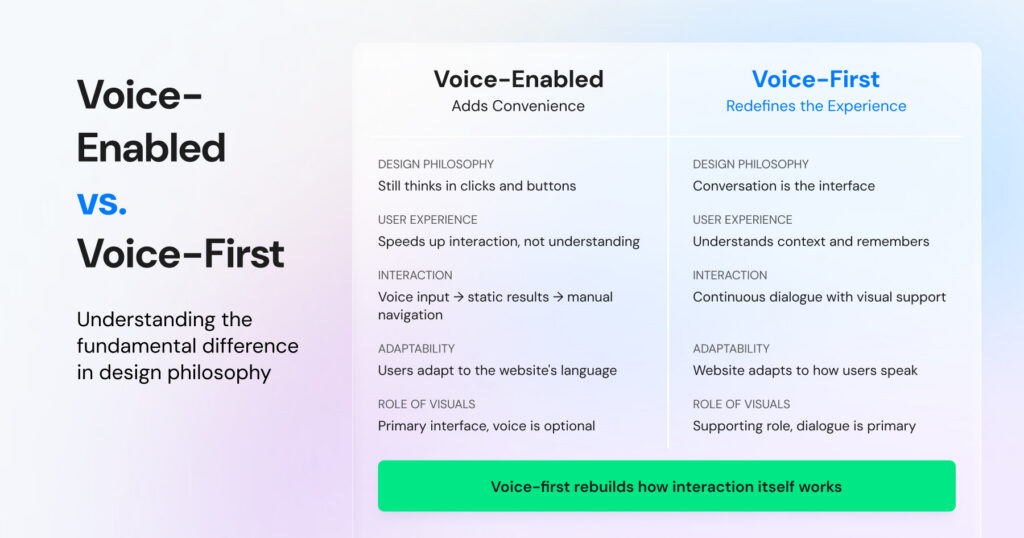
- Voice-enabled websites: A voice-enabled website adds a microphone to the search bar so users can speak their query instead of typing it. It saves a few keystrokes, but once the results appear, users still have to scroll, click through menus, and apply filters manually.
- Voice-first websites: A voice-first website treats the entire visit as a conversation. Users speak to the site, and an AI voice agent responds by answering questions, asking follow-up questions, and completing tasks like finding a product or booking an appointment.
In short, voice-enabled websites use voice to search, while voice-first websites use voice to get things done. That's why more businesses are moving from basic voice search to AI-powered voice agents that guide users from their first question to the final action.
Voice Cloning: Making Your AI Agent Sound Like Your Brand
A voice-first experience only works if customers enjoy talking to it. That depends a lot on how the voice agent sounds.
There are two common approaches:
- Traditional IVR systems: These follow fixed menus, like "Press 1 for sales" or "Press # to return to the main menu." They respond only to set commands and often sound robotic.
- AI voice agents with voice cloning: These hold natural conversations and can speak in a cloned voice, such as yours or a team member's. Customers feel like they're talking to a real person from your brand, not a generic AI voice.
Voice cloning helps businesses keep every conversation on-brand and personal, even at scale.
Astra brings AI voice agents with voice cloning to WhatsApp and websites. Businesses can use Astra to answer questions, qualify leads, book appointments, and provide support through natural voice conversations, on the channels customers already use.
For sales teams, this means Astra can handle large volumes of inquiries on WhatsApp, automate routine conversations, and pass ready-to-buy leads to the team. See how it works.
How Voice Conversations Move from WhatsApp to Your Website
Customers rarely stay on one channel. A lead might start on WhatsApp after a WhatsApp marketing campaign, then click through to your website to learn more. Without the right setup, the conversation starts over every time they switch.
Astra solves this with cross-channel memory. When a lead talks to an Astra voice agent on WhatsApp, the agent remembers what they discussed.
If the lead then clicks through to your website, the web voice agent picks up exactly where the WhatsApp conversation left off, and the same works in reverse.
The customer never has to repeat their details, and your team gets one continuous conversation instead of disconnected chats across channels.
Beyond Search: 4 Real-World Use Cases for Voice-Enabled Web Experiences
As mobile browsing dominates and users demand “frictionless” experiences, a voice UI web experience is becoming a competitive necessity.
From boosting e-commerce conversions to streamlining heavy-duty logistics, here are five ways businesses are actually using voice technology today.
1. Frictionless E-Commerce Product Discovery
Imagine a shopper on a furniture site. Instead of toggling five different dropdown filters, they simply say: “Show me grey sofas under ₹40,000.”
A voice-enabled search layer interprets intent, filters the catalog in real time, and serves results instantly. This zero-typing experience is convenient for mobile shoppers who are often multitasking.
2. Hands-Free Efficiency in Healthcare & Logistics
In environments where hands are occupied, such as clinics, warehouses, or delivery vans, typing is a liability. Here is how embedding a voice layer can help in such scenarios:
- Healthcare: Patients can check in at kiosks via voice, reducing physical contact and wait times.
- Logistics: Warehouse operatives can process shipments by speaking SKU numbers as they move boxes.
Also, learn how the WhatsApp API for healthcare improves patient care and automates health operations.
3. Intelligent FAQ & Customer Support Flows
If users have to scroll through an FAQ portal with 100 answers, they will get lost in a maze.
By embedding a voice-first agent, you can help customers navigate the FAQ section and answer their queries. Shifting customer support workflows to voice agents reduces ticket escalation, quickens response times, and improves customer satisfaction.
4. Hyper-Local Multilingual Website Onboarding
With voice UI, you can cater to multiple demographics where users speak specific local languages. Voice models are trained on large datasets, enabling better handling of accents and variations.
Even if users speak partially, have heavy accents, or speak with confusion, voice models can still guide you through onboarding.
For businesses in linguistically diverse markets like South Asia or the Middle East, offering a “voice-first” welcome in a native tongue is a massive brand differentiator.
Along with fueling agentic experiences on the website, brands are also integrating them with WhatsApp for an omnichannel experience.
5 Key Benefits of Voice-first Web Experiences in 2026
As most people move away from traditional sign-ups and embrace voice-first platforms, brands can build better relationships with people without any bias.
Voice-first web experiences help brands be inclusive, build next-gen UI, and give competitor-first benefits to their loyal visitors.
Some brands also offer multimodal functionality, allowing customers to press a button that triggers an online action. Let’s look at 4 such key benefits:
- Speed & Efficiency: Speaking is much faster than typing on a mobile. A voice-first interface allows users to complete complex tasks, like booking a consultation or tracking an order, in a single sentence.
- True Accessibility: It removes barriers for users with visual impairments, motor disabilities, or dyslexia, making your site inclusive by design rather than as an afterthought.
- Hands-free: Voice-first design captures users in “situational impairment” moments, when they are driving, cooking, or multitasking, expanding the windows of time they can interact with your brand.
- Reduced Cognitive Load: Users don’t need to learn your product catalog anywhere. They just say what they need, and a voice UI helps them navigate with ease.
- Multimodal functionality: With brands now offering immersive virtual experiences, users can run virtual meetings on a surface (say, a wall) with just a touch of a button, or dictate a command to browse a catalog or read a review side by side.
The Hurdles: 5 Real-World Challenges of Voice-First Design
Implementing voice isn’t as simple as toggling a switch. To build an interface that users actually trust, developers must navigate several significant roadblocks:
- Invisible Voice UI: Because voice UI is different from a graphical interface, users can’t check what’s happening in the backend. Users often suffer from “blank page syndrome,” not knowing where to go or what to say.
- Always Listening Anxiety: Trust is the primary currency of voice-powered websites. Users are often scared to grant microphone access, fearing that their data will be compromised.
- Environmental Interference: Background noise, like office chatter, wind, or traffic, alongside diverse regional accents, can cause traditional Speech-to-Text engines to fail.
- Latency: If a website takes 3+ seconds to process a spoken request, the user experience breaks. High latency makes the AI feel broken.
- Turn-taking: If a user has a complex doubt, the system should give a visual cue, such as “uh, I need to check that,” to keep users engaged. Simple buffering may disengage the user.
The Future of Voice-First Web Experiences
Voice-first websites make browsing easier. Instead of clicking through pages and filters, visitors say what they need and get it done in one conversation.
Voice also does something a static website can't: it makes customers feel heard. A well-designed voice agent listens, understands what the customer is asking, and responds naturally, without rushing them or guessing what they mean.
Astra brings this to your website and WhatsApp, so you can answer questions, qualify leads, and support customers through natural voice conversations.
Book a demo to see how Astra can power voice-first experiences for your business.
Frequently asked questions
What is the difference between a voice-enabled and a voice-first website?
A voice-enabled site simply adds a voice-to-text button (like a search bar). A voice-first site, powered by agents like Astra, treats the entire visit as a conversation, allowing users to navigate, ask complex questions, and complete tasks entirely through speech.
Does voice-first technology work with different accents and languages?
Yes. Modern voice AI is trained on billions of linguistic tokens, allowing it to understand heavy regional accents, "filler" words (like um or ah), and even partial sentences. Astra, for instance, can provide a hyper-local onboarding experience in a user's native tongue.
Is my privacy protected when using voice-first web features?
Absolutely. Leading platforms use a "Consent-First" architecture, meaning the microphone is only active when you explicitly trigger it. Data is handled via strict security protocols to ensure your conversations remain private and secure.
How does voice-first design improve web accessibility?
It removes the inconvenience of browsing. Users with visual impairments, motor disabilities, or dyslexia can interact with the site naturally without relying on screen readers or complex menu navigation.
How long does it take to implement a voice AI agent on my site?
While custom builds can take months of development, a platform like Astra can be deployed in minutes. It integrates directly with your website to begin qualifying leads and answering queries without any coding required.
Related posts
- AI Customer Support in 2026: What It is, How It Works, and Why Smart Teams are Quietly Switching Over
Learn how AI in customer support manages ticket escalations, automates ticket tagging and routing, and improves customer satisfaction. See how Astra does it.
- Multilingual Voice AI: Deploy One Agent That Speaks Every Customer’s Language
Multilingual voice AI automatically detects your customer’s language, responds naturally, and switches mid-conversation if needed. See how it works in 2026.
- How to Automate Business Conversations With a WhatsApp AI Agent in 2026
Learn how to build a WhatsApp AI agent to engage, qualify, and convert prospects round the clock without any delays in 2026.
- How Voice AI Agents Qualify Leads: A Sales Team’s Guide to Hands-Free Pipeline
know how does voice ai qualifies leads for an effective sales action and potential conversion and where does astra 2.0 stand when it comes to pre-configured lead qualification