
Too Long? Read This First
- E-commerce customer retention is the share of customers who buy again after their first order.
- The second purchase is the biggest drop-off point. Most first-time buyers never return, but customers who order twice are far more likely to keep buying.
- The 8 strategies that drive repeat purchases: connected post-purchase updates, segmentation, replenishment reminders, loyalty and referrals, consistent support, easy exchanges, win-back campaigns, and AI-based prioritization.
- Measure repeat purchase rate, time between purchases, CLV, and churn, and judge campaigns by repeat orders, not opens.
- Wati connects WhatsApp, Instagram, Messenger, TikTok, RCS, SMS, and WebChat so you can run post-purchase updates, campaigns, and support from one platform.
You paid to win that first order. Without a second one, you may never earn that money back. A Beauchamp Sullivan & Co. analysis of more than 156,000 DTC customers found that 81% never place a second order
E-commerce customer retention strategies help businesses drive repeat purchases through personalized offers, timely reminders, and consistent support.
This guide covers proven strategies, how to measure retention across channels, and how Wati helps e-commerce businesses improve customer retention.
What is an E-commerce Customer Retention Strategy?
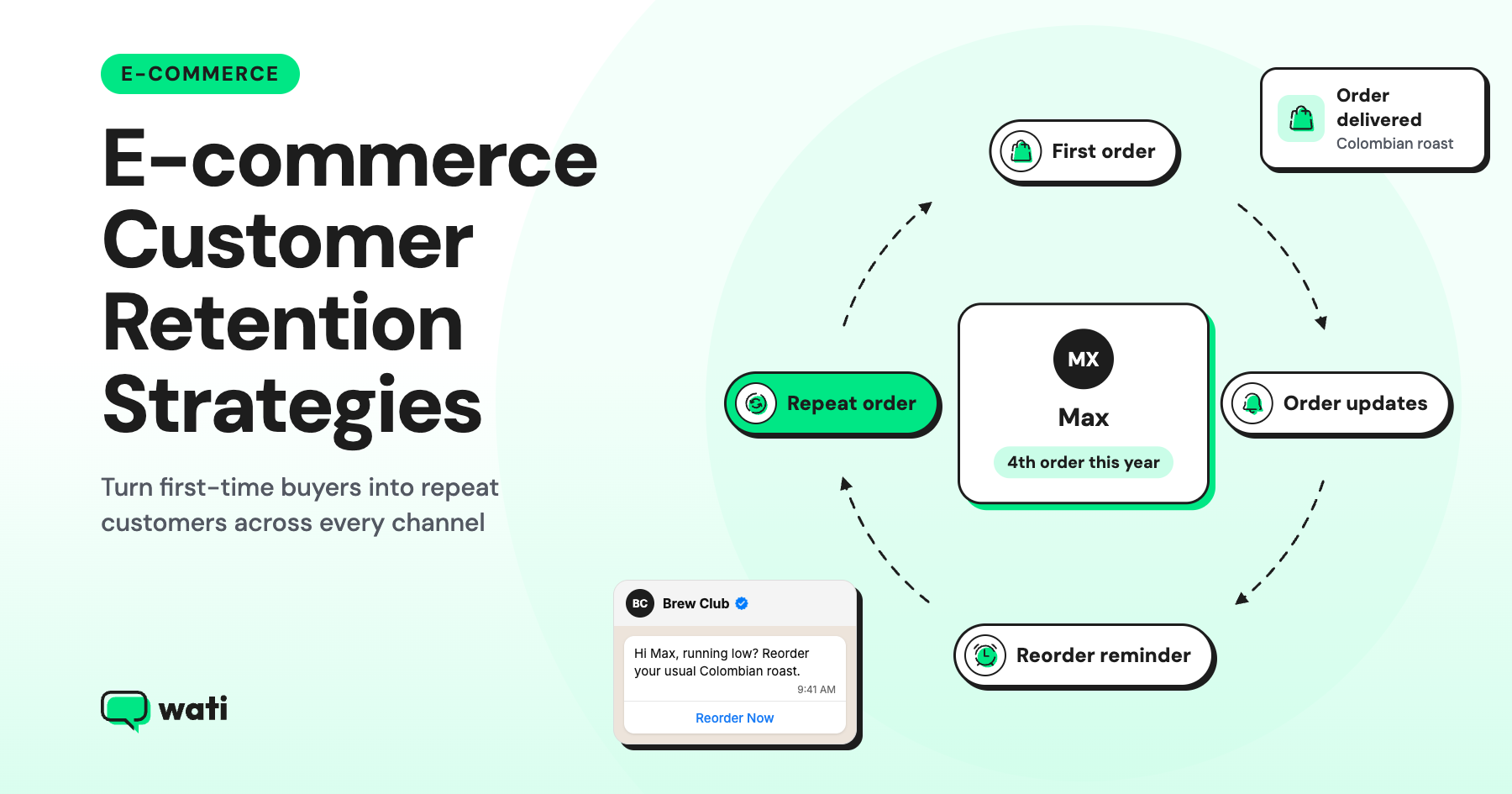
E-commerce customer retention is the share of customers who come back and buy again after their first order.
A customer retention strategy is the set of messages, offers, and experiences a store uses to increase that share and earn more value from existing customers.
The goal is to get customers to buy again, stay satisfied with their purchases, and choose the same store over competitors.
Omnichannel marketing supports retention by connecting customer interactions across WhatsApp, Instagram, Messenger, and an online store through shared customer data.
For example, a skincare brand sends a WhatsApp reminder when a customer is likely to run out of moisturizer. If the customer does not reorder, the brand can retarget them with a relevant offer on Instagram.
Why the Second Purchase Matters Most
The second order is the biggest turning point in e-commerce retention.
How often customers come back depends on what you sell. In the same BS&Co analysis, consumable brands saw repeat rates of 22–44%, fashion about 10–17%, and durables 7–18%.
That makes the step from first to second order the point where most customers are lost. Once a customer orders twice, every later order is easier to win.
The window to win that second order is short, and it varies by product. Shopify recommends tracking your time to second purchase.
Use your own order data to find your median time to a second purchase. Then time your post-purchase messages inside that window.
8 Omnichannel Customer Retention Strategies for E-commerce
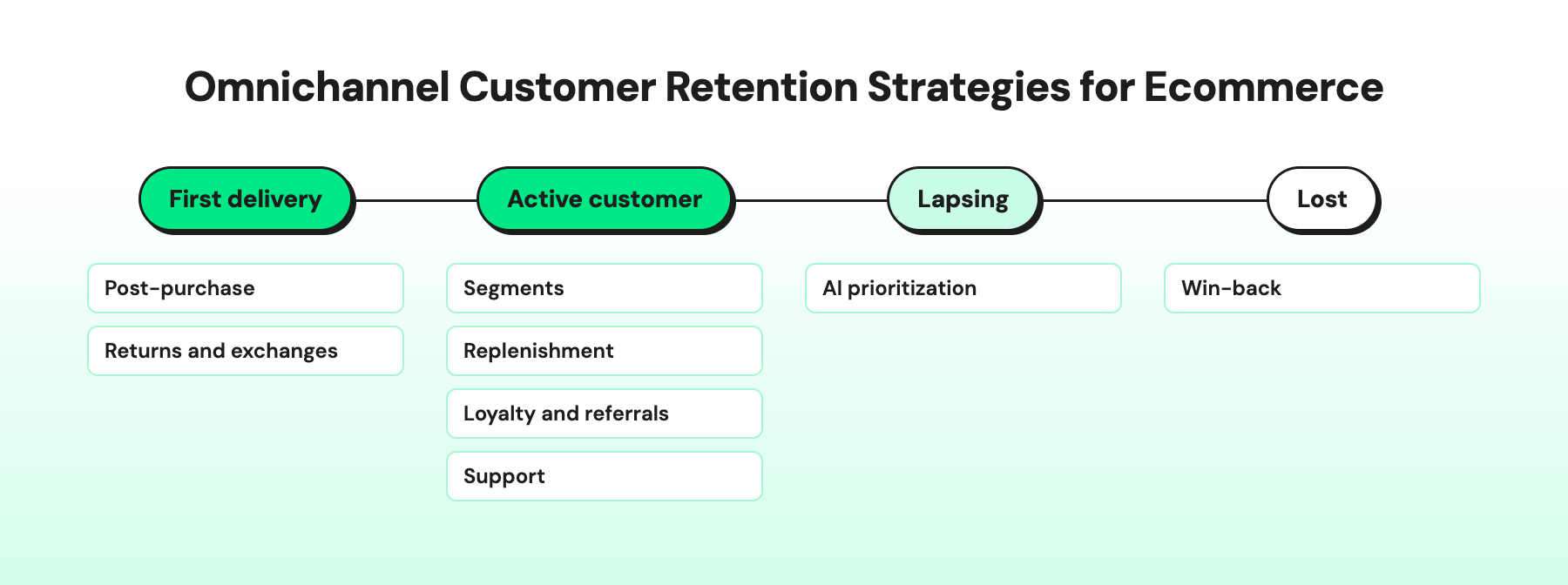
Each strategy targets a specific moment in the customer lifecycle, from first delivery to winning back a lapsed buyer.
1. Win the Second Order With Connected Post-Purchase Communication
What happens after delivery decides whether a customer comes back. Send order confirmations, shipping updates, and usage tips on WhatsApp, and pause ads for products they just bought.
With Wati's Shopify and WooCommerce integrations, these updates are sent automatically to WhatsApp.
Example: A fashion store confirms a jacket's delivery via WhatsApp, including washing tips. A week later, it suggests matching trousers.
2. Personalize Retention Campaigns Using Customer Segments
One message can't work for monthly buyers, sale-only shoppers, and one-time customers. Segment by lifecycle stage and value: first-time, repeat, loyal, lapsing, and high-value customers. Reach each segment on the channel where they engage most.
Example: Frequent buyers get early access to a new collection, while first-time buyers get recommendations based on their first order.
3. Send Timely Replenishment Reminders
Products that run out, like pet food, coffee, or skincare, give you a natural reason to reach out. Time reminders to typical usage, and offer a subscription once a customer has reordered on their own.
On Wati, you can send reminders as segmented broadcasts with products from your WhatsApp catalog, so customers reorder without leaving the chat.
Example: A pet store sends a reorder reminder around day 25 for a 5 kg bag of dog food that lasts about a month.
4. Build Loyalty With Rewards, Referrals, and Exclusive Offers
The best loyalty programs reward the next order, especially the second, instead of letting points pile up unused.
Favor status perks like early access over discounts, since constant discounts train customers to wait for deals. Ask for referrals right after a positive moment, such as a five-star rating.
Example: A beauty brand messages customers on WhatsApp when they're one order away from free shipping for life.
5. Deliver Consistent Support and Close the Feedback Loop
Poor support stops repeat purchases. Answer questions on WhatsApp, Instagram, and Messenger with one shared conversation history, then collect quick feedback after delivery and fix recurring issues.
Wati's Team Inbox brings these channels into one workspace, and Astra AI Agent handles routine questions on WhatsApp and website chat, then hands complex chats to your team.
Example: A customer asks about a delay on Instagram, then follows up on WhatsApp. The agent sees the full history and resolves it without starting over.
6. Turn Returns and Exchanges Into Retention Moments
A wrong size or damaged item is often where loyalty is won or lost. Make exchanges easy in chat, and keep refunds just as simple for customers who want their money back.
Example: A customer says new shoes are too tight. The support rep offers the next size with a free return label in the same chat.
7. Re-Engage At-Risk Customers With Targeted Campaigns
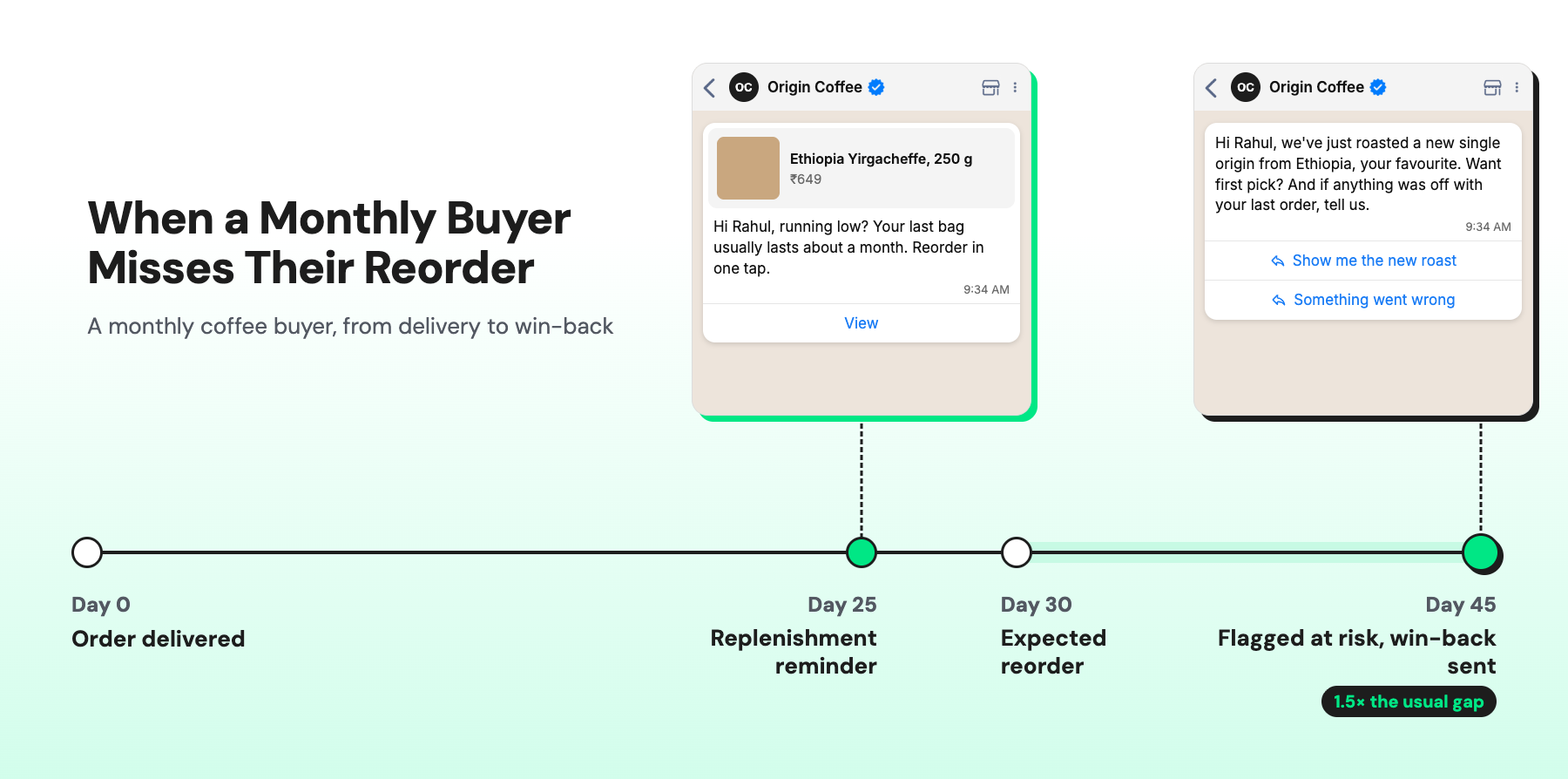
Flag customers who go about 1.5 times longer than their usual reorder gap. Lead with new arrivals in categories they've bought before, ask if anything went wrong, and save discounts for last.
Click-to-WhatsApp Ads on Wati bring lapsed customers straight into a one-to-one conversation.
Example: A coffee brand notices a monthly buyer hasn't ordered in 45 days and sends a message about a new roast from their favorite origin.
8. Use AI to Prioritize and Personalize Retention Efforts
AI can spot churn signals like longer gaps between orders and fewer message replies. Group customers by risk, choose a different follow-up for each group, and measure success by repeat purchases, not open rates.
Example: Customers whose orders have slowed down receive a product suggestion, while those who've stopped engaging hear from you through a different channel.
How to Measure E-commerce Customer Retention Across Channels
E-commerce customer retention metrics show whether customers come back, how often they buy, and how much they're worth to your business. Use them as a baseline before you connect them to your campaigns.
Metric | What it measures | Formula |
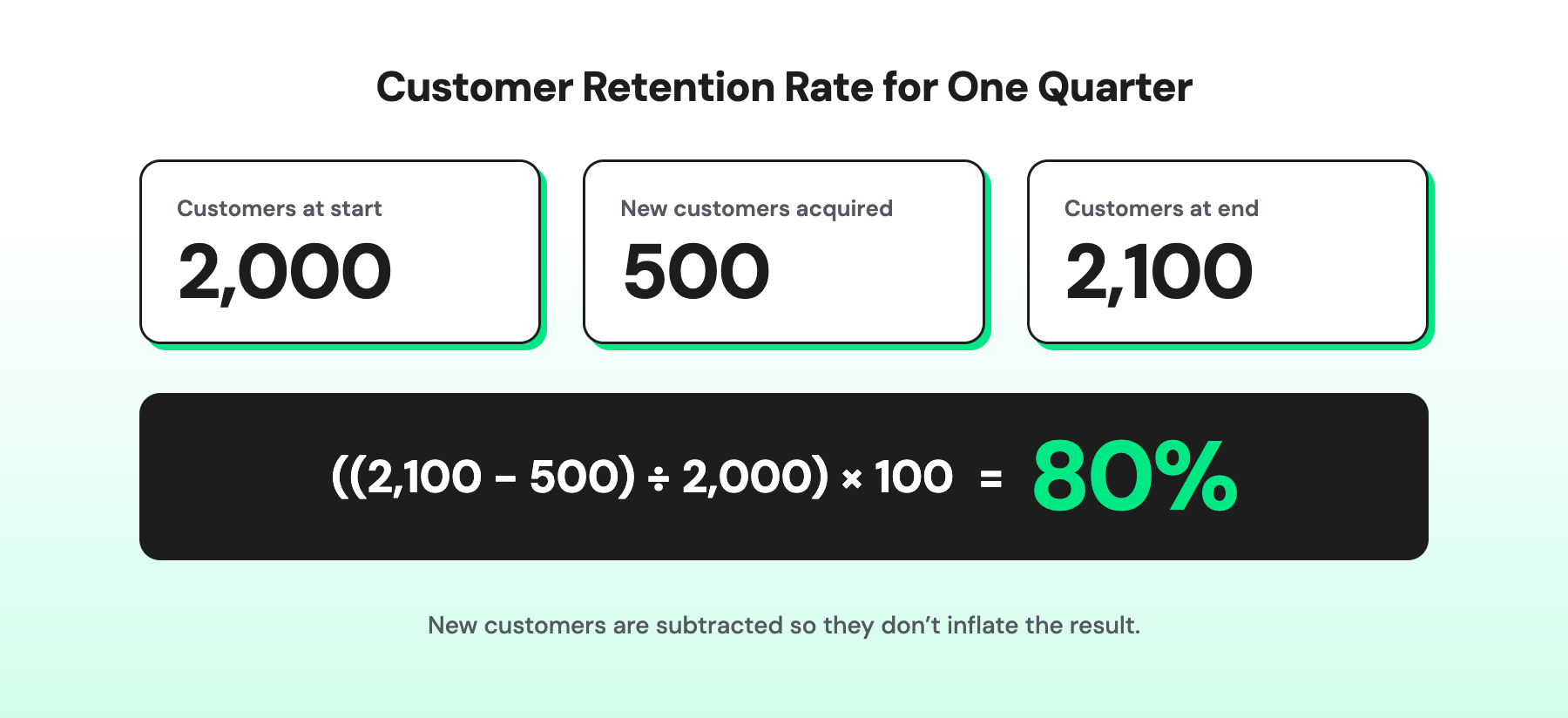
Customer retention rate | Share of existing customers you keep over a set period | ((Customers at end - New customers acquired) ÷ Customers at start) × 100 |
Repeat purchase rate | Share of unique customers who buy more than once | (Customers with more than one purchase ÷ Total unique customers) × 100 |
Purchase frequency | Average number of orders per customer in a period | Total orders ÷ Total unique customers |
Time between purchases | Average gap between a customer's orders | Total days between orders ÷ Number of repeat orders |
Average order value (AOV) | Average amount spent per order | Total revenue ÷ Total orders |
Customer lifetime value (CLV) | Estimated revenue from a customer over their relationship with your store | AOV × Purchase frequency × Average customer lifespan |
Customer churn rate | Share of customers lost in a set period | (Customers lost during the period ÷ Customers at start) × 100 |
For example, say your store starts a quarter with 2,000 customers, gains 500 new ones, and ends with 2,100.
To see how your omnichannel campaigns affect these numbers, connect them to customer and order data:
- Track campaign-attributed purchases: Use UTM parameters and campaign links to measure purchases from WhatsApp messages, Instagram ads, and other campaigns.
- Connect conversations with orders: Use your CRM or customer engagement platform to link chats and campaign responses to purchase history, where integrations and consent allow.
- Compare repeat purchases by campaign: Check whether customers who received replenishment reminders or win-back offers bought again.
- Prioritize purchases over engagement: Opens, clicks, and replies show interest, but repeat purchases and revenue show real business impact.
For example, a skincare store can compare repeat purchase rates for customers who got WhatsApp replenishment reminders with those who didn't. The difference shows how much the reminders actually add.
Note: The time-between-purchases formula above is a simple average. If your tool calculates it per customer instead, use that method, since it handles customers with very different buying patterns more accurately.
How Does Wati Help You Drive Omnichannel E-commerce Customer Retention?
Wati connects customer conversations and campaigns across WhatsApp, Instagram, Messenger, TikTok, RCS, SMS, and WebChat. You can use it to follow up after purchases, send relevant offers, resolve issues, and encourage repeat orders.
1. Automate Post-Purchase Updates
Wati's Shopify integration supports automated WhatsApp order confirmations, shipping updates, and cash-on-delivery confirmations. Customers can receive order updates directly on WhatsApp.
You can also collect WhatsApp opt-ins on your storefront. This lets you send updates and promotional messages to customers who have agreed to receive them.
2. Personalize Campaigns With Customer Segments
Target campaigns using synced Shopify customer segments or Wati's predefined segments, such as Winback and At Risk. Use these groups to share product recommendations, announce new arrivals, or re-engage customers who have stopped interacting.
Click-to-WhatsApp Ads on Facebook and Instagram can also bring interested shoppers into a WhatsApp conversation.
3. Send Timely Reminders and Follow-Ups
WhatsApp drip campaigns let you schedule a series of messages for replenishment reminders, product care tips, and feedback requests. Each series stops automatically when the customer replies, so you don’t over-message customers who’ve already engaged
4. Deliver Consistent Support Across Channels
Wati’s Team Inbox puts every customer conversation in one shared workspace. Your team can handle order questions, delivery issues, and exchange requests without switching between apps.
When an Instagram contact and a WhatsApp contact belong to the same customer, your team can link them, so messages from both channels sit in one view.
5. Answer Customer Questions With Astra
Astra AI Agent answers common product and order questions on WhatsApp and website chat, including outside business hours, while your team focuses on requests that need personal attention. Customers can get answers outside business hours while your team focuses on requests that need personal attention.
6. Track Campaign Performance
Wati's campaign reports show how customers respond to your messages. Compare campaign results with repeat purchase rates, order data, and churn metrics from your e-commerce analytics tools to identify which campaigns drive repeat purchases.
Feature availability, including Shopify segment sync and predefined segments, depends on your Wati plan.
Grow Repeat Purchases Across Every Channel With Wati
E-commerce customer retention starts with understanding what customers need after their first purchase. Connect customer data across channels, personalize follow-ups, and make every interaction useful, from order updates to post-purchase support.
With Wati, you can bring customer conversations and retention campaigns together across messaging channels.
Book a demo to see how Wati can help you build stronger customer relationships and encourage repeat purchases.
Frequently asked questions
What are the best customer retention strategies for e-commerce?
The most effective e-commerce customer retention strategies are connected post-purchase communication, customer segmentation, replenishment reminders, loyalty and referral programs, consistent support, easy exchanges, targeted win-back campaigns, and AI-based prioritization. Focus first on winning the second purchase, where most customers are lost.
How do you calculate customer retention rate?
Customer retention rate = ((Customers at end of period − New customers acquired) ÷ Customers at start of period) × 100. For example, a store that starts with 2,000 customers, gains 500, and ends with 2,100 has an 80% retention rate.
How does omnichannel marketing improve customer retention?
Omnichannel marketing connects customer data and conversations across channels like WhatsApp, Instagram, and email. That lets businesses send relevant follow-ups, avoid asking customers to repeat themselves, and reach shoppers on the channels they already use.
Why use WhatsApp for customer retention?
WhatsApp lets e-commerce brands reach known customers directly with order updates, replenishment reminders, and support in one ongoing conversation. In Meta's 2026 research across 22 markets, 73.3% of consumers said they prefer messaging when communicating with businesses.
Related posts
- Instagram Comment Automation: How It Works and How to Set It Up in Wati
Instagram comment automation auto-replies to comments and DMs commenters within seconds via Meta's API. Covers strategy, use cases, and Wati setup.
- Shared Team Inbox for Instagram: A Buyer’s Checklist for 2026
Use this fastest checklist to evaluate any shared team inbox for Instagram, which covers DMs, comments, automation, and multi-channel support.
- How to Send Bulk Messages on WhatsApp Without Getting Blocked
Learn how to send bulk WhatsApp messages without getting blocked. Compare the WhatsApp Business app and API, messaging limits, costs, templates, and best practices for safe, compliant bulk messaging.
- How to Set Up a TikTok Business Account: Step-by-Step Guide
Set up a TikTok Business Account step by step: switch from personal, pick a category, add your profile, and unlock ads and analytics.