

-

-
-
Solutions
-
Soluções
-
Soluciones
-
解决方案
-
解決方案
-
الحلول
-
Product
-
Produto
-
Producto
-
产品
-
產品
-
المنتج
-

-
-


 Wati for Marketing
 Wati for Support
 Wati for Sales
 eLearning
 E-commerce
 Marketing Agencies
 Healthcare
 No Code Chatbots
 WhatsApp Business API
 Instagram Automation
 Click to WhatsApp ads
 Campaigns
 Team Inbox
 WhatsApp Business Calling
 Wati AI
 Overview
 Library
 Agente de suporte de IA
What is a Voice AI Agent? How it Works & Why it’s Different from a Voicebot
Written by:
 Rohan Chaturvedi
|
Last updated on:
April 20, 2026
|
Fact Checked by :
Rohan Chaturvedi
|
Last updated on:
April 20, 2026
|
Fact Checked by :
 Namitha Sudhakar
|
According to: Editorial Policies
Namitha Sudhakar
|
According to: Editorial Policies

Too Long? Read This First
- AI Voice agents are not IVR or voicebots. They understand free-form speech, respond conversationally, and take real actions in real time.
- A voice AI software runs on five layers: speech-to-text, natural language understanding, dialogue management, action execution, and text-to-speech, all in under a second.
- Businesses are using voice AI agents to qualify leads, book appointments, answer product questions, and handle customer calls around the clock without human intervention.
- The four qualities that separate good from great are low latency, natural language flexibility, action capability, and memory across conversations.
- The same voice AI intelligence works across phone and WhatsApp, so businesses do not have to choose between channels or maintain separate systems.
- When evaluating a platform, look beyond the demo. Ask about setup complexity, channel support, integrations, and total cost of ownership before committing.
Most businesses think they’ve already tried voice AI. They set up a phone tree. Customers pressed 1 for sales or 2 for support, then got frustrated and hung up. Or they deployed a robotic assistant that mishears every third word and apologizes on loop.
That’s not voice AI but IVR. Traditional IVR systems originated in the 1990s and, while improved, still rely heavily on structured inputs and routing logic.
An AI voice agent is a different category altogether. It listens to free-form speech, understands what the person actually means, and responds in natural, conversational language in real time.
It doesn’t route calls but handles them. Plus, it can qualify a lead, book an appointment, answer a pricing question, and update your CRM without a human on the line.
The technology has fundamentally changed. Most businesses haven’t caught up yet, and the confusion between old voicebots and modern voice AI agents is costing them.
In this guide, you will find a breakdown of:
- What is a voice agent?
- How do voice agents work?
- IVR Vs Voice agent software
- Traditional voicebots vs voice automation platform
- What to look for if you are considering one for your business.
What is a Voice AI Agent?
A voice AI agent is a software system that uses speech recognition, natural language understanding, and AI to hold real-time conversations and perform actions like booking appointments or updating CRM systems.
It processes what a caller says, determines intent, and responds conversationally. It can also take actions, such as booking appointments or updating records, making it far more than a talking interface.
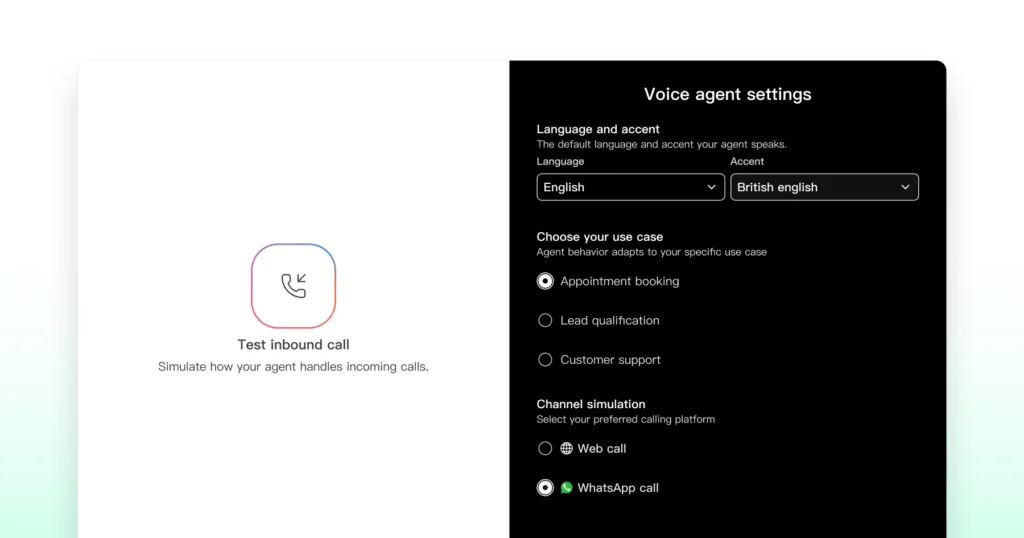
In simple terms, a conversational voice AI agent:
- Understands what a user says
- Interprets intent (not just words)
- Responds like a human conversation
- Takes real actions (not just replies)
Voice AI Agent vs IVR vs Voicebot: Key Differences Explained
If you have ever been told to “press 1 for billing” or had a chatbot completely misunderstand your question, you have already experienced the limitations of legacy voice technology.
The conversation around voice bots vs. AI agents gets muddled because the three generations of technology look similar on the surface. They all answer calls.
The differences are in what happens next.
| IVR | Traditional Voicebot | Voice AI Agent | |
| Technology | Keypad tones and pre-recorded menus | Scripted speech recognition | Large language models with natural language voice AI |
| Understands free speech? | No | Partially, within narrow limits | Yes, with high accuracy across accents and interruptions (depending on model quality) |
| Learns from conversation? | No | No | Yes, maintains context and improves responses using memory and prior interactions |
| Can they take action? | No | Rarely | Yes, CRM updates, bookings, escalations |
| Deployment complexity | Low | Medium | Low to medium, no developers needed |
| Sounds like | A phone tree | A scripted robot | A near-human AI voice |
For businesses evaluating an IVR replacement, this table is the core of the decision.
IVR routes, voicebots respond, while a conversational voice AI agent resolves.
How a Voice AI Platform Actually Works: The 5-Layer Stack
Most people assume voice AI works like a smarter version of Siri or Alexa. It does not.
There are five distinct layers that run in sequence every time someone speaks.
Each layer has a specific job, and the quality of each one determines whether the experience feels robotic or genuinely conversational.
1. Speech-To-Text
The moment someone speaks, the AI phone agent converts raw audio into text. This happens in milliseconds. The accuracy of this layer determines everything downstream.
A weak speech-to-text engine stumbles over accents, background noise, and natural speech patterns such as filler words and mid-sentence corrections.
2. Natural Language Understanding
This is where the AI figures out what the speaker actually means, not just what they said. Natural language voice AI separates intent from phrasing.
A caller saying “I need to move my appointment” and one saying “can we reschedule for next week” are asking for the same thing. This layer recognizes that.
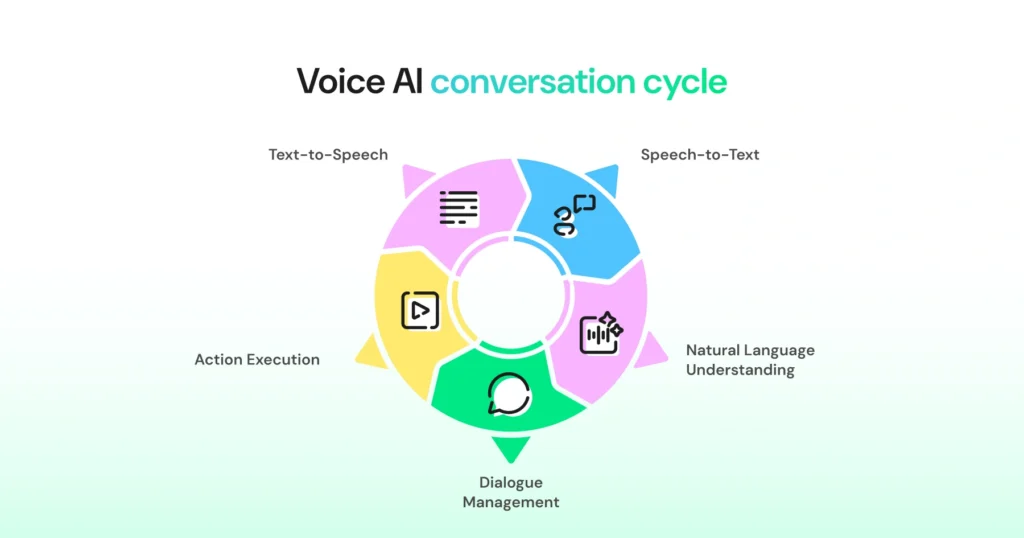
3. Dialogue Management
Think of this as the brain of the voice AI agent. It tracks the full context of the conversation, determines the right response, and decides whether the agent needs more information before acting.
This is what makes a conversational voice AI feel like a real exchange rather than a scripted back-and-forth.
4. Action Execution
This is what separates a voice AI software for companies from a simple talking interface. Once the AI understands what the caller wants, it can actually take action.
That means updating a CRM record, booking a slot in a calendar, pulling up an order status, or routing the call to the right human with full context already attached.
5. Text-to-Speech
The final layer converts the agent’s response back into audio. This is where near-human AI voice quality becomes critical.
An intelligent response that sounds robotic breaks the experience. Modern text-to-speech engines produce natural cadence, appropriate pauses, and tonal variation that keep the conversation feeling human.
All five layers run in under a second in a well-built system. That speed is what makes real-time conversation possible.
What Can a Voice AI Software Actually Do? Business Use Cases for 2026
A voice agent is an operational tool that handles real workload, at scale, around the clock. Here is what it actually looks like in practice.
1. Qualify Inbound Leads 24/7
When a prospect calls at 11 pm, an AI voice agent does not send them to voicemail. It asks the right questions, scores the lead based on their answers, and either books a follow-up or escalates immediately if the intent is high.
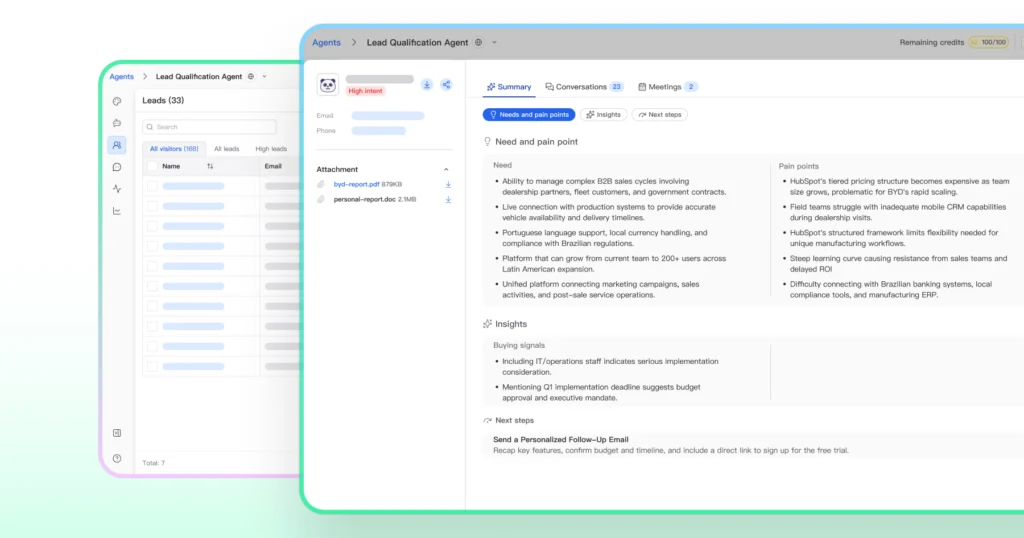
Your sales team starts the next morning with qualified leads already in the pipeline, not a list of missed calls.
2. Book Appointments Directly Into Your Calendar
The agent checks real-time availability, confirms the slot with the caller, and updates your scheduling system without any back and forth.
A dental clinic, a financial advisor, or a logistics company can handle hundreds of booking requests a day without a single staff member picking up the phone.
3. Answer Product and Pricing Questions With Context
Unlike a static FAQ or a voicebot reading from a script, a conversational voice AI pulls relevant information based on what the caller has already said.
If a customer mentions they are on a specific plan, the agent takes that into account before responding. The answer fits the person, not just the question.
4. Escalate to Human Agents When It Matters
A well-built voice agent knows its limits. When a conversation requires judgment, empathy, or authority, it hands off to a human with the full call transcript and context already attached.
The customer never has to repeat themselves.
5. Remember Past Conversations Across Calls and Chats
This is where a voice AI agent moves beyond anything IVR or a traditional voicebot can do. When a customer calls back three days later, the agent picks up where they left off without being reminded.
That continuity is what turns a transactional interaction into an experience that feels genuinely personal.
What are the Qualities That Make a Voice AI Agent Good?
Not every voice AI software delivers what it promises. As the space grows, the difference is becoming easier to see.
Whether you are evaluating an AI phone agent for the first time or replacing a system that has not delivered, these are the four qualities that separate good from great.
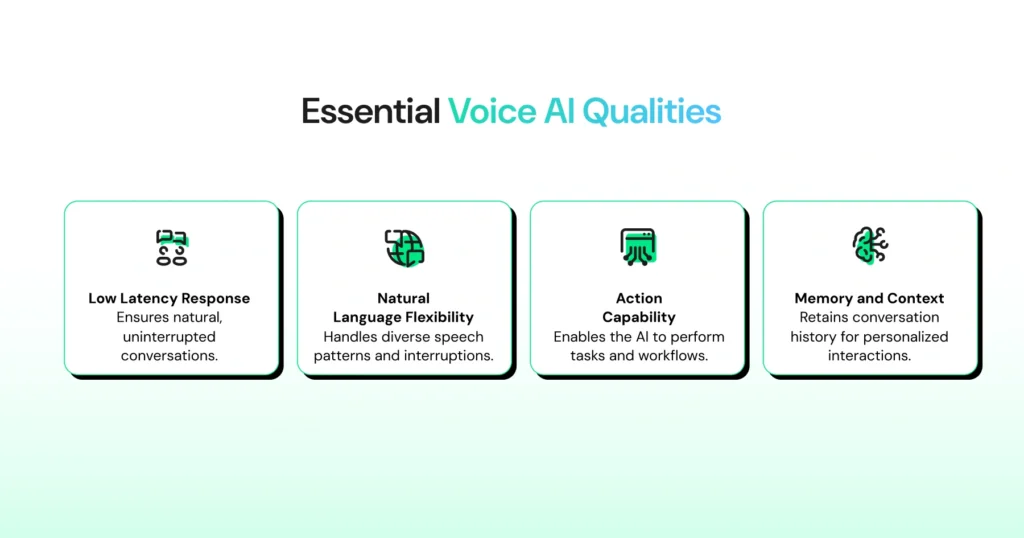
1. Low Latency Response
When a voice AI agent takes more than a second to respond, the interaction starts to feel robotic, regardless of how natural the language is.
The best systems respond in under a second, without loading, maintaining the rhythm of natural conversation without awkward pauses. The delays, repetitions, and friction make the caller frustrated.
2. Natural Language Flexibility
A strong conversational voice AI understands how people actually speak, not how a script expects them to.
That means managing interruptions mid-sentence, understanding regional accents, interpreting incomplete questions, and recovering gracefully when the conversation takes an unexpected turn.
Rigidity at this layer is one of the biggest reasons voice bot vs AI agent comparisons still favor human agents in many evaluations.
3. Action Capability
This is the quality that defines the category. An AI voice agent that can only talk is a more expensive voice bot. Taking actions based on what the agent understands closes the workflow gaps for your teams.
These actions include updating a CRM record, triggering a follow-up workflow, confirming a booking, and pulling live order data.
These are the actions that make a voice AI agent for business genuinely useful rather than just conversational.
4. Memory and Context
The difference between a voice agent vs chatbot often comes down to memory. A chatbot resets. A well-built voice AI agent remembers.
It retains context within a conversation so the caller never has to repeat themselves, and it carries relevant history across conversations so returning customers feel recognized.
According to Forrester’s Predictions 2026 report, 78% of AI decision-makers find AI outputs trustworthy, which is driving broader deployment of intelligent voice agents across customer-facing functions. Memory is a significant part of why that trust is building.
5. Voice Personalization (Voice Cloning)
Most voice AI agents sound like voice AI agents. Competent, clear, and completely generic. That sameness is one of the biggest barriers to creating an experience that feels genuinely on-brand.
Advanced systems now go a step further, enabling businesses to replicate their exact brand voice, tone, and personality.
Instead of a neutral AI reading responses, the agent can sound like your best salesperson or most trusted support representative, complete with natural pauses, warmth, and familiarity.
This is the quality that separates a good voice AI agent from an outstanding one. The shift from AI that simply talks to AI that sounds like you is what defines the next generation of voice interfaces.
Bonus Resource: Best Voice AI Agents for Business in 2026: Retell AI vs Bland AI vs Astra Compared
Voice AI Agents on WhatsApp vs Phone: Is There a Difference?
A common question businesses ask when evaluating a voice AI agent is whether the channel changes the experience. If you are already using WhatsApp for customer communication, does switching to phone mean starting over?
The short answer is: not necessarily.
In well-built systems, the AI intelligence layer remains consistent across channels. The same system can understand, respond, and take action regardless of where the conversation happens. What changes is the interaction modality.
1. Phone Calls
On a phone channel, the AI phone agent operates in real time. The conversation is live and continuous, with speech-to-text and text-to-speech working together to deliver responses within a second. This is where low latency matters most.
2. WhatsApp Voice Messages
On WhatsApp, the interaction is more flexible. Voice messages are primarily asynchronous, giving users more control over when and how they respond.
Most voice AI solutions treat WhatsApp as an add-on, often routing users to external calls or separate interfaces. A more advanced approach is running a conversational voice AI agent natively on WhatsApp, where voice interactions happen directly within the chat experience instead of being routed through external systems.
This reduces friction, keeps conversations in a familiar interface, and allows businesses to manage both voice and chat in a single thread without switching channels.
Why this Matters for Your Business
A well-built voice AI agent for business should not force you to choose between channels. The same intelligence should work across phone and WhatsApp without requiring separate systems, delivering a consistent experience wherever your customers are.
How to Choose the Right Voice AI Agent for Your Business?
The market for voice AI agents is growing fast.
According to Accenture’s “Reinventing Enterprise Operations with Gen AI” report, three in four organizations have seen their investments in generative AI and automation meet or exceed expectations, with 63% planning to increase that investment by 2026.
However, not every platform delivers on the same promise. Before committing, here are the four questions worth asking
Question 1: Does it Require Developers to Set Up and Maintain?
Some voice AI platforms are built for engineering teams. They offer flexibility but come with setup costs, ongoing maintenance requirements, and a reliance on technical resources that most small and mid-sized businesses do not have.
Look for a platform that lets non-technical teams build, deploy, and adjust workflows without writing a single line of code.
The faster you can go from evaluation to live deployment, the faster you see returns.
Question 2: Does it Support the Channels Your Customers Actually Use?
An AI phone agent that only works on the phone is a constraint, not a solution. As the WhatsApp vs phone section above makes clear, the underlying intelligence of a voice AI agent should be channel-agnostic.
Before choosing a platform, confirm it supports the specific channels your customers prefer, whether that is phone, WhatsApp, or both, without requiring separate systems for each.
Question 3: Does it Include Business Logic or Just Voice?
This is the question most businesses forget to ask. A platform that handles natural language voice AI but cannot connect to your CRM, calendar, or support system is only solving half the problem.
The action execution layer is what separates a genuinely useful conversational voice AI from a sophisticated answering machine.
Ask specifically what integrations are available out of the box and how much custom work is required to connect your existing tools.
Question 4: What Does it Actually Cost?
Per-minute pricing models can look attractive upfront, but become expensive at scale.
Per-minute fees compound quickly at scale. What looks affordable in a demo can become one of your highest operational costs once call volume picks up.
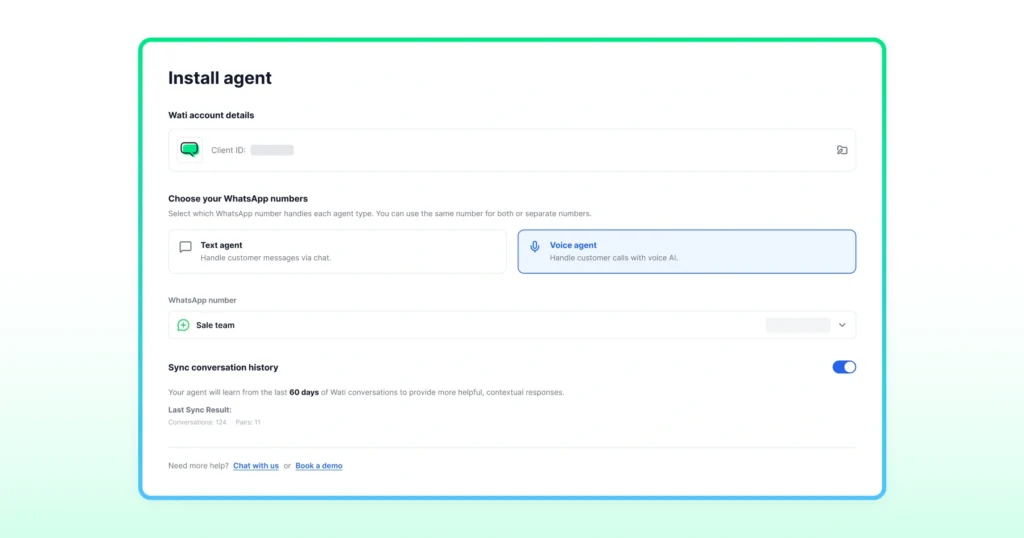
Get clarity on the pricing structure before evaluating features. Astra by Wati is built specifically for businesses that want a no-code, multi-channel voice AI agent without the per-minute pricing trap.
It combines phone and WhatsApp support in a single intelligence layer, lets you clone your brand voice from a short recording, and deploys that cloned voice as a live conversational AI agent natively on WhatsApp.
The result is a consistent, familiar voice across every channel your customers already use, without the developer dependency or the escalating call costs.
For a full breakdown of how leading platforms compare on these criteria, see our guide to the best voice AI agents for business in 2026.
Your Business Deserves a Voice AI Agent That Actually Works
The gap between what most businesses think voice AI is and what it actually delivers in 2026 has never been wider.
IVR was built for a world where routing a call was the best technology could do. That world is gone.
What has replaced it is a category that listens, understands, acts, and remembers. Not as a future promise but as a working reality that businesses across industries are deploying right now.
The businesses that move first do not just save on operational costs. They create a customer experience that feels genuinely different from what their competitors offer.
A caller who gets a real answer at midnight, books an appointment without being put on hold, or calls back and is immediately recognized does not forget that experience. The question is no longer whether a voice AI agent belongs in your business. It is how quickly you can get one working for you.
See and understand how the voice AI agent works. Try Voice AI today.
Frequently Asked Questions
A voice AI agent is an AI-powered software that holds real, two-way conversations in real time. Unlike IVR or a traditional voicebot, it understands free-form speech, determines intent, and responds conversationally. It can also take actions like booking appointments or updating CRM records without a human on the line.
A voicebot follows a fixed script and can only respond to narrow, preset inputs. A voice AI agent uses natural language understanding to handle free-form conversation, adapt in real time, and take meaningful actions. The gap between the two is not incremental. It is generational.
A voice AI agent runs on five layers: speech-to-text, natural language understanding, dialogue management, action execution, and text-to-speech. Each layer processes the conversation in sequence, all within under a second, making real-time conversation possible.
Yes. The underlying intelligence of a voice AI agent is channel-agnostic. The same AI brain that handles a live phone call can process voice messages on WhatsApp, without rebuilding logic or maintaining separate workflows for each channel.
IVR routes callers through pre-recorded menus using keypad inputs. It cannot understand free speech, learn from a conversation, or take actions. A voice AI agent does all three, making it a true IVR replacement rather than an incremental upgrade.