
Too Long? Read This First
- Conversational commerce helps customers discover products, get recommendations, and complete purchases through chat.
- Common types include live chat, messaging apps, chatbots, AI agents, SMS, RCS, and voice assistants.
- Key benefits of conversational commerce are higher conversions, fewer abandoned carts, more qualified leads, better customer retention, and lower support costs.
- The process involves five steps: starting a conversation, answering questions, exploring products, completing a purchase, and following up.
- Businesses can use AI agents to answer product questions, recommend relevant options, and hand complex requests to sales reps.
- Wati supports conversational commerce through Wati AI (including Astra), WhatsApp catalogs, a shared Team Inbox, and store integrations.
- Heritage Foods reported 2x higher order-to-purchase conversion after moving its ordering journey to WhatsApp with Wati.
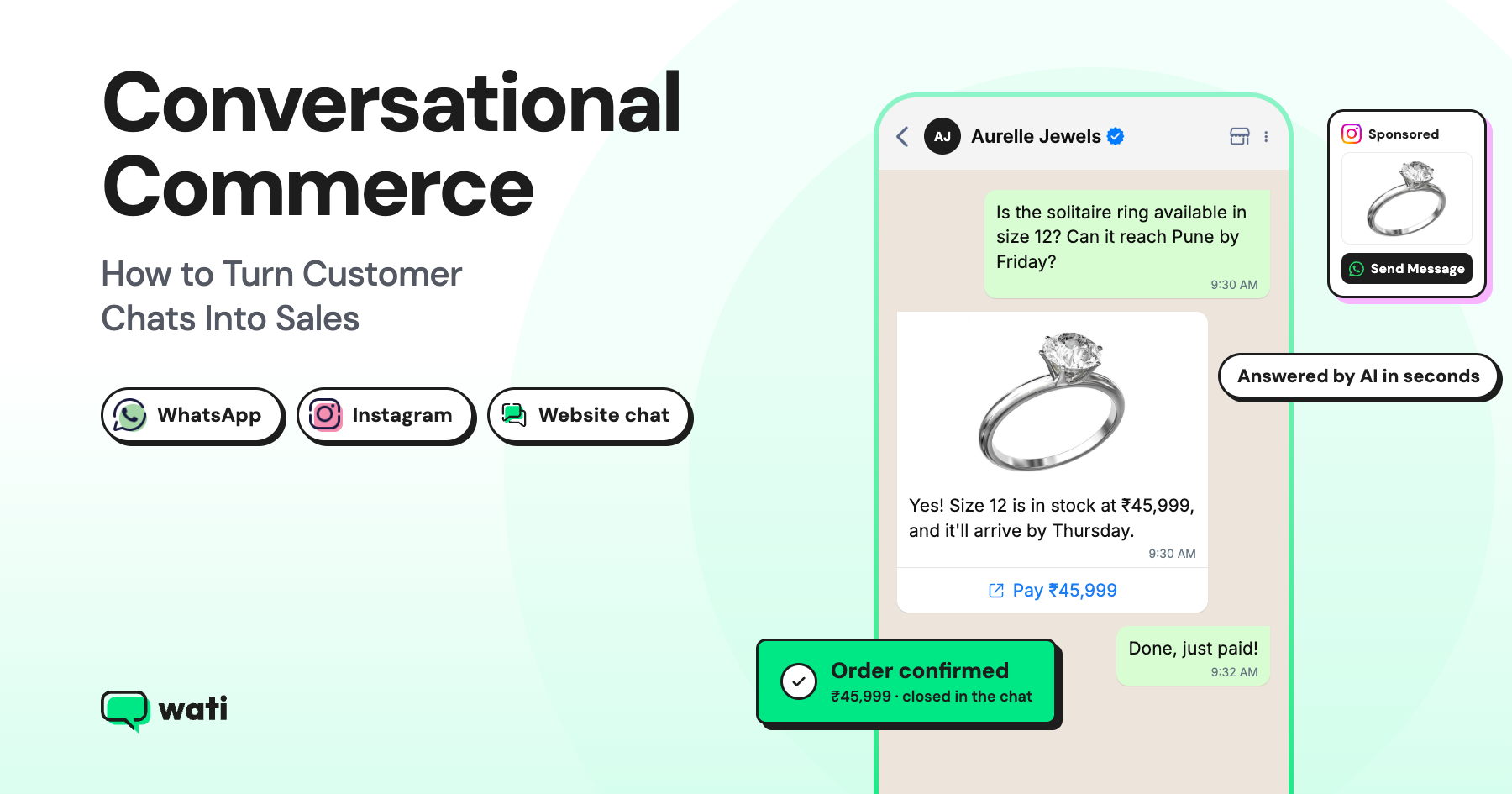
“Hi, do you have this dress in medium, and can it reach Pune by Friday?” A shopper sends this message on WhatsApp at midnight. Soon after, they get an answer and two matching options.
This is conversational commerce in action. Shoppers ask, compare, and buy in the chat, whether they’re talking to a person, a chatbot, or an AI agent.
However, these chats rarely stay on one channel or within office hours. The same shopper might ask about the dress in your website chat at night and follow up on WhatsApp the next morning, expecting a quick reply both times.
That’s why more businesses are using AI to keep up. Juniper Research expects conversational AI service revenue to grow from $2.4 billion in 2026 to $8.5 billion by 2030.
Astra, Wati’s AI agent for customer conversations, answers customer questions even outside office hours and passes the chat to your team when a person needs to step in.
In this guide, we cover what conversational commerce is, its types and benefits, how it works, and how Wati helps you turn customer conversations into sales.
What is Conversational Commerce?
Conversational commerce is the use of messaging apps, website chat, chatbots, AI agents, and voice assistants to help customers discover, research, and buy products through a conversation instead of browsing a website.
Customers ask questions, get recommendations, and place orders in the chat, with answers from a person, a chatbot, or an AI agent.
Common examples of conversational commerce include:
- Asking a brand on WhatsApp whether a product is in stock and receiving a payment link in the same chat
- Chatting with an AI agent on a brand’s website to compare two products before buying
- Tapping an Instagram ad that opens a chat, then ordering after a few questions
- Answering a few quick questions in a chatbot to get a skincare recommendation, then ordering it
Conversational commerce often works alongside social commerce. Shoppers discover products on social media, and the sale closes in a conversation.
What Are the Types of Conversational Commerce?
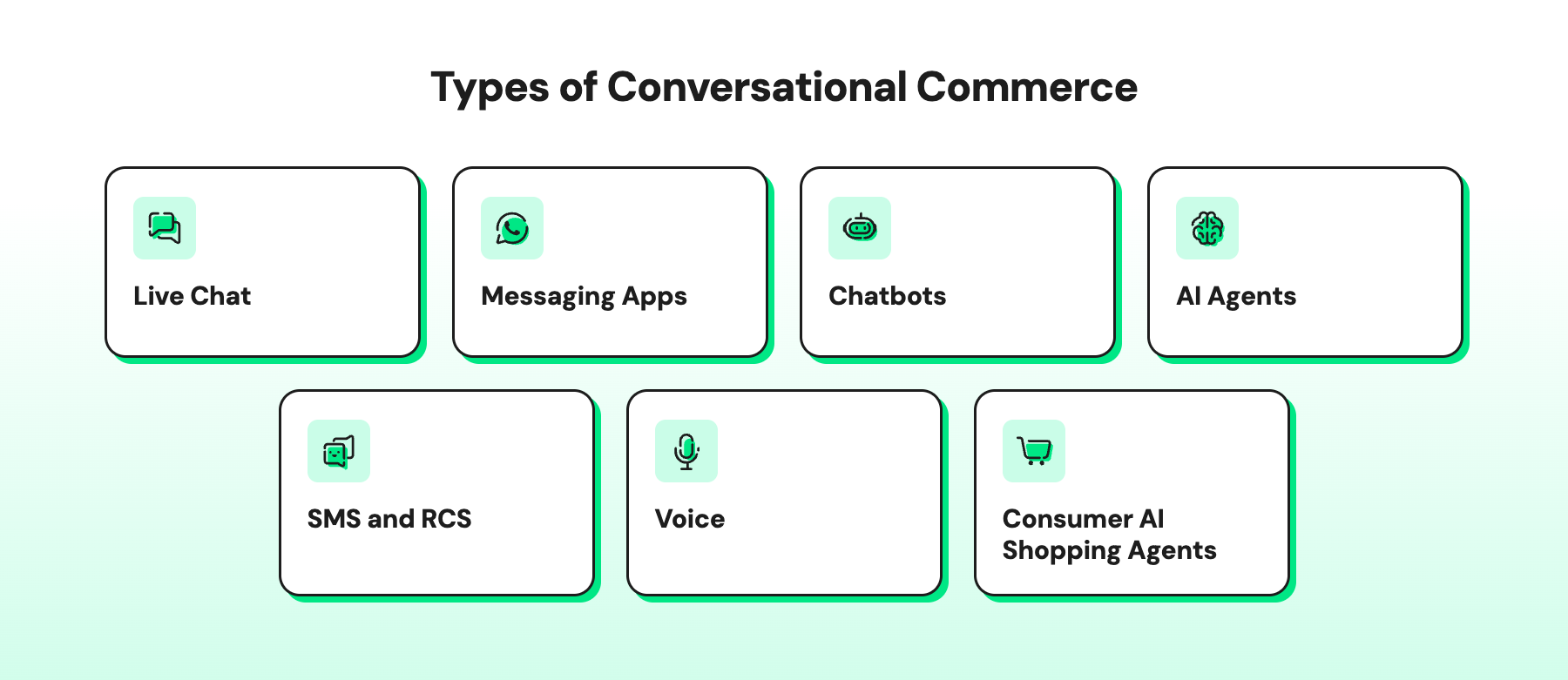
There are seven types worth knowing: live chat, messaging apps, chatbots, AI agents, SMS and RCS, voice notes and calls, and consumer AI shopping agents. Many brands run several at once. The real skill is knowing which one should handle which part of the sale.
1. Live Chat
Live chat is the oldest form, and still underrated for one moment: the shopper sitting on your product page with their card half out. A rep who answers “will this fit a 15-inch laptop?” in under a minute closes sales that no amount of page copy will.
Its blind spot is memory. Once the tab closes, the conversation is gone, and so is the shopper.
The fix is simple: before they leave, ask for their number and permission to continue on WhatsApp. “Thinking about it” becomes a conversation you can pick up tomorrow.
2. Messaging Apps
This is where shoppers already are: in Meta’s 2026 State of Business Messaging report, 73.3% of consumers said they prefer messaging when communicating with a business. WhatsApp, Instagram DMs, Messenger, and TikTok DMs are where shoppers already talk to friends, so messaging a brand there doesn’t feel like contacting customer service.
The advantage over live chat is that the thread stays open. A shopper can ask about a kurta on Monday, disappear, and reply “ok, sending payment” on Thursday, and the whole context is still sitting there.
In India, many can pay through UPI in WhatsApp, where the business has it enabled. That’s about as short as a checkout gets.
3. Chatbots
Chatbots handle the predictable questions, such as order tracking, store timings, and return policies. A button-based flow can also collect a PIN code before a support rep joins the chat.
Where they fall apart is the question nobody planned for. A shopper types “can I gift-wrap this and send it to my mother’s address?” and the bot loops back to the main menu.
That one frustrating moment is why most brands now put an AI agent behind the flow. With Wati’s no-code chatbots, anything the flow can’t handle goes to Astra or straight to a rep.
4. AI Agents
An AI agent reads a question the way a good salesperson would. Ask “which serum is better for oily skin, and can I use it with retinol?” and you get an actual answer, not a list of options to tap through.
The mistake we see most often is expecting the AI to do everything. The setups that convert let AI handle the routine at any hour, then hand bulk orders, discount negotiations, and unhappy customers to a person quickly, with the full chat history attached.
Astra works this way. It answers from your website, product documents, and FAQs, and passes the chat to your team when a human should take over.
5. SMS and RCS
Nobody browses a catalog over SMS. But SMS reaches every phone, which makes it the dependable fallback for order updates and reminders when a customer isn’t on WhatsApp.
RCS is the more interesting one. It turns the phone’s default messaging app into something that looks like a modern chat, with images, carousels, buttons, and a verified brand name.
Think of both as backup channels: if a cart reminder can’t be delivered on WhatsApp, it falls back to RCS, then SMS, instead of disappearing.
6. Voice
The voice shift in commerce is happening inside messaging apps. On WhatsApp, voice notes are already an everyday habit, and shoppers bring that habit into their chats with businesses.
Many shoppers would rather speak a detailed question than type it. A voice note is faster for them, especially when the question is long, or they prefer their own language.
A business that only reads text ignores some of its most engaged buyers. AI agents that understand voice notes close that gap, answering an 11 p.m. voice note as fast as a typed message.
Some purchases still need a live conversation. For a ₹40,000 sofa or a bridal order, a two-minute call often settles what ten messages can’t.
With WhatsApp Business Calling, shoppers tap to call inside the same chat. They don’t need to look up a number or switch apps.
7. Consumer AI Shopping Agents
Shoppers ask ChatGPT or Gemini for “the best running earbuds under ₹5,000,” get a shortlist, and in some markets buy inside the chat. They never message your brand at all.
If the AI doesn’t pick you, you never learn you lost the sale. There’s no abandoned cart or unanswered DM, only a customer who bought elsewhere.
To make the shortlist, publish complete product details in text and keep prices and stock consistent everywhere. Write return and delivery policies an AI can read and quote.
You still own what happens after an AI sends you a customer: the confirmation, the delivery update, and the “where’s my order?” message. Handle those well on WhatsApp, and a one-off AI order becomes a customer who returns to you directly.
What Are the Benefits of Conversational Commerce?
Conversational commerce helps businesses sell more, answer customers faster, and keep customers coming back.
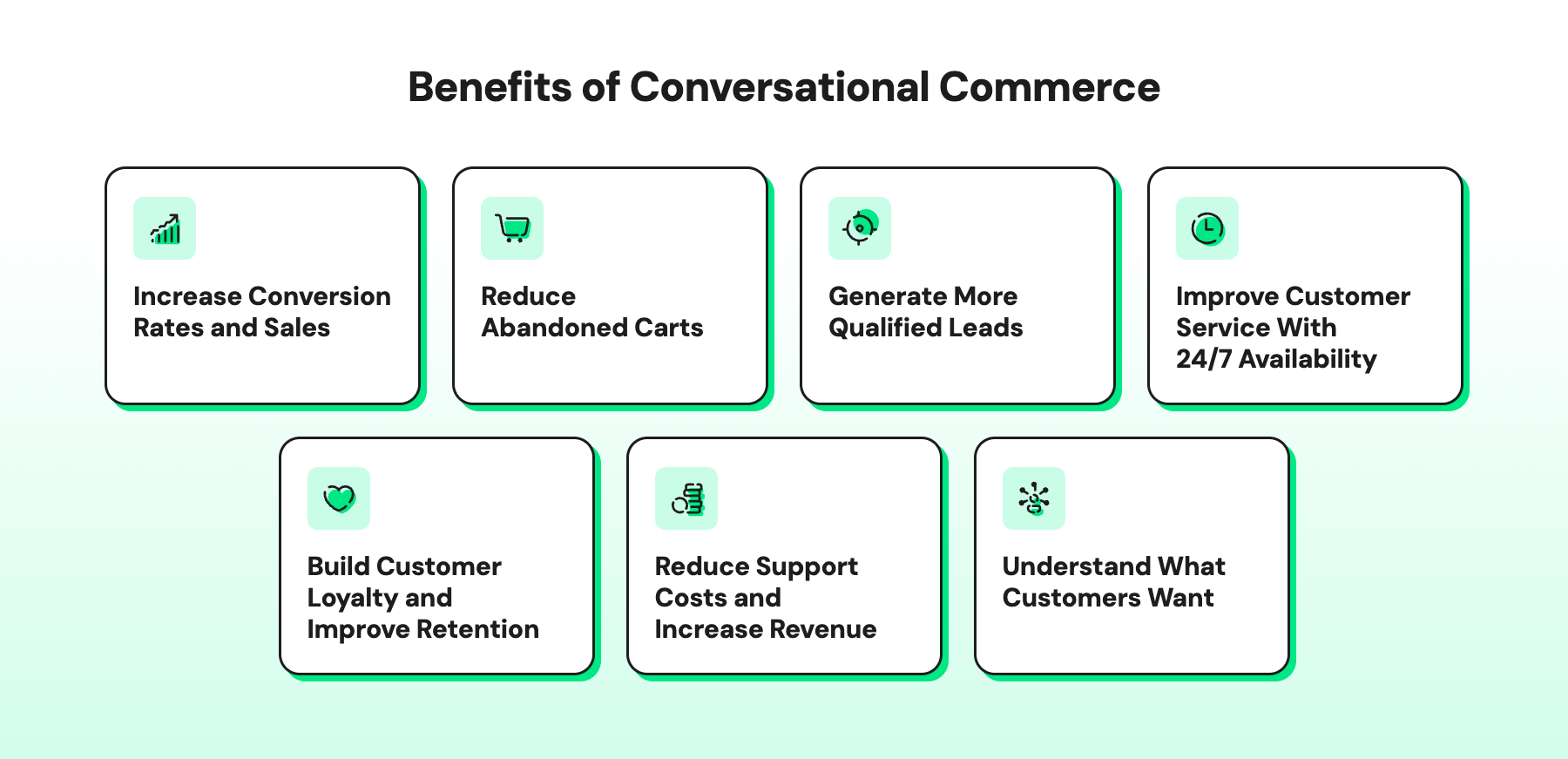
Here are seven benefits for growing brands.
1. Increase Conversion Rates and Sales
Shoppers who get answers and recommendations in a chat are more likely to buy than those left to browse on their own. Every question you answer removes one more reason to leave.
A conversation also lets you spot exactly when a shopper is ready to buy, so you can help them place the order right then.
2. Reduce Abandoned Carts
Many shoppers leave at checkout because of one unanswered question, such as the final price, delivery date, payment options, or return policy. A quick reply in a chat can clear that doubt before they leave.
If they do leave, a message reminding them about their cart gives them an easy way to come back and finish the order.
3. Generate More Qualified Leads
For high-value purchases, such as courses, property, or bulk orders, a conversation helps you understand what each prospect needs, their budget, and how ready they are to buy. Chatbots and AI agents can ask these questions automatically.
Your sales team then receives leads with this context already collected, so they can focus on prospects who are ready to talk.
4. Improve Customer Service With 24/7 Availability
Customers can ask questions at any time, whether it's about a product's features before buying or a delivery update after. With chatbots and AI agents, customers get answers even outside business hours.
5. Build Customer Loyalty and Improve Retention
Customers return to brands that make buying easy and stay helpful after the sale. Order updates, quick fixes for delivery issues, and personalized product suggestions all keep the relationship going.
Over time, these conversations turn first-time buyers into regular customers.
6. Reduce Support Costs and Increase Revenue
Chatbots and AI agents answer repeat questions about delivery, payments, and sizing, so your team handles fewer chats by hand. You can manage busy periods, such as festive sales, without hiring extra staff for each spike in messages.
The time your team saves goes toward conversations that drive revenue, such as high-value orders, bulk inquiries, and upsells. Even a support chat can become a sale when a rep suggests a matching product or an upgrade.
7. Understand What Customers Want Through Conversation Data
Every chat shows you what customers ask about, which products interest them, and what stops them from buying. Patterns in these conversations point to gaps in your product pages, offers, and policies.
For example, if many customers ask whether a product is waterproof, adding that detail to the product page can answer the question before it's asked.
How Does Conversational Commerce Work?
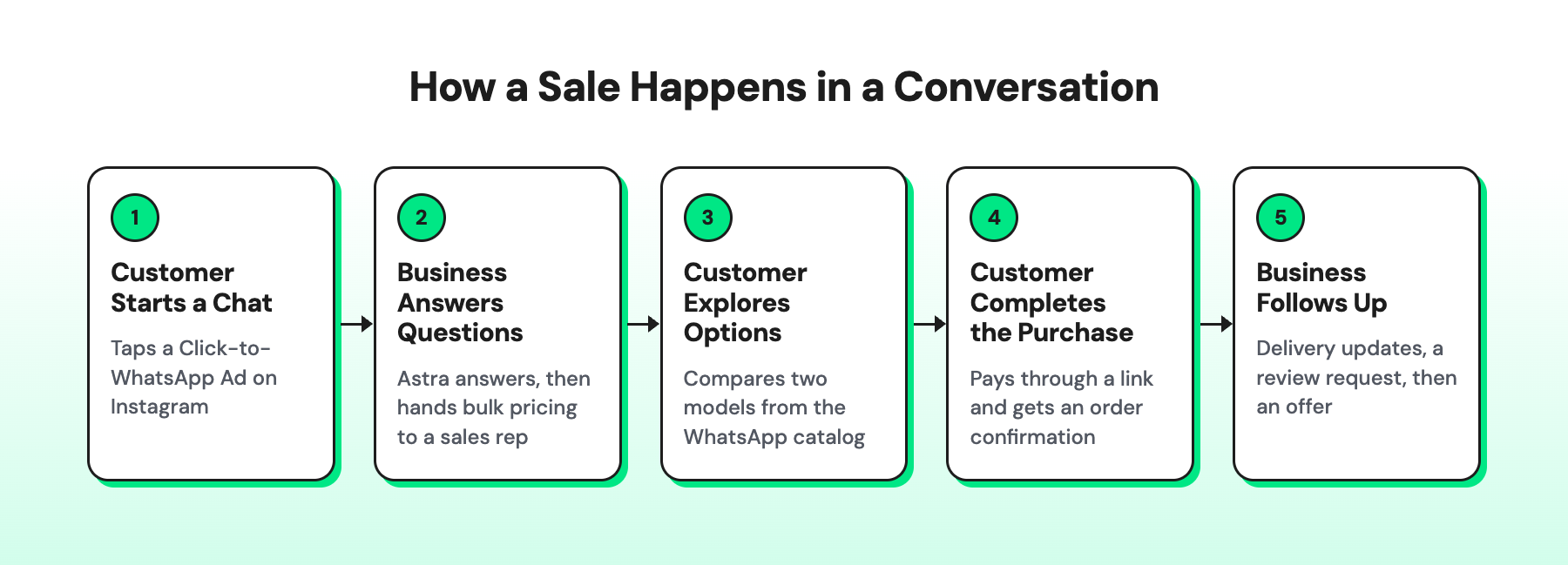
Conversational commerce works in five steps: a customer starts a conversation, gets answers, explores options, completes a purchase, and receives follow-up messages.
Here's how the process works for Rachel, who's shopping for wireless earbuds.
- Starting a Conversation
Rachel sees an ad for wireless earbuds on Instagram and taps "Send message." The Click-to-WhatsApp Ad opens a WhatsApp conversation with the brand, where she can ask questions without first browsing its website.
- Answering Customer Questions
Rachel asks, "Do these work with an iPhone, and can they reach Bengaluru by Friday?" Astra answers her question right away.
She then asks whether the brand offers a discount for buying five pairs for her team. Astra hands the conversation over to a sales rep in the Team Inbox.
- Exploring Product Options
The sales rep shares two models from the brand's WhatsApp catalog, including product photos and prices. Rachel compares the options in the chat and chooses the model with the longer battery life.
- Completing the Purchase
The rep shares a link for Rachel to place her order and complete payment. Because the brand's store is connected to Wati, an order confirmation reaches her on WhatsApp as soon as the purchase goes through.
- Following Up After the Sale
Rachel receives delivery updates on WhatsApp until her earbuds arrive. At checkout, she also agreed to receive offers from the brand on WhatsApp, so a drip campaign sends her a review request two weeks later, followed by an offer on a compatible charging case.
How Does Wati Help You Sell Through Conversational Commerce?
Wati helps shoppers move from product questions to purchase without leaving the conversation. Each feature below supports a different stage of the buying process.
Wati AI: Help Customers Buy and Your Team Sell
With Wati AI, you can support both customer conversations and your sales team.
For customers:
- Astra answers product questions on WhatsApp and guides shoppers toward the next step. When a request needs human attention, such as a bulk order or custom requirement, Astra hands the conversation over to a sales rep.
For your team:
- Wati AI Agents handle sales tasks in the background and prepare actions for your approval. The Ready-to-Buy agent identifies contacts showing buying intent and suggests grouping them so your team can follow up.
- Ask Wati AI lets your team ask questions about Wati data in plain language, such as which customers asked about a product this week.
- AI Translate helps sales reps communicate with customers who speak different languages.
WhatsApp Catalog: Show Products in the Conversation
Your team can share products from your WhatsApp catalog, including photos, prices, and descriptions. Shoppers can compare options in the conversation and ask follow-up questions before deciding what to buy.
Shared Team Inbox: Continue the Conversation Without Starting Over
Wati’s Shared Team Inbox brings conversations from WhatsApp, Instagram, Facebook Messenger, TikTok, SMS, RCS, and web chat into one place.
When a sales rep takes over, they can review the conversation history and share a checkout link without asking the shopper to repeat information.
Store Integration: Recover Carts and Confirm Orders
Wati connects with Shopify and WooCommerce, so actions in your store can trigger WhatsApp messages automatically.
Shoppers who leave without paying get a reminder with a link back to their cart, and Shopify cash-on-delivery orders can be confirmed on WhatsApp before you ship.
Heritage Foods' 2x Order Conversion: From App to WhatsApp Ordering
Heritage Foods, a leading Indian dairy brand serving millions of households across 35+ cities, was losing potential orders through its mobile app and website. Customers had to download the app and go through several steps to place an order.
What Heritage Foods Did
Working with its technology partner Version Next, Heritage Foods moved its ordering journey to WhatsApp using Wati:
- Location-based catalog: Meta Catalog integrated into WhatsApp, auto-updating product listings for 35+ cities based on the user’s PIN code.
- Ordering in WhatsApp: Order journeys run within WhatsApp, without redirecting customers to external apps.
- Keyword-based discovery: Custom flows are triggered by product keywords. For example, typing “milk” shows the milk category.
- WhatsApp subscriptions: Customers set up recurring dairy orders, with offers based on how long they subscribe.
The Results
- 2x higher order-to-purchase conversion after moving ordering to WhatsApp
- WhatsApp broadcasts reached about 5x more customers, compared with SMS and email open rates below 15%.
Start Turning Customer Conversations Into Sales
Shoppers already ask questions in chat before they buy. Conversational commerce lets you answer those questions, show the right products, and close the sale in the same conversation, on whichever channel the customer chooses.
Wati brings this together with Astra answering shoppers, the shared Team Inbox keeping every conversation in one place, and store integrations helping you recover lost carts.
Book a demo to see how Wati can turn more of your conversations into orders.
Frequently asked questions
Is conversational commerce right for small businesses?
Yes. Small businesses can start with one channel, such as WhatsApp, and a few automated replies for common questions, then add AI and more channels as conversations grow.
Do I need AI to get started with conversational commerce?
No. You can start with your team replying to chats and simple chatbots for routine questions, then add an AI agent when the number of conversations becomes hard to manage.
Which channel is best for conversational commerce?
It depends on where your customers already message you. In India and many other markets, WhatsApp is usually the main channel, while Instagram DMs and website chat often start the conversation.
How do you measure conversational commerce success?
Track how many conversations turn into orders, how quickly customers get a reply, and how much revenue comes from chat. Tagging conversations by source, such as an ad or a website chat, shows which channels bring in the most sales.
What’s the difference between conversational commerce and social commerce?
Social commerce is where shoppers discover products in feeds, Reels, and live streams. Conversational commerce is where they ask questions and buy in chats on WhatsApp, Instagram DMs, or website chat. Many sales start with one and close with the other.
Related posts
- Instagram Comment Automation: How It Works and How to Set It Up in Wati
Instagram comment automation auto-replies to comments and DMs commenters within seconds via Meta's API. Covers strategy, use cases, and Wati setup.
- Shared Team Inbox for Instagram: A Buyer’s Checklist for 2026
Use this fastest checklist to evaluate any shared team inbox for Instagram, which covers DMs, comments, automation, and multi-channel support.
- How to Send Bulk Messages on WhatsApp Without Getting Blocked
Learn how to send bulk WhatsApp messages without getting blocked. Compare the WhatsApp Business app and API, messaging limits, costs, templates, and best practices for safe, compliant bulk messaging.
- How to Set Up a TikTok Business Account: Step-by-Step Guide
Set up a TikTok Business Account step by step: switch from personal, pick a category, add your profile, and unlock ads and analytics.