
Too Long? Read This First
- What changed: Meta Business Agent moved from per-message billing to token-based billing on August 1, 2026.
- The rate: $2.00 per 1,000,000 tokens. Meta bundles the AI processing charge and the message delivery fee into this single rate, so businesses no longer pay for AI usage and message delivery as separate line items.
- Where it applies: Meta Business Agent conversations on WhatsApp, Messenger, and Instagram.
- What ended: The free build-and-test window that ran July 1 to July 31, 2026.
- What’s next: Separate changes to service messages and in-window utility templates take effect October 1, 2026.
Meta Business Agent switched to token-based pricing on August 1, 2026. Businesses running AI-powered customer conversations now pay $2.00 per million tokens processed, roughly 4 to 5 cents for a typical message, instead of a flat per-message fee.
The change applies to Meta Business Agent conversations across WhatsApp, Messenger, and Instagram, and ended the free testing window that ran through July 2026.
This guide explains what changed, who is affected, how token billing is calculated, what a conversation costs, how it compares to other AI customer-service tools, and how to control that cost.
What is Meta Business Agent?
Meta Business Agent launched globally on June 3, 2026, at Meta’s Conversations conference in London, and more than 1 million businesses were already using Meta Business Agent as of its June 3, 2026, launch.
Meta Business Agent is Meta’s generative AI conversational layer that lets businesses automate customer chats across WhatsApp, Messenger, and Instagram.
Unlike rule-based chatbots that follow fixed decision trees, Meta Business Agent interprets customer intent, generates responses, and handles a broad range of support and sales interactions: answering questions, recommending products, booking appointments, and qualifying leads.
It’s worth knowing that “Meta Business Agent” is not one single product. Meta currently ships it in three distinct forms, and they are not interchangeable.
Version | Who it’s for | What it can’t do | Availability |
MBA on WhatsApp (self-serve) | Small and mid-size businesses using the WhatsApp Business app | Complete purchases, process payments, run complex workflows, or route conversations to a team | Rolling out market by market, expanding from an initial Latin America launch |
MBA on Messenger (self-serve, shown as "Business AI" in-product) | Small and mid-size businesses using Meta Business Suite | Same limits as above | Available in selected Southeast Asian markets, with further expansion planned |
MBA Platform (enterprise) | Larger businesses in supported verticals (retail, e-commerce, travel, telecom, etc.) use the WhatsApp Business Platform (Cloud API). Invite-only, subject to Meta's eligibility criteria. | Full commercial pricing is not yet public; still invite-only and pilot-based | Early pilots are live in select markets, with more markets "coming soon" |
For most small and mid-size businesses, the version that matters is self-serve MBA. It runs only in the WhatsApp Business consumer app, not in the WhatsApp Business API, which means it cannot take payments, hand off a conversation to a specific team member, or trigger a broadcast.
The enterprise Platform closes most of those gaps, but its target customer profile is well above that of a typical small- or mid-market business today.
Bonus Read: Why Meta Business Agent Doesn’t Replace WhatsApp Business API
Meta Business Agent Pricing Change, August 1, 2026?
Meta Business Agent launched July 1, 2026, as a new message category and became billable on August 1 under token-based pricing.
The specifics:
- Rate: $2.00 per million tokens, applied as a single global rate.
- Scope: Conversations handled by Meta Business Agent on WhatsApp, Messenger, and Instagram.
- Basis: Each delivered AI message is charged, with its cost set by the tokens that message consumes (~20,000–25,000 tokens per message).
- Free window closed: The July 1 to 31, 2026 period, when brands could build and test agents at no cost, has ended. Meta Business Agent conversations are now billable.
- Structure: Meta treats Meta Business Agent as a single message category and pricing structure, one per-token charge, regardless of whether the agent was configured through the self-serve app or the enterprise Platform.
First, Attach a Credit Line or Messages Won't Send
As of August 1, 2026, Meta will not deliver Meta Business Agent messages unless a credit line is attached to your Business Agent account.
Billing runs through monthly invoicing via a Meta credit line in Billing Hub, with credit-card support only targeted for September 2026.
If you already have a Meta credit line for ads or messaging, you can attach your Business Agent account to it in Billing Hub; if you don't, you'll need to apply for one, subject to Meta's review and approval.
Sort this out before you go live, because without it, your AI simply stops replying.
The shift ties cost to the amount of AI processing each interaction requires rather than to message volume.
What is a Token & How is Billing Calculated?
A token is a unit of text that an AI model processes, roughly a word or a fraction of a word, depending on the tokenizer.
A token may represent part of a word, a whole word, punctuation, or other text elements.
Every customer message sent to a Meta Business Agent and every AI-generated response consumes tokens, so longer prompts and longer conversations cost more.
Billing is straightforward: total tokens processed, divided by 1,000,000, multiplied by $2.00. The key detail is that Meta's figures are per message, not per conversation.
Worked example: a single AI message typically uses 20,000 to 25,000 tokens.
25,000 tokens ÷ 1,000,000 × $2.00 = $0.05 per message
A full conversation runs higher. Meta's own examples put a simple, 4-message inquiry at about 80,000 tokens (roughly 16 to 20 cents) and a complex, 10-message interaction at about 250,000 tokens (roughly 40 to 50 cents). So 1 million tokens covers about 40 to 50 messages, or roughly 4 to 12 full conversations, depending on complexity.
In short, a typical Meta Business Agent message costs about 4 to 5 cents, and a full conversation ranges from roughly 16 to 50 cents. Cost scales with conversation length and complexity, so short, well-scoped interactions are the cheapest.
Conversation Type | Approx. Tokens | Approx. Cost |
Simple query (typical) | 20,000 to 25,000 | $0.04 to $0.05 |
Long, multi-step sales chat | ≈ ~$0.40–$0.50 | |
1 million tokens | 1,000,000 | $2.00 (about 40 to 50 conversations) |
At that per-conversation rate, a business handling 10,000 AI-resolved customer interactions a month would spend roughly $1,600 to $5000 on Meta Business Agent billing alone, before any standard WhatsApp messaging charges.
No Free Window for MBA Messages
One assumption worth correcting: the usual "replies inside the customer service window are free" rule does not apply to Meta Business Agent.
Marketing, utility, authentication, and service messages are all free inside the 72-hour free-entry-point window, but MBA messages are the one exception. They're charged whenever they're delivered, window or not.
If your team is used to leaning on the free 24-hour window to keep costs down, that option doesn't apply to AI-handled conversations.
How Charges Stack in One Conversation
Meta's own worked example shows how charges add up across a single flow. A business sends a cart-abandonment marketing template, the customer replies, the Meta Business Agent answers two questions, the chat is handed to a human rep, and the business closes with an order-confirmation template, all within an hour.
As of August 1, 2026, that conversation costs three charges: one marketing template plus two MBA replies, while the rep's message and the utility confirmation are still free.
From October 1, 2026, the same flow costs five charges, because the rep's service message and the in-window utility template both become billable. Same conversation, same messages, two extra charges, and that's the October 1 change in practice.
Who is Affected by the Change?
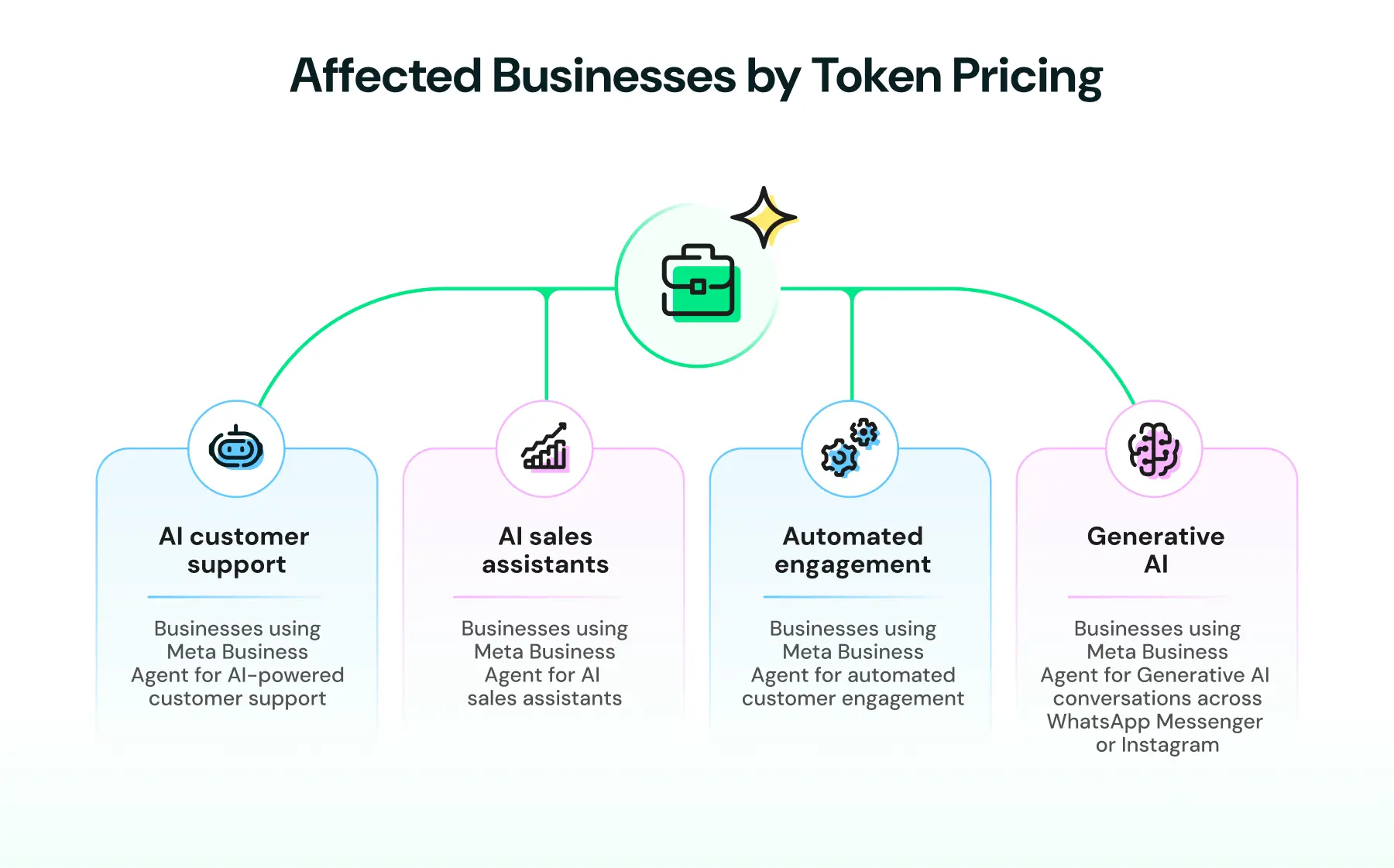
The token pricing affects businesses that use Meta Business Agent to automate customer conversations.
Businesses on the standard WhatsApp Business Platform that do not use Meta Business Agent continue on Meta’s existing per-message pricing.
It applies if you use the Meta Business Agent for:
- AI-powered customer support
- AI sales assistants
- Automated customer engagement
- Generative AI conversations across WhatsApp, Messenger, or Instagram
Service Messages vs. Meta Business Agent: Two Different Bills
Token pricing only applies to Meta's own agent. Since July 1, 2026, Meta splits non-template messages into two billing categories: Meta Business Agent messages, powered by Meta's Business Agent Platform and billed per token, and service messages, powered by a human rep or a third-party AI and billed per message at the same rates as utility and authentication.
That distinction matters for anyone weighing a third-party option: replies from a platform like Wati's Astra are billed as service messages on a per-message basis, not under MBA's token model.
So the real comparison isn't token versus token; it's Meta's per-token charge against per-message service rates, and the two behave very differently as conversations get longer or more complex.
Meta's Own Benchmark: Service vs. 3rd-Party AI vs. MBA
Meta publishes its own cost comparison, and it's revealing. For 1,000 AI-powered replies to users in Brazil, Meta estimates roughly $27 for a low-complexity service-message setup, about $97 for a higher-complexity third-party AI handling the same volume, and $40 to $50 for Meta Business Agent.
In other words, Meta positions MBA as cheaper than a heavy third-party AI stack but more expensive than a lightweight one, with message-delivery costs (about 0.68 cents per message at Brazil's utility and authentication rate) already baked into the math.
Treat the figures as directional, since they're Meta's own benchmarks, but they make the point that cost depends heavily on how complex your AI actually needs to be.
Added Resource: Meta Business Agent is Not Another WhatsApp Chatbot – Here’s Why
How Does Token Pricing Change the Way You Manage AI Costs?
Token pricing makes AI cost variable and ties it directly to conversation design. Three practical shifts follow.
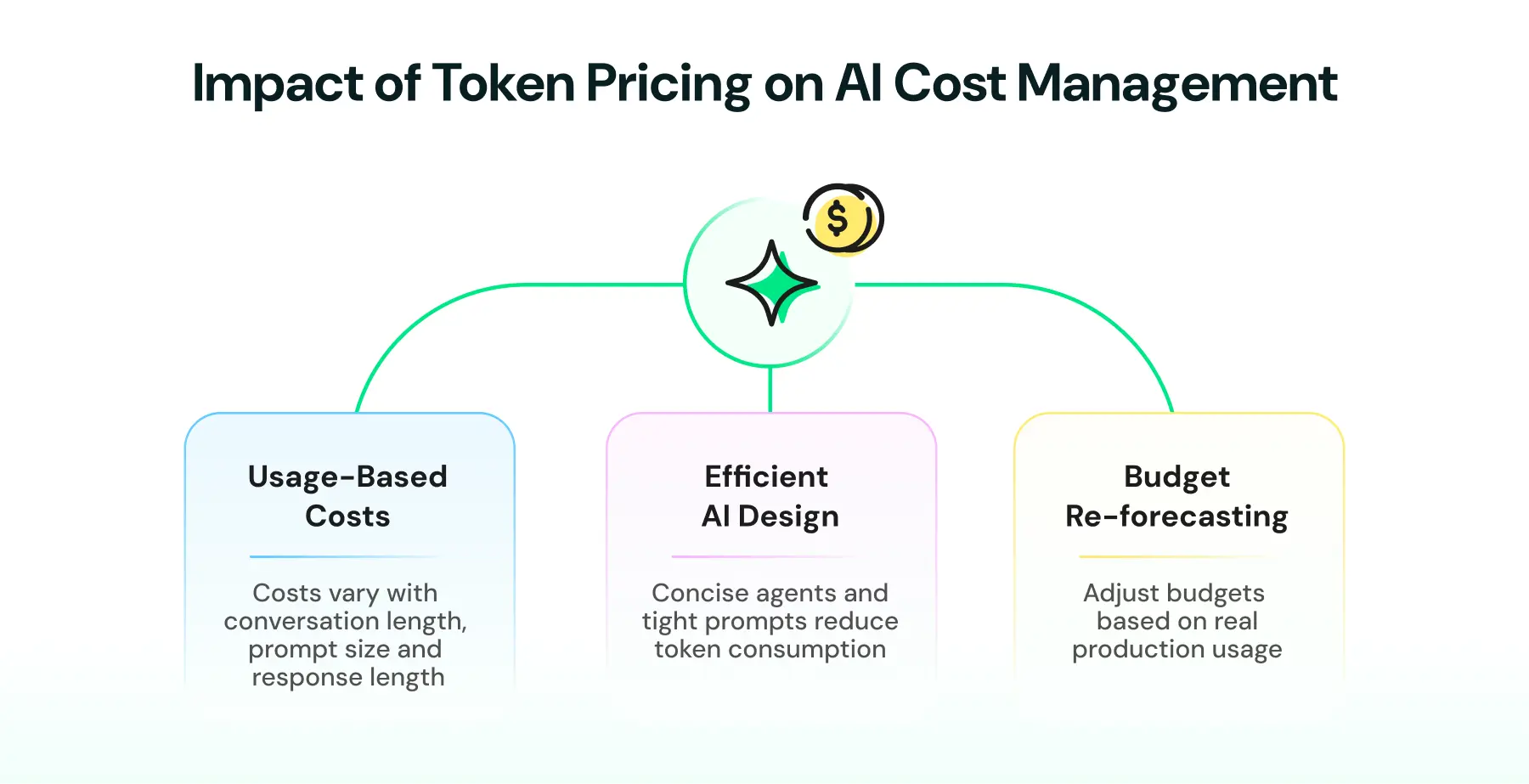
- Costs now depend on usage, not message count: Conversation length, prompt size, and response length all affect the final bill, so two similar conversations can cost different amounts.
- Efficient AI design becomes a cost lever: A concise agent that resolves a query in one clean exchange consumes fewer tokens than one that loops through repetitive prompts. Tightening prompts and flows lowers both cost and customer friction.
- Budgets need re-forecasting: If you tested Meta Business Agent during the July 2026 free window, re-estimate spend against real production usage.
What Should Businesses Do Next?
Review how your AI conversations perform and what they now cost. A practical starting checklist:
- Estimate expected monthly AI conversation volume.
- Track tokens per resolved conversation as a core efficiency metric.
- Review prompts for unnecessary length or repetition.
- Optimize flows to resolve issues in fewer turns.
- Monitor AI costs weekly to catch spending trends early.
- Model your cost as the sum of AI processing and standard WhatsApp messaging charges, since many implementations incur both.
If you are evaluating alternatives to self-serve Meta Business Agent, compare not just per-token cost but what each option can actually do: payments, team routing, broadcast, CRM integration, and voice.
Want to see what predictable, API-level automation costs for your own conversation volume? Start a free 7-day Wati trial and run the comparison against your own numbers.
Frequently asked questions
Does this change affect all WhatsApp Business API users?
No. The token-based pricing that took effect August 1, 2026 applies only to conversations handled by Meta Business Agent. Standard WhatsApp Business Platform messaging continues on Meta’s existing per-message pricing unless Meta announces further changes.
How much does a Meta Business Agent conversation cost?
A typical Meta Business Agent conversation costs about $0.04 to $0.05, based on 20,000 to 25,000 tokens at $2.00 per million tokens. Longer, multi-step sales conversations can cost up to about $0.24.
Does token billing replace WhatsApp conversation and template pricing?
No. Token billing applies specifically to Meta Business Agent AI interactions. Per-message template pricing and other WhatsApp Business Platform charges continue to apply where relevant.
When did the free testing period end?
The free build-and-test window ran July 1 through July 31, 2026. From August 1, 2026, Meta Business Agent conversations became billable at $2.00 per million tokens.
Are more WhatsApp pricing changes coming in 2026?
Yes. Separate changes affecting service messages and utility templates sent within the 24-hour customer service window are scheduled for October 1, 2026. These are distinct from the August token pricing but add to overall messaging costs.
Is Meta Business Agent cheaper than a third-party WhatsApp AI platform?
It depends on the market and the message category. Wati’s internal cost modeling puts Astra and Meta Business Agent close to parity, with Astra cheaper in markets like India and Hong Kong, and Meta Business Agent cheaper in markets like Brazil and the United Kingdom. Price alone is rarely the deciding factor since the two options differ sharply in what they can do, not just what they cost.
Can Meta Business Agent handle payments and team routing?
Self-serve Meta Business Agent cannot complete purchases, process payments, or route a conversation to a specific team member; it hands those cases to a human. The invite-only enterprise MBA Platform closes some of these gaps for large businesses, but it is not yet broadly available.
Related posts
- How to Send Bulk Messages on WhatsApp Without Getting Blocked
Learn how to send bulk WhatsApp messages without getting blocked. Compare the WhatsApp Business app and API, messaging limits, costs, templates, and best practices for safe, compliant bulk messaging.
- Complete Guide to Instagram Automation
Instagram comment automation auto-replies to comments and DMs commenters within seconds via Meta's API. Covers strategy, use cases, and Wati setup.
- How to Set Up a TikTok Business Account: Step-by-Step Guide
Set up a TikTok Business Account step by step: switch from personal, pick a category, add your profile, and unlock ads and analytics.
- TikTok for Business: How to Set Up, Market, Advertise & Grow (2026)
Learn how to use TikTok for Business to build your brand, create content, run ads, manage customer messages, and turn views into growth.