
Too Long? Read This First
- Omnichannel sales for healthcare turns patient inquiries from every channel into booked care, with one connected record for each patient.
- It matters most for services patients compare and often pay for themselves, such as dental, dermatology, fertility, eye care, and health check packages.
- The patient acquisition pipeline runs from inquiry to qualification, consultation, treatment plan, decision, and booked treatment.
- Fast, accurate first replies matter more than persuasion, because patients usually contact several providers at once.
- Healthcare sales must stay ethical, with clear pricing, no pressure or outcome promises, consent before marketing, and clinical decisions left to clinicians.
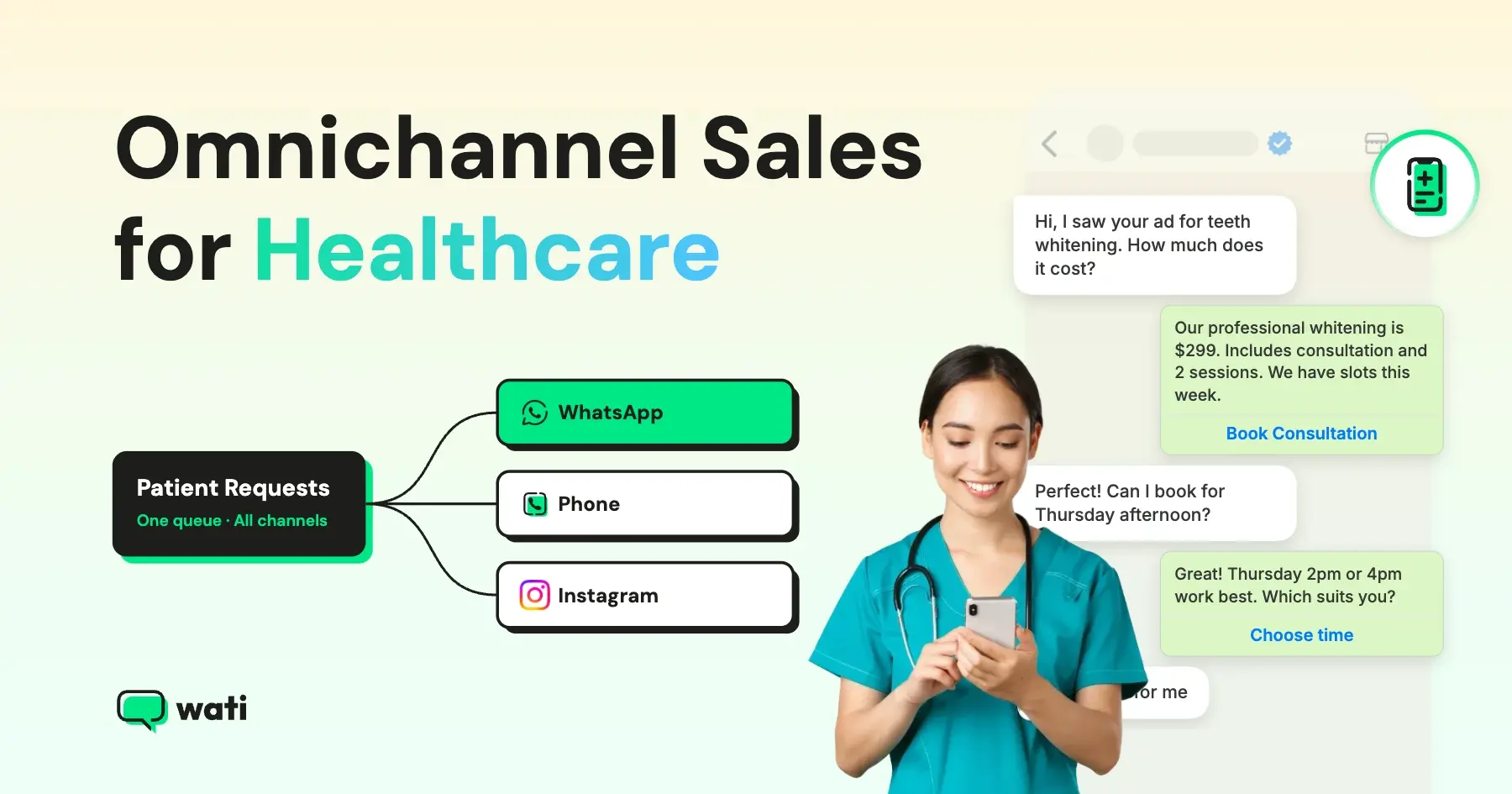
Omnichannel sales for healthcare is the process of turning patient inquiries into booked consultations and treatment. Those inquiries might arrive as an Instagram DM, a WhatsApp message, a web chat, or a phone call. Every conversation stays connected, and every decision stays in the patient's hands.
Here is the part most healthcare sales advice gets wrong. By the time a patient sends that first message, the hardest decision is already made: they want care.
Nobody needs to be persuaded. What they need is a fast, honest answer, a clear price, and an easy next step. Most clinics don't lose patients to competitors with better doctors. They lose them to slower replies, vaguer quotes, and follow-ups that never happen.
So the job of healthcare sales is not to push. It is to remove the friction between a patient's intent and their appointment, on whichever channel they choose. Wati for Healthcare is built around that idea.
This guide walks through the full process. We start with what omnichannel sales means in healthcare and where it applies most, then map the patient acquisition pipeline from first inquiry to booked treatment.
After that, we cover healthcare lead generation, speed to lead, qualification, and the patient coordinator's role. We finish with pricing and follow-ups, what a healthcare CRM should do, and the ethical rules that keep the whole process trustworthy.
What is Omnichannel Sales in Healthcare?
Omnichannel sales in healthcare is the coordinated way a provider handles every pre-treatment conversation across social media, messaging apps, web chat, phone, and walk-ins. A patient can move from first question to booked care without repeating themselves.
Each inquiry lands in one place, gets a fast reply, and remains linked to the same patient record as it moves forward.
It covers the business side of patient access: answering questions about services and prices, booking consultations, sharing treatment plans and quotes, following up respectfully, and tracking which channels bring in patients. It does not cover clinical decisions. Diagnosis and treatment recommendations always belong to qualified clinicians.
How is It Different in Pharma and Medtech?
In pharmaceutical and medical device companies, "omnichannel sales" usually means something else: coordinating how sales reps, email, webinars, and digital content reach healthcare professionals (HCPs), such as doctors and pharmacists.
That is a business-to-professional model with its own regulations.
This guide focuses on providers: clinics, hospitals, labs, and other organizations whose "customers" are patients and their families.
Which Healthcare Services Rely Most on Omnichannel Sales?
Omnichannel sales matter most where patients compare providers, take time to decide, and often pay out of pocket. In these services, every unanswered question is a patient who may book somewhere else.
Service | How Patients Decide | Who Is Involved | Typical First Channel |
|---|---|---|---|
Dental and orthodontics | Compare price, reviews, and location | Patient, often a parent for children | Search, Instagram, WhatsApp |
Dermatology and aesthetics | Research results and cost carefully | Patient | Instagram, ads, WhatsApp |
Fertility and IVF | Long, emotional decision over weeks or months | Couples, sometimes wider family | Search, referrals, WhatsApp |
Eye care and vision correction | Compare procedures and price | Patient | Search, ads, phone |
Hair restoration and elective surgery | High cost, long research | Patient | Instagram, ads, WhatsApp |
Health check packages and diagnostics | Compare tests and prices quickly | Patient or employer | Search, web chat, WhatsApp |
Physiotherapy and wellness | Compare convenience and cost | Patient | Search, referrals |
Home healthcare and elder care | Urgent but careful family decision | Adult children and family | Phone, WhatsApp |
International patient programs | Long research across countries | Patient and family | Web chat, WhatsApp, email |
In each of these, the patient usually contacts more than one provider. The one that answers accurately and quickly, and makes the next step simple, usually earns the consultation.
If you run dental lead generation or any similar program, the same principle applies: generating inquiries is only half the job.
How is Selling Healthcare Different From Selling Anything Else?
Selling healthcare is different because the stakes are higher, the decision is personal, and the seller is not the expert who decides what the patient needs. Six differences shape the whole process.
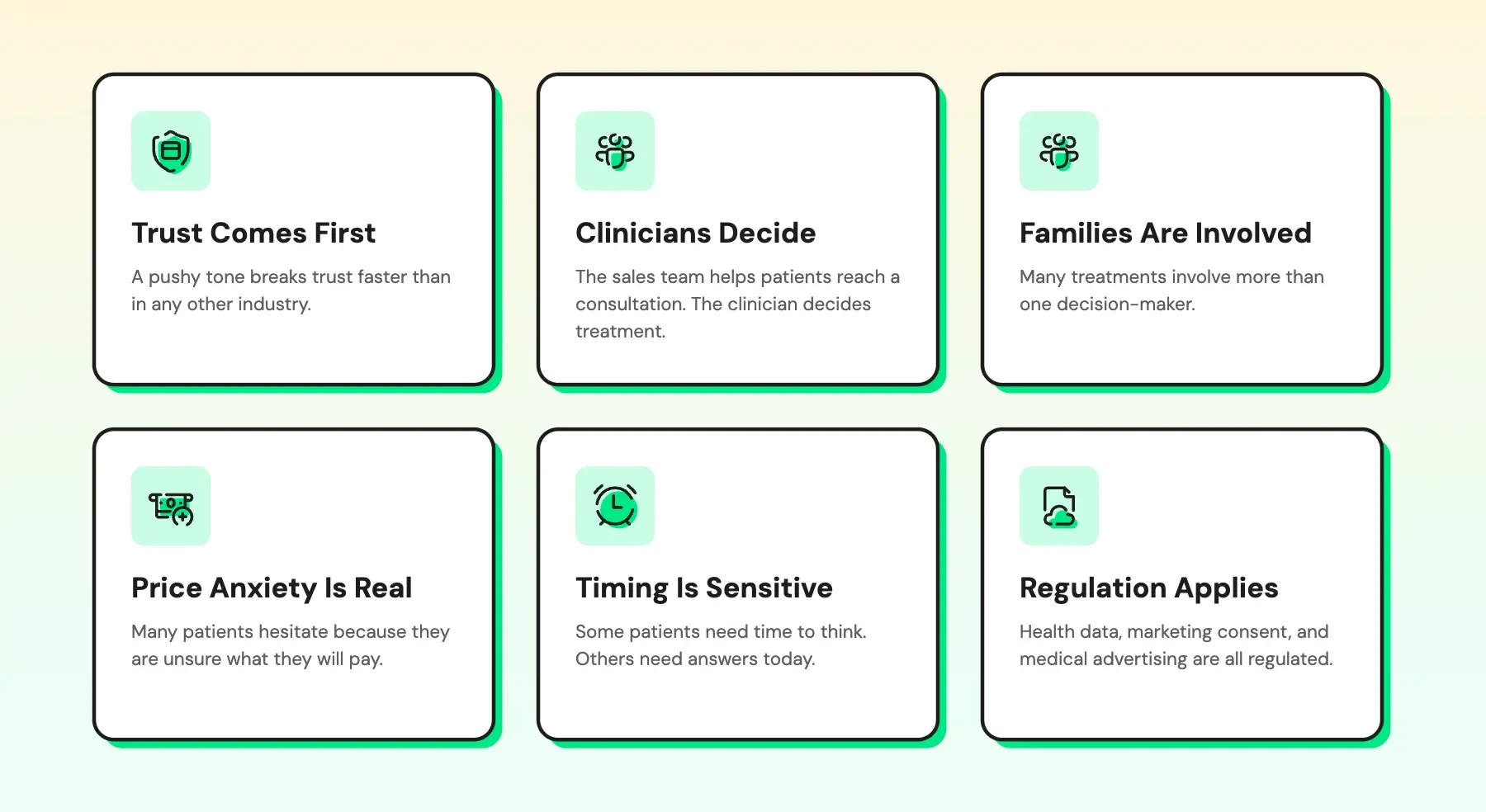
- Trust comes first. Patients are sharing worries about their health. A pushy tone breaks trust faster than in any other industry.
- Clinicians decide, not coordinators. The sales team helps patients reach a consultation. The clinician decides whether a treatment is right.
- Families are often involved. Fertility, elder care, and children's treatment usually involve more than one decision-maker.
- Price anxiety is real. Many patients hesitate because they are unsure what they will pay, not because they are unsure about the care.
- Timing is sensitive. Some patients need time to think. Others, such as families arranging home care, need answers today.
- Regulation applies. Health data, marketing consent, and medical advertising are all regulated, and the rules differ by country.
These differences are why healthcare sales works best as a supportive, informative process rather than a persuasive one.
What Does the Patient Acquisition Pipeline Look Like?
The patient acquisition pipeline is the set of stages a patient inquiry moves through, from first contact to booked treatment. Each stage has a named owner and a defined exit point, so nothing stalls without someone noticing.
Stage | What Happens | Usual Owner | Moves Forward When |
|---|---|---|---|
1. Inquiry | A patient asks a question on any channel | AI agent or front desk | The patient gets a first answer |
2. Qualification | Basic needs, location, timing, and budget are understood | AI agent or patient coordinator | The patient fits a service and wants a consultation |
3. Consultation booked | A consultation slot is confirmed | Patient coordinator | The patient confirms the slot |
4. Consultation attended | The patient meets the clinician | Clinician | The clinician recommends a plan |
5. Treatment plan and quote | The plan and cost are shared clearly | Patient coordinator | The patient has what they need to decide |
6. Decision support | Questions about cost, financing, and timing are answered | Patient coordinator | The patient decides |
7. Treatment booked | The treatment date is set, with any deposit | Patient coordinator | Treatment is scheduled |
8. Closed or nurture | Booked, declined, or not ready yet | Patient coordinator | Follow-up ends or continues with consent |
Two rules keep the pipeline healthy. First, each inquiry should have an owner within minutes, not hours. Second, “not ready yet” is a valid outcome. Patients who need time should remain in a respectful nurture list, not a pressure sequence.
With Wati, all inquiries from WhatsApp, Instagram, Messenger, and web chat land in the same Team Inbox, so the pipeline starts in one place.
Contact attributes such as service of interest, preferred doctor, and pipeline stage can be stored on each patient's contact, and the record can sync with your CRM, for example, HubSpot or Salesforce.
Where Do Healthcare Leads Come From?
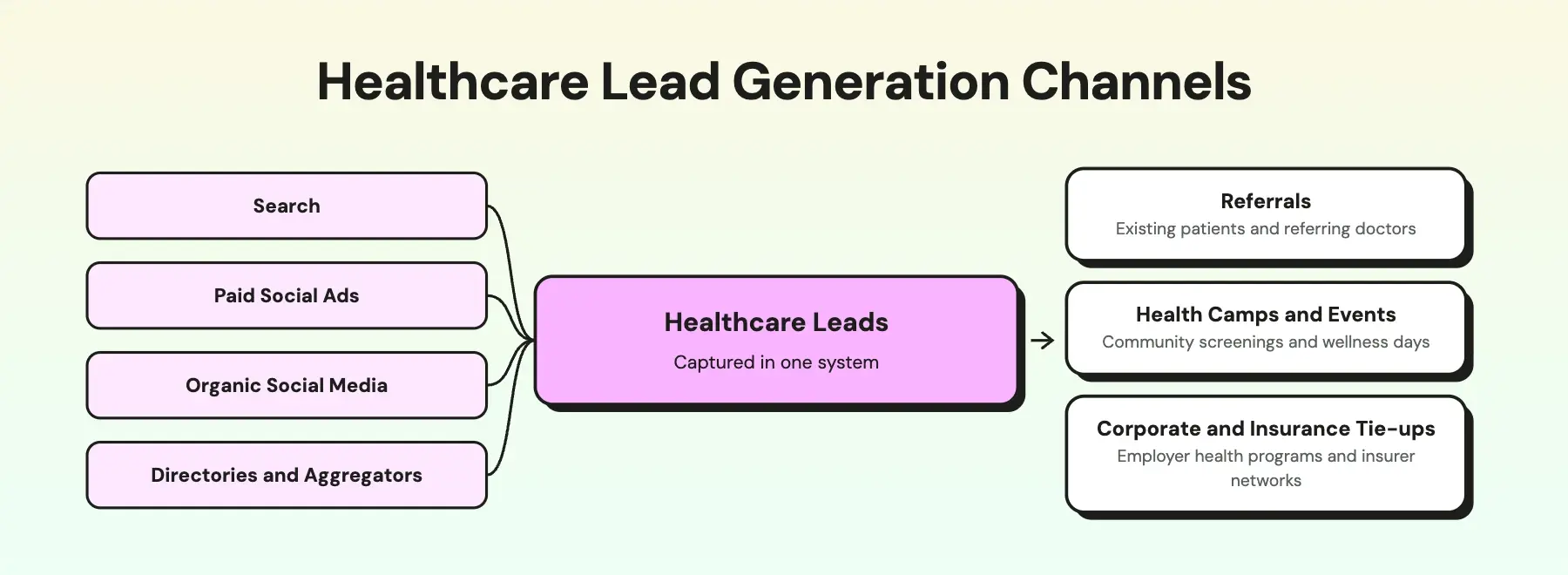
Healthcare leads come from a mix of digital and offline channels, and the best healthcare lead generation programs capture all of them in one system. The most common sources are:
- Search: Patients searching for a service, condition, or nearby clinic.
- Paid social and click-to-chat ads: Ads on Facebook and Instagram that open a conversation instead of a form.
- Organic social media: Comments and DMs on educational posts and reels.
- Referrals: Existing patients and referring doctors.
- Directories and aggregators: Healthcare listing platforms where patients compare providers.
- Health camps and events: Community screenings, corporate wellness days, and talks.
- Corporate and insurance tie-ups: Employer health programs and insurer networks.
Capturing the lead is only half the job. You also need to know where it came from, so you can see which sources bring patients who actually book, not just patients who ask.
Wati helps here in several ways.
- Click-to-WhatsApp ads open a chat straight from Facebook or Instagram, and each lead is tagged by campaign, ad set, and creative.
- Instagram comment automation can move a public question such as "what's the consultation fee?" into a private DM.
- Web chat on your website can capture a name and phone number before the chat starts, and Facebook Page comments arrive in the same Team Inbox.
- Clinics without a CRM can log every new lead automatically with the Google Sheets integration.
Turn ad clicks and comments into patient conversations. Wati brings click-to-WhatsApp ad leads, Instagram DMs, Messenger chats, and web chat inquiries into one Team Inbox. Each ad lead is tagged by campaign. See how Instagram and Messenger work in Wati |
Why Does Speed to Lead Matter in Healthcare?
Speed to lead is the time between a patient's first inquiry and your first useful reply. In healthcare, it matters because patients rarely contact only one provider, and the first clear answer often wins the consultation.
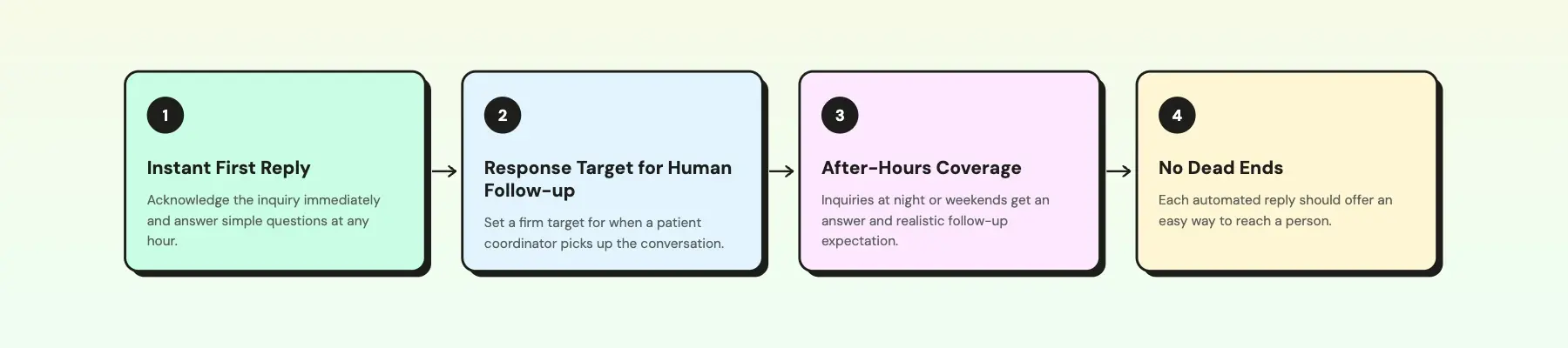
A strong speed-to-lead process has four parts:
1. An instant first reply, at any hour. Acknowledge the inquiry immediately and answer simple questions, such as fees, timings, and location, on the spot.
2. A response target for human follow-up. Set a firm target for when a patient coordinator picks up the conversation during working hours.
3. After-hours coverage. Inquiries that arrive at night or on weekends should get an answer, a realistic expectation for follow-up, and an emergency notice where relevant.
4. No dead ends. Each automated reply should offer an easy way to reach a person.
Speed should never come at the cost of accuracy. A fast but wrong answer about price or eligibility damages trust more than a slightly slower correct one.
With Wati, Astra answers routine questions instantly on WhatsApp, Instagram, and Messenger, using your clinic's approved knowledge base. Welcome and out-of-office messages cover WhatsApp, Instagram, and Messenger when your team is away.
Round Robin assignment spreads new inquiries across available coordinators.
How Do You Qualify Patient Leads Without Overstepping?
You qualify patient leads by understanding practical needs, such as service, location, timing, and budget, without asking for or assessing clinical details that belong in a consultation. Good qualification helps patients reach the right clinician faster. It should never feel like a screening test.
Helpful questions to ask:
- Which service or specialty are you interested in?
- Which location or branch suits you best?
- When would you like to come in?
- Will you be paying yourself, or using insurance or an employer program?
- What's the best way to reach you, and in which language?
What to avoid in a sales conversation:
- Asking for detailed medical history in an open chat
- Telling a patient whether a treatment will work for them
- Suggesting a patient doesn't need to see a doctor
- Using symptoms to push a more expensive service
When a patient mentions symptoms or clinical concerns, the conversation should move to clinical staff, not remain with the sales team.
In Wati, Dynamic WhatsApp Flows turn qualification into a short in-chat form, so answers arrive structured and ready for your system.
Smart Escalation hands a chat to a person when a patient asks for one or sounds upset. Wati’s Astra AI agent also scores intent, so coordinators know which inquiries to prioritize.
What Does a Patient Coordinator Do in Omnichannel Sales?
A patient coordinator is the person who guides a prospective patient from inquiry to booked care.
They answer non-clinical questions, book consultations, share treatment plans and quotes, coordinate with clinicians, and follow up until the patient decides. In many clinics, the patient coordinator is the human face of omnichannel sales.
A good patient coordinator:
- Owns the conversation across channels. Whether the patient writes on Instagram, sends a WhatsApp message, or calls, the same coordinator, or a teammate with full context, picks it up.
- Explains, doesn't sell. They make sure patients understand the process, the price, and their options.
- Coordinates with clinicians. They pass clinical questions to the right doctor or nurse, and bring the answer back to the patient.
- Follows up with respect. They check in at agreed times and accept a "no" or "not now" gracefully.
- Keeps records accurate. Each update goes into the shared patient record, so the next person sees it.
Wati gives patient coordinators the tools for this.
In the Team Inbox, Private Notes hold internal context, such as "waiting for the doctor's input on the treatment plan," that the patient never sees. WhatsApp Business Calling lets patients call from the chat, and calls can be recorded, transcribed, and summarized on the patient's contact.

Wati AI summarizes long conversations before a callback and translates messages for patients who write in another language.
How Should You Handle Treatment Plans, Pricing, and Follow-Ups?
You should handle treatment plans, pricing, and follow-ups with clarity and restraint. Patients decide faster and feel better about their decision when they understand exactly what they're paying for and never feel rushed.
Share treatment plans clearly:
- Put the plan and the price in writing after the consultation.
- Break the cost into itemized parts, such as consultation, procedure, follow-ups, and any extras.
- Explain what is and isn't included.
Make payment options easy to understand:
- Explain financing, installment, or EMI options in plain language.
- Be upfront about deposits, refund policies, and cancellation terms.
- Never hide fees that appear later.
Follow up with respect:
- Agree on a follow-up time with the patient, rather than chasing them daily.
- Set a limit on follow-ups, such as two or three over a few weeks.
- Offer answers, not pressure, such as "Do you have any questions about the plan?"
- Respect a "no" immediately, and stop messages if a patient opts out.
Using Wati, follow-ups can run as drip sequences for patients who have opted in, spaced out at sensible intervals. Our guide to WhatsApp drip campaigns explains how to set them up.
For patients who are not ready yet, segmented broadcasts can share useful updates, such as new clinic hours or educational content, only with those who agreed to receive them.
What Should a Healthcare CRM Do for Patient Acquisition?
A healthcare CRM should give your team one record of every prospective patient, every conversation, and every pipeline stage, while protecting health information and respecting consent.
Patient relationship management is the practice of using that record to treat each patient as an ongoing relationship, not a one-time transaction.
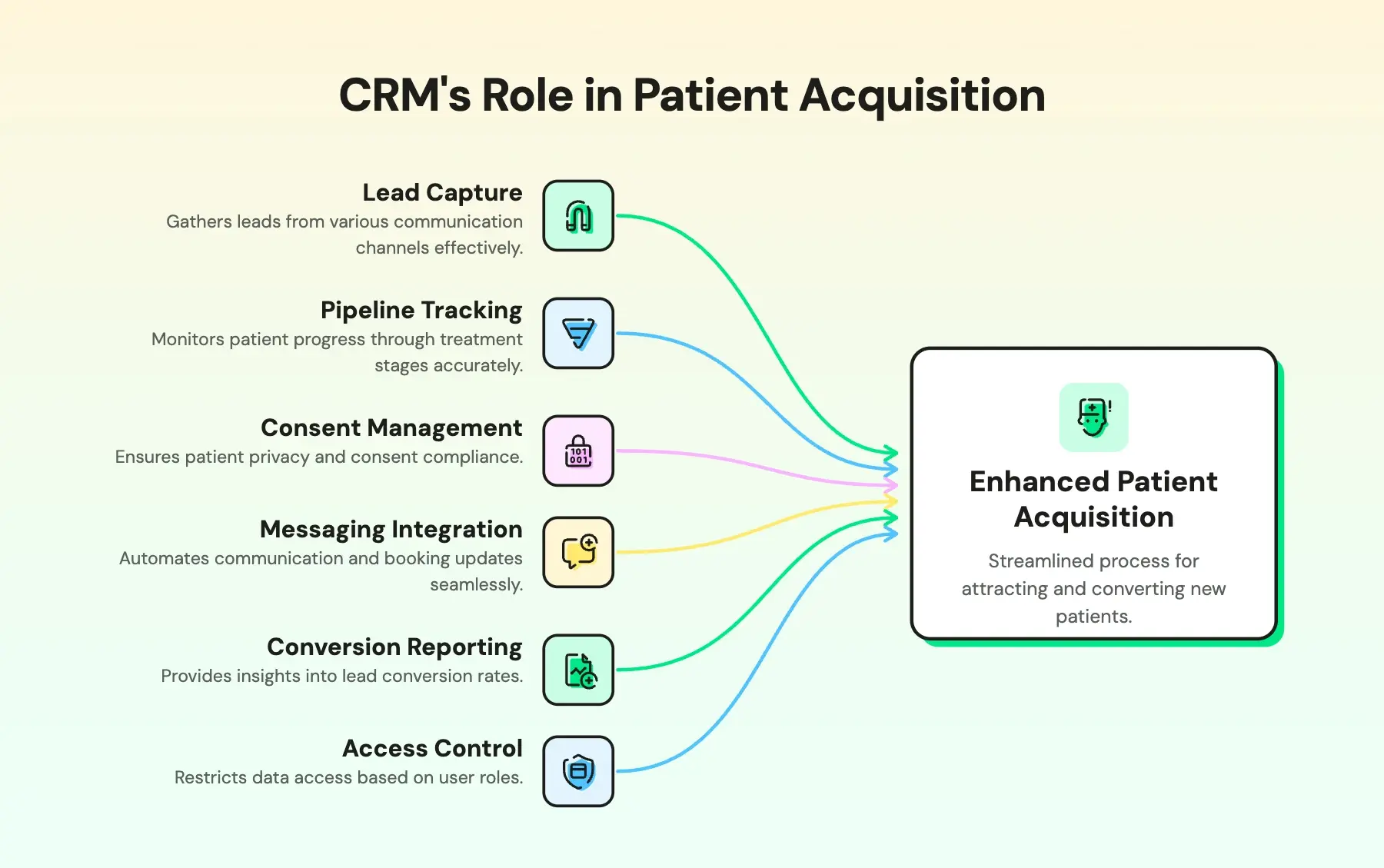
For patient acquisition, a healthcare CRM should:
- Capture leads from every channel, including messaging apps, web chat, phone, and forms.
- Track pipeline stages, from inquiry to booked treatment, with owners and next steps.
- Store consent records, showing what each patient agreed to receive, on which channel, and when.
- Connect to messaging and scheduling, so conversations and bookings update the record automatically.
- Report on sources and conversion, from first inquiry to booked treatment.
- Control access, so staff only see the information their role requires.
The HIPAA question to ask every vendor: In the US, a CRM or messaging tool may handle protected health information (PHI) for a covered entity. If it will, ask whether the vendor will sign a business associate agreement (BAA), and review how they protect PHI. Requirements differ in other countries, so check local rules with your compliance team.
Wati can sync conversations and contact details can sync with CRMs such as HubSpot and Salesforce, or with your booking system through chatbot webhooks.
Ask Wati AI lets coordinators ask plain-language questions like how many inquiries came from this week's ad campaign, without building a report. Teams that use their own AI models can connect them through Connect External Agent.
What Ethical Rules Should Guide Healthcare Sales?
Ethical healthcare sales puts the patient's interest ahead of the sale at every step. These principles apply everywhere, and some are backed by specific regulations.
Core Ethical Principles
- No false urgency. Avoid "only two slots left today" tactics for decisions that deserve time.
- No outcome promises. Never guarantee results. Only clinicians should discuss expected outcomes, and only in consultation.
- Transparent pricing. Share the full cost upfront, including likely extras.
- Consent before marketing. Only send promotional messages to patients who agreed to receive them, and make opting out easy.
- Clinicians decide. Coordinators and AI agents support the decision. They never recommend treatments.
- Fair incentives. Avoid commission structures that reward pushing patients toward more expensive treatments.
- Extra care with vulnerable patients. Patients facing fertility challenges, serious illness, or caring for elderly family members deserve extra patience and sensitivity.
Rules in the United States
Under HIPAA, using a patient's protected health information for marketing generally requires the patient's written authorization, with narrow exceptions such as face-to-face communications and promotional gifts of nominal value. Authorization is also needed when a third party pays for the communication.
Tracking technologies on healthcare websites also need care. In June 2024, a federal court vacated part of HHS's guidance on online tracking technologies, specifically the part covering unauthenticated public webpages.
The rest of the guidance still stands, so review any pixels or trackers on pages patients use to book or share health details.
Rules in India
On 6 October 2026, the National Medical Commission (NMC) released new Guidelines on Ethical Advertising and Public Communication for hospitals, medical institutions, and registered medical practitioners.
They aim to prevent false, misleading, exaggerated, or unverifiable medical claims. Reported provisions include restrictions on patient testimonials, guaranteed-cure claims, and AI-generated promotional campaigns for commercial interest, with penalties for doctors that range from warnings to suspension of registration.
India's DPDP Act also requires clear, informed consent when personal data is processed on the basis of consent.
What This Means for Your Process
Keep your messaging factual and verifiable, collect consent per channel and purpose, leave clinical details out of open chats, and let clinicians handle anything clinical. Use AI agents to answer factual, approved questions, such as fees and timings, not to create promotional claims.
This section is general information, not legal advice. Review your sales and marketing process with your legal or compliance team.
Inside Wati, Private Notes keep internal context off the patient's screen, team-based routing sends sensitive conversations to the right team, and keyword rules route clinical concerns to clinicians. Opt-in and opt-out management helps your team respect each patient's communication choices.
Which Metrics Show Healthcare Sales is Working?
The metrics that show healthcare sales are working follow the pipeline from inquiry to booked treatment, plus two checks that keep the process ethical.
Metric | What It Measures | What It Tells You |
|---|---|---|
Inquiries by source | New inquiries from each channel and campaign | Which sources bring patients, not just clicks |
Speed to lead | Time from first inquiry to first meaningful reply | Whether patients get answers before they go elsewhere |
Qualification rate | Share of inquiries that fit a service and want a consultation | How well lead sources attract the right patients |
Consultation booked rate | Share of qualified inquiries that book a consultation | How well coordinators remove friction |
Consultation attended rate | Share of booked consultations that patients attend | How well confirmations and reminders work |
Consultation-to-treatment rate | Share of consultations that lead to booked treatment | How clear plans and pricing are |
Time to decision | Time from consultation to booked treatment | Where patients hesitate |
Cost per acquired patient | Marketing spend divided by patients who book treatment | The true cost of growth |
Opt-out rate | Share of patients who stop receiving messages | Whether follow-ups feel respectful |
Complaint rate | Complaints related to sales conversations | Whether the process stays ethical |
For measurement, Wati’s click-to-WhatsApp ad attribution shows which campaigns start conversations, inbox reporting shows response times, and campaign reports show reads, replies, and clicks. Ask Wati AI can answer questions like "how many inquiries from last week's campaign booked a consultation?" in plain language.
How Does Wati Support Omnichannel Sales for Healthcare?
Wati is an agentic customer engagement platform that turns conversations into revenue growth across marketing, sales, and support. For healthcare providers, it brings every patient inquiry, AI agent, and patient coordinator into one place.
Here is what a typical day looks like for a coordinator at a dermatology clinic using Wati.
- At 8:30 a.m., the coordinator opens the Team Inbox. Overnight, Astra answered 14 questions about consultation fees and timings, and two inquiries are waiting for a person. One arrived from an Instagram ad, already tagged with the campaign that brought it in. Wati AI has summarized both conversations, so there's no need to scroll back.
- At 11:00 a.m., a patient who filled in a qualification form on WhatsApp asks about laser treatment costs. The coordinator shares the price list, books a consultation from open slots, and adds a Private Note for the doctor. When the patient mentions a skin reaction, a keyword rule routes the question to the clinical team.
- At 3:00 p.m., a patient calls through WhatsApp Business Calling to discuss a treatment plan with her husband on the line. The call is recorded and summarized on her contact, so anyone on the team can see what was discussed.
- At 6:00 p.m., Wati AI agent flags a few patients who received treatment plans last week but haven’t replied. The coordinator reviews the list and sends one short, friendly check-in only to those who opted in to follow-ups. Before logging off, she uses Ask Wati AI to check how many consultations came from this month’s ads, and the answer arrives in seconds.
Turn More Patient Inquiries Into Booked Care
Omnichannel sales for healthcare is about making the path from question to care as clear and easy as possible.
Answer fast, price transparently, follow up thoughtfully, and leave every clinical decision with your clinicians.
When all your channels feed one connected process, more patients reach the care they were already looking for.
Ready to connect your patient inquiries? Start your free Wati trial or book a demo.
Frequently asked questions
What is omnichannel sales in healthcare?
Omnichannel sales in healthcare is the process of turning patient inquiries from every channel, such as social media, messaging apps, web chat, and phone, into booked consultations and treatment. Every conversation stays connected to one patient record, and clinical decisions stay with clinicians.
Is it ethical to use sales processes in healthcare?
Yes, sales processes can be ethical in healthcare when they focus on helping patients reach care rather than pushing treatment. That means clear pricing, no false urgency or outcome promises, consent before marketing messages, and leaving clinical recommendations to qualified clinicians.
What is speed to lead in healthcare?
Speed to lead in healthcare is the time between a patient's first inquiry and the provider's first meaningful reply. Because patients often contact several providers at once, a fast and accurate reply makes it much more likely they book a consultation.
What does a healthcare CRM do?
A healthcare CRM keeps one record of every prospective and current patient, including conversations, pipeline stage, and consent. For patient acquisition, it tracks inquiries from each channel, shows which sources lead to booked treatment, and controls who can see patient information.
Can clinics send marketing messages on WhatsApp?
Clinics can send marketing messages on WhatsApp only to patients who have opted in, using approved message templates. They should also follow local health marketing and data protection rules, keep clinical details out of promotional messages, and make it easy for patients to opt out.
Related posts
- Instagram Comment Automation: How It Works and How to Set It Up in Wati
Instagram comment automation auto-replies to comments and DMs commenters within seconds via Meta's API. Covers strategy, use cases, and Wati setup.
- Shared Team Inbox for Instagram: A Buyer’s Checklist for 2026
Use this fastest checklist to evaluate any shared team inbox for Instagram, which covers DMs, comments, automation, and multi-channel support.
- How to Send Bulk Messages on WhatsApp Without Getting Blocked
Learn how to send bulk WhatsApp messages without getting blocked. Compare the WhatsApp Business app and API, messaging limits, costs, templates, and best practices for safe, compliant bulk messaging.
- How to Set Up a TikTok Business Account: Step-by-Step Guide
Set up a TikTok Business Account step by step: switch from personal, pick a category, add your profile, and unlock ads and analytics.