
Too Long? Read This First
- Agentic commerce is a model of buying and selling where an AI agent doesn't just answer questions; it completes the transaction: checking inventory, applying offers, and closing the sale.
- McKinsey projects agentic commerce could orchestrate $3–5 trillion globally by 2030, and Meta's June 2026 Business Agent launch just brought it to WhatsApp, Instagram, and Messenger.
- Wati's Astra helps businesses build, train, and connect an agent for this exact moment. Watch Astra in action →
Agentic commerce is a form of buying and selling in which an AI agent acts on the customer's behalf, finding products, comparing options, and completing the purchase, rather than just answering questions and handing back a link.
When most people hear "agentic commerce," they picture that AI on a website: a shopping assistant that compares prices and completes checkout without the user lifting a finger.
That's real. But it's not the whole picture.
The bigger shift is happening inside chat, where most customer conversations with businesses already live.
McKinsey puts the global agentic commerce opportunity at $3 trillion to $5 trillion by 2030, with the US B2C retail market alone accounting for up to $1 trillion of it.
This guide covers what agentic commerce actually means, the data behind it, why Meta's 2026 launch changed the timeline, and how to get an agent running on WhatsApp.
What does Agentic Commerce Actually Mean?
Agentic commerce means an AI agent completes the transaction for the customer, not just the conversation. It connects to your real systems, inventory, orders, payments, and CRM, and takes real actions inside the chat: checking stock, applying discounts, and confirming the order.
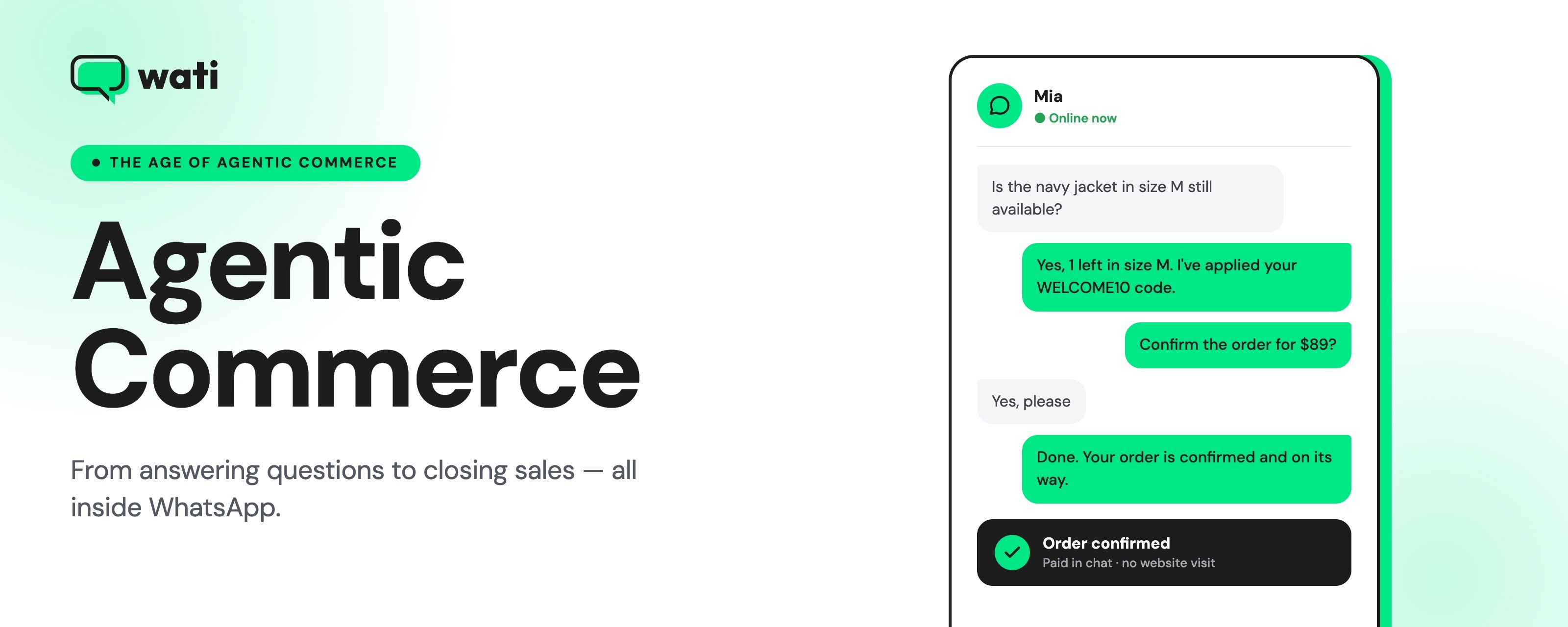
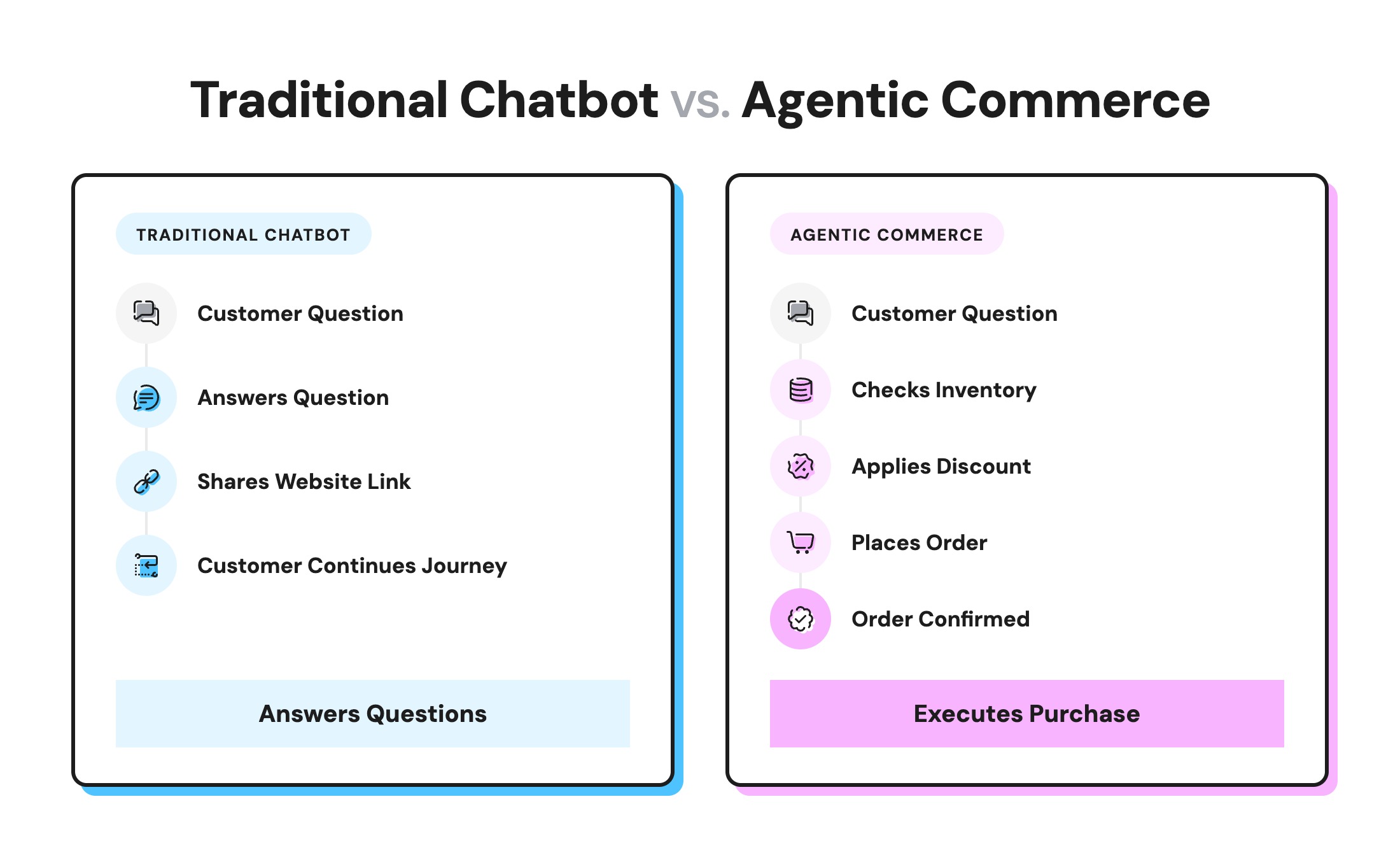
Here's what that looks like in practice. A customer messages a clothing brand on WhatsApp: "Is the navy jacket in size M still available?" A basic chatbot sends back a link to the website. An agentic setup checks live inventory, confirms the size is in stock, applies the customer's saved discount code, and completes the order right there in the chat, no website visit, no extra steps.
That's the difference in one line: a chatbot answers questions; an AI agent finishes the purchase.
McKinsey describes agentic commerce as taking shape through three interaction models:
- Agent-to-site: an agent navigating merchant platforms for you.
- Agent-to-platform.
- Agent-to-agent: supported by emerging standards like the Model Context Protocol (MCP), Agent-to-Agent Protocol (A2A), Agent Payments Protocol (AP2), and the Agentic Commerce Protocol (ACP).
Chat is where all three models meet the customer.
How Big is the Agentic Commerce Opportunity?
The numbers behind agentic commerce are no longer speculative:
- $3–5 trillion globally by 2030. McKinsey projects that AI agents could orchestrate this much global consumer commerce by 2030, with the US B2C retail market representing $900 billion to $1 trillion of it.
- Half of consumers already use AI-powered search. In McKinsey's August 2025 survey, half of consumers said they now intentionally use AI-powered search, and 44% of the users called it their top digital source for buying decisions.
- $750 billion through AI search by 2028. McKinsey projects that this much US consumer spending will flow through AI-powered search within three years.
- Up to a quarter of transactions. Bain expects agentic AI to complete 15%–25% of U.S. e-commerce purchases by 2030, as shoppers become more comfortable letting AI agents handle product selection and checkout.
Consumers aren't typing into a search bar and browsing product pages. They're asking a tool for an answer and, increasingly, expecting the tool to act.
The Agentic Commerce Opportunity Most Brands are Missing on WhatsApp
Most articles about agentic commerce focus on websites: product catalogs, checkout flows, AI on a homepage. That makes sense for the platforms writing them. But it misses where most commerce conversations are actually happening.
That's the same behavior shift that makes conversational commerce on WhatsApp so powerful for agentic commerce specifically.
WhatsApp is already where your customers go to ask questions about your business. It's the most-used messaging app in the world, with more than 3 billion users globally, according to Meta.
When an agentic commerce setup lives inside that channel, it's not waiting for someone to visit your website. It's there the moment a customer reaches out, ready to check stock, confirm an order, or close a sale right inside the conversation.
That's the opportunity. An agent on your website waits to be found.
That's why an AI customer service agent works differently on WhatsApp than anywhere else. It doesn't wait for a customer to come to it. So the real question becomes: what does it actually take to build one?
Building for This Moment: Where Astra Fits
Meta's launch created an overnight surge in demand, but it also left a gap. Meta Business Agent gives businesses a native starting point. Most companies, however, still need a solution that trains the agent on their own data, integrates it with their tools, and works across multiple platforms.
That's what Astra is built for. You can build an AI agent without writing any code, train it on real sources like your website, FAQ page, or product catalog, and connect it to tools like HubSpot or Salesforce so it can actually do things, not just chat.
The same agent works on the web and WhatsApp, so you're not rebuilding it from scratch every time a new surface appears. If you want to get your first one live, here's where to start.
Astra also handles voice, so the same agent who handles a WhatsApp message can take a phone call in your brand's voice, without you needing to build a separate setup. It can clone your voice from a short recording and deploy it on calls in minutes.
This is already working in production. Terpel, one of Colombia's largest energy companies, deployed a Wati AI agent on WhatsApp and generated 9 million customer interactions, onboarded 330,000 customers, processed more than 1.8 million invoices, and helped drive $35 million in revenue. The pattern is the one this whole article describes: the customer starts a conversation, and the agent finishes the job inside it.
How to Prepare for Agentic Commerce on WhatsApp
Three steps cover the first move.
- Pick one use case. Order status, appointment booking, or stock checks are all solid first tests. Don't try to automate everything at once.
- Train the agent on real data. Point it at your website, FAQ page, or product catalog using something like Astra VIBE, so it answers from your actual content instead of a generic script.
- Connect one real action. Link it to your CRM or order system so it can do something tangible, then watch how real conversations go before expanding further.
While you're building, it's also worth knowing what's coming next, because the landscape is shifting fast.
What to Watch Next
Most businesses are figuring out agentic commerce on WhatsApp for the first time right now.
The real advantage isn't just having an agent. It's having one that knows your business, works inside your existing tools, and runs on WhatsApp, where your customers already are. That's what Wati built Astra for, and it's why the businesses using it today are better placed for what comes next.
When agentic commerce on WhatsApp becomes the default, not the exception, you'll already be running it.
Book a demo and see what an agent built for your business looks like in practice.
Frequently asked questions
What is agentic commerce?
Agentic commerce is a model of buying and selling in which an AI agent acts on a customer's behalf - finding products, comparing options, and completing purchases - rather than just answering questions. McKinsey projects it could orchestrate $3–5 trillion in global commerce by 2030.
Is agentic commerce the same as a chatbot?
No. A chatbot follows a script and can't act outside its programmed replies. Agentic commerce connects an AI agent to real systems so it can actually finish part of the transaction inside the chat.
What is the difference between agentic commerce and conversational commerce?
Conversational commerce is selling through chat - a customer asks, a business (or bot) answers, and a human usually completes the sale. Agentic commerce goes one step further: the AI agent itself completes the transaction, checking inventory, applying offers, and confirming the order inside the conversation.
What is the Meta Business Agent?
It's an AI agent Meta built directly into WhatsApp, Instagram, and Messenger that can answer questions, recommend products, book appointments, and close sales. It launched globally on June 3, 2026, after pilots with more than 1 million businesses in India, Mexico, and Brazil.
How can a business start with agentic commerce on WhatsApp?
Start by training an agent on your real business data and connecting it to one tool, like a CRM or order system, using a platform built for messaging-first commerce, such as Astra .
Can an AI agent for customer service work on WhatsApp?
Yes. An AI agent for customer service on WhatsApp handles questions, checks orders, and closes sales inside the conversation. It connects to your real systems so it can act, not just reply. Astra is built specifically for this.
Related posts
- Complete Guide to Instagram Automation
Instagram comment automation auto-replies to comments and DMs commenters within seconds via Meta's API. Covers strategy, use cases, and Wati setup.
- How to Set Up a TikTok Business Account: Step-by-Step Guide
Set up a TikTok Business Account step by step: switch from personal, pick a category, add your profile, and unlock ads and analytics.
- TikTok for Business: How to Set Up, Market, Advertise & Grow (2026)
Learn how to use TikTok for Business to build your brand, create content, run ads, manage customer messages, and turn views into growth.
- Shared Team Inbox for Instagram: A Buyer’s Checklist for 2026
Use this fastest checklist to evaluate any shared team inbox for Instagram, which covers DMs, comments, automation, and multi-channel support.