
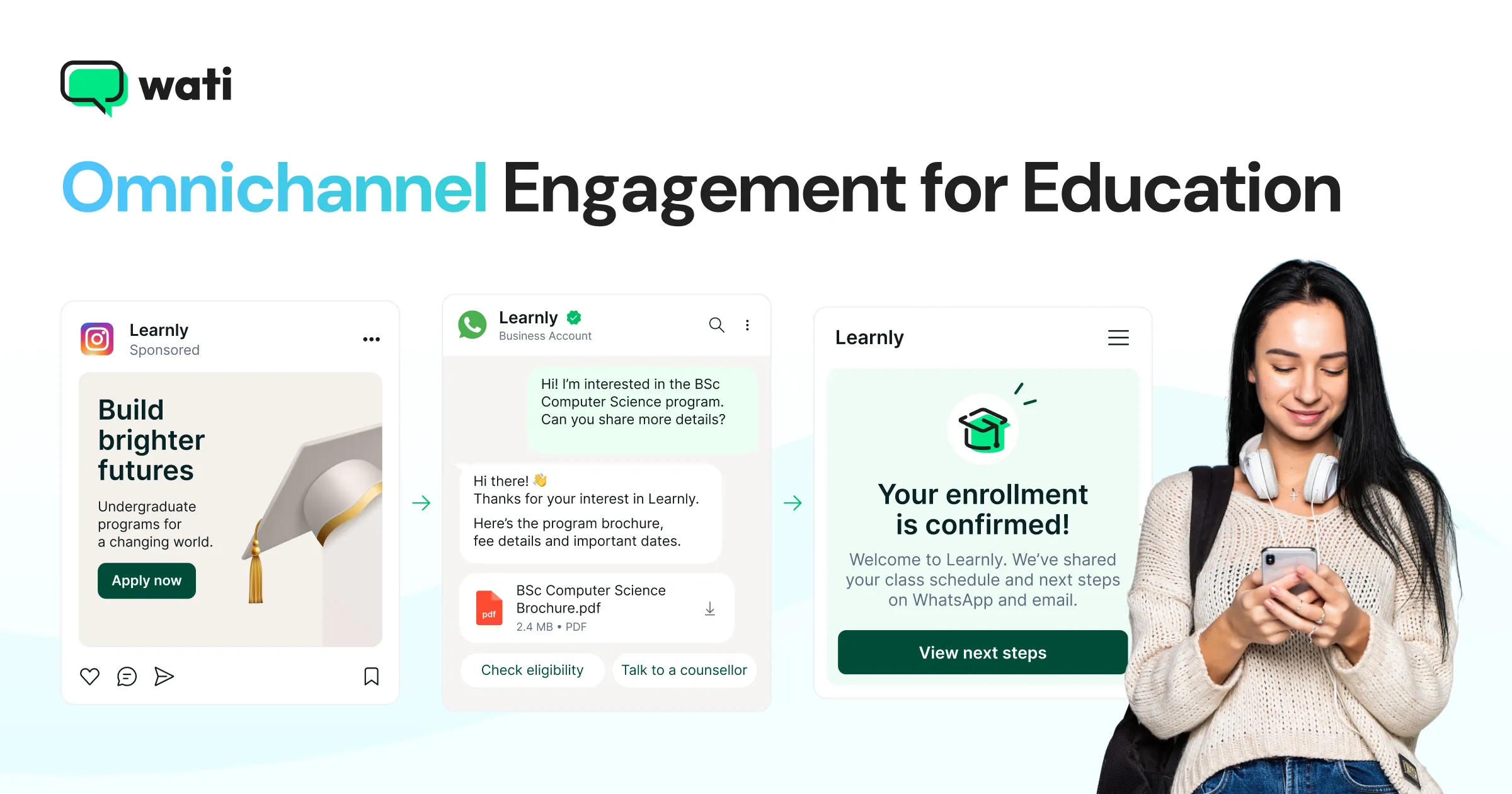
Too Long? Read This First
- Omnichannel customer engagement for education connects every channel and department around one student record, so families never repeat themselves.
- Most educational journeys involve two decision-makers, the student and the parent, who often prefer different channels.
- Admission seasons create short, intense spikes in inquiries, so the speed of response decides how many inquiries become enrollments.
- The biggest barrier to a connected experience is department silos, with marketing, admissions, academics, finance, and support each running separate systems.
- Automation works best for inquiry replies, document and fee reminders, and class updates, while counselors focus on conversations that need a person.
Omnichannel customer engagement for education connects all the channels an institution uses into a single, continuous conversation with each student. Those channels include WhatsApp, Instagram, phone, email, SMS, web chat, and campus visits.
The goal is simple: a student should never have to repeat themselves, whichever channel or team they reach.
It applies to schools, colleges, coaching institutes, and edtech platforms alike. Instead of each department running its own conversations, every team works from the same student history.
Education needs this more than most industries, for three reasons:
- The journey often involves more than one person, such as a student and a parent.
- Admissions happen in short, intense seasons.
- Every stage is owned by a different department.
In this guide, you'll learn:
- How the student journey works, stage by stage, from inquiry to alumni
- How engagement differs across K-12 schools, higher education, edtech, coaching, upskilling, and study abroad
- How to engage parents and students on the channels each one prefers
- Which student recruitment strategies work across channels, and how to handle admission-season spikes
- Where automation in education helps most, and what a student communication platform should include
- How to handle consent and student data, and which metrics to track
What is Omnichannel Customer Engagement for Education?
Omnichannel customer engagement for education is the practice of connecting every touchpoint a prospective or current student has with an institution, online and offline, around one shared view of that student and their family.
A parent who asks about fees on WhatsApp, attends a campus tour, and later emails a question about transport should feel like they are talking to one school, not three departments.
Three realities make this harder in education than in most industries:
- Two audiences: In K-12 and much of edtech, the student uses the service while the parent researches, decides, and pays. In higher education, the student leads but family still influences the decision.
- Department divides: Marketing owns awareness; admissions owns inquiries and applications; finance owns fees; academics owns learning; and support owns everything in between. Each team often runs its own tools and phone numbers.
- Offline still matters: Campus visits, counseling sessions, and printed materials remain part of the journey. RNL's 2025 E-Expectations report, based on data from more than 1,500 high school students, found that 80% prefer in-person visits and 33% still prefer printed materials from colleges, underscoring the need for a layered, cross-channel approach.
Omnichannel engagement does not replace these channels. It connects them, so every conversation builds on the last.
How Does the Student Journey Work from Inquiry to Alumni?
The student journey has nine stages, and each one is usually owned by a different team. Knowing who owns each stage is the first step to connecting them.
1. Awareness
Families discover the institution through search, social media, rankings, referrals, education fairs, and ads.
- Owned by: Marketing
- Key touchpoints: Instagram and YouTube content, search ads, education fairs, and word of mouth
- What to measure: Reach, inquiry volume, and cost per inquiry
- Conversational moment: A parent comments on an Instagram post asking about admission dates, providing the first opportunity to start a one-on-one conversation.
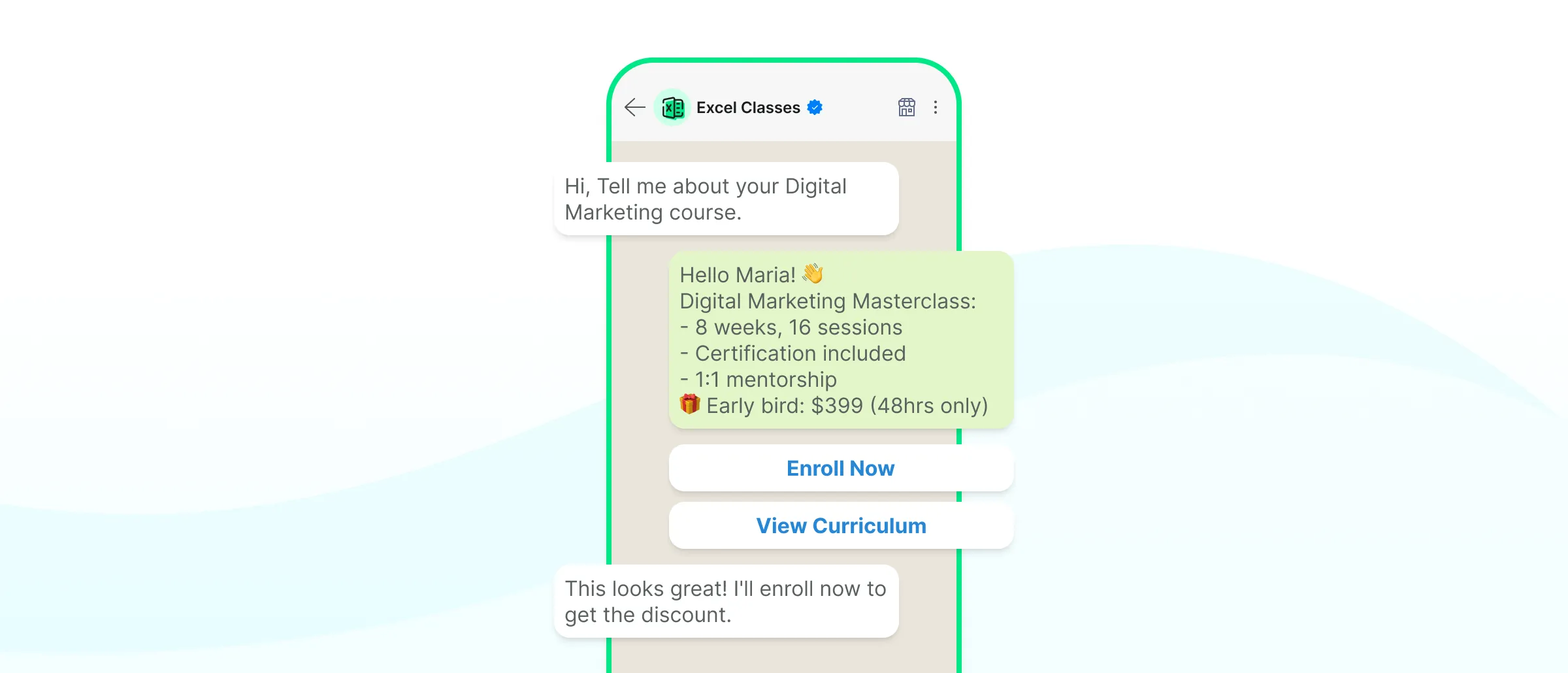
Social channels are often underused at this stage. RNL found that 63% of students use Instagram, yet nearly half say they never see college content there.
Here, Wati assists by turning that first spark of interest into a one-on-one conversation, wherever it happens:
- Instagram comment-to-DM: A parent comments “admission dates,” and Wati automatically sends them a DM. The comment also lands in the Team Inbox so admissions can follow up.
- Click-to-WhatsApp Ads: An ad click opens a WhatsApp chat instead of a landing page. Wati replies instantly, collects the student’s details, and routes the lead to the right program team.
- QR codes and chat links: Put them on fair booths, prospectuses, and YouTube descriptions. Using a different pre-filled message for each channel shows which one drove each inquiry.
2. Inquiry
A student or parent reaches out for the first time.
- Owned by: Marketing and admissions
- Key touchpoints: Website forms, missed calls, click-to-WhatsApp ads, Instagram DMs, and walk-ins
- What to measure: Time to first response and inquiry-to-qualified-lead rate
- Conversational moment: "What are the fees for Class 6?" A reply within minutes keeps the family engaged.
Wati makes sure every first question gets a fast, useful answer, whichever channel it comes from:
- Instant replies with Astra: Astra answers “What are the fees for Class 6?” in seconds, around the clock, using the school’s own information. That keeps time to first response low even during admission season.
- Qualification inside the chat: WhatsApp Flows collect the student’s grade, location, and preferred intake right in the conversation. Inquiries become qualified leads without a separate form.
- Every channel in one inbox: Click-to-WhatsApp ad leads and Instagram DMs land in the shared Team Inbox and are auto-assigned to the right counselor. Website form submissions can trigger a WhatsApp follow-up through integrations like HubSpot, Zapier, or Google Sheets.
3. Counseling and Qualification
The institution understands the student's needs and explains the right program.
- Owned by: Admissions counselors
- Key touchpoints: Counseling calls, demo classes, campus tours, and webinars
- What to measure: Counseling completion rate and demo-to-application rate
- Conversational moment: Confirming a demo class slot and sending a reminder the evening before.
In the counseling and qualification stage, Wati keeps counseling, demos, and follow-ups in the same WhatsApp thread where the family first reached out:
- Counseling over WhatsApp Calling: Counselors call families right from the Team Inbox, and the same counselor handles each family every time. AI-generated transcripts and summaries mean no context is lost between calls.
- Demo booking and reminders: A WhatsApp Flow lets parents pick a demo slot in a few clicks. An automatic reminder goes out the evening before, with a single tap option to reschedule.
- Campus tours and webinars at scale: Broadcast campaigns send invites and reminders to hundreds of families at once. Every reply comes back into the inbox as a one-on-one conversation, so teams can track counseling completion and demo-to-application rates in one place.
4. Application and Documents
The family completes the application and submits documents.
- Owned by: Admissions operations
- Key touchpoints: Application portals, document checklists, and entrance tests
- What to measure: Application completion rate and time to complete documents
- Conversational moment: A reminder listing the two documents still missing, sent where the parent will actually see it.
In the application and documentation stage, Wati moves application nudges out of the inbox and onto WhatsApp, where parents actually see them:
- Personalized missing-document reminders: When the application portal or CRM shows a gap, Wati sends a template message that lists exactly which documents are still missing, for example, a birth certificate and a transfer certificate. The trigger runs through integrations like Zapier, HubSpot, or the API.
- Documents shared right in the chat: Parents can reply with a photo or PDF in the same thread. Admissions staff review it in the Team Inbox and confirm receipt without a separate email exchange.
- Entrance test logistics: Test dates, admit cards, and day-before reminders go out automatically. Fewer families miss a step, which lifts application completion rates and shortens the time to complete documents.
5. Admission and Fee Payment
The student is offered a place, and the family pays.
- Owned by: Admissions and Finance
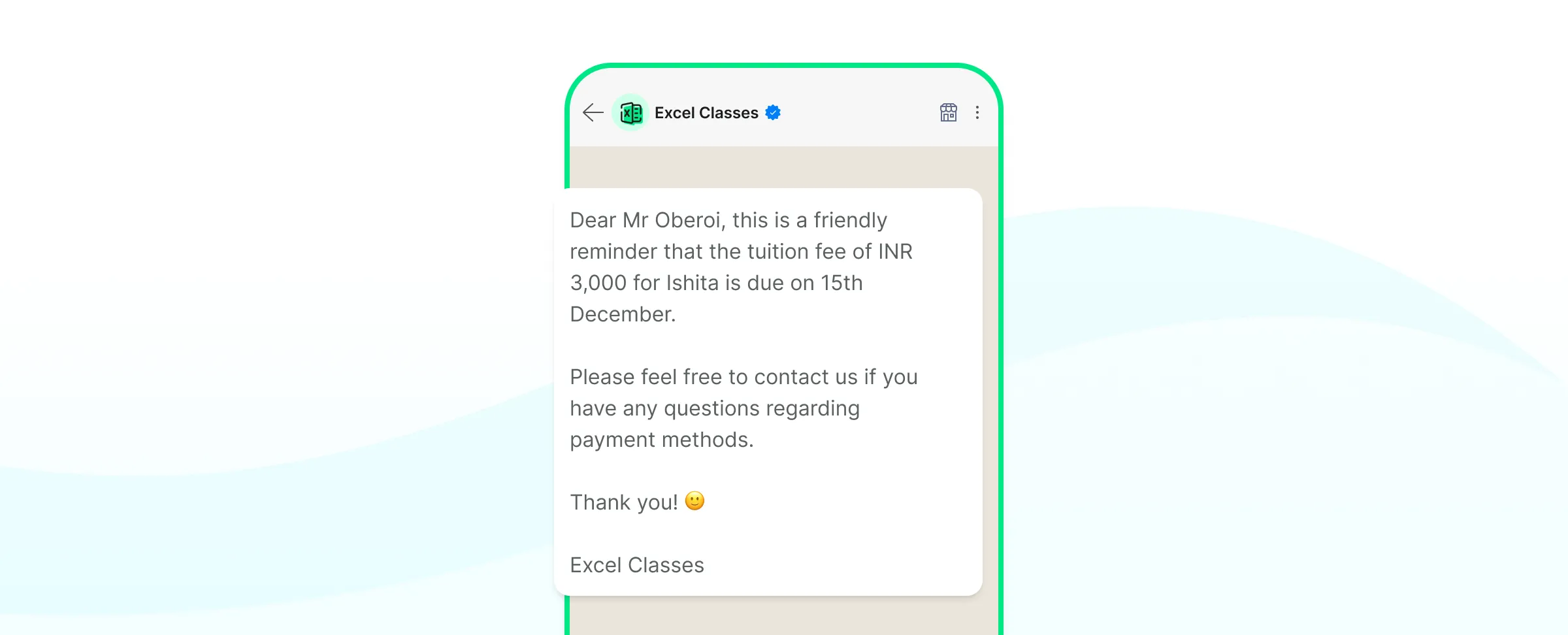
- Key touchpoints: Offer letters, scholarship decisions, fee payment links, and installment plans
- What to measure: Offer acceptance rate and fee collection rate
- Conversational moment: A payment link with clear installment options, plus a quick answer to "Is there a sibling discount?"
6. Onboarding
The new student gets set up before classes begin.
- Owned by: Student services and academics
- Key touchpoints: Welcome messages, orientation, timetable, app access, and uniform or book lists
- What to measure: Onboarding completion and first-week attendance
- Conversational moment: A welcome message with login details, the first-day schedule, and a contact for questions.
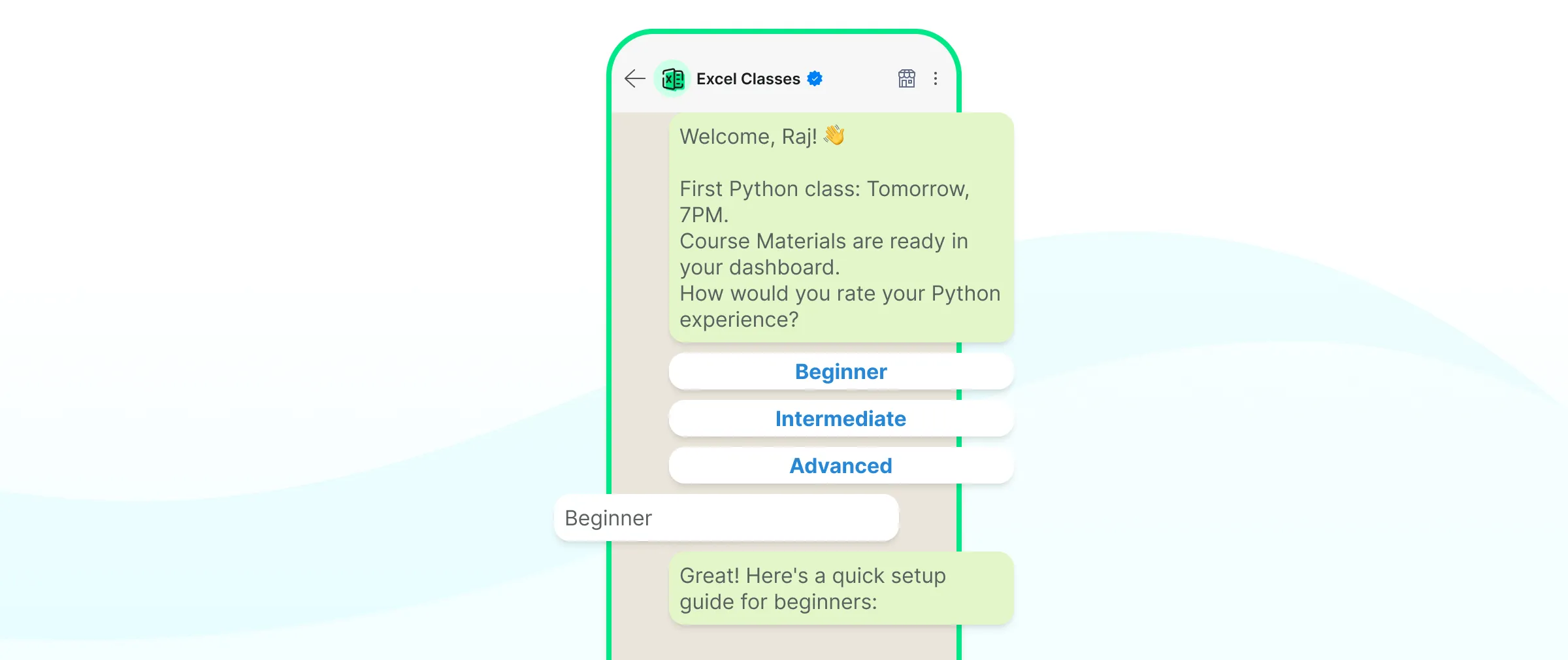
Wati is helpful in delivering offers and fee requests in a channel families open right away, so acceptance and payment happen faster:
- Offer letters and scholarship decisions: Personalized WhatsApp messages carry the offer letter as a PDF along with any scholarship details. A clear “Accept offer” button makes the next step obvious.
- Payment links and installment reminders: Fee messages include a quick payment link with installment options. Automated reminders are sent before each due date, improving fee collection without the finance team having to chase every family by phone.
- Instant answers to fee questions: Astra answers “Is there a sibling discount?” straight from the school’s fee policy. Anything it can’t resolve is sent to the finance team in the Team Inbox, along with the full chat history.
7. Learning Engagement
The student attends, learns, and progresses, while parents stay informed.
- Owned by: Academics and support
- Key touchpoints: Class reminders, assignments, attendance alerts, progress reports, and parent-teacher meetings
- What to measure: Attendance, assignment completion, and support response time
- Conversational moment: An alert to a parent when a student misses two classes in a row.
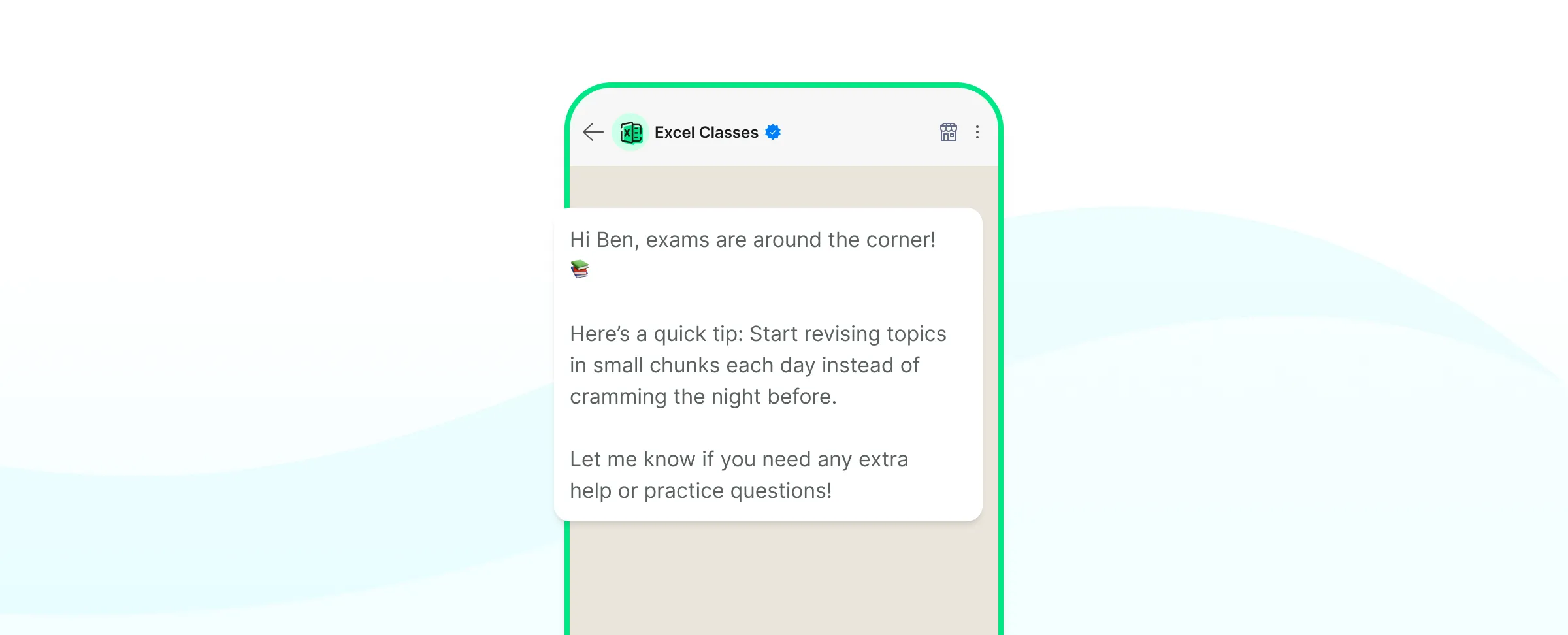
If you are tied up with a platform such as Wati, the platform helps by keeping students on track and parents in the loop with updates they’ll actually read:
- Class reminders and attendance alerts: Automated messages that share class schedules, live class links, and assignment deadlines. When a student misses two classes in a row, an alert triggered from the school’s attendance system or LMS goes straight to the parent.
- Progress reports and parent-teacher meetings: Report cards are sent as PDFs, and meeting invites include a WhatsApp Flow so parents can pick a slot in seconds. Day-before reminders keep turnout high.
- Fast academic support: Astra answers routine questions about timetables, syllabus, or exam dates. Anything more complex goes to the right teacher or support team in the Team Inbox, which keeps support response times low as student numbers grow.
8. Retention and Re-Enrollment
The student continues to the next term, grade, or course.
- Owned by: Academics, finance, and admissions
- Key touchpoints: Re-enrollment reminders, renewal offers, course upgrades, and fee reminders
- What to measure: Re-enrollment rate and dropout rate
- Conversational moment: A renewal reminder that includes the student's progress, not just the fee due.
Wati AI spots students at risk of dropping out early and to make every renewal conversation personal:
- Early dropout signals: Conversation Intelligence reads and scores every parent-student chat, so a frustrated parent or a quiet student gets flagged. Academics or admissions can then step in before the decision to leave is made.
- Progress-led renewal reminders: Contact Intelligence builds up each student’s history across the journey, so the renewal message can include real progress, for example, “John completed 92% of Term 1 assignments,” alongside the fee due and a payment link. Campaign Intelligence learns which messages and timing drive re-enrollment and applies that to the next send.
- Astra for upgrade and fee questions: It answers questions like “What’s the difference between the foundation and advanced course?” or “Can I pay next term in installments?” Families who are ready to upgrade or renew get handed to a counselor with the full context, which lifts re-enrollment without adding headcount.
9. Alumni and Referrals
Former students and their families become advocates.
- Owned by: Marketing and alumni relations
- Key touchpoints: Results announcements, referral programs, testimonials, and alumni events
- What to measure: Referral inquiries and review volume
- Conversational moment: A referral request sent right after exam results, when families are happiest.
Wati turns happy moments into referrals and reviews, right in the chat where families already celebrate:
- Referral requests at the right moment: Results announcements go out as personalized WhatsApp messages, followed by a referral request with a shareable chat link. Each family’s link carries its own pre-filled message, so every referral inquiry that arrives can be traced back to the family who sent it. Campaign Intelligence learns which message and timing get the most referrals and applies that to the next results season.
- Testimonials and reviews: A quick WhatsApp Flow collects a rating and a short testimonial with minimal effort. Parents can also reply with a photo or video in the same thread. Happy families get an instant tap link to leave a Google review, which steadily lifts review volume.
- Alumni events and closing the loop: Alumni receive event invites and can RSVP with one tap on WhatsApp. When a referred family reaches out, Astra picks up their first question instantly, and the journey starts again at Inquiry.
How Do You Engage Parents and Students on Different Channels?
You engage parents and students well by deciding who receives which message, on which channel, at which stage.
Sending everything to everyone creates noise, and sending the wrong message to the wrong person creates confusion.
Message Type | Parent | Student | Best Channels |
|---|---|---|---|
Fees, payments, and installments | Primary | Informed (higher ed) | WhatsApp, SMS, email |
Admission updates and documents | Primary (K-12) | Primary (higher ed) | WhatsApp, email |
Class reminders and timetables | Informed | Primary | WhatsApp, app notifications |
Attendance alerts | Primary | Informed | WhatsApp, SMS |
Progress reports and parent-teacher meetings | Primary | Informed | WhatsApp, email |
Events, results, and community | Both | Both | Instagram, WhatsApp broadcasts |
A few principles help:
- Respect the language each family prefers. In multilingual markets, a fee reminder in a parent's own language gets read and acted on faster.
- Keep one thread per family. When a parent and a student both message, staff should see both conversations on the same record.
- Match urgency to channel. Use messaging for time-sensitive updates, email for detailed documents, and calls for sensitive conversations.
Our guide to WhatsApp for education includes ready-to-use templates for parent and student updates.
What Student Recruitment Strategies Work Across Channels?
The student recruitment strategies that work best today combine fast response, conversational channels, and timely follow-up. These six strategies cover the inquiry and counseling stages:
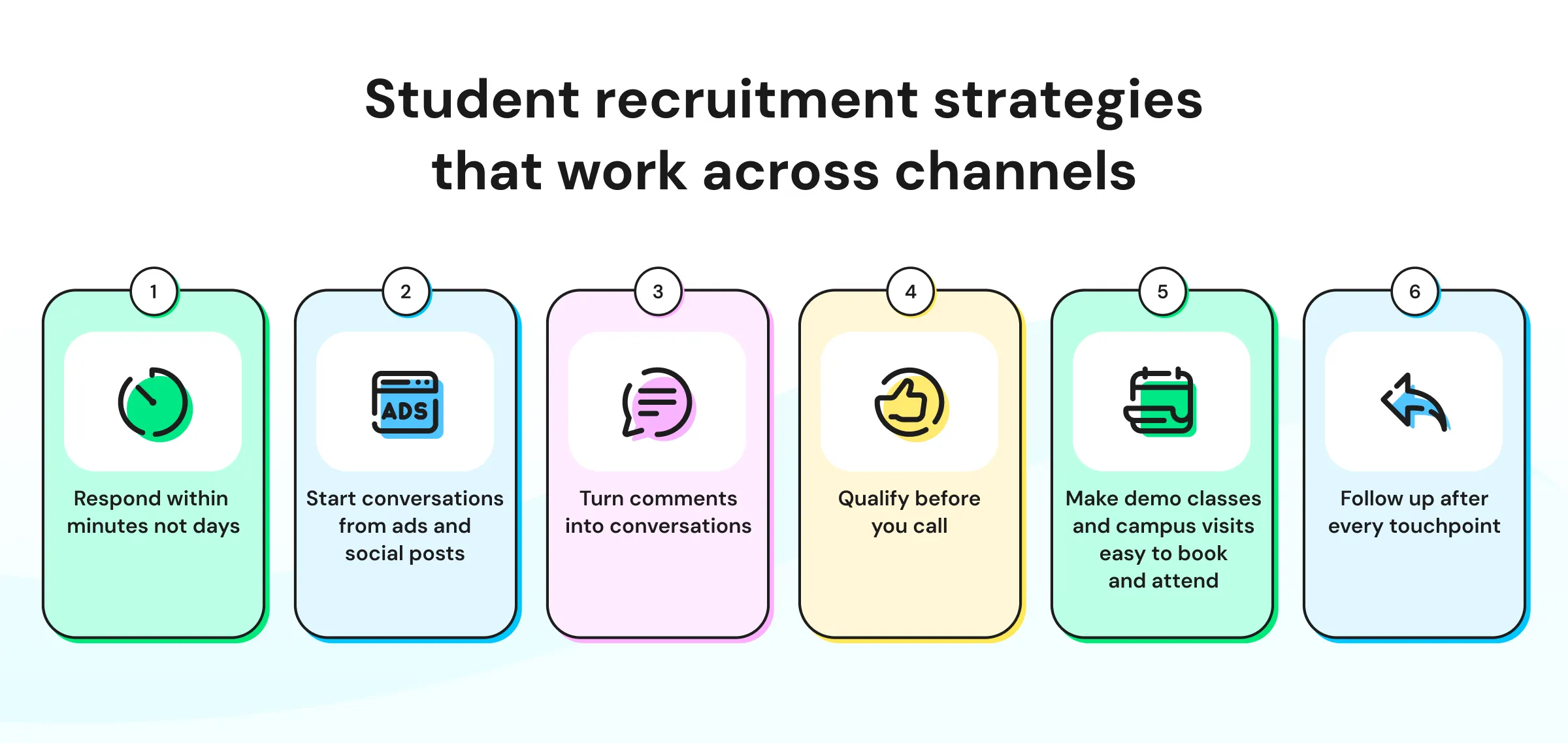
1. Respond Within Minutes, Not Days
Families often inquire with several institutions at once. The first one to answer clearly usually earns the counseling call. Make your first reply instant: with an AI Agent that answers fee, program, and admission questions within seconds.
2. Start Conversations from Ads and Social Posts
Click-to-WhatsApp ads open a chat straight from Facebook or Instagram instead of a form, so families can ask questions immediately. Click-to-WhatsApp Ads and Instagram comment-to-DM automation respond the moment a family clicks or comments.
Every inquiry then lands in the shared Team Inbox and is auto-assigned to the right counselor, so the handover to a counseling call occurs within minutes
3. Turn Comments Into Conversations
Automatically reply to comments like "fees?" or "admission open?" with a DM. Our guide to Instagram comment automation covers the setup.
4. Qualify Before You Call
Ask two or three questions first, such as grade, location, and preferred start date, so counselors spend their time on families ready to talk.
Build an AI agent for initial filtering. The AI Agent naturally asks about grade, location, and preferred start date, or a WhatsApp Flow collects the same details easily without a separate form. Each family’s answers are saved to their contact and tagged, so only qualified, ready-to-talk families are routed to a counselor, already briefed on what they need.
5. Make Demo Classes and Campus Visits Easy to Book and Attend
Confirm the slot, send directions or a joining link, and remind families the day before. WhatsApp Flow lets families pick a demo or campus visit slot in a few taps, and an instant confirmation follows with Google Maps directions or the online class joining link.
A reminder goes out automatically the day before, with a one-tap option to reschedule. If a family replies with a question, the AI Agent answers it right away, so fewer bookings turn into no-shows.
6. Follow Up After Every Touchpoint
Send a short message after a tour, demo, or webinar with the next step and a clear way to ask questions.
Set up an automated follow-up within hours of the tour, demo, or webinar, with a thank-you, the next step, such as “Start your application,” and a one-click button to take it.
These strategies are a core part of enrollment marketing, which focuses on turning interest into completed applications rather than just generating inquiries.
How Do You Handle Admission-Season Spikes?
Admission seasons compress months of demand into a few weeks.
Board exam results, entrance exam results, and the start of a new academic year all trigger sudden surges in inquiries, and a slow response during these windows means lost enrollments.
These five steps help institutions handle spikes without losing inquiries:
- Prepare answers in advance. Build a knowledge base of the questions families most often ask, such as fees, eligibility, deadlines, scholarships, and transportation, before the season starts. If you are with Wati, you can train Astra with your knowledge base to answer the questions.
- Let AI agents handle the first reply. AI agents can answer common questions instantly at any hour and collect the details counselors need. Wati helps you build a business-facing AI agent and a client-facing AI agent. One helps make your job easier by finding information and answering your queries, and the other helps by answering students' and parents' questions.
- Route by program and priority. Send each qualified inquiry to the right counselor or team based on program, location, or language. Wati routes each qualified inquiry automatically: once Astra or a WhatsApp Flow captures the family’s programme, location, and preferred language, Workflows tag the contact and auto-assign the conversation to the right counsellor or team in the Team Inbox. High-priority inquiries, such as families ready to book a visit, can be routed straight to senior counsellors, so nobody wastes time triaging and every family speaks to someone who can actually help them.
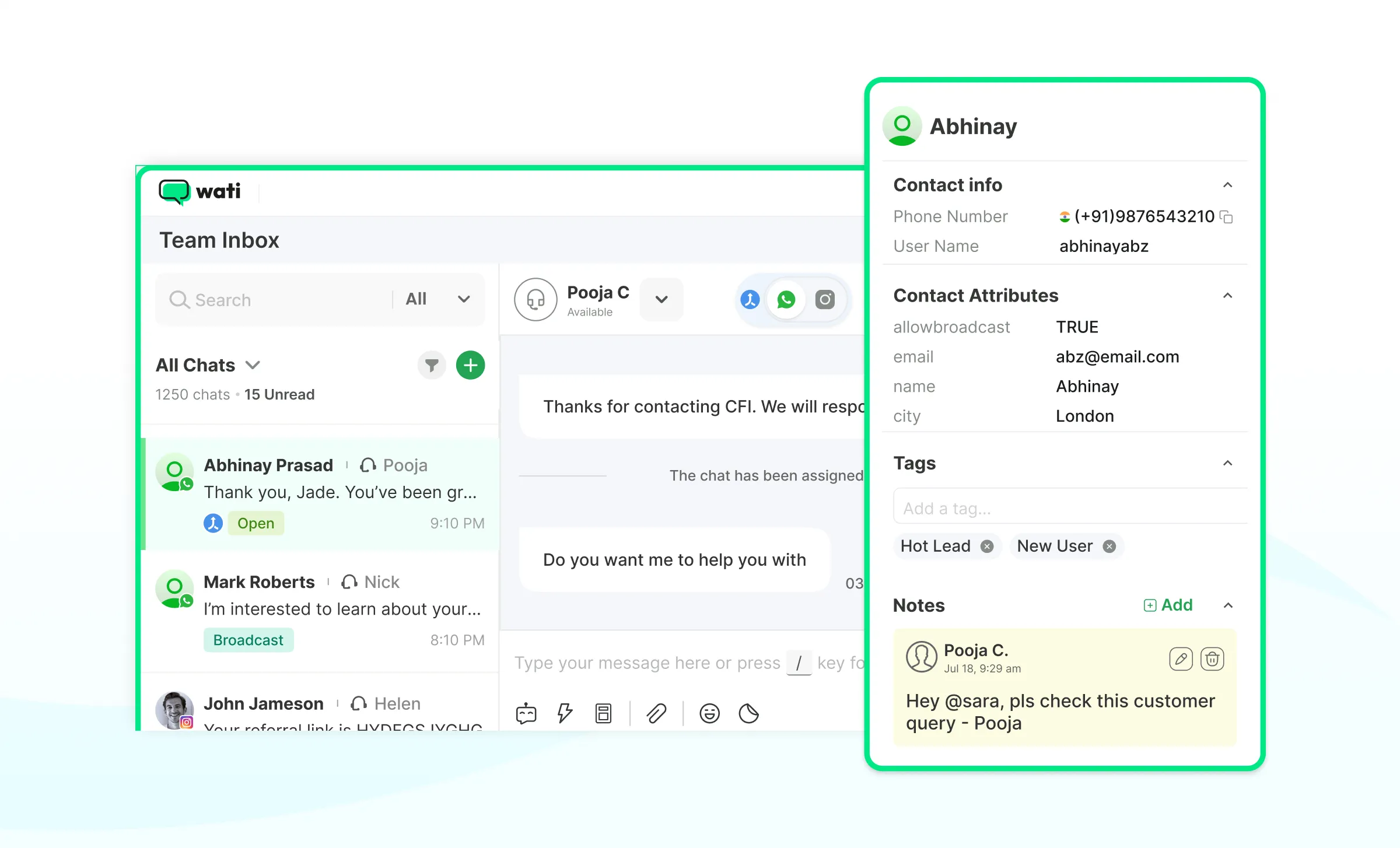
- Give counselors one shared inbox. When every channel lands in one place, no inquiry sits unanswered in a personal phone or a forgotten mailbox. Our guide to running WhatsApp with multiple team members shows how to structure this.
- Track response time daily. During peak weeks, response time is the earliest warning that inquiries are being lost.
What is Student Lifecycle Management & Why Does It Need Omnichannel?
Student lifecycle management is the practice of managing every interaction with a student, from first inquiry to alumni, as one connected relationship rather than a series of handoffs between departments.
It needs an omnichannel approach because each stage happens on different channels and is owned by different teams.
Without a shared record, the problems are predictable:
- An admissions counselor promises a scholarship that finance never sees.
- A parent asks the same transport question three times on three channels.
- An at-risk student's attendance drop is noticed by academics but never reaches the counselor who enrolled them.
With omnichannel engagement, every team sees the same conversation history, tags, and status. The handoff from admissions to academics, or from academics to finance, carries full context, so families experience one institution instead of five departments.
How Do You Protect Student Data and Get Consent?
Protecting student data starts with collecting clear opt-in before you message families, and sharing information only with the people who should see it. Education data is sensitive, and in many cases it belongs to minors.
- India: The Digital Personal Data Protection (DPDP) Act, 2023 treats anyone under 18 as a child and requires verifiable parental consent before their personal data is processed. The government notified the final DPDP Rules on 13 November 2025, with phased enforcement timelines. The rules include some exemptions for educational institutions when processing is limited to specific defined purposes, so check with your legal team which applies to you.
- United States: FERPA governs access to and disclosure of student education records at institutions that receive federal funding.
- Everywhere: Collect opt-in for each channel, explain what families will receive, make it easy to opt out, and keep marketing messages separate from essential academic and fee updates.
This section is general information, not legal advice. Review your communication practices with a legal or compliance professional.
Which Metrics Should Education Teams Track?
The most useful metrics follow the student journey, so each team can see exactly where families drop off.
Stage | Primary Metric | Supporting Metric |
|---|---|---|
Awareness | Inquiry volume | Cost per inquiry |
Inquiry | Time to first response | Inquiry-to-qualified-lead rate |
Counseling | Demo or visit attendance rate | Counseling-to-application rate |
Application | Application completion rate | Time to complete documents |
Admission and fees | Offer acceptance rate | Fee collection rate |
Onboarding | Onboarding completion | First-week attendance |
Learning | Attendance rate | Support response time |
Retention | Re-enrollment rate | Dropout rate |
Alumni | Referral inquiries | Review volume |
Review these together. A strong inquiry volume with a weak application completion rate, for example, points straight to a follow-up problem in the counseling stage.
How Does Wati Support Omnichannel Engagement in Education?
Wati is an agentic customer engagement platform that turns conversations into revenue growth across marketing, sales, and support. For schools, colleges, and edtechs, it brings WhatsApp, Instagram, Messenger, RCS, voice, and web chat into one place, so every family conversation, from first inquiry to re-enrollment, lives in a single shared history.
Astra handles conversations with families end to end. It answers questions about fees, eligibility, and batches from the institution’s own knowledge base, qualifies each family, and books demo classes and campus visits. It hands sales-ready families to counselors with full context and handles calls in 30+ languages with regional accents.
Behind the scenes, Wati AI helps admissions, academic, and support teams work faster:
- Ask Wati AI: get instant answers like “How many Class 6 inquiries came in this week?”
- Wati AI Agents: flag families ready to enroll, chats still waiting on a reply, and spam clogging the queue.
- AI Editor: draft accurate replies from the institution’s knowledge base in one click.
- AI Translation: reply to parents in their preferred language.
- AI Template Generator: get fee reminders and admission updates approved by Meta the first time.
- AI Segments: build the right audience for renewal, upgrade, or event campaigns.
- Campaign Recommendations: know which campaign to send next and to whom.
- CX Score: spot unhappy families early, before they consider leaving.
- Conversation Summary: get any counselor up to speed on a family’s history in seconds.
Vedantu, an Indian live tutoring platform with more than 200,000 students, runs its student lifecycle on WhatsApp with Wati. Lead qualification, FAQ answers, and admissions all happen on WhatsApp.
Students and mentors are routed to each other through Vedantu's official number, and automated class reminders have raised online attendance by more than 7%.
Connect Every Stage of the Student Journey
Omnichannel customer engagement for education turns a set of separate departments and channels into one continuous experience for students and parents.
Start by mapping who owns each stage, connect your channels in one shared inbox, automate the repetitive messages, and give counselors the context they need to close admissions.
Ready to connect every stage of the student journey? Start your free Wati trial or book a demo.
Frequently asked questions
What is omnichannel engagement in education?
Omnichannel engagement in education connects every channel a school, college, coaching institute, or edtech platform uses, such as WhatsApp, Instagram, email, phone, and campus visits, around one shared student record. Students and parents get one continuous conversation, and every department sees the same history.
How do schools communicate with parents and students on different channels?
Schools communicate best by sending each message to the right person on the right channel. Parents usually receive fee, attendance, and progress updates on WhatsApp or SMS, while students receive class reminders and timetables on messaging apps or the school's learning app.
How can automation help the admissions process?
Automation helps the admissions process by replying to inquiries instantly, asking qualifying questions, confirming demo classes and campus visits, and reminding families about missing documents and fee deadlines. Counselors then spend their time on families who are ready to talk.
What is student lifecycle management?
Student lifecycle management is the practice of managing every interaction with a student, from first inquiry through enrollment, learning, re-enrollment, and alumni, as one connected relationship. It relies on a shared student record so departments can hand off without losing context.
Is WhatsApp safe for school and student communication?
WhatsApp can be safe for school and student communication when institutions use the official WhatsApp Business Platform, collect opt-in from families, follow data protection laws such as India's DPDP Act, and share sensitive information only with the right parent or student.
Related posts
- Instagram Comment Automation: How It Works and How to Set It Up in Wati
Instagram comment automation auto-replies to comments and DMs commenters within seconds via Meta's API. Covers strategy, use cases, and Wati setup.
- Shared Team Inbox for Instagram: A Buyer’s Checklist for 2026
Use this fastest checklist to evaluate any shared team inbox for Instagram, which covers DMs, comments, automation, and multi-channel support.
- How to Send Bulk Messages on WhatsApp Without Getting Blocked
Learn how to send bulk WhatsApp messages without getting blocked. Compare the WhatsApp Business app and API, messaging limits, costs, templates, and best practices for safe, compliant bulk messaging.
- How to Set Up a TikTok Business Account: Step-by-Step Guide
Set up a TikTok Business Account step by step: switch from personal, pick a category, add your profile, and unlock ads and analytics.