
Too Long? Read This First
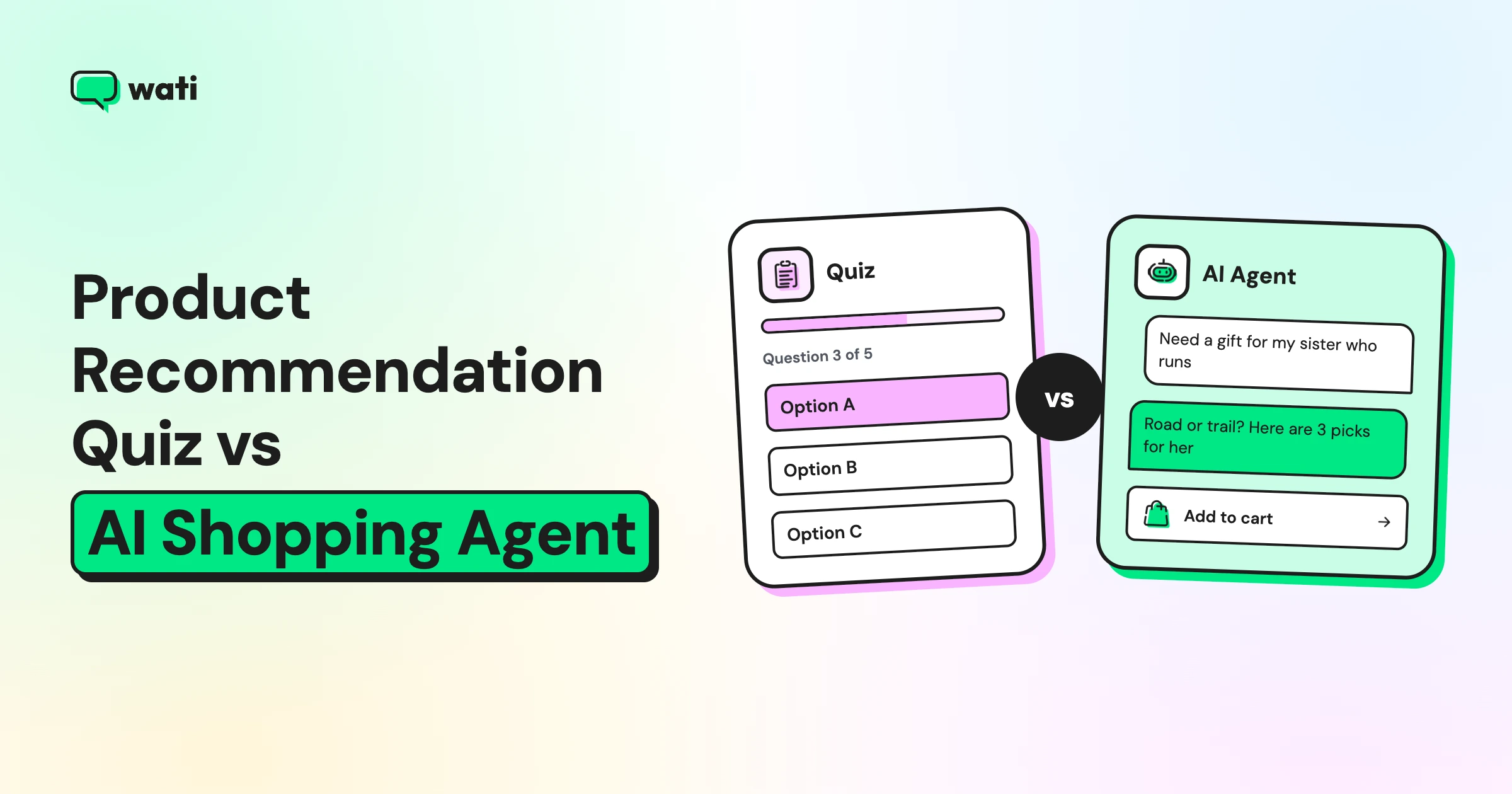
- A product recommendation quiz guides shoppers through fixed questions, while an AI shopping agent adapts to whatever the shopper says.
- Quizzes still work well for list building, small catalogs, and brand-led experiences.
- AI agents handle open-ended needs, follow-up questions, and channels beyond your website, such as WhatsApp.
- The strongest setup often combines both: keep the quiz's best questions and let AI ask them in conversation.
- Compare the two on the same traffic for a few weeks before switching.
A product recommendation quiz still works for some Shopify stores, but it's no longer the only way to guide shoppers to the right product. AI shopping agents now do what a fixed set of questions can't: follow up, handle unexpected answers, and keep helping after the first suggestion.
With Wati’s Astra AI Agent, that conversation can happen on your website or on WhatsApp.
Shoppers are ready for it. A McKinsey survey found that 68% of US consumers used at least one AI tool in the past three months, with research the most common reason.
This guide compares the two approaches side by side and shows when a quiz still wins. You'll also get a template for turning your best quiz questions into an AI conversation, plus a fair way to measure which one sells more.
What is a Product Recommendation Quiz?
A product recommendation quiz is an interactive set of questions on your store that suggests products based on the shopper's answers. A skincare brand might ask about skin type, main concern, and budget, then show three matching products on a results page.
On Shopify, a product quiz usually runs through a quiz app that connects answers to your catalog. Quizzes earn their place for three reasons:
- They collect zero-party data. Shoppers tell you their preferences directly, which you can use in later emails or messages.
- They grow your list. Many quizzes ask for an email address before showing results.
- They reduce choice overload. A short quiz narrows a big catalog to a few clear options.
What is an AI Shopping Agent?
An AI shopping agent is software that talks with shoppers in natural language, understands what they need, and suggests items that fit. People also call it an AI shopping assistant.
Unlike a rule-based chatbot, it doesn't force shoppers down a fixed menu. A shopper can type "I need a gift for my dad who runs marathons, under $80," and the agent works with all three details at once. If something is unclear, it asks a follow-up question.
Use of AI for shopping is climbing fast. Boston Consulting Group reports that shopping-related generative AI use grew 35% between February and November 2025.
Where Do Product Quizzes Fall Short?
Product quizzes struggle in four predictable places.
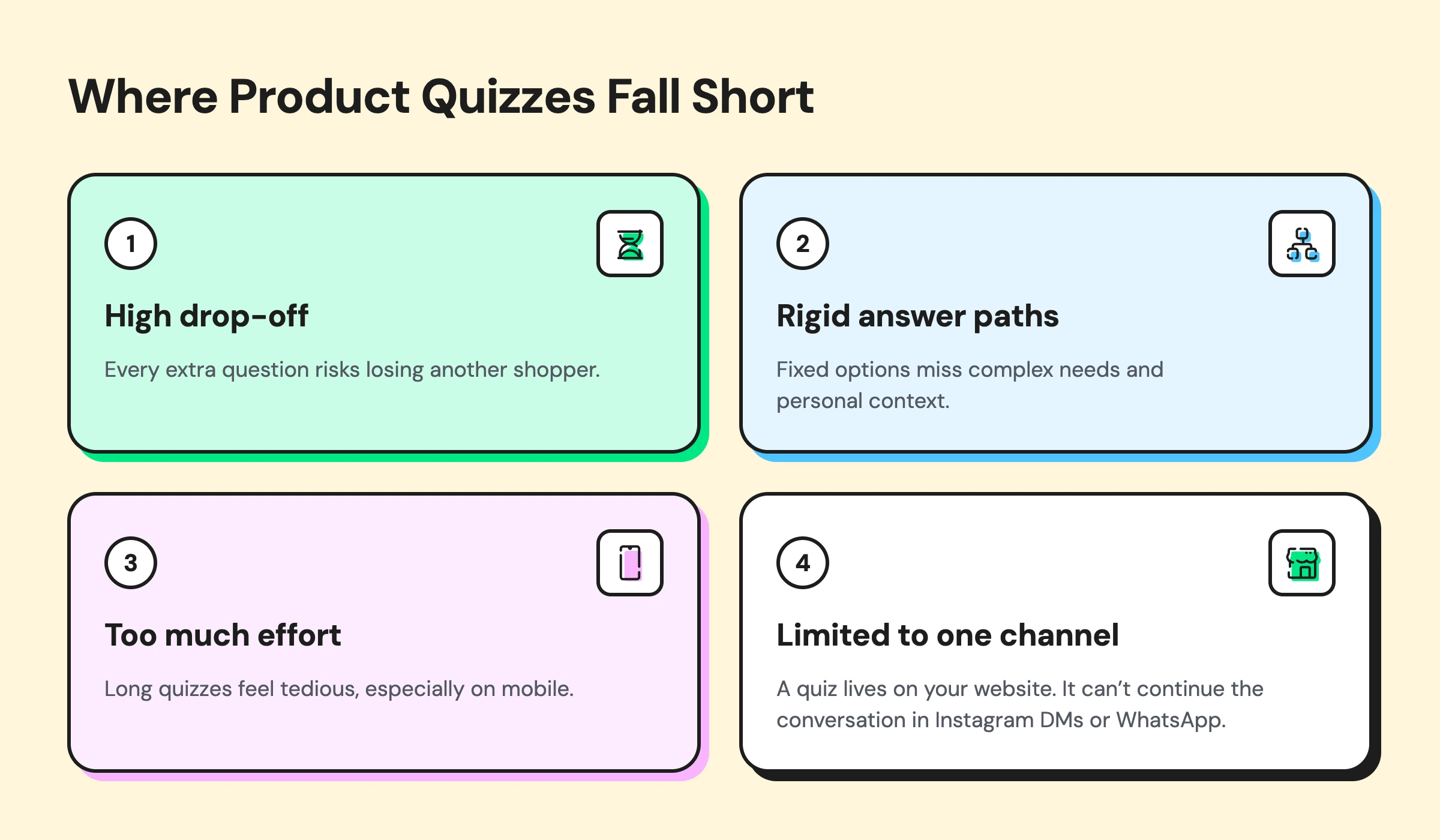
Drop-off compounds with every question. Each step loses some shoppers, and the losses multiply. ConvertFlow illustrates the math: a six-step quiz where 70% of people finish each step delivers only about 12% of starters to the results page.
Fixed paths miss real needs. A quiz can't handle "it's a gift," "I've tried your bestseller and it didn't work," or two needs at once. Shoppers either pick the closest answer or leave.
Long quizzes feel like work on mobile. Long quizzes may start to feel like a survey, and that's when shoppers bail, especially on phones.
They live in one place. A quiz sits on your website. It can't follow a shopper into Instagram DMs or WhatsApp, where many product questions now start. In markets like India, Brazil, and the Middle East, where messaging a store is everyday behavior, a quick chat can feel more natural than a multi-step quiz.
How Do Quizzes and AI Shopping Agents Compare?
Here's how the two approaches stack up on the criteria that matter most for Shopify stores.
Criteria | Product Recommendation Quiz | AI Shopping Agent |
|---|---|---|
Question flow | Fixed order, set answer choices | Adapts to each reply, accepts free text |
Flexibility | Handles expected needs only | Handles unusual, combined, or vague needs |
Mobile experience | Multiple screens to tap through | Feels like texting |
Data captured | Structured answers, often an email | Preferences, questions, and objections in the shopper's words |
Channels | Website only | Website chat, WhatsApp, and other messaging apps |
Setup effort | Build questions and logic once | Train on catalog, policies, and FAQs |
Ongoing upkeep | Edit logic when products change | Update knowledge and review conversations |
Best fit | Small catalogs, list building, branded experiences | Large or complex catalogs, high-consideration products |
The short version: quizzes are predictable and easy to measure, while AI shopping agents are flexible and reach shoppers beyond your website. A candle brand with six scents may gain little from an AI agent. A skincare store with 400 products and a dozen skin concerns usually gains a lot.
When Does a Product Recommendation Quiz Still Win?
A product recommendation quiz is still the better choice in several situations. Keep your Shopify product quiz if:
- Email growth is your main goal. A quiz with a clear incentive is one of the most reliable list builders.
- Your catalog is small and easy to sort. If three questions always lead to the right answer, a quiz is fast and accurate.
- Recommendations follow strict rules. Some categories, such as supplements or regulated products, need consistent, approved logic every time.
- The quiz is part of your brand. A playful "find your scent" experience can be marketing in itself.
- It already performs well. If completion and result-to-cart rates are strong, don't replace something that works. Add AI alongside it instead.
If none of these apply, an AI agent will usually serve your shoppers better.
How Do You Turn Quiz Questions Into an AI Conversation?
You don't have to choose one or the other. The best quiz questions make excellent clarifying questions for an AI agent, which can ask them only when needed and in a natural way.
Here's a mapping template using a skincare example:
Quiz Question | How the AI Asks It | Saved On the Contact As |
|---|---|---|
What's your skin type? | "Would you say your skin is more oily, dry, or a mix?" | Skin type |
What's your main concern? | "What would you most like to improve, like breakouts, dryness, or dark spots?" | Main concern |
What's your budget? | "Is there a price range you'd like me to stay within?" | Budget |
How many steps do you want in your routine? | "Do you prefer a quick routine or a full regimen?" | Routine length |
Three rules make this work:
- Ask only what's missing. If a shopper says "I have oily skin and want something under $30," skip those two questions.
- Ask no more than two or three questions before recommending something. You can refine after the first suggestion.
- Save every answer. Stored preferences make the next conversation, and your next campaign, more relevant.
In Wati, each answer can be saved as an attribute on the shopper’s contact record, so your team and future campaigns can use it.
Recommend products where shoppers already chat. With WhatsApp Catalog, shoppers browse recommendations in the chat and check out through a payment link, or WhatsApp Pay in supported markets. Explore WhatsApp Catalog
How Should You Measure a Quiz vs an AI Agent?
Comparing the two fairly means measuring each on its own terms, then on revenue.
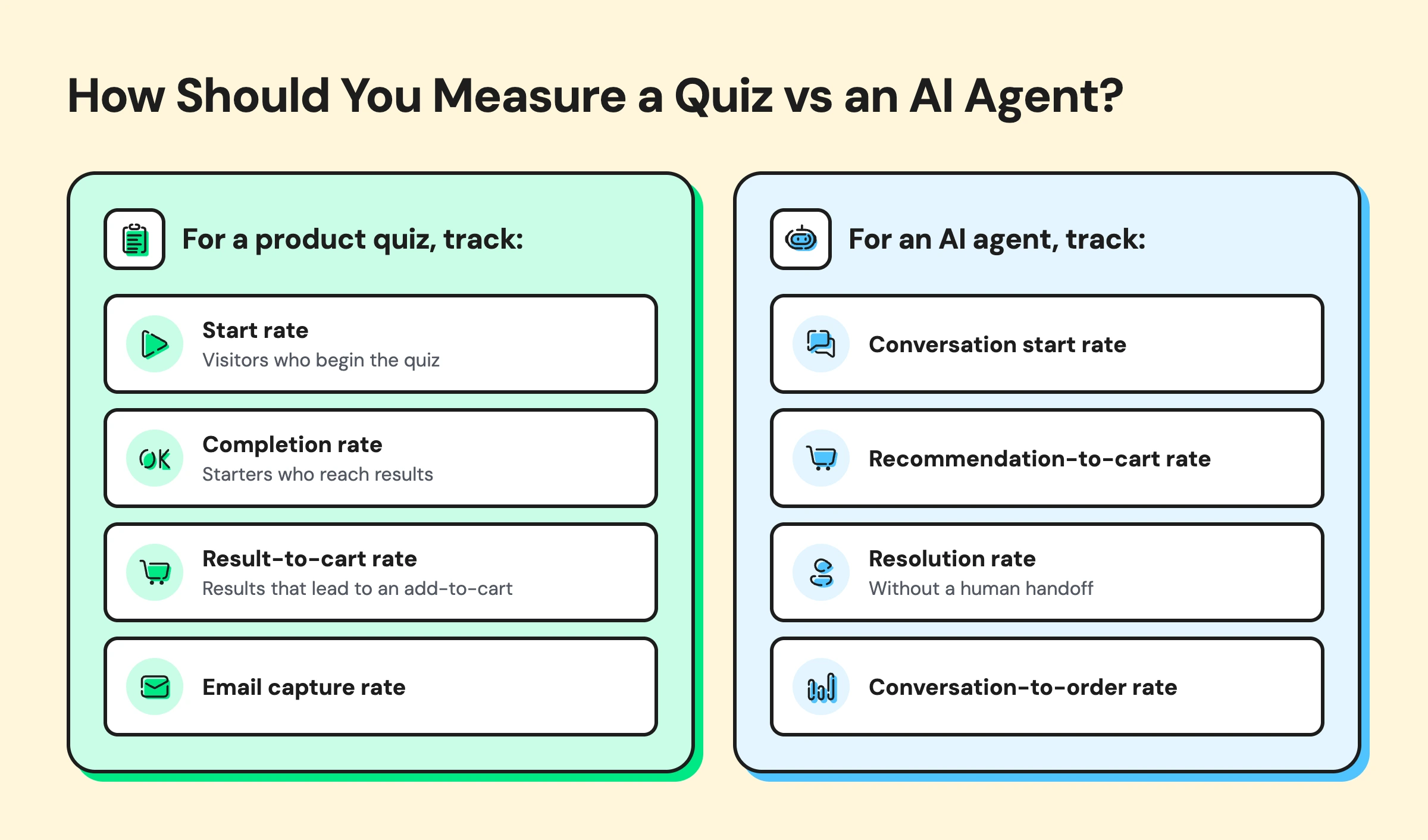
For a quiz, track:
- Start rate (visitors who begin the quiz)
- Completion rate (starters who reach results)
- Result-to-cart rate (results that lead to an add-to-cart)
- Email capture rate
For an AI agent, track:
- Conversation start rate
- Recommendation-to-cart rate
- Resolution rate without a human handoff
- Conversation-to-order rate
Then compare both on the numbers that matter most: conversion rate and average order value for shoppers who used each. Run the test on the same traffic source for at least four weeks, so seasonality doesn't skew the result.
How Does Wati Turn Product Questions Into Sales?
Wati is an agentic omnichannel customer engagement platform that turns conversations into revenue growth across marketing, sales, and support.
For Shopify stores replacing or supporting a quiz, it brings guided selling into the chat.
Astra AI Agent holds the conversation on WhatsApp and your website, understands free-text answers, and suggests products that match, using your website, product pages and FAQs.
Stored preferences don't stop at one chat. On Pro and Business plans, details like skin type or budget can feed segments, so your next campaign reaches the right shoppers with the right products.
When the shopper is ready to buy, WhatsApp Catalog lets them browse in the chat and check out through a secure payment link, or WhatsApp Pay in supported markets. See how other online stores use Wati on the Wati for e-commerce page.
Guide Every Shopper to the Right Product
Whether you keep your quiz, replace it, or combine both, the goal is the same: help every shopper find the right product faster.
Ready to turn product questions into sales? Start your free Wati trial to see Astra AI Agent in action, or book a demo to plan your setup.
Frequently asked questions
Are product recommendation quizzes still worth it?
Yes, for some stores. Quizzes work well for list building, small catalogs with clear choices, and brand-led experiences. For large catalogs or complex needs, an AI shopping agent usually guides shoppers better.
How many questions should a product quiz have?
Most quiz builders recommend somewhere between four and ten questions, depending on how complex the products are. Fewer may not give enough detail for a good match, while more tends to increase drop-off, especially on mobile.
What is the difference between an AI shopping agent and a chatbot?
A traditional chatbot follows fixed menus and scripted replies. An AI shopping agent understands free-text questions, handles several needs at once, asks follow-up questions, and makes product suggestions that fit.
Can I use a product quiz and an AI agent together?
Yes. Many stores keep a quiz for list building and use an AI agent for open-ended questions. You can also turn your quiz questions into clarifying questions the AI asks only when needed.
What should I look for in a Shopify quiz app?
Look for easy question and logic editing, accurate catalog syncing, mobile-friendly design, email and SMS integrations, and clear analytics on completion and result-to-cart rates.
Related posts
- Instagram Comment Automation: How It Works and How to Set It Up in Wati
Instagram comment automation auto-replies to comments and DMs commenters within seconds via Meta's API. Covers strategy, use cases, and Wati setup.
- Shared Team Inbox for Instagram: A Buyer’s Checklist for 2026
Use this fastest checklist to evaluate any shared team inbox for Instagram, which covers DMs, comments, automation, and multi-channel support.
- How to Send Bulk Messages on WhatsApp Without Getting Blocked
Learn how to send bulk WhatsApp messages without getting blocked. Compare the WhatsApp Business app and API, messaging limits, costs, templates, and best practices for safe, compliant bulk messaging.
- How to Set Up a TikTok Business Account: Step-by-Step Guide
Set up a TikTok Business Account step by step: switch from personal, pick a category, add your profile, and unlock ads and analytics.