
Too Long? Read This First
- Elevate Conversions: WhatsApp API guarantees High open rates and higher conversion rates than traditional marketing channels.
- Identify the Best: A good provider offers Meta compliance, a shared inbox, no-code automation, and transparent tiered pricing for scalability.
- Top 7 Shortlist: The leading providers for 2026 include Wati, Twilio (Developers), , Gallabox (Sales CRM), and Infobip (CPaaS).
- Wati’s Edge: Wati dominates the SMB space by providing a no-code, all-in-one platform featuring Astra AI Sales Agent and Gemini 3.0 support for maximum ROI.
Customers are growing smarter, and they want to get the work done as early as possible. They are choosing fast-paced, utility-driven brands compared to brands that try hard to impress.
When I speak of convenience, my mind automatically thinks about WhatsApp. From ticket reservations to food delivery updates to healthcare assistance, brands engaging on WhatsApp are making a big impact in the market.
To engage and reach out, you need to work with a WhatsApp Business API platform to access the WhatsApp API and integrate it with your marketing stack.
WhatsApp has evolved into a comprehensive business platform, enabling businesses to centralize communication and automate workflows for greater efficiency. The WhatsApp business platform empowers organizations with automation, customer engagement tools, and integration with existing business tools, making it easier to scale and enhance customer experiences.
This list entails the seven best WhatsApp API service providers that brands can refer to build a foolproof consumer engagement strategy and drive sales growth via WhatsApp.
Why do You Need a WhatsApp API Provider in 2026?
WhatsApp conversion rates are decently higher than those in traditional Email efforts and marketing campaigns.
By switching to a WhatsApp API provider, you can build effective and intelligent WhatsApp conversations to stand out and offer quality in a saturated market. With a WhatsApp Business API, you can leverage personalization at scale without worrying about upfront customer infrastructure costs, increasing sales agent hours, and automating conversations with inbound intelligence.
With a BSP, you can connect to the WhatsApp API and streamline your WhatsApp engagement process for customers without relying on developers or third-party hosting services.
Here are the reasons why you should go for a WhatsApp API service provider in 2026.
1. Faster Template Approvals and Launch Velocity
Traditional message templates can slow down marketing campaigns. WhatsApp message templates play a key role in streamlining the approval process and ensuring consistent communication, making it easier for businesses to maintain brand voice and efficiency.
With top BSPs, you can deploy automated business message templates, thereby reducing the approval time for your WhatsApp marketing campaigns and engaging and assisting faster.
This approval speed ensures that your flash sales and critical alerts are delivered exactly when intended, providing higher customer engagement and return on investment with greater clarity.
2. Chatbot Automation with No-Code Support
Establishing a quick consumer touchpoint via chatbot replies is the key driver of conversion potential.
The WhatsApp API unlocks powerful chatbot automation without requiring much technical expertise. A WhatsApp chatbot can be used to automate customer engagement and provide instant responses, handling inquiries and tasks efficiently to improve service.
From the first WhatsApp ad click to product catalogs to sales agent routing, chatbots stay connected with the customer right through to the end.
Also Refer: Top 20+ WhatsApp tools to automate smart campaigns and accelerate sales productivity.
3. Intelligent WhatsApp Automation with Drip Campaigns
The WhatsApp API Provider unlocks powerful marketing campaign automation without requiring technical expertise.
From abandoned cart reminders to post-purchase feedback loops, providers enable sales and marketing teams to set up complex, personalized customer journeys using visual, drag-and-drop builders.
Also known as WhatsApp flows, these visual builders enable you to set database conditions, run nodal loops, and take a specific action or decision if the customer satisfies that criteria. Automated workflows can streamline repetitive marketing and support tasks, making it easier to scale customer engagement and improve efficiency.
4. Multi-Agent Shared Inbox For Efficiency
Teams might be confused about whether to go with a WhatsApp Business account or a WhatsApp API service provider to digitize e-commerce.
However, a WhatsApp Business account has limited inbox functionality, but the WhatsApp API offers a multi-agent shared inbox that tracks ongoing customer interactions for high volumes. The WhatsApp API is specifically designed to handle high message volumes efficiently, making it ideal for businesses with large-scale messaging needs.
While WhatsApp Business cannot handle a high volume of conversations, the WhatsApp API can not only allow shared chat visibility but also link 4+ multiple devices for the same account.
A professional WhatsApp Business API provider offers a shared team inbox to handle multiple concurrent chats, assign tickets, and maintain conversation history in one centralized location, drastically reducing response time and improving customer satisfaction (CSAT).
Also Read: Benefits of shared team inbox for sales agents using WhatsApp Business
5. Omnichannel Integration for E-Commerce Automation
Automating inbound calls and messages is the cog that can drive faster conversions in your e-commerce consumer experience.
WhatsApp API providers integrate with your third-party CRM or ERP providers (Like Shopify or WooCommerce) and helpdesk to gather inbound data and fuel omnichannel experiences.
They can also integrate with e-commerce platforms to enhance customer engagement, automate communication workflows, and scale messaging capabilities for online stores. Additionally, WhatsApp API solutions can integrate with your existing CRM to enable data synchronization and improved personalization.
Integrating WhatsApp API with existing systems such as helpdesk, CRM, and e-commerce platforms ensures smooth operations and a unified customer communication strategy.
This unified view, critical for effective segmentation and personalization, allows a brand to deliver highly contextual messages, whether it is an alert triggered by a CRM update or a promotion based on recent purchase history.
This omnichannel layer now typically extends to Instagram DMs and comments and, on some platforms, TikTok business messaging, not just WhatsApp, Facebook Messenger, and email.
Also Read: Instagram Comment Automation
6. WhatsApp Business Calling
WhatsApp Business Calling has moved from a nice-to-have to a genuine buying criterion in 2026.
The best providers now let support and sales teams place and receive voice calls with customers directly inside the same inbox used for chat, including from mobile apps, not just desktop.
This means conversations can move from text to voice without switching tools or losing context.
7. Advance Analytics to Track ROI
Running WhatsApp broadcast campaigns in the dark without tracking actionable metrics creates confusion about what worked and what didn’t.
BSPs provides a custom analytics dashboard to build sales reports and capture sales insights, directly mapping your ROI list and following action in line.
Tracking customer analytics is a crucial part of lead nurturing because the metrics inform you about customers’ reciprocation (like response rates, click-through rates, or open rates) to your campaigns and advise you on how to fine-tune messaging.
Bonus Read: Learn how to convert WhatsApp into WhatsApp Business account to run WhatsApp-focused purchase cycles and refine marketing.
Conversational Commerce and Marketing with WhatsApp API
The WhatsApp Business API has become the backbone for brands looking to deliver real-time customer engagement and drive business growth through personalized, interactive conversations.
A top-tier WhatsApp Business API provider helps businesses move beyond traditional marketing by enabling two-way, real-time interactions that guide customers through every stage of their journey.
With the WhatsApp API, companies can send personalized promotional messages, automate order confirmations, and provide instant responses to customer queries, all within a secure, familiar messaging platform.
The power of WhatsApp lies in its ability to blend marketing and commerce into a single, frictionless experience. Businesses can use the WhatsApp Business API to share rich media product catalogs, send tailored marketing messages, and even facilitate in-chat purchases, making it easier to convert conversations into sales.
Automated messaging and smart chatbots ensure that customer inquiries are handled promptly, boosting customer satisfaction and building customer loyalty.
By partnering with the right WhatsApp API provider, businesses unlock advanced analytics, message templates, and automation tools that streamline customer communications and keep customers informed at every touchpoint. This enhances the customer experience while also providing valuable insights to refine marketing efforts and maximize ROI.
How to Identify a Good WhatsApp API Service Provider in 2026
Choosing the right BSP is one of the most important decisions a sales or marketing leader will make in 2026.
The ideal provider balances WhatsApp's security features with transparent pricing.
Security and Compliance
- Official Meta Partnership: Ensure they are an approved Business Solution Provider (BSP) to guarantee adherence to Meta’s security protocols and avoid account bans.
- Data governance: Check for certifications (like ISO) and data localization features, especially if you serve global markets. The provider must guarantee end-to-end encryption and secure handling of personally identifiable information (PII). WhatsApp API providers can also use verification codes for secure authentication, which enhances data security and simplifies the user verification process.
Features and Capabilities
- No Code Chatbot Builder: Look for a platform with a user-friendly, drag-and-drop interface for building complex conversational flows without coding.
- AI Support and Natural Language Processing (NLP): Modern platforms use AI to instantly answer FAQs, but increasingly to let you build an entire agent just by describing it in plain English. You type what you want, and the platform builds and deploys the agent for you, no manual flow-building required.
- WhatsApp Broadcast, Drip Campaigns Segmentation: Send bulk campaigns to your whole list, or set up drip campaigns catering to each stage of the customer journey, like a cart-abandonment reminder followed by a post-purchase check-in. Deep audience segmentation (past purchases, browsing behavior, engagement history) decides who gets which message and when, so broadcasts and drip campaigns both stay targeted instead of going out to everyone the same way.
- Conversational Intelligence: WhatsApp API providers should support features like List Messages, Reply Buttons, and WhatsApp Flows to simplify customer input and accelerate conversions.
- Omnichannel messaging: the strongest platforms now unify WhatsApp with Instagram DMs and comments, Facebook Messenger, and TikTok business messaging, all inside one inbox, so teams aren't switching tools by channel.
- Voice AI: the newest capability tier, near-zero-latency voice agents that can hold a natural spoken conversation in 30+ languages, clone a voice so the agent sounds like your own brand's rep, and hand off to a human agent when needed.
Plan and Pricing Structure
- Transparency: Look for clear, predictable costs. The total cost involves two components: The BSP’s subscription fee (often based on agents/users or contacts) and Meta’s per-conversation fee.
- Scalability: The plan should support your growth, offering cost-effective tiers from SME to Enterprise without penalizing high volume.
- Free conversation allowance: Some BSPs may offer a set number of free conversations monthly, which significantly lowers your operational costs.
- Per-message vs. per-conversation billing: Meta's own pricing model has shifted toward per-message billing for several message categories; confirm which model a provider's rate card actually uses before comparing sticker prices across vendors.
Also read: Learn all about WhatsApp API pricing in 2026
How to Choose the Best WhatsApp API Service Provider in 2026
With so many WhatsApp Business API providers in the market, picking the right one can feel overwhelming. It’s important to evaluate different WhatsApp solutions, as providers offer a range of features such as automation, CRM integration, and customization to fit your business needs.
But don’t worry, here’s a simple checklist to help you make an informed decision.
1. Official Meta Approval
Always choose a provider that is officially approved by Meta (formerly Facebook). This ensures:
- Compliance with WhatsApp’s business policies
- Higher message delivery rates
- Secure, scalable infrastructure
2. Ease of Setup and Onboarding
Time is money. Look for a provider that offers
- Quick onboarding with minimal tech setup
- Easy-to-use dashboard (no dev team needed)
- Support during the WhatsApp API verification process
If the first steps feel confusing or slow, that’s a red flag.
3. Messaging and Automation Features
Not all providers offer the same level of control. Check if you get:
- Broadcasting at scale (with segmentation, scheduling, etc.). It’s important to choose a provider that allows you to integrate WhatsApp messaging into your business processes for consistent communication.
- Automation tools like chatbots, drip campaigns, and smart routing
- Ability to manage opt-ins and templates within the platform
4. Team Collaboration Tools
WhatsApp is no longer a solo tool; your team will use it daily. Look for:
- Shared inboxes to collaborate without overlapping responses
- Role-based access for agents, managers, and admins
- Internal comments and customer history tracking
5. Integrations with Tech Stack
Does it connect with the tools you already use? Check if it offers custom integrations with:
- CRM: HubSpot, Salesforce, Zoho
- E-commerce: Shopify, WooCommerce
- Spreadsheets: Google Sheets with Click to Google Messages integration
- Customized native APIs: APIs for custom workflows
Integrating your WhatsApp API provider with CRM and e-commerce platforms enables efficient bulk messaging for marketing campaigns and customer support, allowing you to reach large audiences quickly and securely.
6. Analytics and Reporting
It’s not enough to just send messages. You need insights:
- Open, click, and response rates for campaigns
- Agent performance reports
- Funnel tracking for chatbot flows
Tracking real-time engagement metrics is crucial for optimizing customer communication strategies, as it allows you to monitor and improve how quickly and effectively your team interacts with customers.
7. Customer Support and Documentation
Evaluate how easy it is to utilize WhatsApp for customer support whenever you need it. Check for.
- Live chat or email support availability
- Help docs, video tutorials, or onboarding guides
- Community forums or knowledge base
Reliable support becomes crucial during verification or outages.
8. Transparent Pricing
Watch out for hidden costs like:
- Additional charges for template approvals
- Per-message fees not disclosed upfront
- Limits on the number of agents or broadcasts
Cost affects your user experience and the suitability of businesses with specific needs.
7 Best API Service Providers in 2026 for Faster Consumer Engagement
When reviewing the market for top-tier WhatsApp API Providers in 2026, you need to focus not just on message delivery but also on strategic partners that can help drive commercial success.
Some WhatsApp API providers are specifically designed to meet the needs of medium and large enterprises, offering solutions for high-volume messaging, advanced automation, and CRM integration.
The list below includes the API providers known for scale, features, and target audience focus, ensuring you find the right fit for your business needs.
1. Wati
Wati is an end-to-end WhatsApp Business API tool that automates marketing campaigns, facilitates e-commerce workflows, and builds effective conversations to assist your sales and marketing teams.
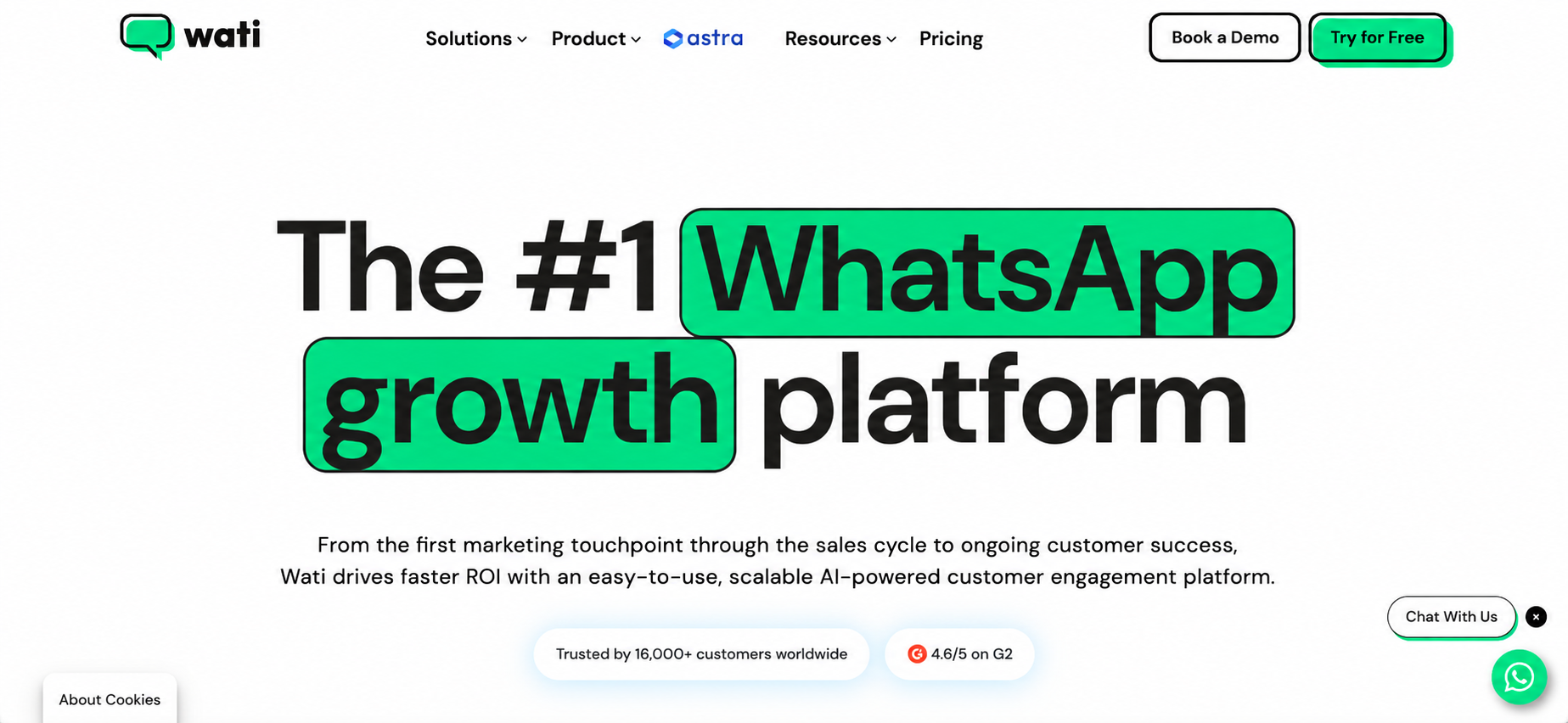
It links with a CRM or ERP to run WhatsApp broadcast campaigns, generate product catalogs, assist with voice integration, offer conversational templates, and integrate AI agents to improve campaign conversions.
Wati also enables businesses to efficiently manage WhatsApp chat interactions for both sales and support, making it easier to engage customers and resolve inquiries in real time. With Wati, you can handle multiple customer inquiries with dynamic agent assignment and templates to provide excellent customer service.
Key Features:
- Superior Automation: The Flow Builder is robust for handling complex, branching conversations, a key feature for scaling support.
- Agent Efficiency: The Unified Inbox is essential for teams managing conversations across multiple channels efficiently.
- E-commerce Ready: Supports features like WhatsApp Catalog integration and cart abandonment reminders, and native Shopify checkout flows (Shopflo/GoKwik).
- Astra AI Agent: Create and deploy AI agents to web, WhatsApp, and voice, including cloned-voice agents in 30+ languages.
- Omnichannel inbox: WhatsApp, Instagram (DMs and comments), Facebook Messenger, and TikTok business messaging now appear in the same Wati inbox, so teams aren't juggling separate tools per channel.
- WhatsApp Business Calling: place and receive voice calls with customers, including from the Wati mobile app, not just desktop, so a conversation can move from chat to voice without leaving the same inbox.
- Multiple WhatsApp numbers and Coexistence: run several WhatsApp numbers with round-robin assignment, or sync an existing WhatsApp Business App with Wati instead of migrating away from it.
- Ease of Use: It provides a highly intuitive interface and a simple deployment process, lowering the technical barrier for SMBs.
- Feature Depth: It provides advanced broadcast campaign insight and click tracking to improve ROI measurement.
Sign up for a free trial of Wati to learn more and experience the product in your sales strategy.
2. SleekFlow
SleekFlow is a WhatsApp marketing platform that targets mid-market and enterprise brands that want to build advanced, cross-channel consumer journeys.
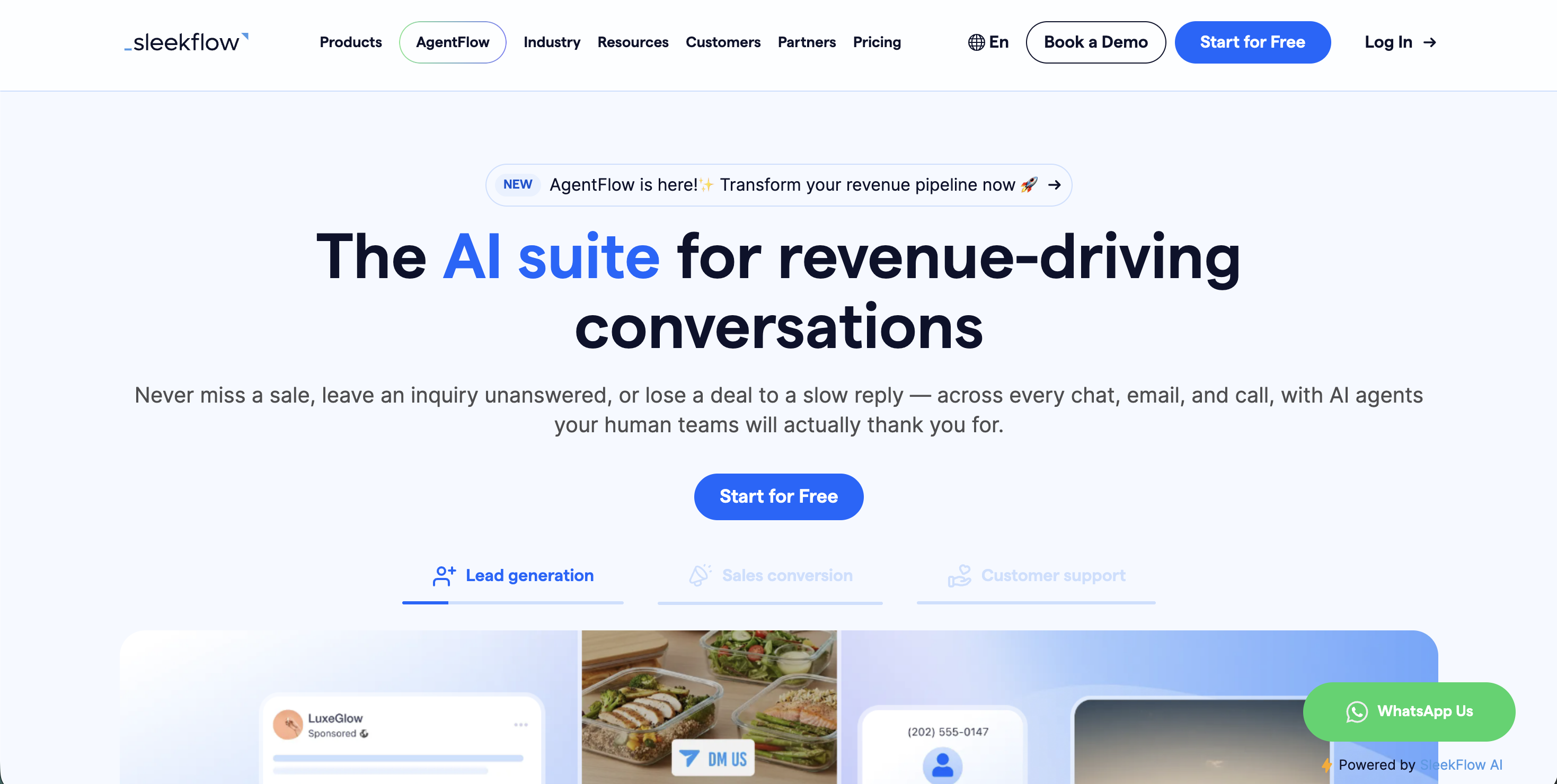
It unifies channels like WhatsApp, Instagram, and Facebook Messenger into one shared inbox for sales and support teams. SleekFlow also enables businesses to send personalized messages to customers, enhancing engagement and supporting targeted campaigns.
Key Features:
- Omnichannel Flow Builder: Drag-and-drop tool to create complex, cross-channel customer journeys and automation sequences. You can easily set up automated appointment reminders for customers, streamlining engagement and reducing no-shows.
- Agentic AI Core: Uses AI to enrich leads, automate qualification, and intelligently escalate conversations with full context to human agents.
- Conversational Commerce: Integrated tools to share product catalogs, generate payment links, and facilitate in-chat purchases directly via WhatsApp.
- Unified Inbox & Social CRM: Centralizes messages from 10+ channels and builds rich, segmentable customer profiles with flexible Custom Objects.
3. Gallabox
Gallabox is a comprehensive WhatsApp engagement platform that offers user experience and third-party CRM integration capabilities for sales and marketing teams.
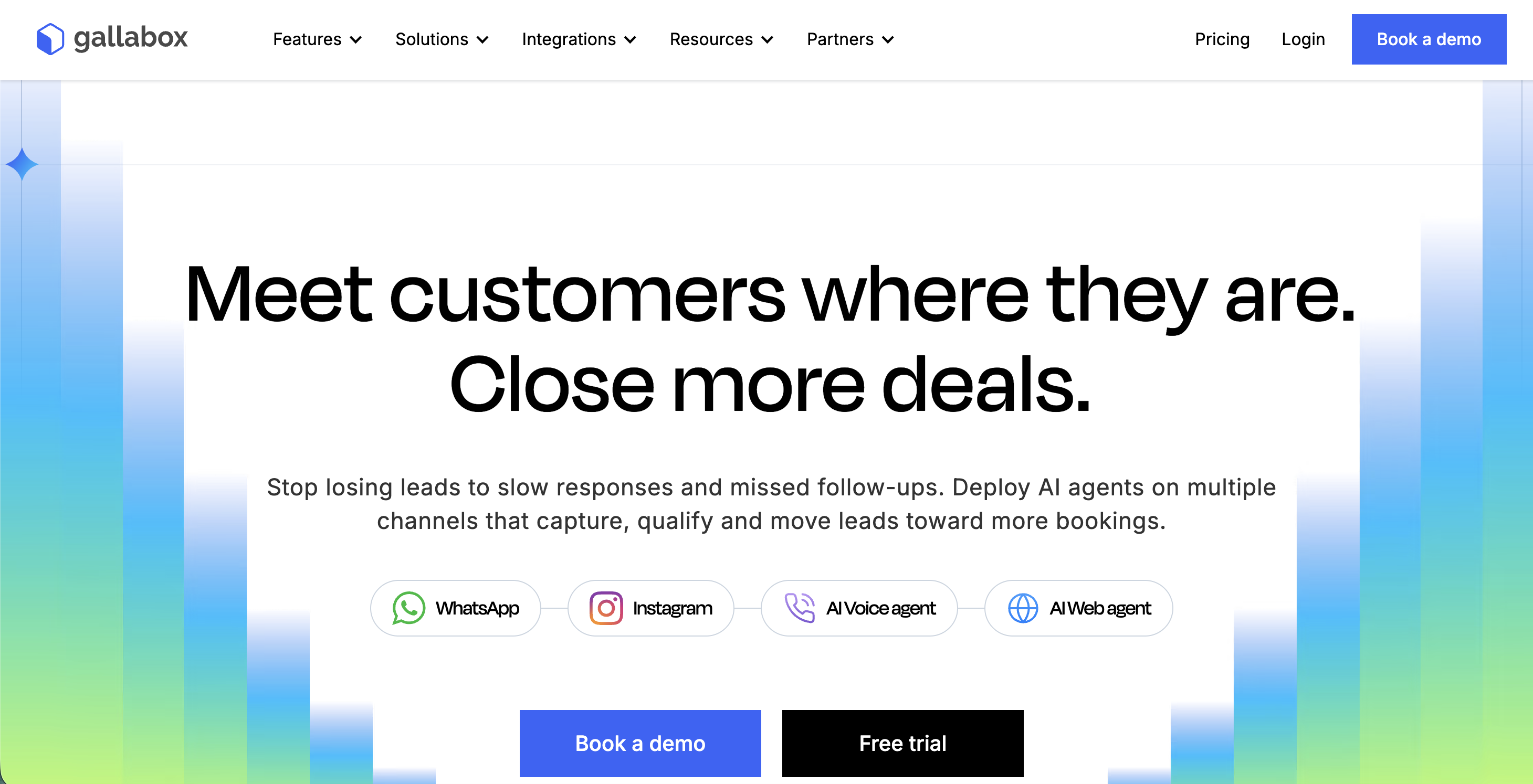
With Gallabox, you can integrate the WhatsApp API into your tech stack to automate conversations, qualify leads, and drive your sales revenue.
It also features a centralized Shared Team Inbox with sophisticated routing logic to ensure hot leads are instantly assigned to the right agent, maximizing conversion velocity and team productivity.
Key Features:
- Drag-and-Drop Chatbot: Intuitive no-code visual builder for rapid deployment of conversational flows for lead capture and qualification.
- CRM Integration & Lead Management: Strong connectivity with popular CRM systems (like Zoho) for data sync and pipeline management.
- Shared Inbox with Smart Routing: A Centralized inbox allows multiple agents to manage customer queries efficiently with intelligent lead assignment and load balancing.
- Drip Campaigns & Conversion Focus: Enables automated, multi-touch drip campaigns and broadcast messaging to nurture leads and re-engage high-intent customers.
- WhatsApp Flows: A highly visual and no-code builder to create automated lead qualification and nurturing sequences on WhatsApp.
Also Read: Discover which platform better suits your scale goals by reviewing the Top Gallabox Alternatives.
4. Twilio
Twilio is an enterprise-focused marketing automation solution that offers developer support, customer journey automation, and deep enterprise customization.
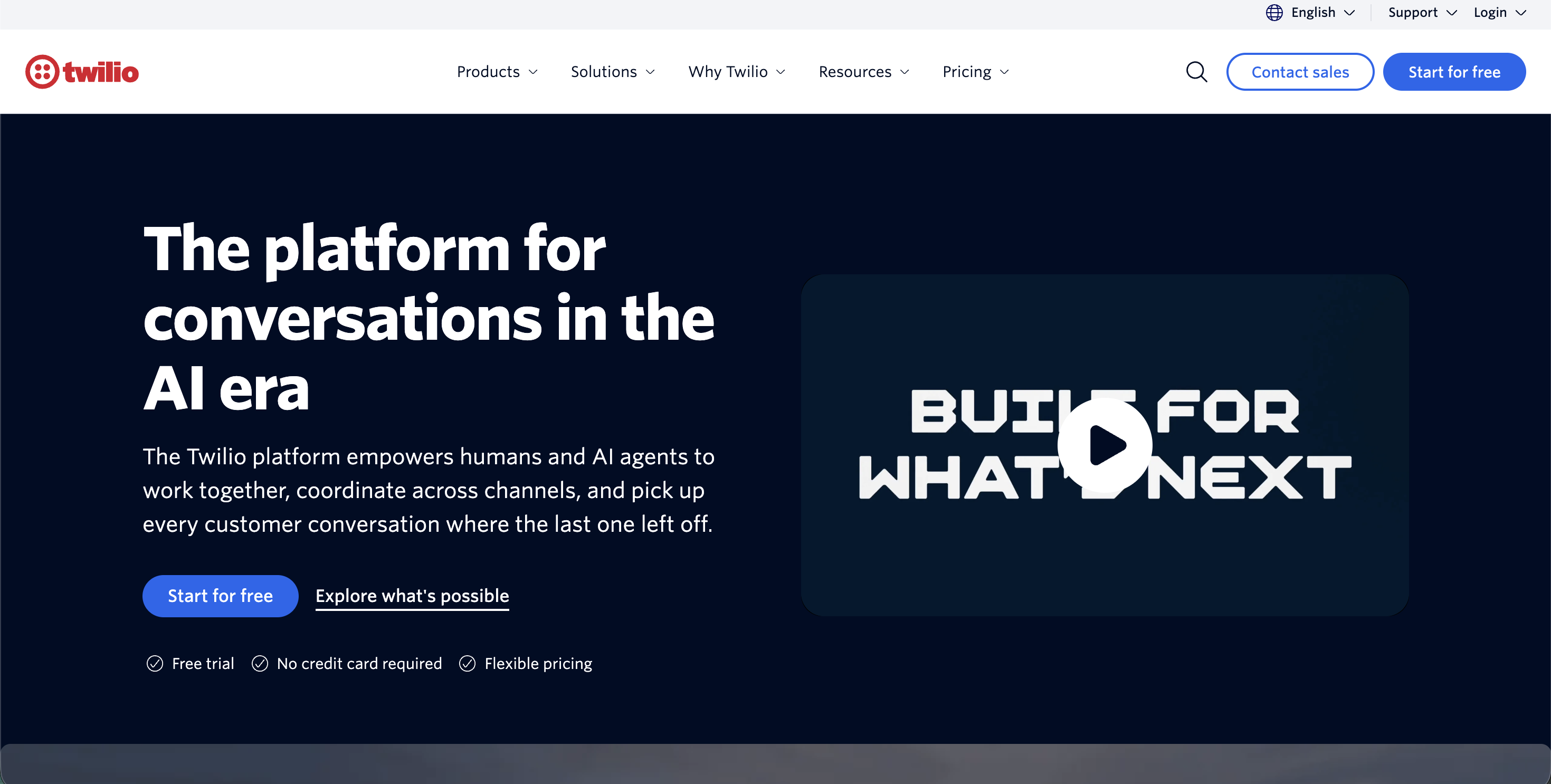
It provides core APIs that allow teams to build and integrate WhatsApp into existing tech stacks alongside other channels.
Key Features:
- API-First Programmability: Provides robust APIs for integrating WhatsApp, SMS, Voice, and Email into custom applications.
- Global Reach & Scalability: Built on a massive cloud infrastructure, ensuring high deliverability and reliable scalability for global traffic.
- Drag-and-Drop Studio: Non-developers can use the Studio tool to build communication workflows and simple chatbot flows without writing code.
- Unified Messaging Platform: Allows businesses to use a single API for messaging across multiple channels, ensuring a consistent customer experience.
5. SendPulse
SendPulse is a multichannel platform that integrates WhatsApp automation with traditional channels like email, SMS, and Viber. It allows marketers to manage outreach from a single dashboard.
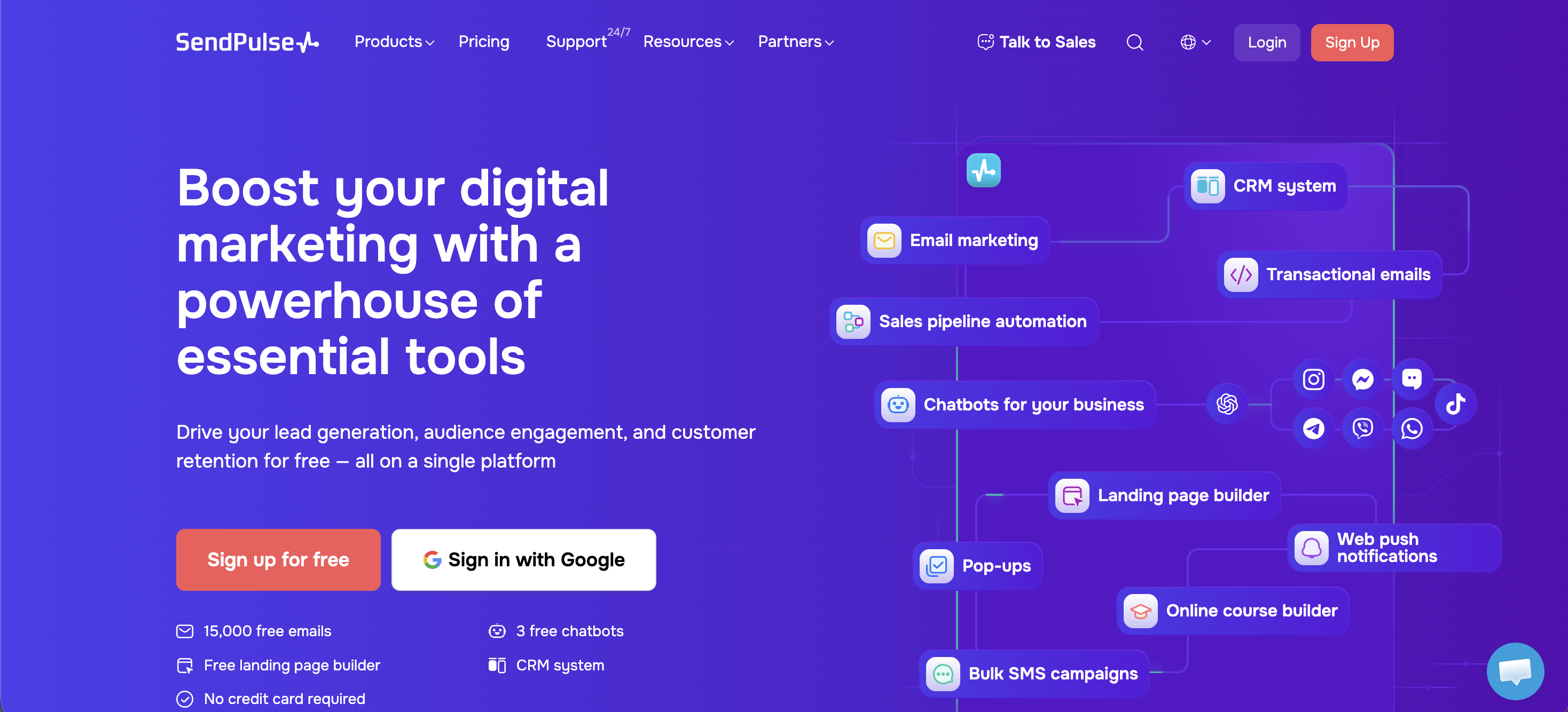
With SendPulse, you can run omnichannel lead nurturing sequences and track actionable metrics to refine your communication and build better CX, all from a single platform.
Key Features:
- Omnichannel Chatbot Builder: Drag-and-drop tool for creating automated flows and chatbots across WhatsApp, Facebook Messenger, and Telegram.
- Marketing Campaigns & Segmentation: Supports personalized bulk campaigns with rich media and interactive buttons, segmented by activity or custom variables.
- Free 24-Hour Window: Allows businesses to respond to user-initiated chats for free within the standard 24-hour customer service window.
- Email & SMS Integration: Provides a consolidated platform for email marketing, SMS campaigns, and WhatsApp from a single account.
Also read: Top WhatsApp Marketing Software To fuel powerful shopping experiences for businesses.
6. Infobip
InfoBip is a global, enterprise-grade communication platform as a service (CPaaS) provider known for its global operational flexibility and deliverability.
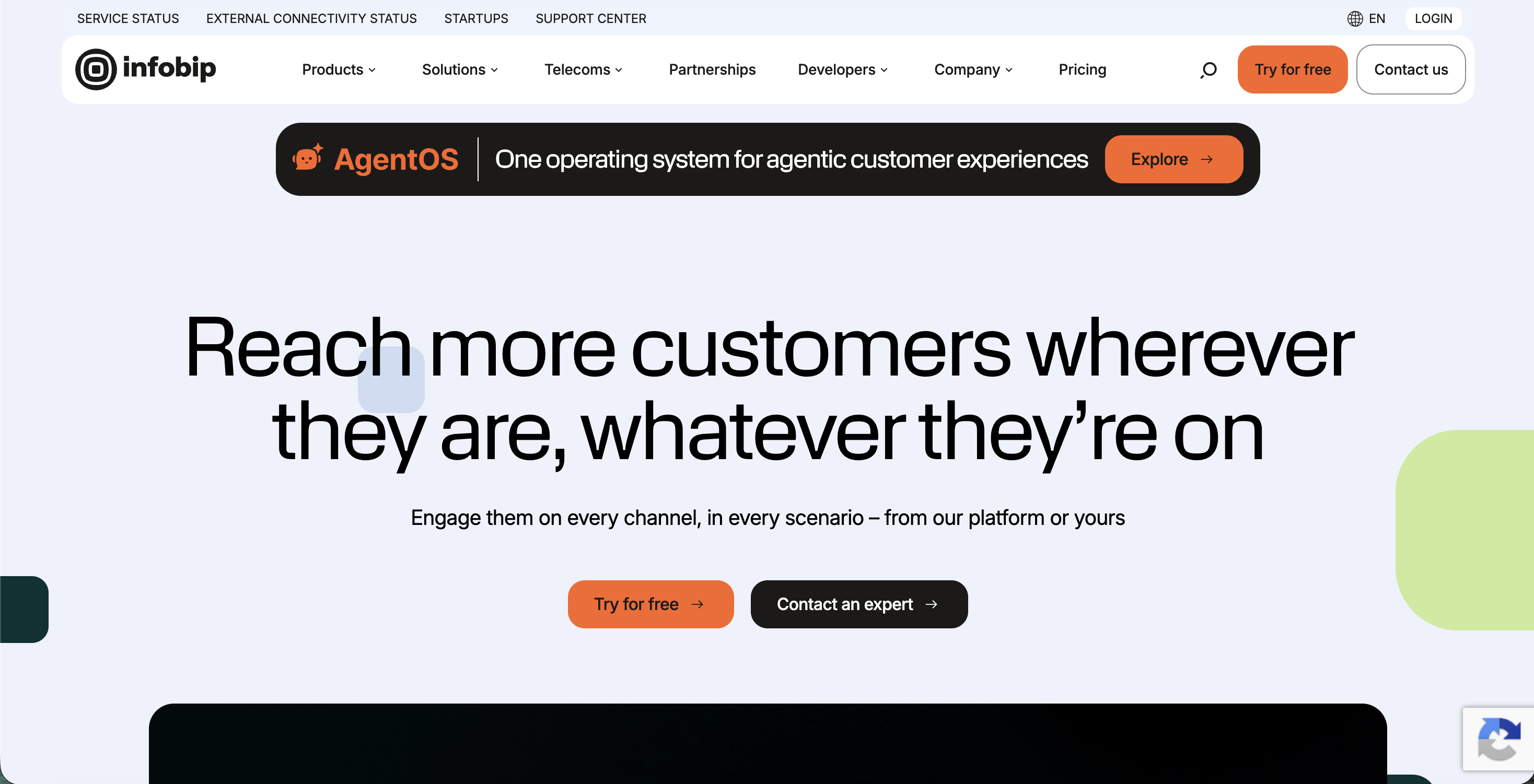
With InfoBip, you can consolidate your WhatsApp automation workflows across all communication channels, track performance, maintain custom repositories, and gain insights into any campaign to stabilize overall sales productivity.
Key Features:
- Omnichannel Orchestration: Automate customer journeys with event triggers and ensure message continuity with failover to SMS, RCS, or other channels.
- Enterprise-Grade Security: Focuses on best-in-class security and compliance, suitable for industries like Finance and Healthcare (e.g., for secure OTPs).
- Rich Media and Flows: Supports advanced features like in-chat payments, WhatsApp Flows (app-like forms), and dynamic product catalogs.
- Unified Customer Data: Consolidates customer profiles, consent, and behavioral signals into a single data platform for precise segmentation.
7. Interakt
Interakt is a cost-effective WhatsApp Business API Platform explicitly designed for D2C and E-commerce brands. It is a product of Jio Haptik that focuses on affordability and conversion-centric workflows.
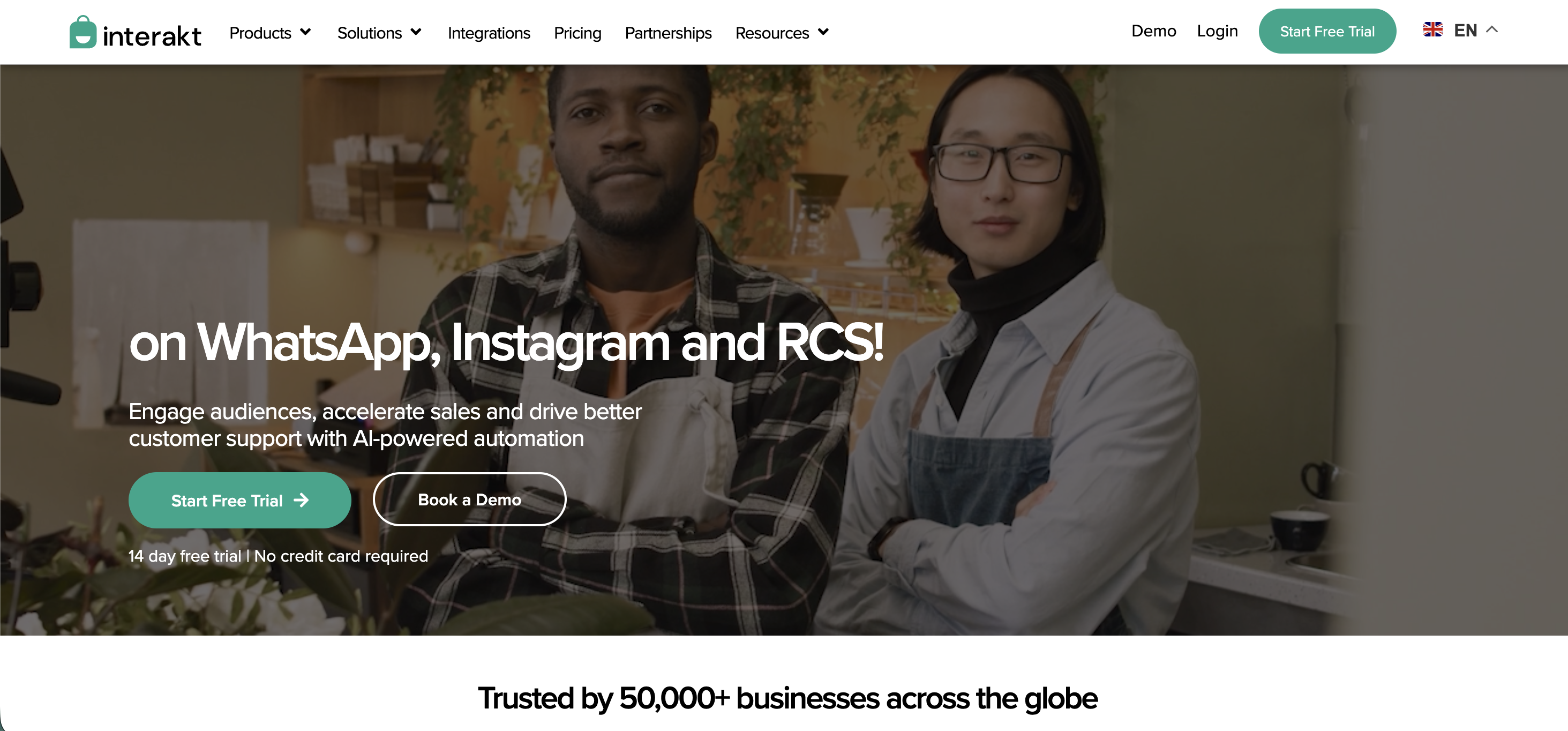
With Interakt, you can improve your customer acquisition via WhatsApp with broadcasts, thereby reducing upfront paid marketing costs and improving performance monitoring.
Key Features:
- E-commerce Automation: Ready-to-use flows for abandoned cart recovery, order confirmation, and shipping updates.
- Shared Team Inbox: Multi-agent inbox with auto-assignment and the ability to manage chats from WhatsApp and Instagram DMs/comments.
- No-Code Chatbot: Simple builder for setting up automated welcome messages, away replies, and basic lead qualification flows.
- Sales Pipeline & Catalog: Features a dedicated sales pipeline view and native integration to showcase WhatsApp Catalogs for quick ordering.
7 Key WhatsApp API Service Providers at a Glance: Overall Recap
Below is a recap of all 7 WhatsApp API service providers discussed so far, to help you find the best strategic partner for your sales and marketing goals.
WhatsApp API Provider | Best For | Strengths |
Wati | SMBs to Mid-size Teams, D2C | No-code chatbots and AI agent builder, Omnichannel inbox, Broadcast and drip campaigns, E-commerce and catalog tools, WhatsApp Business Calling, Deep integrations |
SleekFlow | Enterprise Omnichannel CX, Retail | Agentic AI lead qualification, Cross-channel automation, Social CRM integration. |
Gallabox | Sales-Led Teams & Agencies, CRM Focus | Intuitive no-code chatbot, Strong CRM integration, Centralized lead management. |
Twilio | Developers and Global Scale | API-first programmability, Massive global reach, highly customizable infrastructure. |
SendPulse | Multichannel Marketers | Unified platform for Email, SMS, and WhatsApp automation, Omnichannel chatbot builder. |
Infobip | True Omnichannel CPaaS, Global Enterprise | Global network reliability, Omnichannel orchestration (failover), Enterprise security & compliance. |
Interakt | E-commerce Conversion, Affordability | Simple setup, Dedicated abandoned cart recovery, Native e-commerce integrations. |
Double Growth with the Right WhatsApp API Provider!
While choosing a suitable WhatsApp API service provider, make a list of the features and capabilities that are a priority to you.
If you are an SMB that is looking for sales and revenue growth, WhatsApp Business Platforms like Wati are the right pick. However, do not jump into any decision before evaluating current sales capacity, revenue, and budget potential, product robustness, and overall tech infrastructure.
To know how Wati can help you supercharge your sales strategy and build high customer engagement workflows, see it live in action. We hope this list helped you!
Book a free demo to see Wati live in action.
Frequently asked questions
Why do I need a WhatsApp Business API provider instead of the standard WhatsApp Business App?
The API is required for scaling: it provides a shared inbox for unlimited agents, advanced no-code automation, CRM integration, and high-volume broadcasting, which the basic App cannot handle.
What are the three non-negotiable features a good WhatsApp API provider must offer?
Look for Official Meta Partnership for security, a Multi-Agent Shared Inbox for team efficiency, and No-Code Automation (chatbots/flows) for easy, rapid deployment of customer journeys.
How does the WhatsApp API help drive sales and ROI for e-commerce brands?
It facilitates Conversational Commerce by powering high-converting flows like abandoned cart recovery, instant checkout links, and product recommendations, achieving much higher ROI than email.
What are the hidden costs I should look out for in a WhatsApp API pricing plan?
Beyond the monthly fee, scrutinize charges for additional agent seats, template approvals, and clearly separate the BSP fee from the fluctuating Meta per-conversation charges.
Related posts
- WhatsApp API for Enterprise: Designing Intelligent End-to-End Workflows for 2026
Build scalable workflows using the WhatsApp API for enterprise. Connect CRM, ERP, ticketing, and RPA tools to automate enterprise sales operations.
- WhatsApp API For SaaS: Scaling Intelligent Conversations in 2026
learn how whatsapp can help saas companies engage better with consumers, improve product analytics and better their functioning for improved contract renewals
- WhatsApp API Errors: What They Mean and How to Navigate Them
A complete list of common WhatsApp API errors and step-by-step solutions so teams can diagnose issues quickly and keep conversations flowing.
- WhatsApp For Gyms And Fitness Center: Boost Your Subscription and Renewals
Fitness centers run on constant communication, and WhatsApp is the one channel members never ignore. But as your gym grows, the basic WhatsApp app cannot handle bookings, reminders, renewals, and daily inquiries. This blog breaks down how fitness centers use the WhatsApp Business API and Wati to automate class scheduling, support, payments, and marketing while keeping every interaction fast, personal, and organised.