
Too Long? Read This First
- CTWA starts a WhatsApp conversation, while Lead Form Ads collect contact details through an in-app form.
- CTWA can drive better ROAS by providing verified contacts, real-time lead qualification, faster follow-ups, and clearer attribution.
- Lead Form Ads are better suited for businesses that prioritise lead volume, low CPL, or simple purchases.
- Businesses that switched to CTWA saw strong results, with Habuild reducing cost per lead by 80% and Bowaba's clients achieving up to 11x ROAS.
- The right option depends on your sales process, with CTWA working best for high-intent leads and Lead Forms making more sense when volume is the priority.
What happens when the biggest ad platform changes hands? In 2026, Meta is forecast to earn $243.46 billion in ad revenue worldwide, just ahead of Google's $239.54 billion.
Ad budgets keep growing, but the destination of the click decides how much of that spend turns into revenue. A click can land on a form or open a chat, and the two paths perform differently.
This blog compares Click-to-WhatsApp Ads with Lead Form ads on the metrics that determine ROAS.
What are Click-to-WhatsApp Ads?
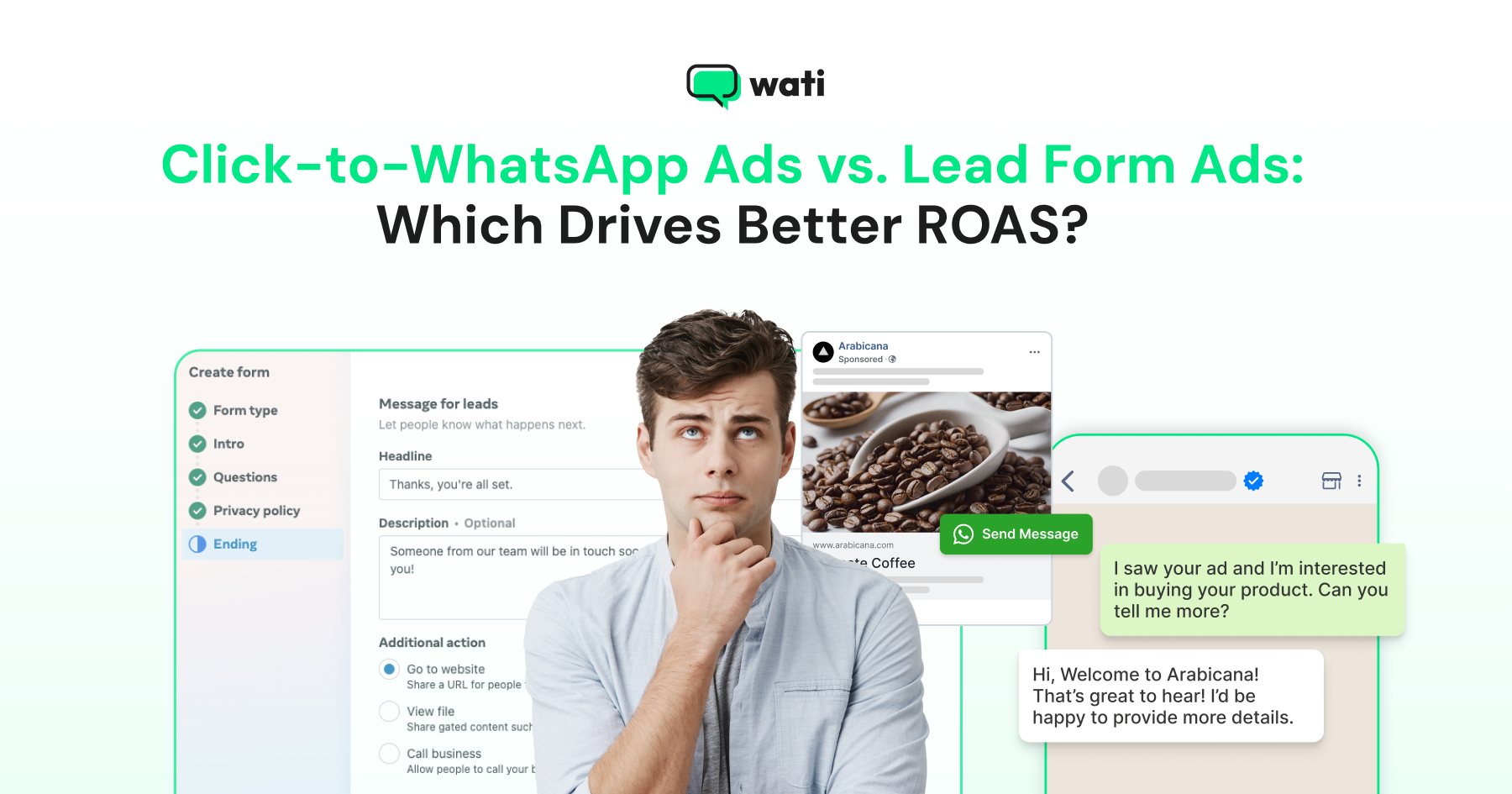
Click-to-WhatsApp ads (CTWA) are Meta ads that open a WhatsApp chat instead of a landing page. They run across Instagram, Facebook, and Meta's Audience Network.
The only difference from a lead form ad is the destination, since it opens a WhatsApp chat, and the conversation starts right away.
The advertiser sets a pre-filled message when building the ad. When a person taps the ad, WhatsApp opens with that message already typed into the chat box, so the person only has to tap send to start the conversation.
Every conversation carries the ad ID it came from. A business can trace a sale back to the exact ad, audience, and creative that produced it. A landing page form cannot do this on its own.
What are Lead Form Ads?
Lead form ads, also called Meta Instant Forms, open a form inside the ad instead of sending the person to an outside page. They run across Facebook, Instagram, and Meta's Audience Network, and the person fills in a few fields and submits without ever leaving the app.
Meta pulls fields such as name, email, and phone number from the person's Meta profile, so most fields need no typing at all.
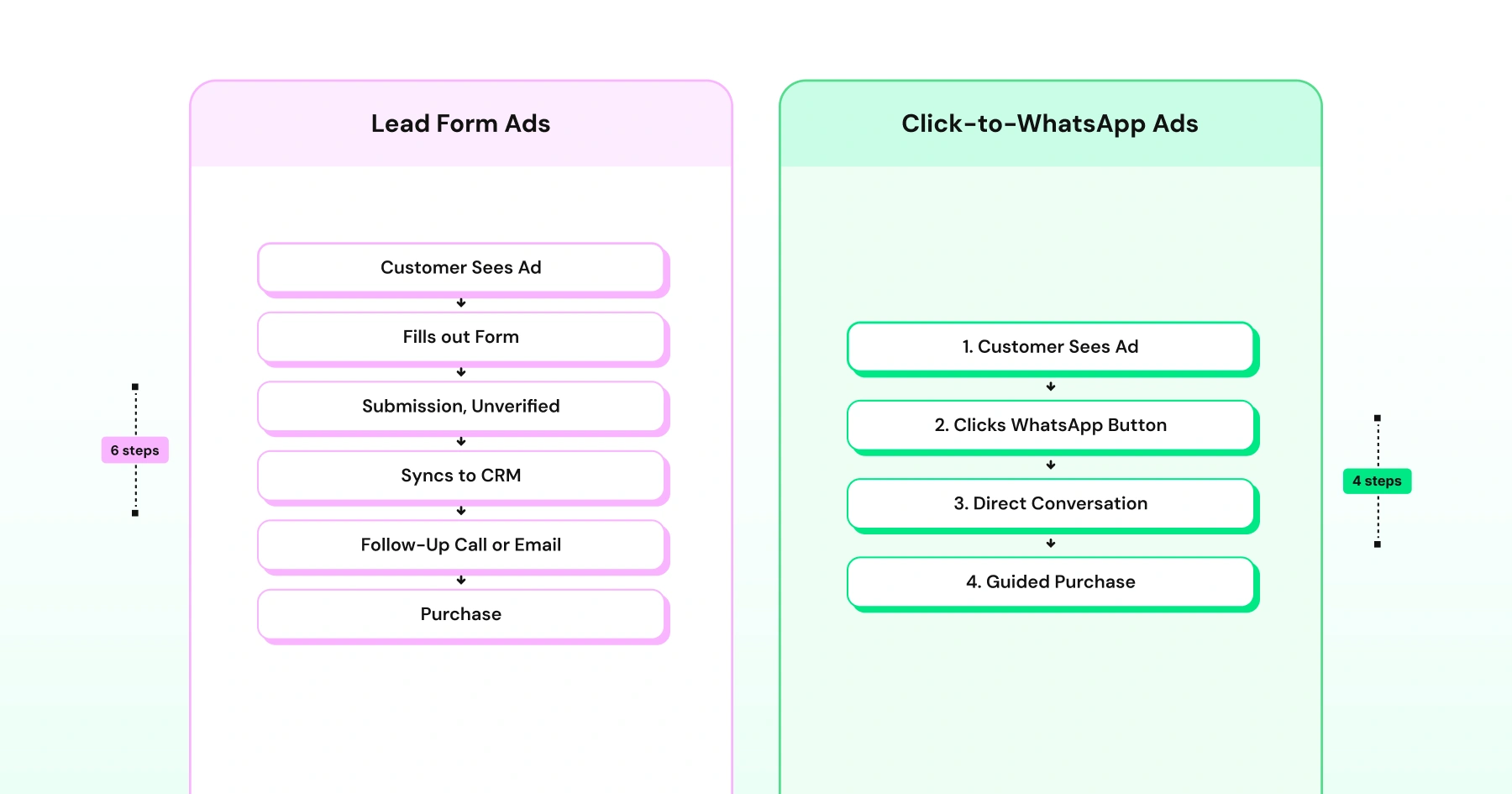
The submission goes straight into Meta's Ads Manager, then usually syncs to a CRM through an integration or a manual export.
The whole journey stays inside the Meta app, so pages load fast, and nothing redirects the person elsewhere. The tradeoff is that Meta never checks if the phone number or email works. The business only finds out when it tries to make contact.
CTWA vs. Lead Form Ads: Side-by-Side ROAS Comparison
A campaign can cost less and still deliver poor ROAS. Or it can look expensive and still win on revenue. The difference comes down to a few metrics working together: cost per lead, conversion rate, lead quality, and attribution accuracy.
Here is how CTWA and lead form ads compare on each.
Cost per Lead
Cost per lead is how much a business spends for every lead it gets. It depends on how easy the ad makes it to take the next step.
Click-to-WhatsApp Ads (CTWA): When set up for conversations, Meta's system finds people who are likely to start a WhatsApp chat. The cost depends on auction competition, audience demand, and how willing people are to message your business.
Lead Form Ads: Meta finds people who are likely to fill out a lead form. Auto-filled fields make this fast and easy. But by default,
Meta does not verify the phone number or email address someone submits. Businesses can turn on SMS verification to fix this, but it's not switched on automatically. Without it, some leads turn out to be incomplete or hard to reach.
Lead to Conversion Rate
This is how many leads actually turn into paying customers. It depends on how well a lead is qualified before the sales team gets involved.
Click-to-WhatsApp Ads (CTWA): A conversation gives a business the chance to ask questions, clear up doubts, and qualify the lead before the lead buys. This often leads to higher-intent leads and better conversion rates.
Lead Form Ads: A lead form collects contact details in one step. There's no conversation before or during submission. Some leads are ready to buy right away. Others don't respond to follow-up calls or messages. This makes it harder to know who's actually serious.
Lead Quality and Verified Contact Data
This is about whether the contact details a business collects are actually correct and reachable. Bad data means wasted follow-up time.
Click-to-WhatsApp Ads (CTWA): When someone starts a WhatsApp chat from your ad, you know their WhatsApp number is real and active. There's no guesswork. You can also ask questions in real time to check if the lead is a good fit.
Lead Form Ads: Lead forms often pull contact details straight from a person's Meta profile. This is fast, but the details can be outdated or wrong. Meta now offers an SMS verification option to fix this. It's a helpful add-on, but businesses need to turn it on. Without it, teams usually end up double-checking contact details during follow-up.
Attribution Accuracy on iOS and ATT
This is about how well a business can track results back to the ad that caused them. iOS privacy settings have made this harder across the board.
It helps to separate two distinct moments here: the start of the conversation and what happens afterward.
Click-to-WhatsApp Ads (CTWA): The first part is simple. When someone taps your ad and opens a WhatsApp chat, Meta tracks that connection directly. This happens inside Meta's own apps, so it isn't affected much by iOS privacy settings.
The second part is where it gets trickier. If you want to track what happens after the chat, like a sale or a booking, you need to send that data back to Meta. This is done through the Conversions API for Business Messaging.
It's a server-to-server connection, so it keeps working even when browser tracking or iOS privacy settings block other signals. This is what lets a business tie a real sale back to the ad that started it.
Lead Form Ads: Meta tracks the form submission accurately, too, since the ad and the form both live inside Meta's apps. The harder part is what comes next. To track a sale or a qualified deal after the form is submitted, businesses usually need to connect their CRM or set up offline conversion reporting.
Click-to-WhatsApp Ads vs. Lead Form Ads: Quick Comparison
Both ad types run on the same Meta platforms and cost real budget, but they take the lead down very different paths after the click. Here's how they stack up side by side.
Click-to-WhatsApp Ads | Lead Form Ads | |
Where the click leads | Opens a WhatsApp chat | Opens a form inside the ad |
First step for the user | Tap send on a pre-filled message | Fill and submit a short form |
Contact info | Confirmed the moment the chat starts | Pulled from Meta profile, not checked by default |
Conversation before purchase | Yes, right away | No, only after follow-up |
Cost per click | Higher | Lower |
Cost per qualified lead | Lower once wasted leads are removed | Higher once wasted leads are removed |
Attribution | Tracked by ad ID through the whole conversation | Tracked at submission, needs a CRM after that |
Free follow-up window | 72 hours once a business replies to a CTWA-started chat | Not applicable |
Best fit | Considered or high-value purchases | High-volume, low-cost offers |
The numbers only tell half the story. The sections below show what these differences actually looked like for two businesses that made the switch.
Why CTWA Wins on ROAS
CTWA wins on ROAS because it cuts three costs that quietly eat into lead-form campaigns: lost visitors, wasted calls to dead numbers, and paid messages that didn't need to be paid for.
Below are a few ways this plays out.
No Landing Page to Lose People On
A lead form ad depends on a page that loads fast and a form that is short enough to finish. CTWA skips both risks, since WhatsApp opens straight into the conversation.
A Phone Number That Already Works
Every CTWA lead arrives with a number proven to work, since the chat could not have started otherwise. This reduces wasted spend on calling numbers that bounce.
A 72 Hour Window to Follow Up for Free
Meta waives WhatsApp conversation fees for 72 hours once a business replies to a CTWA-started chat. A business can use that window to qualify and close the lead before standard message pricing applies.
Real Results From Businesses That Switched to CTWA and What Changed
Numbers on a comparison table are one thing. Here's what CTWA actually did for two businesses that moved away from lead forms.
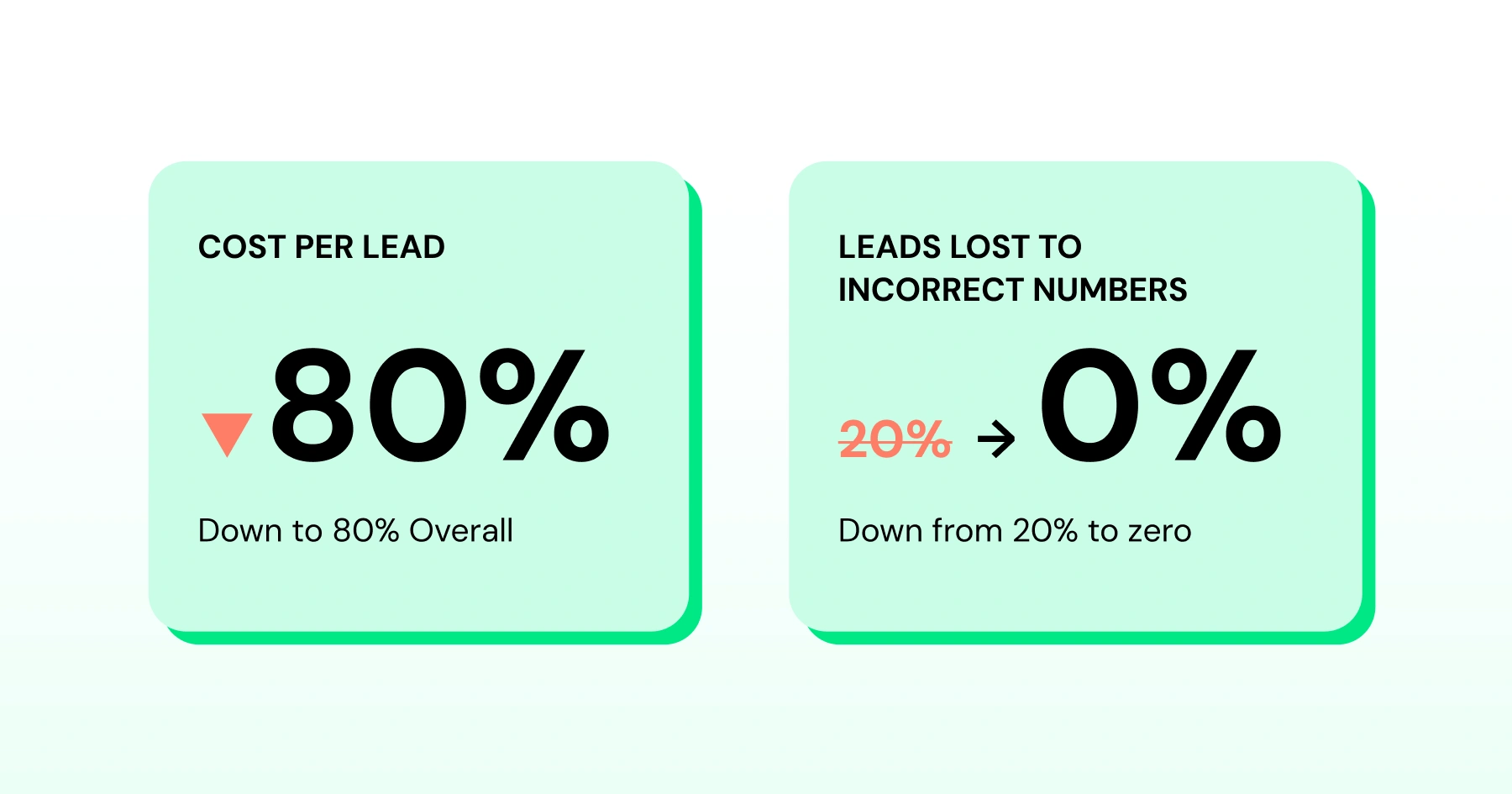
Habuild Cut Cost per Lead by 80% and Stopped Losing Leads to Bad Numbers
Habuild, an online yoga and habit-building platform, was losing leads before it even got a chance to follow up.
Lead forms collected phone numbers directly, but 20% of them turned out to be wrong, so those leads were dead on arrival.
Habuild switched to CTWA, so leads could only come in through a real WhatsApp conversation. Since a chat can't start without a working number, the bad-number problem disappeared.
Cost per lead also dropped sharply, since spend was no longer going toward leads that could never be reached.
Bowaba's Clients Saw Up to 11x ROAS After Moving Off Lead Forms
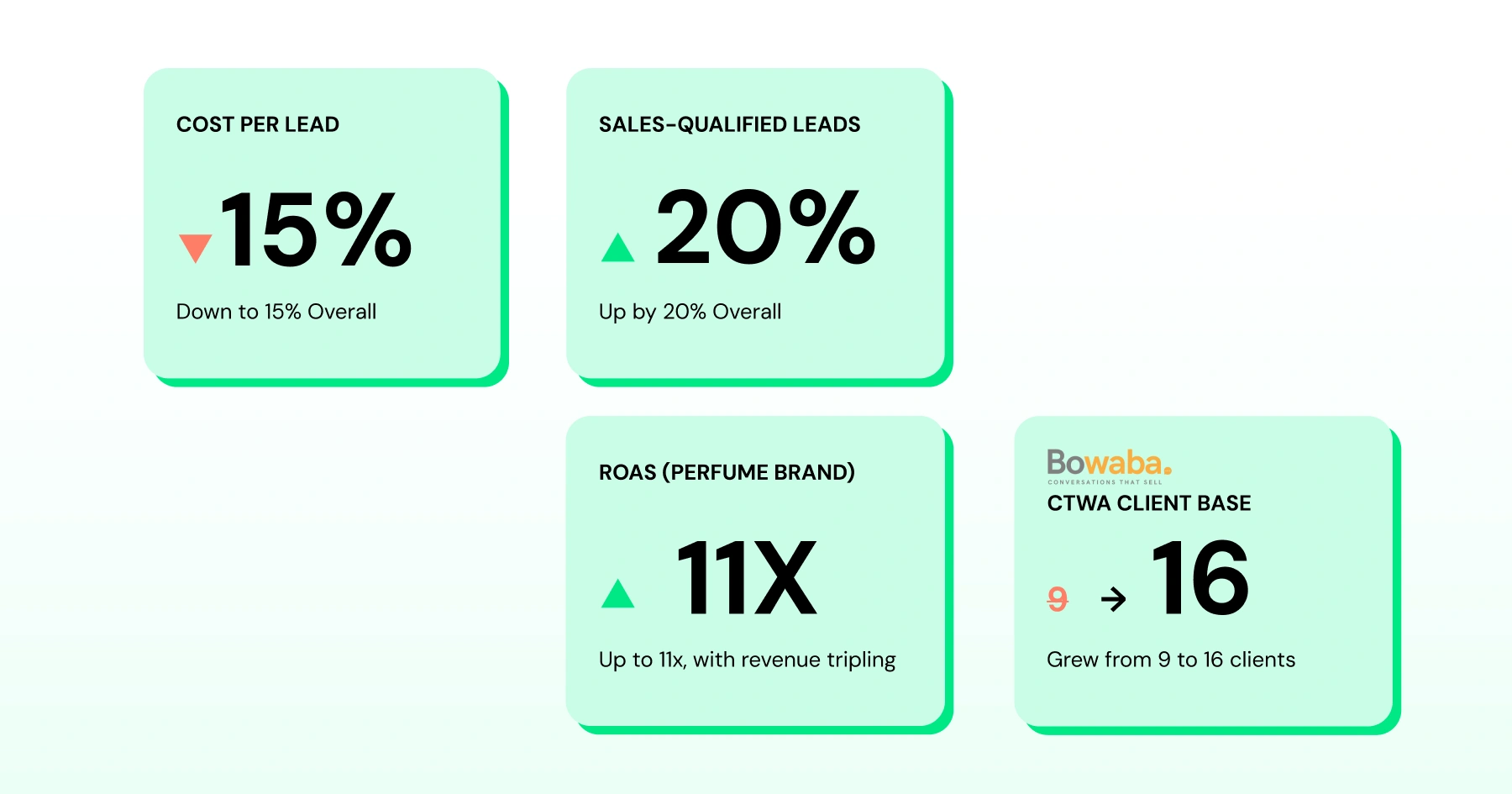
Bowaba is a digital marketing agency running campaigns for brands across the GCC. Their clients' lead form funnels had four recurring problems: people dropped off before finishing the form, most leads that did come in were not decision-makers, there was no real-time interaction to build trust before a purchase, and it was hard to trace which ad actually drove a sale.
Bowaba moved its clients from lead forms to CTWA, so prospects could talk directly with a brand on WhatsApp instead of filling out a form.
This gave clients real-time conversations at the moment of intent, built-in qualification during the chat itself, and full attribution from ad to outcome. The results were strong enough that more of Bowaba's clients adopted CTWA over time.
When Lead Form Ads Still Make Sense
CTWA doesn't win every time. Lead ads still fit three situations. Below are the cases where a lead form is the better call.
Top of Funnel Reach
Early CTWA campaigns often focus on building a pipeline of potential customers before closing deals. A business launching a new product or entering a new market needs to reach first, so it has a list to follow up with later.
A lead form costs less per click and collects contact details fast, without asking for the kind of commitment a WhatsApp chat implies. This makes it the better fit when the goal is to reach, not revenue, in the first few weeks of a campaign.
Simple, Low-Cost Purchases
Some products sell on a single click, with no need to build trust first. A low-cost accessory, a subscription trial, or a one-time digital download rarely needs a conversation to close.
The buyer has already decided by the time they click the ad. Sending that person into a WhatsApp chat adds a step they didn't ask for, so a short lead form converts better here.
Volume Over Quality
Some sales teams are built to process a high volume of leads quickly rather than qualify every prospect before making contact. They expect many leads to be unresponsive and optimize their workflow around reaching as many people as possible.
In this instance, CTWA's strengths are less valuable. While Click-to-WhatsApp Ads often generate higher-intent leads through conversations, they typically produce fewer leads than lead forms for the same budget.
Lead Form Ads are a better fit for teams that prioritize volume. They can deliver a larger pool of contacts, which lets sales reps work through more leads, even if many never convert. Businesses with efficient outbound sales processes may prefer this tradeoff when maximizing reach is more important than lead quality.
How to Set Up CTWA for Maximum ROAS
Launching a Click-to-WhatsApp campaign is only the first step. To maximize ROAS, the campaign, conversation flow, and conversion tracking all need to work together.
Before You Start
Your WhatsApp Business number and Facebook Page must be linked under the same Meta Business Manager account.
Check this under Facebook Page → Settings → WhatsApp. If they don't match, your ad won't publish, or it won't sync correctly with Wati.
For the full account setup and campaign walkthrough, step by step, see How to Create Click-to-WhatsApp Ads
Once your campaign is live and connected to Wati, the step that actually determines your ROAS is conversion tracking.
Set Up Conversion Tracking in Wati
Your ROAS numbers depend on this step.
Go to Track Purchases and select the template message you send when an order is confirmed, like "Your order is confirmed." Go to Track Leads and select the template that confirms a qualified action, like a booked appointment.
Wati checks whether each conversation started from a CTWA ad. If it did, it sends the conversion back to Meta through the Conversions API (CAPI), a server-to-server connection that works even when browser tracking is blocked. Track purchase value here too. That's how Wati calculates your ROAS.
Tips to Maximize ROAS
- Target high-intent audiences: Use custom audiences, lookalikes, or retargeting to reach people most likely to start a conversation.
- Respond instantly: Set up a welcome message or chatbot in Wati so every lead gets an immediate response. Faster response times reduce drop-offs.
- Qualify leads early: Ask one or two questions at the start of the conversation to spot high-intent prospects and route them to the right team.
- Track meaningful conversions: Use Wati's Track Purchases and Track Leads to send qualified events back to Meta via CAPI. This helps the algorithm optimize for outcomes, not just conversations.
- Test creatives and messaging: Experiment with ad creatives, copy, and welcome messages to find what generates the highest-quality conversations.
- Review performance regularly: Monitor cost per qualified lead, conversion rate, and ROAS in Wati's ads analytics. Refine targeting and creatives based on results.
Common Setup Mistakes
- Avoid selecting the wrong campaign objective or conversion location. CTWA needs Engagement plus Messaging Apps → WhatsApp, not Traffic or Leads without the WhatsApp destination.
- Don't let your WhatsApp number mismatch between your Facebook Page and Wati account. This breaks ad delivery or tracking.
- Don't let the free 72-hour window close before following up. This shifts messages to paid pricing.
- Skip vague calls to action like "Contact us." Use a specific one like "Get a quote."
- Resist counting chats started as the win. Track chats that convert instead.
CTWA or Lead Form Ads: Which Should You Choose?
The comparison so far comes down to one thing: what happens after the click. CTWA opens a conversation. Lead forms collect details and end there.
The right pick depends on your product, its price, and how fast your team can respond.
Choose CTWA If...
- You want to boost conversion rates by qualifying leads through conversation instead of a static form.
- You want to increase reply rates and cut response time to under a few minutes, since WhatsApp works best with fast replies.
- You want to reduce the cost per qualified lead by filtering out low-intent clicks early in the chat.
- You want to grow repeat purchases, since the WhatsApp thread stays open for retargeting long after the ad stops running.
- Your product needs some explanation before someone is ready to buy or book.
- You have a team or a chatbot ready to handle the conversation as soon as it starts.
- You want to see real outcomes, like purchases or bookings, tied directly to your ad spend through conversion tracking.
- Your product or service is valuable enough to justify a higher cost per conversation.
Choose Lead Form Ads If...
- You are running large campaigns and plan to follow up over email or phone calls, not chat.
- Your team cannot regularly monitor and reply to WhatsApp messages.
- You need specific details upfront, such as budget, city, or company size, before any conversation starts.
- Your sales process takes days or weeks, and leads move through it slowly.
- You are trying to determine how much demand there is and want the lowest cost per lead, even if some leads are weak.
How Wati Helps You Run CTWA at Scale
Running CTWA well takes more than a good ad. Someone still has to catch the conversation, qualify it, and prove it led to revenue. Wati handles that layer.
Attribution from Ad to Conversation
Wati connects your Meta ad account to WhatsApp and ties every conversation back to the ad that started it. You don't have to match ad spend to chat outcomes by hand.
Astra AI Agent for Instant Qualification
Astra AI Agent picks up the conversation the moment someone taps your CTWA ad. It asks qualifying questions and can qualify leads over voice as well as chats. It’s well-suited to high-consideration categories where a quick call builds more trust than text.
Shared Team Inbox for Handoff
When a lead needs a human, Astra hands off the conversation to your shared Team Inbox with the full chat history and an AI-generated summary attached. Your team picks up exactly where the bot left off, instead of asking the lead to repeat themselves.
Chatbots for Rule-Based Qualification
For simpler flows, Wati's no-code chatbots ask one or two questions right in the first message and route the lead to the right team automatically. No AI needed for straightforward qualification paths.
CRM and Tool Integrations
Wati's native HubSpot integration automatically syncs qualified leads, conversation details, and AI summaries to your CRM. The Salesforce integration syncs qualified leads and conversation details as well. Zapier connects Wati with thousands of other business applications.
For e-commerce, Wati integrates with Shopify and WooCommerce to automate abandoned cart recovery, order updates, and checkout workflows, helping customers move from conversation to purchase with less friction.
One Dashboard for Cost and ROAS
Wati shows cost per conversation and downstream conversion in one view. You can compare CTWA and lead ad spend without stitching Ads Manager and CRM data together yourself.
Wrapping Up
CTWA and lead ads solve different problems. The ROAS gap comes from what happens after the click, not the cost of the click.
A lead form gets you a name and a number. CTWA gets you a verified contact and a conversation that closes deals.
Wati runs that conversation end-to-end. It connects your ad to WhatsApp, qualifies leads with Astra AI Agent, shared team inbox, or no-code chatbots, hands off to your team with full context, and tracks every purchase back to the ad that drove it.
Book a demo with Wati and start running CTWA campaigns that convert.
Frequently asked questions
Is CTWA more expensive than Lead Form ads?
Cost per click is higher for Click-to-WhatsApp ads. But cost per converting lead is usually lower, since fewer leads get wasted on wrong numbers or no-shows, which drives better ROAS overall.
Does CTWA work the same way on iOS and Android?
Yes. Attribution runs through a click ID and the Meta Conversions API (CAPI), a server-to-server connection, not a browser pixel. It works the same on both.
Can you run CTWA and Lead Form ads together?
Yes. Many accounts run Lead Form ads for broad reach and CTWA for direct conversion, then compare cost per lead and ROAS across both to decide where to shift budget.
Which types of purchases see the best ROAS from CTWA?
Considered purchases see the largest gains, anything where someone needs reassurance before buying or booking. A conversation solves that, which is why WhatsApp marketing works best for higher-consideration sales rather than one-click buys.
How does Wati track CTWA conversions?
Wati uses template messages, like an order confirmation or booked appointment, as conversion signals. It checks if the conversation started from a Click-to-WhatsApp ad, then sends the event back to Meta through CAPI so your ROAS reporting reflects real outcomes.
Related posts
- How to Send Bulk Messages on WhatsApp Without Getting Blocked
Learn how to send bulk WhatsApp messages without getting blocked. Compare the WhatsApp Business app and API, messaging limits, costs, templates, and best practices for safe, compliant bulk messaging.
- Complete Guide to Instagram Automation
Instagram comment automation auto-replies to comments and DMs commenters within seconds via Meta's API. Covers strategy, use cases, and Wati setup.
- How to Set Up a TikTok Business Account: Step-by-Step Guide
Set up a TikTok Business Account step by step: switch from personal, pick a category, add your profile, and unlock ads and analytics.
- TikTok for Business: How to Set Up, Market, Advertise & Grow (2026)
Learn how to use TikTok for Business to build your brand, create content, run ads, manage customer messages, and turn views into growth.