
Too Long? Read This First
- The e-commerce customer journey spans discovery, consideration, purchase, post-purchase, retention, and advocacy, and it rarely follows a straight line.
- Roughly 7 in 10 online carts are abandoned, so the purchase stage is where most stores lose revenue first.
- The post-purchase stage, from order confirmation to delivery and returns, determines whether a first order leads to a repeat customer.
- In WhatsApp-first markets such as India, the journey depends heavily on messaging, cash-on-delivery, and festive sale peaks.
- A simple journey map that links each stage to a touchpoint, a friction point, and a metric shows you exactly where to fix the journey first.
The e-commerce customer journey is the full path a shopper takes with an online store, from first discovering a product to buying it, receiving it, and coming back to buy again.
It covers every touchpoint along the way, including social media, product pages, checkout, order updates, support conversations, and repeat purchases.
Most guides treat the journey as a series of website clicks. In reality, a large part of it now happens in conversations: a question in an Instagram DM, a sizing check on WhatsApp, a delivery update, or a return request.
In this guide, you'll learn:
- The six stages of the e-commerce customer journey, with real store-level touchpoints
- How the journey changes by product category and by market
- A journey map template you can copy for your own store
- Where e-commerce customer journeys usually break
- How to connect your channels so the journey stays continuous
- How to turn first-time buyers into repeat customers
What is an E-Commerce Customer Journey?
The e-commerce customer journey is every interaction a shopper has with your store before, during, and after a purchase.
It starts with the first time someone sees your product, often on social media or a marketplace, and continues through checkout, delivery, support, and repeat buying.
The journey is no longer linear. A shopper might see a product in an Instagram Reel, ask a question via DM, leave the site, come back via a WhatsApp message a day later, and finally buy on mobile.
Every step happens on a different channel, but to the shopper, it is one experience with one brand.
How is a Customer Journey Different From a Buyer Journey?
A buyer journey describes the general steps any shopper goes through to make a decision: becoming aware of a need, comparing options, and choosing one.
A customer journey is specific to your store. It maps how shoppers actually find, buy from, and return to your brand, including post-purchase touchpoints such as delivery updates, support, and reorders.
What are the Stages of the E-Commerce Customer Journey?
The e-commerce customer journey has six stages: discovery, consideration, purchase, post-purchase, retention, and advocacy.
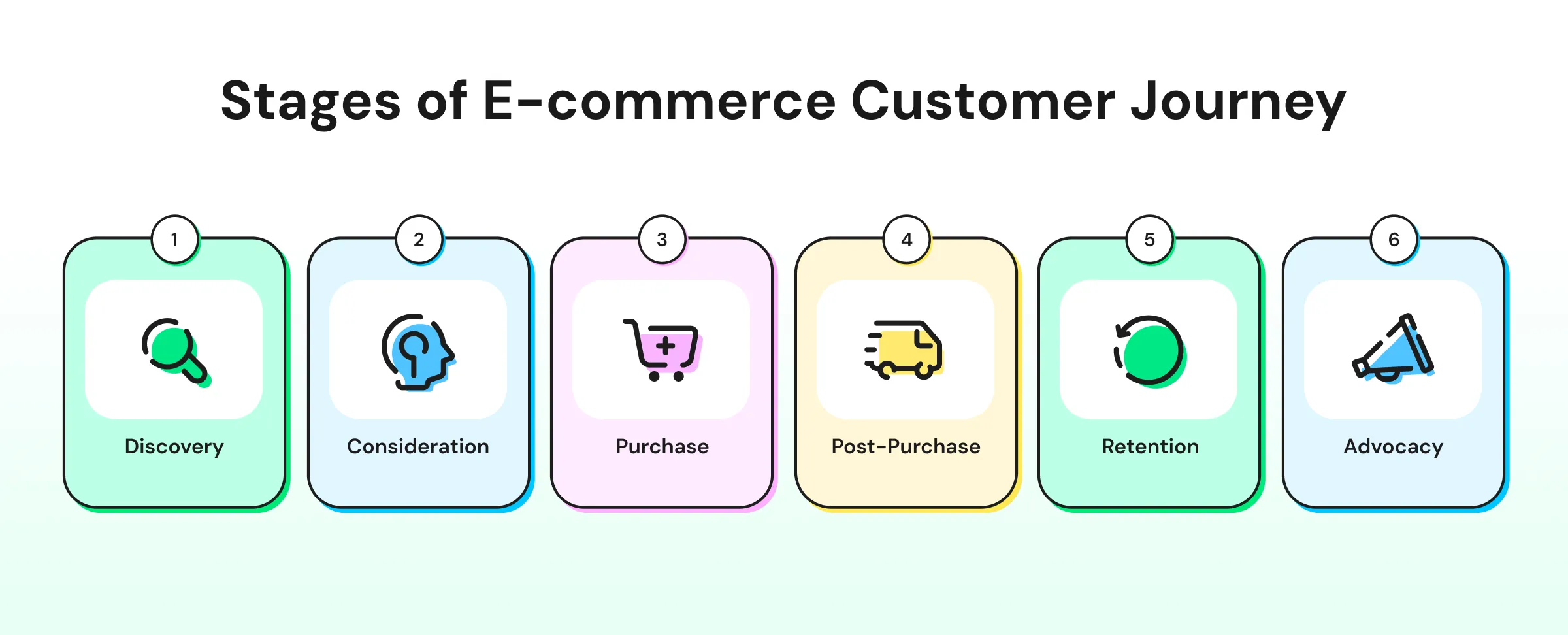
Many guides combine some of these into five stages, but separating post-purchase from retention matters in e-commerce because what happens between checkout and delivery often determines whether a shopper ever buys again.
1. Discovery
Shoppers first come across your brand or product, usually without searching for you directly. It can be from a review, an Ad, or maybe word of mouth.
- What shoppers do: Scroll Reels, watch creator content, browse marketplaces, or click an ad.
- Key touchpoints: Instagram and TikTok posts, influencer collaborations, marketplace listings, search ads, and click-to-WhatsApp ads.
- What to measure: Reach, click-through rate, and new visitors or new conversations.
- The conversational moment: A shopper comments "price?" on a post, which is the first chance to start a one-on-one conversation.
Discovery is increasingly social. Bain & Company's How India Shops Online 2025 report found that 70% of Gen Z shoppers discover brands online and make faster purchase decisions, browsing fewer search listings than millennials before buying.
How Wati helps: Click-to-WhatsApp ads open a chat straight from Facebook or Instagram, and every lead is tagged by campaign, ad set, and creative, so you can see which ads start real conversations. Instagram comments like "price?" can trigger an automated DM, turning public interest into a private chat.
2. Consideration
Shoppers compare options and look for reasons to trust your product. Brand recognition, reviews, and social image matter at this stage.
- What shoppers do: Read reviews, check sizing and specifications, compare prices, and ask questions.
- Key touchpoints: Product pages, site reviews, UGC (user-generated content, especially on social channels), comparison content, and DMs or chat.
- What to measure: Product page views, add-to-cart rate, and response time to pre-sale questions.
- The conversational moment: "Does this run true to size?" A fast, accurate answer at this point often decides the sale.
How Wati helps: With WhatsApp Catalog, shoppers can browse your products, prices, and details without leaving the chat. When they ask a question, Astra answers sizing, stock, and delivery questions instantly and shares the right product from the catalog.
3. Purchase
Shoppers decide to buy and move through checkout. This is the most important step. At this stage, they may put the product in the cart but not check out.
- What shoppers do: Add to cart, choose a payment method, and complete or abandon checkout.
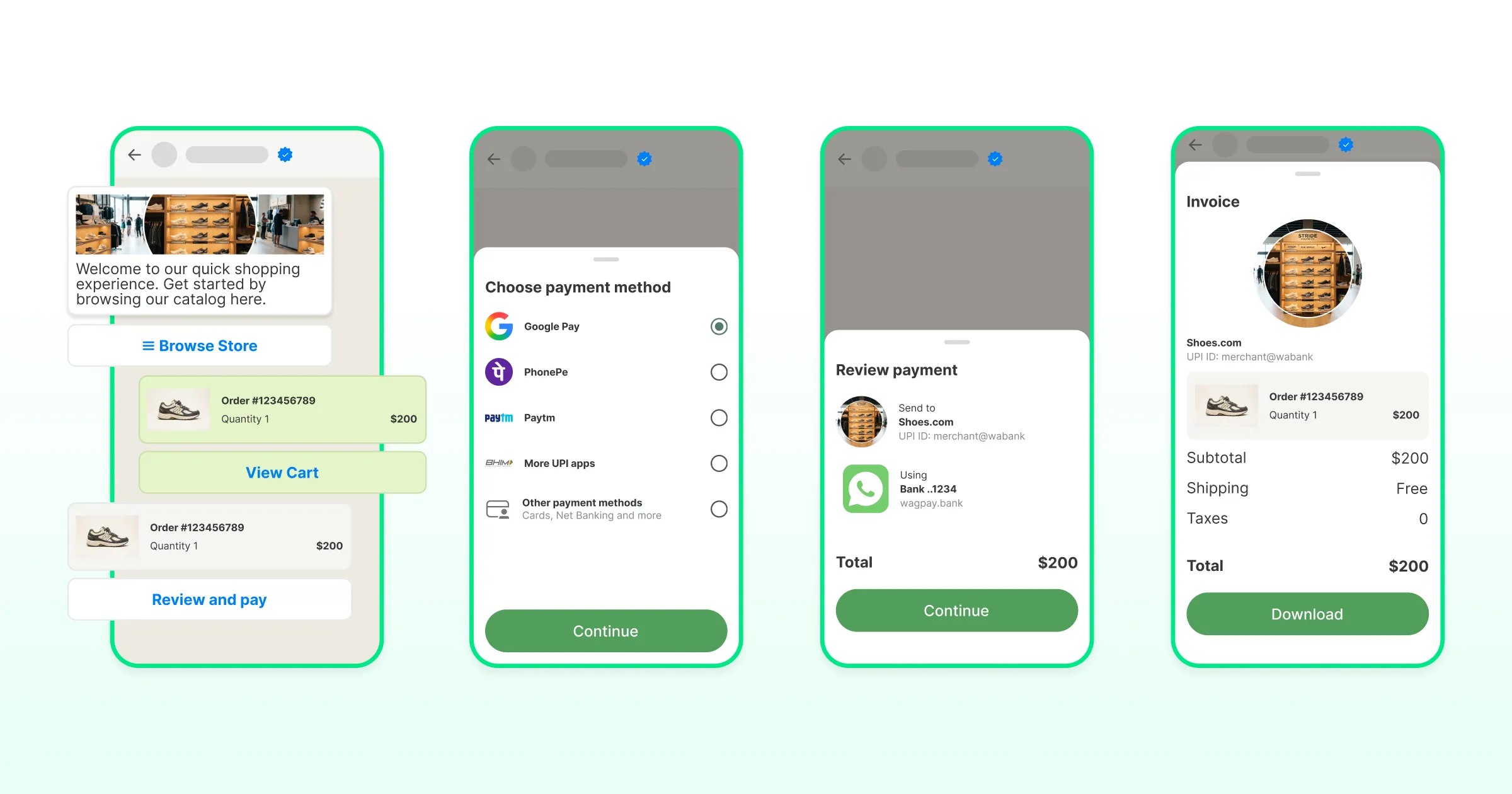
- Key touchpoints: Cart, checkout page, payment options, and cart recovery messages.
- What to measure: Checkout conversion rate, cart abandonment rate, and recovered revenue.
- The conversational moment: A cart reminder that answers the question that stopped the shopper, such as delivery time or extra fees.
This is where most stores lose revenue first. Baymard Institute calculates the average documented online cart abandonment rate at 70.22%, based on 50 different studies.
How Wati helps: Cart reminders go out automatically on WhatsApp, with fallback to RCS and then SMS. When a shopper replies with a question, Astra answers it in the same chat and shares a secure payment link, or WhatsApp Pay in supported markets.
If the conversation needs a person, Wati AI gives your team a chat summary and one-click translation, so they can close the sale without asking the shopper to repeat anything.
4. Post-Purchase
Shoppers wait for, receive, and judge their order.
- What shoppers do: Check order status, confirm cash-on-delivery orders, track shipping, and request returns or exchanges.
- Key touchpoints: Order confirmation, shipping and delivery updates, COD verification, delivery, and returns.
- What to measure: "Where is my order?" questions, delivery success rate, return rate, and post-purchase satisfaction.
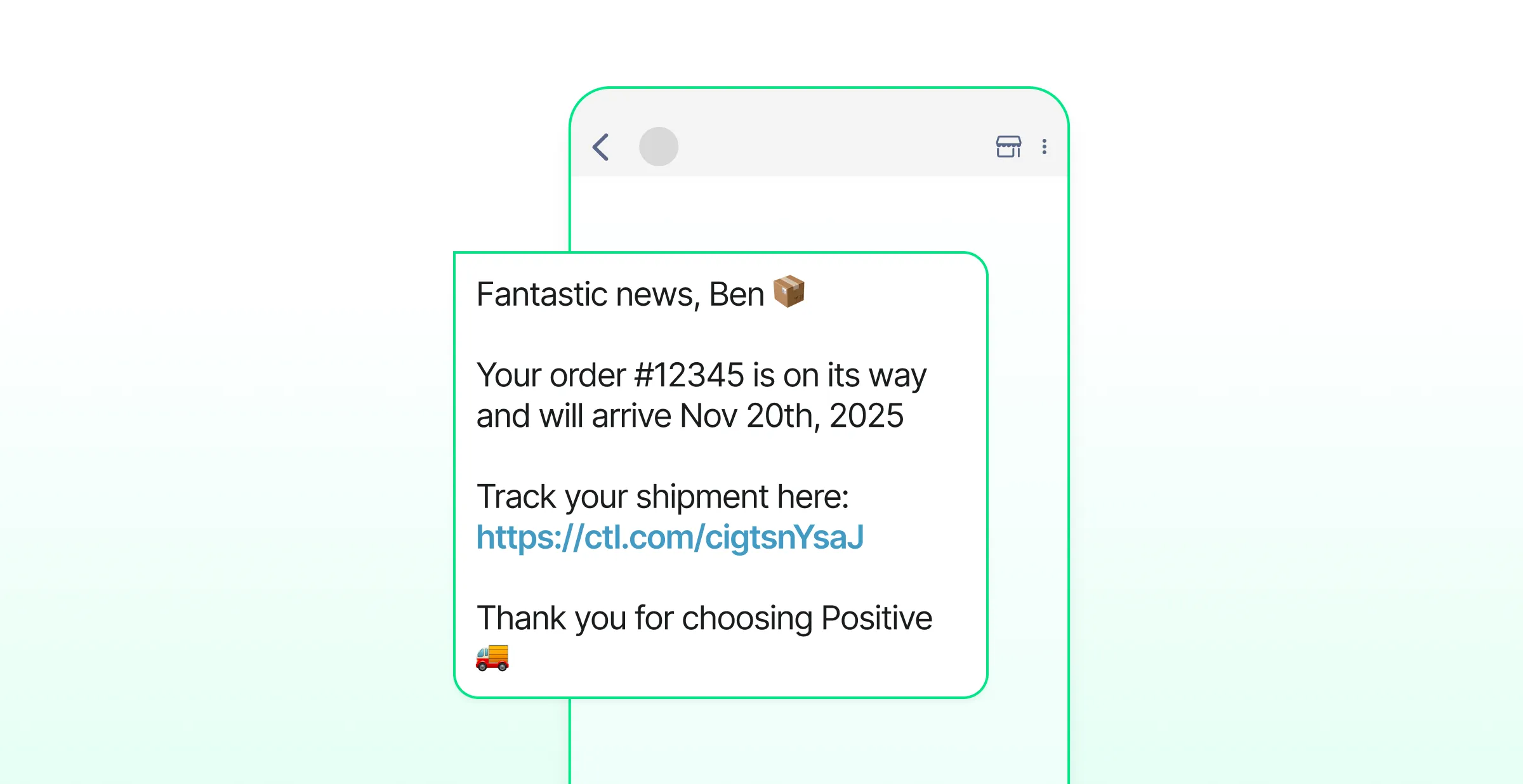
- The conversational moment: A proactive update before the shopper has to ask about their order.
The post-purchase experience is where trust is built or lost. Silence between checkout and delivery is one of the most common reasons first-time buyers never come back.
How Wati helps: Astra answers "where is my order?" and return questions around the clock, and hands complex cases to your support team with full context. Wati AI helps that team reply faster with summaries and translation, and Wati's reporting shows response times, resolutions, and agent-wise performance, so you can spot where post-purchase support slows down.
5. Retention
Customers decide whether to buy again. Re-purchase depends largely on the previous delivery experience and whether you were able to help them during their previous buying journey. If they have to go to returns/exchange, how easily your site has managed them, etc.
- What shoppers do: Reorder, respond to new launches, use loyalty rewards, or drift away.
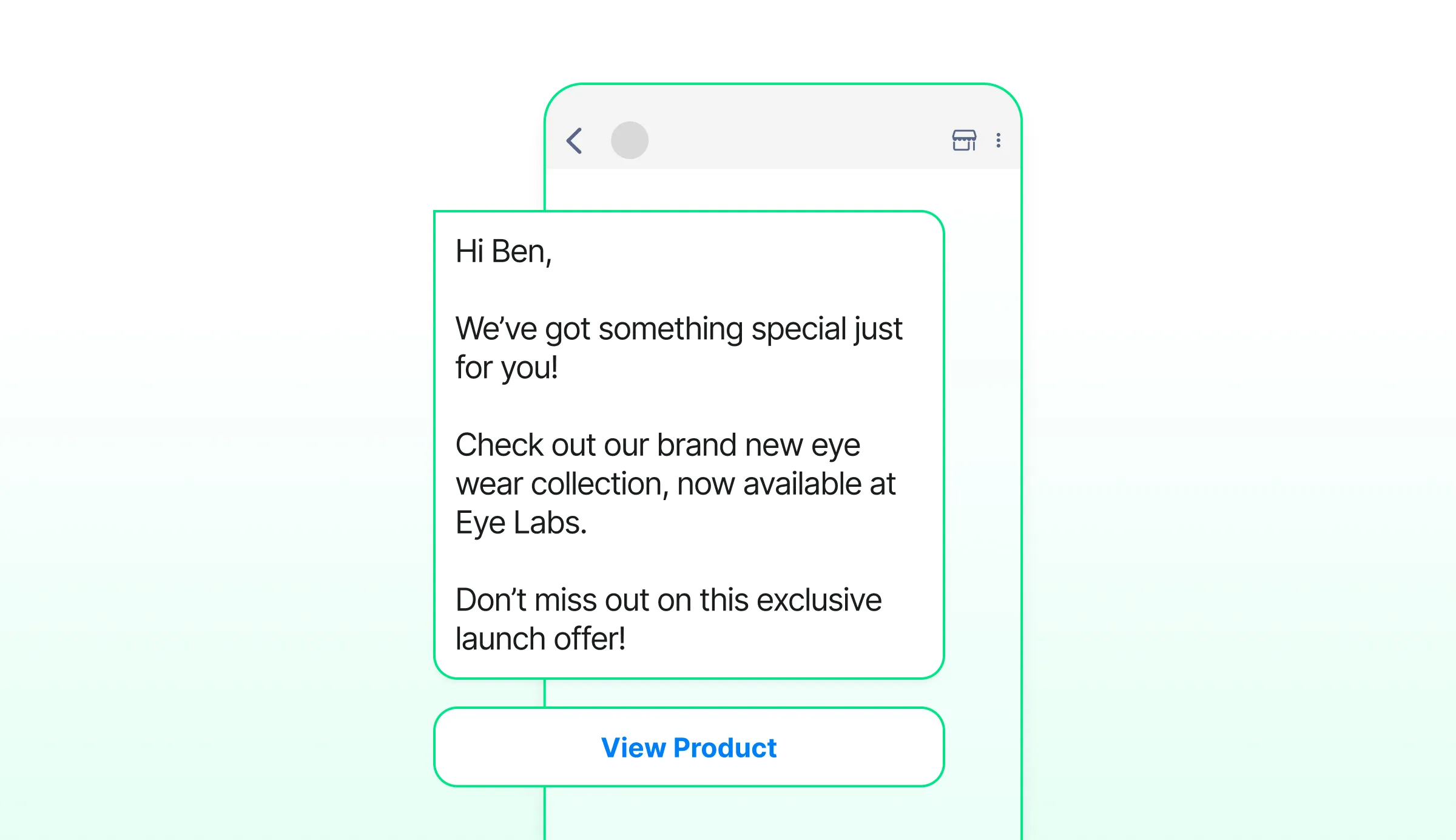
- Key touchpoints: Replenishment reminders, back-in-stock alerts, personalized recommendations, and loyalty offers.
- What to measure: Repeat purchase rate, time between orders, and customer lifetime value.
- The conversational moment: A reminder that arrives right when the customer is about to run out.
How Wati helps: Segmented broadcasts and retargeting reach customers based on whether they read, replied, or clicked, so replenishment reminders, restock alerts, and launch messages go to the people most likely to buy again.
6. Advocacy
Loyal customers recommend your brand to others.
- What shoppers do: Leave reviews, share UGC, and refer friends.
- Key touchpoints: Review requests, referral programs, and community or creator programs.
- What to measure: Review volume, referral rate, and UGC shared.
- The conversational moment: A review request sent a few days after delivery, once the customer has used the product.
How Wati helps: Shopify-triggered post-purchase follow-ups can carry a review request a few days after delivery, on the channel the customer already uses. Because WhatsApp messages are easy to forward, a referral link shared in the chat is also easy for happy customers to pass on.
How Does the E-Commerce Customer Journey Differ by Category?
The stages stay the same across e-commerce, but the stage that matters most changes by product category.
Category | Stage That Matters Most | What Shoppers Need |
|---|---|---|
Fashion and footwear | Consideration and post-purchase | Sizing help before buying, easy exchanges after |
Beauty and personal care | Retention | Regimen advice and timely replenishment reminders |
Electronics | Consideration | Detailed specs, comparisons, and warranty clarity |
Grocery and quick commerce | Purchase and post-purchase | Speed, stock accuracy, and real-time delivery updates |
Home and furniture | Post-purchase | Delivery scheduling, assembly help, and damage claims |
D2C subscriptions | Retention | Flexible changes, reminders, and loyalty rewards |
A fashion brand that invests heavily in discovery but ignores exchanges will keep winning first orders and losing customers.
A beauty brand that nails discovery but never sends a replenishment reminder leaves its easiest revenue on the table.
How Does the E-Commerce Customer Journey Work in Mobile-First Markets?
In mobile-first markets, the e-commerce customer journey rarely stays within a single channel. Shoppers discover products on social media, compare prices on marketplaces, ask questions on messaging apps, buy on a website or app, and sometimes still visit a store.
Local payment and delivery habits add extra stages that most guides overlook, and each one has to work across every channel.
India is the clearest example. The country’s e-retail market has reached about $60 billion in gross merchandise value, with the world’s second-largest online shopper base. Three local realities shape the journey there.
Cash on Delivery Adds a Verification Step
Many shoppers, especially outside the largest cities, still pay on delivery. In Fynd’s Festive Season Report 2025, which tracked more than 60 fashion and footwear brands, digital payments made up 53% of transactions, while cash on delivery remained widely used in smaller cities.
Confirming COD orders before dispatch reduces failed deliveries and return-to-origin (RTO) costs. That confirmation works best on whichever channel the shopper actually responds to, whether that’s a messaging app, SMS, or a quick call.
Speed Expectations are Rising
Quick commerce, with deliveries in under 30 minutes, now accounts for over two-thirds of e-grocery orders in India.
That raises the bar for delivery updates across every category. Shoppers expect the same real-time status in the app, on the order page, and in their messages.
Festive Peaks Compress the Journey
Diwali and other festive sales squeeze a large share of yearly demand into a few weeks. Discovery, purchase, and post-purchase all happen at peak volume, across social, marketplaces, your site, and messaging at once.
Our guide to Diwali drip campaigns shows how brands automate cart recovery and COD confirmation during these peaks.
Similar multichannel journeys are common across Latin America, Southeast Asia, and the Middle East. In these markets, shoppers often move between social media, marketplaces, and messaging apps, and expect to ask questions, confirm orders, and get updates on the channel they prefer.
Messaging apps play an especially large role there, as our guide to building a WhatsApp e-commerce store explains.
How is the B2B E-Commerce Customer Journey Different?
The B2B e-commerce customer journey is longer, involves more people, and depends more on repeat ordering than a typical consumer purchase.
Five differences shape the B2B journey:
- More decision makers: A B2C purchase usually involves one shopper. A B2B purchase often involves several people, such as a buyer, a manager, and someone in finance.
- A longer journey: Consumer purchases take minutes to days. B2B purchases can take weeks or months.
- Different pricing: B2C stores show fixed, public prices. B2B stores often use negotiated, volume-based, or contract pricing.
- Built-in repeat buying: For consumers, buying again is optional. For B2B accounts, reorders and contracts are part of the relationship.
- Different conversations: B2C conversations are mostly product questions and order updates. B2B conversations center on quotes, approvals, and reorder confirmations.
For B2B stores, the retention stage often matters most, since one account can reorder for years. Messaging works well for reorders and quote follow-ups, as our guide to omnichannel sales explains.
How Do You Create an E-Commerce Customer Journey Map?
An e-commerce customer journey map is a visual or table-based view of how shoppers move through each stage of buying from your store, including the touchpoints, the friction they face, and the metrics that show whether each stage is working.
You can build one in five steps.
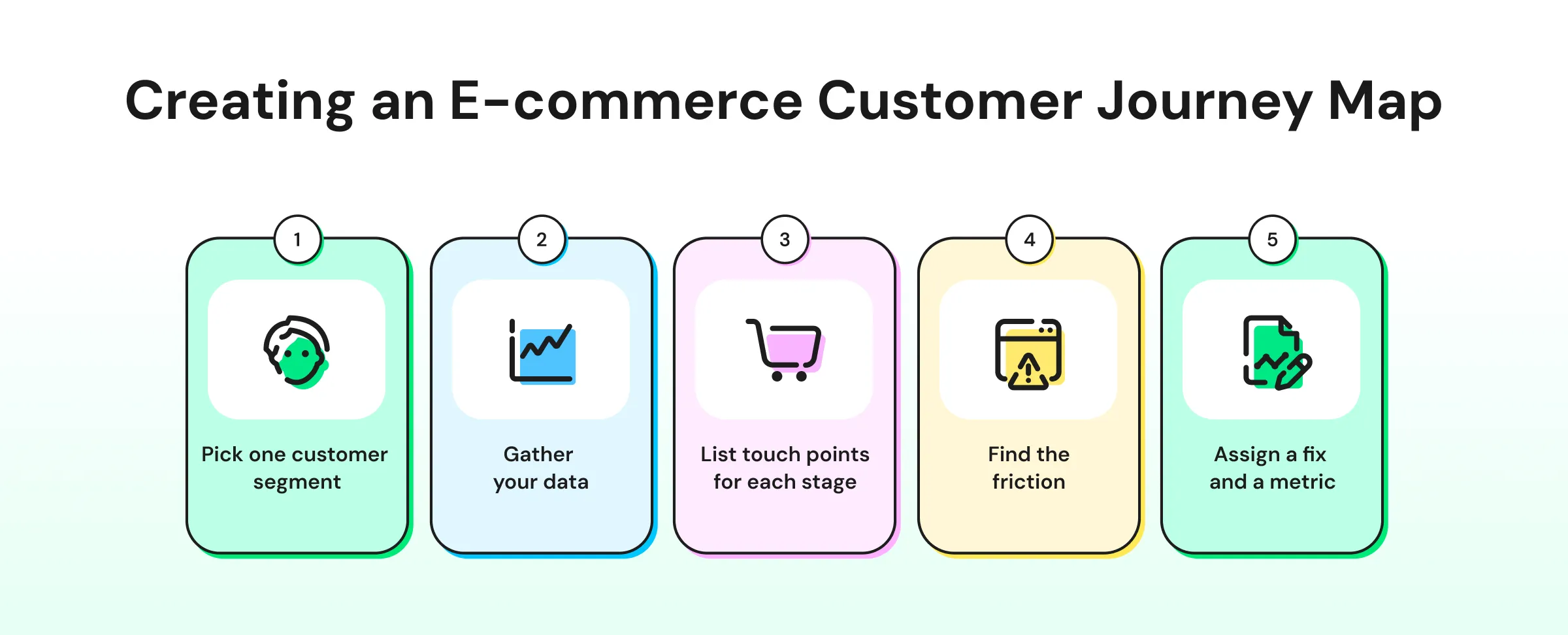
Step 1: Pick One Customer Segment
Start with one high-value segment, such as first-time mobile shoppers from Instagram, rather than mapping every customer at once. A focused map is easier to act on.
Step 2: Gather Your Data
Pull data from your store analytics, ad platforms, and conversation history. Look at traffic sources, add-to-cart and checkout rates, support questions by type, delivery and return data, and repeat purchase rates.
Step 3: List Touchpoints for Each Stage
For each of the six stages, write down every place the shopper interacts with your brand, including messaging and support conversations, not just website pages.
Step 4: Find the Friction
Mark where shoppers drop off, repeat questions, or contact support. Common friction points include slow replies to pre-sale questions, surprise fees at checkout, and silence after the order.
Step 5: Assign a Fix and a Metric
For each friction point, choose one fix and one metric to track it. Review the map monthly, and update it whenever you add a channel or change your checkout.
Here is what a filled-in customer journey map for e-commerce looks like, stage by stage. Use it as a starting point for your own store:
- Discovery: The shopper wants to find something worth buying through Reels, creators, ads, or marketplaces. The common friction is comments and DMs that go unanswered. Fix it with automatic DM replies to comments, and track new conversations started.
- Consideration: The shopper wants to trust the product through product pages, reviews, and DMs. The friction is slow answers to sizing or spec questions. Fix it with instant answers from an AI agent, and track pre-sale response time.
- Purchase: The shopper wants to pay with confidence at the cart, checkout, and payment step. The friction is surprise fees or an unclear delivery time. Fix it with clear costs and a helpful cart reminder, and track cart recovery rate.
- Post-purchase: The shopper wants the order on time through confirmations, shipping updates, and COD checks. The friction is silence after checkout. Fix it with proactive order and delivery updates, and track "where is my order?" volume.
- Retention: The customer wants to buy again easily through reminders, alerts, and recommendations. The friction is having no reason to come back. Fix it with replenishment and back-in-stock alerts, and track repeat purchase rate.
- Advocacy: The customer wants to share a good experience through review requests and referrals. The friction is a review request sent too early. Fix it by requesting reviews after the product is used, and track review volume.
Where Do E-Commerce Customer Journeys Break?
E-commerce customer journeys usually break at four points, and each one costs revenue in a different way.
The Surprise Fee That Kills the Cart
Unexpected extra costs, such as shipping, taxes, and fees, are the top reason shoppers abandon checkout. They were cited in 40% of non-browsing abandonments in Baymard Institute’s 2025 survey.
Show full costs early, and use cart reminders that answer the question that stopped the shopper. Our guide to cart recovery on WhatsApp covers how to build these reminders.
The Silence After “Order Placed”
Shoppers who hear nothing after paying start to worry. They contact support, cancel the order, or refuse a cash-on-delivery package at the door.
Proactive confirmations and shipping updates prevent most of this, because the shopper never has to wonder where their order is.
The Question Nobody Answered in Time
A pre-sale question answered hours later often means a lost sale. By then, the shopper has found the answer, and the product, somewhere else.
Comments, DMs, and chats need the same fast response standard as your website.
The Shopper Who Had to Start Over
When Instagram, WhatsApp, and email run in separate tools, a shopper who switches channels has to explain everything again.
Each restart adds friction and chips away at trust. Connecting your channels keeps the journey continuous, so the conversation picks up exactly where it left off.
Turn comments and ad clicks into sales conversations. Wati turns Instagram comments into automated DMs and click-to-WhatsApp ad clicks into chats, with every lead tagged by campaign, ad set, and creative. See Instagram and Messenger in Wati |
How Do You Connect Channels With Omnichannel Customer Engagement?
Omnichannel customer engagement means every channel a shopper uses, from Instagram and WhatsApp to your website and email, shares one customer record, so the journey continues wherever the shopper goes next.
For e-commerce, that means a question asked in an Instagram DM, an abandoned cart on mobile, and a delivery update on WhatsApp all belong to the same customer story.
An omnichannel customer engagement platform for e-commerce should cover these capabilities:
- A shared inbox: Instagram, Messenger, WhatsApp, TikTok, and other conversations in one place, so support reps never switch apps. Our guide to the WhatsApp team inbox shows how this works.
- AI translation: Incoming and outgoing messages are translated automatically, so support reps can reply in their own language while shoppers read the answer in theirs. In Wati, Wati AI handles this right inside the Team Inbox.
- AI writing assistance: Help drafting replies that match your brand tone, fix grammar, and pull answers from your knowledge base. Wati’s AI Editor does this as support reps type, so every reply stays fast, clear, and consistent.
- Store integration: A live connection to your e-commerce platform, so order status and cart contents are visible in every conversation.
- Event-based automation: Messages triggered by real actions, such as an abandoned cart, a shipped order, or a delivered package.
- Channel fallback: A backup channel, such as SMS, when a message cannot be delivered on the first channel.
- AI agents with a human handoff: Instant answers to common questions, with complex cases passed to a support rep with the full history.
- Attribution: Tracking that connects ads and campaigns to conversations and orders.
The same connected approach applies to service after the sale, which our guide to omnichannel customer service covers in depth.
How Do You Improve E-Commerce Customer Retention After the First Order?
You improve e-commerce customer retention by making the experience after the first order as strong as the one before it. These five tactics turn first-time buyers into repeat customers.
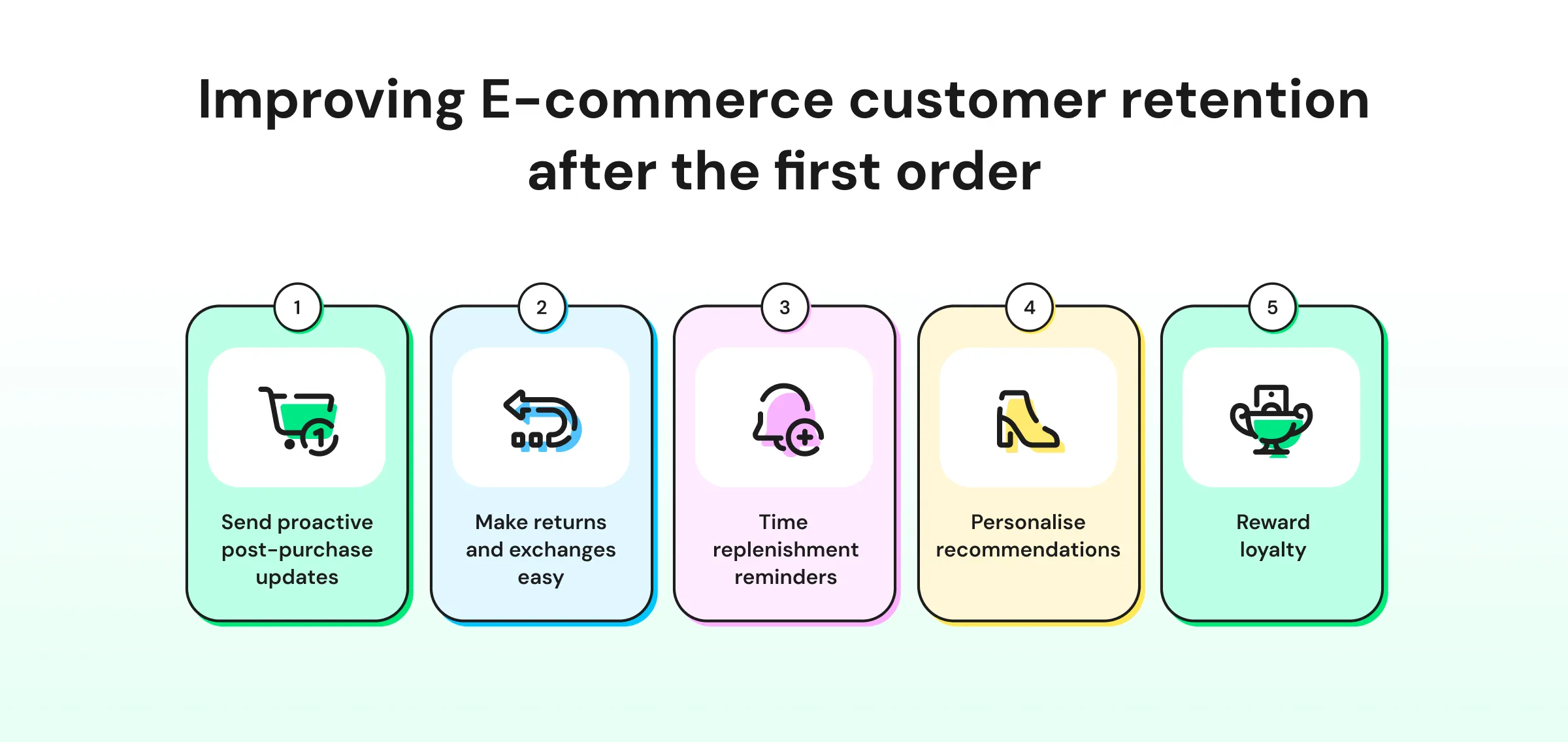
1. Send proactive post-purchase updates. Confirm the order, share shipping updates, and notify customers on delivery, so they never have to ask.
2. Make returns and exchanges easy. A simple exchange over chat keeps a disappointed customer from becoming a lost one, especially in fashion and footwear.
3. Time replenishment reminders. For consumables such as beauty and groceries, remind customers just before they are likely to run out.
4. Personalize recommendations. Use past purchases to suggest the next product, rather than sending every customer the same broadcast.
5. Reward loyalty. Offer early access, exclusive drops, or rewards to repeat buyers, and announce them on the channel each customer uses most.
For automated versions of these tactics, our guide to omnichannel marketing automation walks through ready-to-use workflows for welcome, post-purchase, and win-back journeys.
Which Metrics Should You Track at Each Stage?
The best way to measure the e-commerce customer journey is to track one or two metrics per stage, so you can see exactly where shoppers drop off.
Stage | Primary Metric | Supporting Metric |
|---|---|---|
Discovery | New visitors and conversations | Click-through rate on ads and posts |
Consideration | Add-to-cart rate | Response time to pre-sale questions |
Purchase | Checkout conversion rate | Cart recovery rate |
Post-purchase | Delivery success rate | "Where is my order" question volume |
Retention | Repeat purchase rate | Time between orders |
Advocacy | Review volume | Referral rate |
Review these metrics together, not in isolation. A rising add-to-cart rate with a falling checkout conversion rate, for example, points straight to a checkout problem.
How Does Wati Support the E-Commerce Customer Journey?
Wati is an agentic customer engagement platform that turns conversations into revenue growth across marketing, sales, and support.
For e-commerce brands, Wati's AI agents and support reps work together across WhatsApp, Instagram, Messenger, and other channels, covering every stage of the journey in one place.
Campaigns That Reach the Right Shoppers
Send segmented broadcasts for launches, sales, and restocks, then retarget customers based on whether they read, replied, or clicked a button. Click-to-WhatsApp ads bring new shoppers into a conversation, and every lead is tagged by campaign, ad set, and creative.
Abandoned Cart Recovery That Runs on Its Own
The Shopify integration triggers cart reminders automatically, including multi-step drip sequences. When WhatsApp can't deliver, reminders fall back to RCS and then SMS, so fewer recoverable carts slip away. The same integration sends order confirmations, shipping updates, COD verification requests, and post-purchase follow-ups.
Selling Inside the Chat
With WhatsApp Catalog, shoppers browse products in the conversation and check out through a secure payment link, or WhatsApp Pay in supported markets.
AI Agents and a Team That Work Together
Astra answers shopper questions instantly in 30+ languages and hands complex cases to your team with full context. In the Team Inbox, WhatsApp, Instagram and Messenger, and TikTok conversations sit in one place, with assignment and routing rules.
Wati AI helps support reps with conversation summaries, translation, and an AI Editor that keeps replies on brand. Shoppers who would rather talk can call from the same chat through WhatsApp Business Calling.
Analytics That Show What's Working
Campaign reports show how many customers read, replied to, or clicked each message, with URL click tracking for links. Inbox reporting covers response times, resolutions, and agent-wise performance, so you can see where the journey slows down.
Connections to the Rest of Your Stack
Wati integrates with HubSpot, Salesforce, Shopify, and 100+ other tools. Teams that already use their own AI models can bring them into Wati conversations through Connect External Agent, with support for Claude.
To see how checkout works inside a conversation, read our guide to WhatsApp Pay catalog checkout, and to set up the Instagram side, follow our guide to Instagram comment automation.
Turn Your First Orders Into Repeat Customers
The e-commerce customer journey does not end at checkout.
The brands that grow fastest answer questions quickly, keep shoppers informed after they pay, and give customers a reason to come back.
Start by mapping one segment, fix the stage where most shoppers drop off, and connect your channels so every conversation builds on the last.
Ready to connect every stage of your customer journey? Start your free Wati trial or book a demo.
Frequently asked questions
What are the stages of the e-commerce customer journey?
The five most common stages of the e-commerce customer journey are awareness, consideration, purchase, retention, and advocacy. Many e-commerce teams add a sixth stage, post-purchase, between purchase and retention, because the time between checkout and delivery strongly affects whether a shopper buys again.
What is the 80/20 rule in e-commerce?
The 80/20 rule in e-commerce, based on the Pareto principle, is the idea that a large share of results comes from a small share of causes, such as most revenue coming from a minority of customers or products. It is a rule of thumb rather than an exact ratio, and stores use it to focus retention efforts on their most valuable customers and best-selling products.
What are the 7 C's of e-commerce?
The 7 C's of e-commerce are context, content, community, customization, communication, connection, and commerce. The framework, created by Jeffrey Rayport and Bernard Jaworski, describes the seven design elements of an online store's customer interface, from its layout and content to how it communicates with shoppers and handles transactions.
How do you map an e-commerce customer journey?
You map an e-commerce customer journey by choosing one customer segment, gathering data from your store, ads, and conversations, listing the touchpoints at each stage, marking where shoppers drop off, and assigning a fix and a metric to each friction point. Review the map monthly and update it as your channels change.
How is an e-commerce customer journey different from a buyer journey?
A buyer journey describes the general decision steps any shopper takes, while an e-commerce customer journey maps how shoppers find, buy from, and return to a specific store. The customer journey also includes everything after the sale, such as delivery, support, returns, and repeat purchases.
Related posts
- Instagram Comment Automation: How It Works and How to Set It Up in Wati
Instagram comment automation auto-replies to comments and DMs commenters within seconds via Meta's API. Covers strategy, use cases, and Wati setup.
- Shared Team Inbox for Instagram: A Buyer’s Checklist for 2026
Use this fastest checklist to evaluate any shared team inbox for Instagram, which covers DMs, comments, automation, and multi-channel support.
- How to Send Bulk Messages on WhatsApp Without Getting Blocked
Learn how to send bulk WhatsApp messages without getting blocked. Compare the WhatsApp Business app and API, messaging limits, costs, templates, and best practices for safe, compliant bulk messaging.
- How to Set Up a TikTok Business Account: Step-by-Step Guide
Set up a TikTok Business Account step by step: switch from personal, pick a category, add your profile, and unlock ads and analytics.