
Too Long? Read This First
- TikTok drives discovery and reach; Instagram drives trust and retention. They're not really competing for the same job.
- TikTok wins on engagement (3.70% vs. 0.48%, per Socialinsider), largely because its algorithm pushes content beyond your existing followers.
- TikTok sparks impulse discovery; Instagram helps people research before they buy. Instagram's messaging tools are more mature; TikTok's are newer and still catching up.
- The honest answer isn't TikTok vs Instagram; it's both, managed well with tools like Wati.
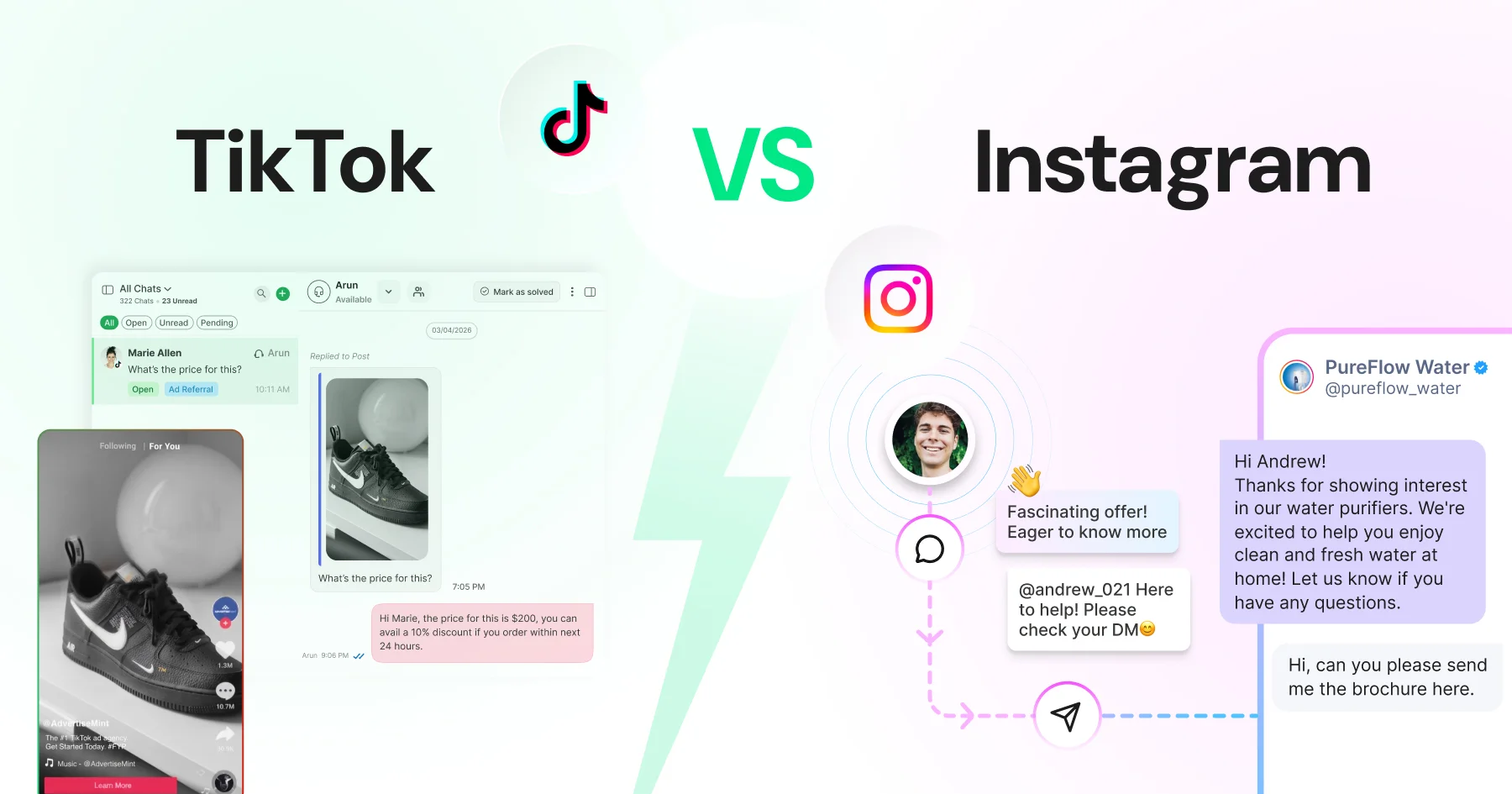
TikTok wins on discovery and reach among people who've never heard of you; Instagram wins on trust, research, and the tools that turn interest into a customer. Most businesses need both, at different stages of the same funnel.
Between them, TikTok and Instagram now reach close to 5 billion monthly active users.
TikTok has roughly 1.9 billion, and Instagram has 3 billion. That's not two platforms competing for the same slice of attention anymore. It's two enormous, mostly overlapping oceans your customers are already swimming in.
So when the TikTok vs Instagram question comes up, and it comes up in nearly every marketing meeting these days, it's worth asking a better question first: overlapping how, exactly?
Because the honest answer isn't as simple as picking a winner.
This guide breaks down where these platforms actually differ: audience, engagement, content, commerce, and conversion behavior. This will help you decide based on what your business needs, not which app feels trendier this quarter.
TikTok vs. Instagram in 60 Seconds
Before the deep dive, here's the fast version.
TikTok | ||
Core format | Short-form video only | Video, photos, Stories, carousels |
Monthly active users | ~1.9 billion | ~3 billion |
Average engagement rate | ||
In-app commerce | TikTok Shop (full in-app checkout) | Instagram Shopping (product tags + catalog) |
Best known for | Discovery, virality, reach beyond your followers | Retention, trust-building, deeper customer relationships |
Instagram vs TikTok: Who's Actually on Each Platform?
The biggest myth in the TikTok vs Instagram debate is that one is "the young app" and the other is "the grown-up app." The real data tells a more interesting story.
TikTok's largest age segment globally is actually 25-to 34-year-olds, not teenagers, followed by 18-to 24-year-olds.
Instagram looks strikingly similar: users aged 25 to 34 make up the largest share of Instagram's global audience at 31.6%, followed closely by those aged 18 to 24 at 29.5%.
In other words, both platforms are led by the same age group, and both skew younger overall, but neither is exclusively a teen hangout anymore. As we noted earlier in our TikTok Ads guide, roughly one in four TikTok users is over 35, a detail worth remembering the next time someone assumes your older customers aren't there.
Geography matters too. India is Instagram's largest market with roughly 360 million users, and both platforms count Indonesia, the US, and Brazil among their biggest audiences - worth knowing if your customers are in WhatsApp-first markets, because it means the same person discovering you on TikTok or Instagram likely expects to message you next.
The platforms genuinely diverge in intensity, not identity. TikTok users spend about 1 hour 37 minutes a day on the app, more time than on Instagram, YouTube, or Facebook.
That's less about who's on TikTok and more about how deeply they engage once they're there, a distinction that matters more for strategy than any age bracket does.
TikTok vs. Instagram: Which One Actually Wins on Engagement?
We already saw the headline numbers: TikTok's engagement rate reached 3.70% in 2025, up 49% year-over-year, while Instagram's sits at 0.48%, holding almost flat. That's more than a 7x gap, and it's not a fluke year.
The divide between TikTok and every other major platform has been widening, not narrowing.
Algorithm Changes
TikTok's algorithm was built to push content toward people who've never followed you, based purely on whether they're likely to enjoy it.
Instagram's algorithm, by contrast, still leans heavily on your existing follower relationships.
TikTok's decision to push content toward non-followers explains most of the engagement gap: TikTok manufactures new engagement constantly, while Instagram mostly recirculates it among people who already know the brand.
There's a second shift worth knowing about. TikTok shares grew 45% year-over-year even as comments dropped 24%, a sign that people are increasingly forwarding TikTok content privately rather than engaging publicly. Instagram is seeing a smaller version of the same trend.
If your reporting only tracks likes and comments, you may already be underselling both platforms.
What This Means For You A high engagement rate isn't automatically better. It depends on what you're optimizing for. TikTok's number reflects genuine reach beyond your existing audience. Instagram's lower rate often reflects a smaller, more qualified audience that already knows your brand, which is a very different, and sometimes more valuable, kind of engagement. |
Instagram Reels vs. TikTok: How Do the Content Formats Actually Compare?
Both platforms are now built around short-form video, but they still ask something different of you as a creator.
TikTok: Built For Speed And Authenticity
TikTok's entire format rewards fast, low-effort creation. A phone, decent lighting, and a hook in the first three seconds go further here than a polished production ever will. The platform's culture actively favors content that feels unscripted, even when it isn't.
Instagram: Built For Range
Instagram gives you more to work with: Reels, Stories, carousels, and static posts, each suited to a different job. Reels compete directly with TikTok on short-form video, but Instagram also rewards slower-burn formats like carousels for tutorials or comparisons, and Stories for casual, disappearing updates.
That range comes with a tradeoff: more formats to plan for, and slightly higher production expectations across the board.
Instagram Reels vs TikTok: Which Wins?
Neither, really, because they're increasingly the same format, wearing two different algorithms. The real question isn't which platform's short-form video is better. It's where your specific content is more likely to be discovered, and that comes down to the audience and algorithm differences covered in the sections above, not the format itself.
TikTok Shop vs. Instagram Shopping: The Commerce Layer
If you sell products, this comparison matters as much as any engagement number.
TikTok Shop is built for impulse: the entire journey - discovery, product page, checkout - happens without leaving the app. Shoppable videos and live selling turn the "I didn't know I needed this" moment into a completed order in a couple of taps.
Instagram Shopping works differently: product tags on posts, Reels, and Stories connect to a catalog synced through Meta, and shoppers typically complete the purchase on your website. It's less impulsive by design, which fits how people actually use Instagram: as a research and confidence-building step before buying.
As with engagement and content format, TikTok compresses the journey into fewer steps, while Instagram deepens it with a longer research phase. On both platforms, a meaningful share of purchase-intent moments doesn't end at a checkout button at all - they end in a DM: "Is this in stock?" "Does it ship to me?" "What's the return policy?" Which platform handles that moment better is covered below.
Which Platform Costs Less to Advertise On?
Cost matters as much as reach when picking where to spend. TikTok is still the cheaper platform to advertise on in 2026, though the gap has narrowed.
TikTok | ||
|---|---|---|
Average CPC | $0.30–$1.50 | $0.40–$0.70 |
Average CPM | $4–$10 | $2–$6 (top-performing campaigns) |
TikTok wins on cost. Instagram wins on funnel stage. Its audience is further along in the buying journey, which is part of why it costs more to reach. Match the platform to your margin, not just the lowest CPC.
Figures reflect 2026 industry benchmarks from WordStream's TikTok and Instagram ad cost guides, and vary by vertical, placement, and creative quality; check current rates before budgeting.
Which Platform Actually Converts Better?
This is where the "you need both" answer starts becoming obvious, because TikTok and Instagram aren't just different in format; they're used differently in the actual buying journey.
42% of Gen Z consumers turn to TikTok for product discovery, often before they've consciously decided to shop at all. TikTok tends to catch people in that early, impulsive moment: "I didn't know I needed this until I saw it."
Instagram plays a different role entirely. 81% of Instagram users say they research products or brands on the platform before buying, using it as a checkpoint to build confidence before committing.
Put simply, TikTok tends to spark the idea, and Instagram tends to confirm the decision. Neither converts "better" in isolation. They're doing different jobs at different points in the same journey.
A brand that only shows up on TikTok might spark plenty of interest that quietly evaporates without a place to be researched and trusted. A brand only on Instagram might build trust with an audience that never discovered them in the first place.
Where the Conversation Actually Happens After the Scroll
Every comparison so far has been about getting attention. This one's about what happens right after someone decides to reach out, and it's the piece most TikTok vs Instagram comparisons skip entirely.
- TikTok's messaging tools are still catching up: Business messaging on TikTok is in Open Beta and still region-restricted- unavailable in the US, EEA, Switzerland, and the UK. Instant Messaging Ads face the same restrictions, plus India. Where it does work, replies run on a 48-hour window, and businesses can't start a conversation cold.
- Instagram's DM infrastructure is far more mature: Messages are open by default, automation and quick-reply tooling have existed for years, and it's long been treated as a genuine customer service channel, not just a personal inbox.
The messaging maturity gap matters operationally. A business running content on both TikTok and Instagram is managing two separate inboxes, not one.
Each with a different set of rules, running at different speeds. That operational reality is exactly why the "which platform" question starts to feel like the wrong one to ask.
So, Which Platform Should You Actually Use?
Here's the honest answer: probably both.
TikTok gives you reach and discovery among people who've never heard of you. Instagram gives you depth, trust, and a more mature set of tools once someone's ready to engage further.
Picking just one means giving up half of that journey; the platforms aren't rivals so much as two different stages of the same funnel.
That said, "use both" is the easy part to say and the harder part to actually do well. It means two content strategies, two ad platforms, and, as we just covered, two very different messaging systems running at two different speeds. Most teams don't struggle with the strategy of running both. They struggle with its operations.
That's really where the conversation needs to go next, not which platform wins, but how you make running both of them sustainable for a team that doesn't have unlimited hours in the day.
Managing Both Without Doubling Your Workload
Running TikTok and Instagram well isn't really a strategy problem anymore, but an operations one.
Two platforms mean two inboxes, two sets of notifications, and two places where a real customer conversation can quietly slip through while your team's attention is elsewhere.
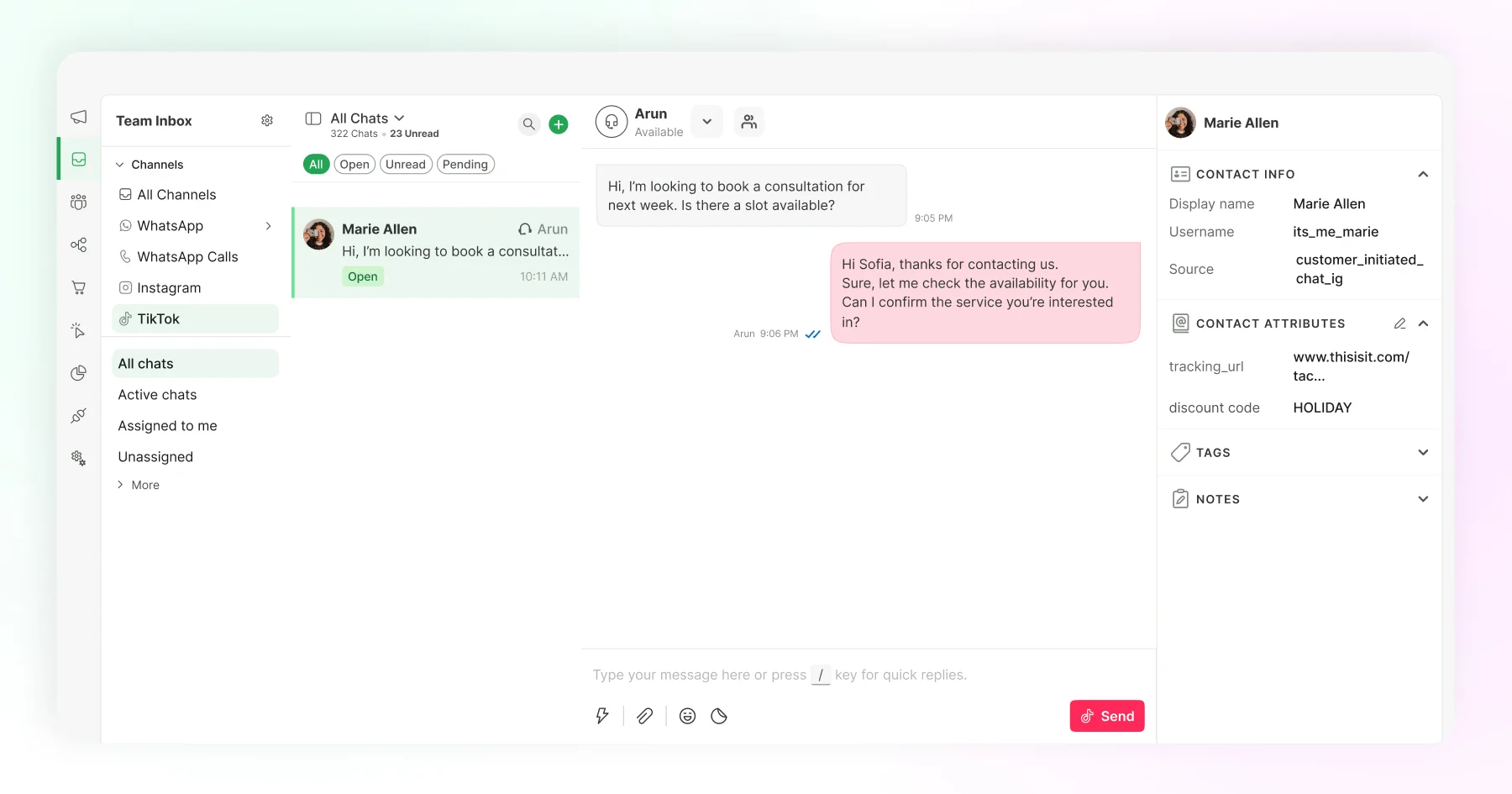
Wati's shared Team Inbox is built to solve the two-inbox problem of running TikTok and Instagram together.
TikTok DMs and Instagram DMs, organic and ad-driven alike, land in the same inbox as your WhatsApp conversations. A few things have changed in practice.
Wati + TikTok Business Messaging: One Inbox for Every Channel | Wati
- Every message gets assigned to the right person, instead of depending on someone remembering to check a third app
- Every conversation carries context on where it came from- a video, a post, or a specific ad- so your team isn't replying blindly
- Every contact is unified across channels, so someone who found you on TikTok and later messages on Instagram is recognized as the same person, not two disconnected leads
You don't have to choose between TikTok and Instagram to get this benefit. You just need one place where both platforms' conversations actually get handled with the same care, no matter which one brought the customer to you in the first place.
See how Wati brings TikTok and Instagram into one inbox by scheduling a free demo.
Frequently asked questions
1. Which is better in 2026, TikTok or Instagram?
Neither, really. TikTok drives discovery and reach. Instagram drives trust and retention. Most businesses benefit from using both rather than picking a side.
2. Is Instagram or TikTok better for business?
It depends on your goal. TikTok tends to perform better for reaching new audiences. Instagram tends to hold the edge when it comes to nurturing existing relationships and repeat engagement.
3. What's the actual difference between Instagram Reels and TikTok?
Both are short-form video, but TikTok's algorithm pushes content further beyond your followers, while Instagram Reels benefits more from your existing audience, with more format variety around it (Stories, carousels, static posts).
4. Should my business use TikTok, Instagram, or both?
Both, if you can manage it. They cover different stages of the customer journey, discovery and conversion, so relying on just one usually means missing the other.
5. Is TikTok Shop or Instagram Shopping better for selling?
TikTok Shop keeps the entire purchase inside the app, which suits impulse-friendly, lower-priced products. Instagram Shopping uses product tags that usually route to your website, which suits considered purchases where buyers want to research first. Match the platform to how your customers buy, not the other way around.
Related posts
- Instagram Comment Automation: How It Works and How to Set It Up in Wati
Instagram comment automation auto-replies to comments and DMs commenters within seconds via Meta's API. Covers strategy, use cases, and Wati setup.
- Best TikTok Marketing Tools for Businesses in 2026
The best TikTok marketing tools depend on your stage: start with TikTok's built-in tools, then add these 10.
- TikTok DM Management: One Inbox for TikTok, WhatsApp & Instagram
The blog highlights how to manage TikTok DMs, what an omnichannel inbox for WhatsApp, Instagram, TikTok is and how a shared inbox like Wati helps manage customer conversations in a unified inbox.
- Why Isn’t Instagram Engagement Converting into Leads? (And How to Fix it)
learn what are the ways to optimize instagram engagement and how to turn public comments and private DMs into leads to improve your sales pipeline and conversions.