
Too Long? Read This First
- Omnichannel marketing in healthcare connects search, social media, WhatsApp, and in-clinic touchpoints around shared patient data, so patients don’t have to start over on each channel.
- Multichannel marketing runs campaigns on each channel separately, while omnichannel marketing connects them with the same offer, patient data, and goal.
- Effective strategies include local search optimization, Click-to-WhatsApp ads, doctor-led content, health calendar campaigns, and recall campaigns.
- Automation handles lead replies, follow-ups, and recalls, while clinical, financial, and sensitive questions go to the right person.
- Track cost per booked appointment, lead-to-booking rate, and opt-out rate to see what’s working.
- Wati, an agentic customer engagement platform for revenue growth, supports omnichannel healthcare marketing with Team Inbox, Campaigns, Click-to-WhatsApp ads, Astra AI Agent, and CRM integrations.
A patient searches “full body checkup near me” and finds your hospital on Google. She compares your package price and reviews, then leaves without booking.
A few days later, your Instagram ad brings her back, and she asks on WhatsApp whether she needs to fast before the test. Your medical receptionist replies the next day, after she has already booked the same checkup at a nearby diagnostic center.
Your hospital attracted her on two channels and lost her on the third. Omnichannel marketing in healthcare prevents this by connecting search, social, WhatsApp, and your front desk through shared patient data.
Patients now expect a high level of coordination. In Bandwidth’s 2026 Patient Preferences Report, 37.9% of surveyed US patients said they would likely switch providers if their channel preferences were ignored.
This guide explains how omnichannel healthcare marketing works, which channels to connect, and eight strategies to reach patients earlier and drive more appointment bookings.
It also covers automation, care-setting examples, and the KPIs that show what’s working.
What is Omnichannel Marketing in Healthcare?
Omnichannel marketing in healthcare is an integrated strategy that connects all digital and physical patient touchpoints into one coordinated experience. Every channel uses the same patient data, so each message reflects what the patient has already seen, asked, or booked.
These touchpoints include the website, Google Business Profile, social media, WhatsApp, SMS, email, mobile app, patient portal, telemedicine, call center, and in-clinic visits. Together, they support every stage of patient care, from the first search and appointment booking to follow-ups and repeat visits.
An effective omnichannel healthcare marketing strategy has five core elements:
- Connected channels: Search, social media, websites, WhatsApp, SMS, phone calls, and in-clinic touchpoints work as one system.
- Shared patient data: A connected CRM record stores each patient’s inquiries, bookings, visits, and channel preferences.
- Consistent messaging: Package names, prices, doctor availability, and preparation instructions match on every channel.
- Trigger-based timing: Each message follows the patient’s last action, such as an inquiry, a booking, or a missed appointment.
- Consent-first communication: Marketing messages respect patient consent, channel preferences, and applicable privacy requirements.
Bonus read: Omnichannel Customer Engagement for Healthcare: Build Better Patient Journeys
How is Omnichannel Different From Multichannel Healthcare Marketing?
Multichannel marketing promotes a hospital on several channels, such as search or messaging Ads, Instagram, and WhatsApp, but each channel is managed separately, with its own offer, team, and data.
What is the Role of Omnichannel Marketing in Healthcare?
The role of omnichannel marketing in healthcare is to connect marketing channels, campaigns, and patient data so hospitals reach potential patients with consistent, relevant messages.
For example, a hospital can use Click-to-WhatsApp Ads, Instagram, and WhatsApp together to move people from first interest to a booked appointment.
For hospital marketing teams, omnichannel marketing plays four key roles:
Marketing function | Without omnichannel marketing | With omnichannel marketing |
Campaign coordination | Search, social, and messaging campaigns run independently, often with different offers | Campaigns follow consistent messaging, offers, and timing |
Inquiry tracking | Inquiries from ads, Instagram, and WhatsApp sit in separate systems | Marketing teams track inquiries by source campaign and channel |
Audience targeting | Patients receive repeated or irrelevant promotions, including after booking | Interaction and booking data determine which promotional messages patients receive |
Campaign attribution | Teams cannot identify which channels contribute to appointment bookings | Connected campaign and booking data shows which channels drive appointment bookings |
What Are the Benefits of Omnichannel Healthcare Marketing?
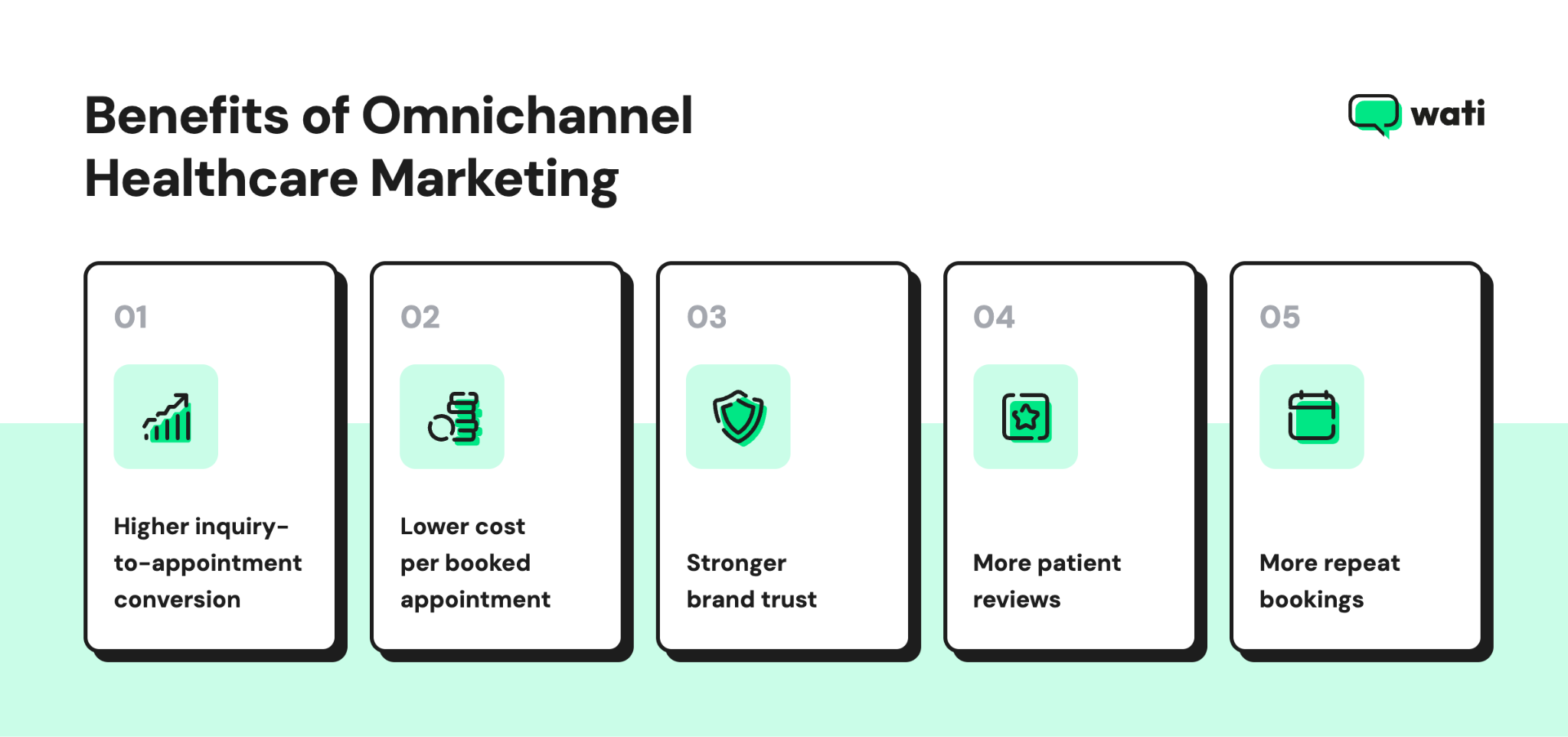
The main benefits of omnichannel healthcare marketing include higher inquiry-to-appointment conversion, lower cost per booked appointment, stronger brand trust, more patient reviews, and more repeat bookings.
These outcomes depend on how well healthcare organizations connect campaign data, patient inquiries, and booking workflows.
1. Higher Inquiry-to-Appointment Conversion
Tracking inquiries from Google Ads, Instagram, and WhatsApp shows teams which campaign or service each patient is asking about.
2. Lower Cost per Booked Appointment
Connected campaign and booking data shows which paid campaigns generate appointments, not just clicks or inquiries.
3. Stronger Brand Trust
Patients see consistent doctor profiles, package prices, and service details across the website, Google Business Profile, social media, and ads.
4. More Patient Reviews
A post-visit WhatsApp or SMS request makes it easy for satisfied patients to leave a Google review. This matters because 84% of US patients check online reviews before choosing a healthcare provider, according to rater8's 2025 patient survey.
5. More Repeat Bookings
Recall campaigns remind existing patients about follow-up consultations, vaccinations, and routine health checkups.
Which Channels Belong in an Omnichannel Healthcare Marketing Strategy?
An omnichannel healthcare marketing strategy connects the channels patients use to discover providers, compare services, ask questions, and book appointments.
These include search engines, healthcare directories, social media, messaging apps, websites, and phone calls, all coordinated through shared campaign and patient data.
i. Discovery Channels: Where Patients Find and Compare Hospitals
Discovery channels help patients find a hospital, explore services, and compare providers.
Channel | Role in healthcare marketing | Example |
Google Search and SEO | Reaches patients actively searching for doctors, treatments, or diagnostic tests | Creating a page targeting "full body checkup near me" |
Google Business Profile | Displays hospital locations, opening hours, services, ratings, and reviews in local search | Keeping branch details and service information accurate |
Healthcare listing sites | Helps patients compare doctors, specialties, and consultation fees | Maintaining updated doctor profiles on Practo |
Paid search and social ads | Promotes specific services, health packages, and health camps | Running a Click-to-WhatsApp ad for a diagnostic package |
Social media | Builds awareness through doctor profiles, health education, and service updates | Sharing a health camp announcement on Instagram |
Website and landing pages | Provides detailed information about doctors, treatments, services, and prices | Adding a WhatsApp contact option to a health checkup landing page |
ii. Conversation Channels: Where Patients Ask, Book, and Return
Conversation channels help patients get answers, make appointments, and receive relevant updates.
Channel | Role in healthcare marketing | Example |
Handles patient inquiries, appointment confirmations, and consent-based campaigns | Sending a health checkup reminder to an opted-in patient | |
Instagram DMs and Facebook Messenger | Continues conversations that begin on social media | Answering questions about a package featured in an Instagram Reel |
SMS and RCS | Delivers appointment updates and short reminders | Sending an appointment confirmation by SMS |
WebChat | Answers questions while patients explore hospital services | Explaining the difference between two diagnostic packages |
Phone and WhatsApp Business Calling | Supports patients who prefer speaking with hospital staff | Answering questions about consultation fees or service availability |
In-clinic touchpoints | Connects physical visits with digital communication | Displaying a QR code that opens a WhatsApp chat or review page |
Using multiple channels does not automatically create an omnichannel strategy. The channels need shared inquiry and booking data, coordinated campaign timing, and consistent service details.
Wati's shared Team Inbox brings conversations from supported messaging channels into one workspace. Start with the channels your patients use most, and send marketing messages only to patients who have opted in.
8 Best Omnichannel Healthcare Marketing Strategies
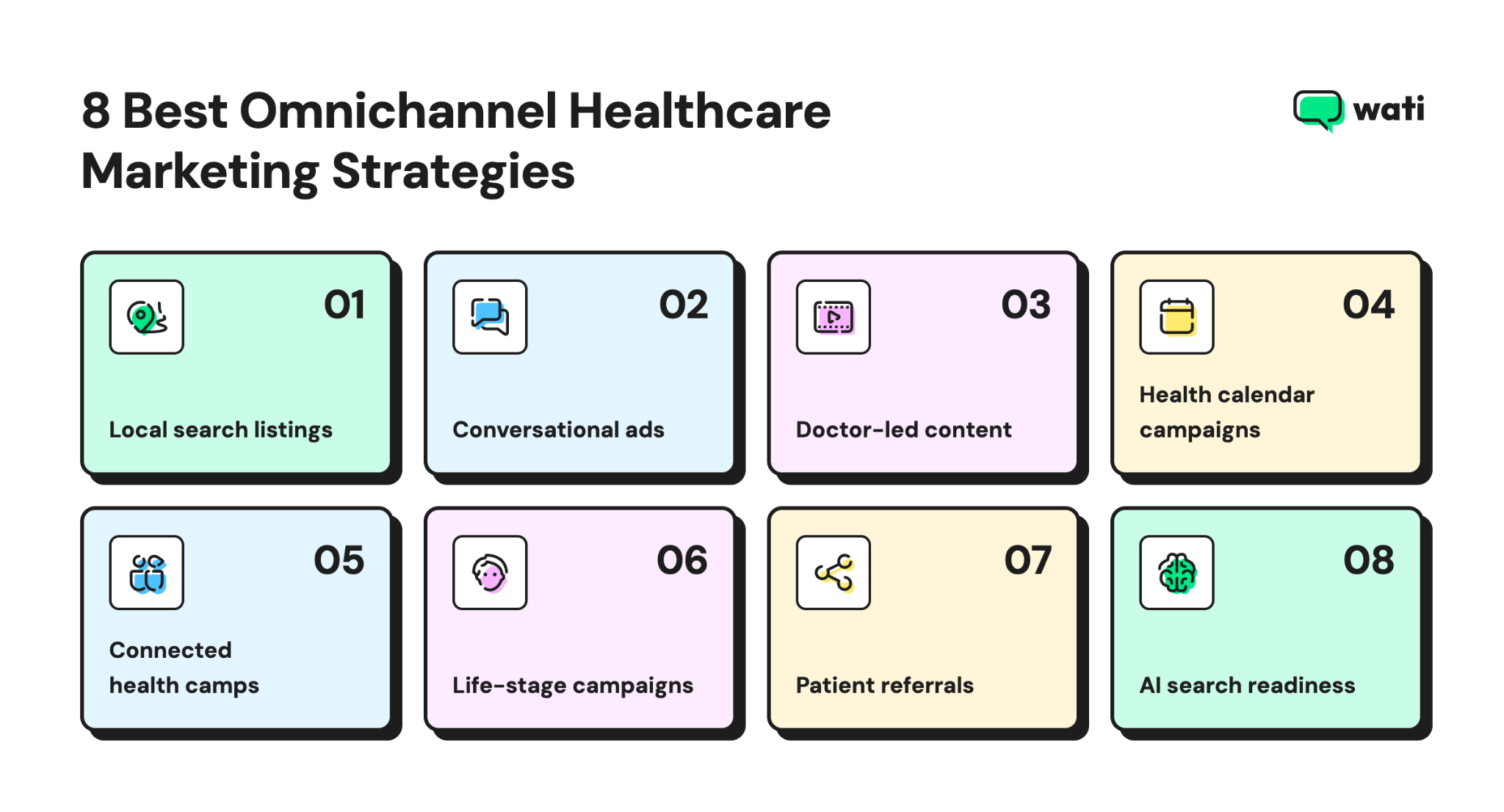
The most effective omnichannel healthcare marketing strategies are local search optimization, conversational ad campaigns, doctor-led content, health calendar campaigns, connected health camps, life-stage campaigns, patient referrals, and AI search readiness.
1. Optimize Branch and Doctor Listings for Local Search
Local search is often where patients first find a hospital, so every branch and doctor listing must be accurate, complete, and easy to act on.
How to apply it:
- Create a separate Google Business Profile for each branch, with OPD timings, services, package prices, and photos.
- Keep doctor qualifications, specialties, and consultation days identical across the website, Google, and directories such as Practo.
- Add a WhatsApp chat button to every branch and doctor page, so patients can ask questions directly from search.
In practice: A patient searching "orthopedic doctor near me" finds the nearest branch and messages its WhatsApp number from the branch page. With Wati's multiple WhatsApp numbers feature, every branch keeps its own number, while all inquiries arrive in one shared inbox that your central marketing team can track.
2. Turn Ad Clicks Into Conversations
Ads that open a WhatsApp chat start a conversation right away, instead of sending patients to a form they may never complete.
How to apply it:
- Promote one specific service per ad, such as a health checkup or maternity package.
- Use the same price and inclusions in the ad as on the website and landing page.
- Prepare an opening message that shares package details and available slots.
In practice: A patient taps a cardiac screening ad on Instagram and lands in a WhatsApp chat with your hospital, without filling in a form. Because the ad runs as a Click-to-WhatsApp ad through Wati, your marketing team can see which ad started each conversation and which ads lead to bookings.
3. Use Doctor-Led Content to Build Trust
Patients often trust doctors more than advertising, so short educational videos by specialists build credibility that promotional ads cannot.
How to apply it:
- Answer common patient questions, such as when to get a thyroid test or what a full body checkup includes.
- Repurpose each video as an Instagram Reel, a YouTube Short, and a landing page embed.
- Have the clinical team approve every medical claim before publishing.
In practice: A gynecologist's 45-second Reel on PCOS symptoms asks viewers to comment "PCOS" for consultation details. With Instagram comment automation, every commenter instantly receives the clinic's timings and a booking link by direct message, turning video views into trackable leads.
4. Plan Campaigns Around the Health Calendar
Seasonal illnesses and health awareness days give hospitals a timely, relevant reason to reach patients.
How to apply it:
- Map the key dates for the year, such as monsoon infections, flu season, World Heart Day, World Diabetes Day, and Breast Cancer Awareness Month.
- Prepare one offer per campaign, with the same price and message on every channel.
- Launch each campaign on the same day across search ads, social media, the website, and WhatsApp.
In practice: Before World Heart Day on September 29, you promote a cardiac screening package on Google, Instagram, and your website. You schedule the WhatsApp message in advance in Wati Campaigns so opted-in patients receive the same offer the morning your ads go live.
5. Connect Health Camps to Digital Follow-Up
Health camps attract high footfall, but attendees are rarely contacted again unless the camp collects their details and consent.
How to apply it:
- Place a WhatsApp QR code at the registration desk so attendees can opt in with a single scan.
- Tag each lead with the camp location and date to see which camps generate bookings.
- Use the same approach for corporate wellness camps and school health checks.
In practice: After a screening camp at a residential society, opted-in attendees enter a three-message WhatsApp drip campaign: a health checkup offer on day 1, the nearest branch’s timings on day 3, and a reminder on day 7.
With the stop-on-customer-reply toggle turned on in Wati, the series ends as soon as an attendee replies, allowing a patient care coordinator to take over and book the visit.
6. Run Life-Stage Campaigns for Existing Patients
Existing patients respond best to campaigns that match their age, life stage, or last service used.
How to apply it:
- Record marketing consent separately from appointment details, at registration or through website forms.
- Build patient groups based on age, last service used, and visit date.
- Send each group its own campaign instead of one broadcast to the full contact list.
In practice: New mothers receive pediatric vaccination reminders, while patients over 40 are invited for annual cardiac screening. When Wati is connected to your hospital's CRM, such as Salesforce, HubSpot, or Zoho CRM, these groups are built from data the hospital already holds, and each patient sees only the message that applies to them.
7. Make Patient Referrals Easy to Share
Family recommendations influence many hospital choices, and a simple referral offer turns this word-of-mouth into a measurable channel.
How to apply it:
- Create a family package for health checkups, maternity care, or dental services.
- Give each satisfied patient an easy way to forward the offer.
- Track every referred patient back to the referral campaign.
In practice: After her checkup, a patient forwards a family package link to her parents. The link, created with Wati's WhatsApp chat link generator, opens a chat with a campaign-specific referral message, so your marketing team knows the source of each new inquiry.
8. Prepare for AI Search
Patients increasingly ask AI tools such as ChatGPT and Google's AI Overviews which hospital to visit or which test to take. Bain & Company's 2026 Asia-Pacific Front Line of Healthcare Report found that 73% of Indian consumers use generative AI to prepare for appointments.
How to apply it:
- Publish FAQ pages that answer common patient questions in plain language, such as package inclusions, fasting requirements, and OPD timings.
- Keep prices, timings, and doctor details identical across the website, Google Business Profile, and listing sites, since AI tools compare these sources before recommending a hospital.
- Make sure patients who arrive via an AI recommendation receive the same answers across all channels.
In practice: A patient asks an AI assistant which hospital in her city offers a full-body checkup on Sundays, and your hospital is recommended because of clear, consistent package pages. She messages the hospital on WhatsApp in Tamil, and the Astra AI Agent, trained on the same approved FAQs, replies in Tamil with the same price and inclusions shown on the website.
What Does an Omnichannel Patient Journey Look Like?
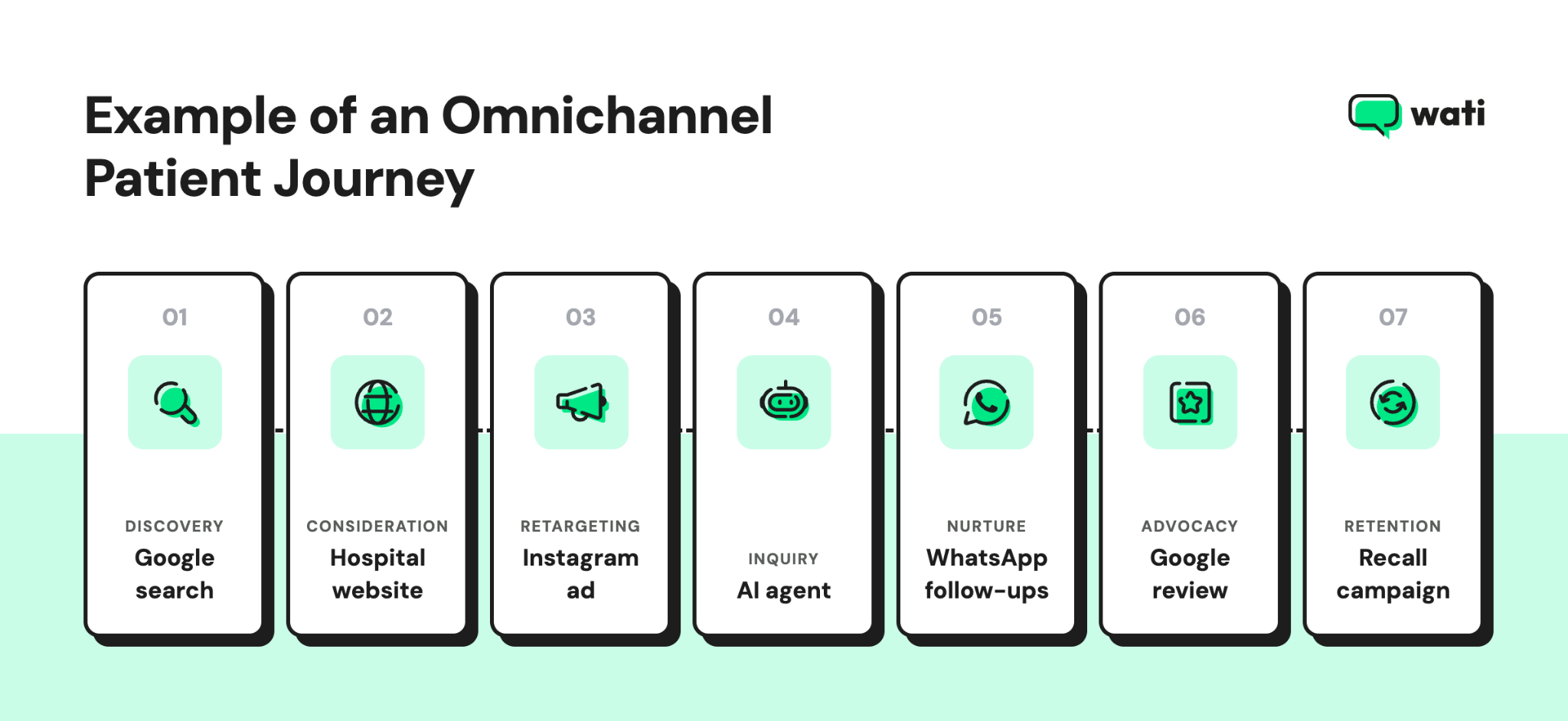
An omnichannel patient journey is the connected path a patient takes from discovering a hospital to booking again, with each marketing channel picking up where the last left off. The example below follows Priya, a patient looking for a full-body checkup, as she moves across connected channels.
Stage 1, Discovery: Priya Finds a Hospital on Google
Priya searches "full body checkup near me" and finds a hospital in the local results. Its Google Business Profile shows a strong rating, current OPD timings, and the package price.
This is where patient acquisition often starts. Accurate listings and recent reviews decide whether she clicks on this hospital or on the diagnostic center down the road.
Stage 2, Consideration: She Compares Packages on the Hospital Website
Priya opens the hospital's Full Body Checkup landing page and compares two package options. She closes the tab without booking because she wants more time to decide.
The website pixel adds her to a retargeting audience for that package. The marketing team now knows she is interested, even though she hasn't contacted the hospital yet.
Stage 3, Retargeting: An Instagram Ad Brings Her Back
Two days later, Priya sees a Reel from the hospital's head of preventive health explaining the package in 30 seconds. It runs as a Click-to-WhatsApp ad on Instagram, so one tap on "Send message" opens a WhatsApp chat with the hospital.
Patients who comment "CHECKUP" on the organic version of the Reel receive the package details by DM through Wati's Instagram automation. Both routes send every lead to the same place, with the campaign source attached.
Stage 4, Inquiry: An AI Agent Answers at 10 PM
Priya messages at 10 PM in Hindi, long after the front office has closed. The Astra AI Agent replies in Hindi, explains the difference between the two packages, and shares the next available slots.
She replies that she isn't ready to book yet. Instead of the inquiry going cold, the AI agent records her interest and asks if she would like a few follow-up messages about the package.
Stage 5, Nurture: A Drip Campaign Keeps the Package Top of Mind
Over the next few days, Priya receives two short WhatsApp follow-up messages from the hospital. The first compares both checkup packages side by side, and the second is a video of the hospital’s doctor explaining why an annual checkup matters.
After the video, Priya replies to book a Saturday slot, and the remaining messages in the sequence are canceled. The marketing team can then see that this booking came from the Instagram ad and the follow-up messages that came after it.
Stage 6, Advocacy: Her Review Brings In the Next Patient
After her visit, Priya receives her reports along with a short WhatsApp message asking about her experience. One tap opens the hospital's Google review page.
Each new review strengthens the hospital's Google Business Profile for the next patient who searches. Over time, a steady flow of reviews reduces how much the hospital relies on paid ads to acquire new patients.
Stage 7, Retention: A Segmented Campaign Brings Her Back Next Year
Eleven months later, Priya is due for her next annual checkup. Because she opted in to health updates, she falls into a WhatsApp campaign segment for patients due for recall, built from her last visit date and package.
The recall campaign reaches her on WhatsApp, with an email version for patients who prefer it. When the hospital runs a cardiac screening camp on World Heart Day, the same segment helps the marketing team invite past checkup patients rather than broadcast to the entire contact list.
At every stage, each channel carries the same offer, every lead is followed up, and the hospital knows which campaign brought Priya in and how to bring her back.
What Does Omnichannel Healthcare Marketing Look Like Across Care Settings?
Every care setting uses connected channels to attract patients, answer questions, convert inquiries into consultations, and encourage return visits. The campaigns differ by service, audience, and how patients make decisions.
These four playbooks show how dental clinics, eye hospitals, multi-specialty hospitals, and fertility clinics can apply omnichannel marketing with Wati.
Dental Clinics: How Do Aligner Campaigns Turn Interest Into Consultations?
- Awareness: A Reel explains how clear aligners work and invites viewers to comment "SMILE" for details. Instagram automation sends each commenter the consultation information by DM.
- Consultation booking: Interested patients continue on WhatsApp, where a chatbot answers approved questions and guides them through the booking process. Live slot selection works when the chatbot is connected to the clinic's booking system.
- Nurture: Opted-in patients who don’t book receive a few follow-up messages covering treatment options, payment plans, and approved testimonials.
- Retention: After treatment, opted-in patients receive a routine cleaning reminder through a segmented WhatsApp campaign.
Eye Hospitals: How do LASIK and Cataract Campaigns Build Trust Before Surgery?
- Search and ads: Search ads and Click-to-WhatsApp ads promote LASIK consultations and invite people to ask about the procedure.
- Questions answered: Astra AI Agent answers common questions about recovery and pricing using hospital-approved information. Insurance queries go to the TPA desk, and questions that need clinical judgment go to an optometrist or patient care coordinator.
- Family decisions: Cataract decisions often involve family members, who may prefer a regional language. AI Translation lets coordinators reply in the family's language, while medical details are confirmed by the clinical team.
- Referrals: After care, patients receive a general appointment link they can share with family and friends.
Multi-Specialty Hospitals: How do Marketing Teams Coordinate Campaigns Across Departments?
- Branch numbers: Each branch keeps its own WhatsApp number, and all numbers connect to one Wati account with clear ownership for each branch.
- Health calendar campaign: Around World Heart Day, cardiology promotes a cardiac screening offer across Google, Instagram, the website, and WhatsApp. Every channel uses the same clinically approved offer and booking link.
- Audience segments: Segments are built from consent status, channel preference, and campaign engagement. Clinical history is not used to target promotional messages.
- Performance review: The marketing manager checks delivery, read, reply, and click rates for each campaign in Campaign reports. Matching these results to confirmed appointments requires booking or CRM data.
Fertility Clinics: How Are Sensitive Services Marketed Discreetly?
- Educational content: Fertility specialists explain IVF, IUI, and egg freezing through short videos. Ads describe the services without implying that the viewer has a fertility condition.
- Discreet first reply: When a patient inquires on WhatsApp or WebChat, the automated reply acknowledges the message and offers a consultation without repeating treatment details.
- Dedicated counselor: One fertility counselor manages each inquiry through to the consultation, and only authorized clinic personnel can access the conversation.
- Respectful follow-up: Opted-in patients receive general updates, such as seminar dates, with no treatment details that could appear on a lock screen.
How Does Automation Support Omnichannel Healthcare Marketing?
Automation handles repetitive marketing tasks across every channel a patient uses, such as replying to new leads, following up with patients who haven't booked, and sending recall campaigns. Patient care coordinators, doctors, and other specialists take over when a conversation involves clinical, financial, or sensitive questions.
i. What Should Be Automated, and What Needs Human Support?
Before any workflow goes live, agree with your medical director and front office head on where automation stops.
Automate in marketing campaigns | Hand to the right person |
Package prices, inclusions, and offer details | Questions about symptoms or whether a test is needed → doctor or nurse |
Available slots for campaign packages | Requests to speak with a doctor → patient care coordinator |
Follow-ups for leads who haven't booked | Discount requests beyond the approved offer → patient relations executive |
Review requests after a visit | Insurance, TPA, and cashless treatment queries → TPA desk |
Recall and health calendar campaigns | Complaints or negative feedback → patient relations executive |
Opt-out handling across all campaigns | Patients who sound distressed or confused → patient care coordinator |
In Wati, Astra AI Agent and no-code chatbots handle the tasks on the left. Smart Handoffs routes the conversations on the right to the correct person.
ii. Which Marketing Workflows Should Hospitals Automate First?
Start with high-volume workflows that follow a fixed pattern and don't require a clinical decision.
Workflow | How it works | Who steps in |
Instant lead reply | Astra AI Agent answers leads from ads, WhatsApp, and Instagram at any hour, using the hospital's approved information | Patient care coordinators handle questions outside the approved package details |
Package selection | A no-code chatbot shows a package menu and lets patients choose a slot with buttons | Doctors review visits that need medical approval before booking |
Lead prioritization | Wati AI Agents (early access) find leads showing booking intent and flag chats that need a reply before WhatsApp’s 24-hour window closes | Tele-callers approve each action and choose which leads to call |
Follow-up for unbooked leads | Opted-in leads who haven’t booked receive a few timed follow-up messages | Patient care coordinators respond to leads who reply with questions |
Campaign planning | Recommended Campaigns suggests and drafts upcoming campaigns in the Campaign Calendar | The marketing manager approves the content, and doctors approve medical claims |
Campaign reporting | Campaign reports show delivery, read, reply, and click rates for campaigns such as World Heart Day | The marketing manager adjusts budget and timing based on the results |
Recall campaigns | Patients due for an annual checkup join the recall segment automatically | Doctors or nurses handle patients who reply with a symptom or clinical question |
No-code chatbots suit fixed flows where every patient follows the same steps. Astra AI Agent handles open-ended questions that fall outside those flows.
iii. How do Handoffs Keep Context Across Channels?
A patient may comment on an Instagram Reel, message on WhatsApp, and later ask for a call. If each channel works separately, the patient has to repeat their question at every step, and the lead is often lost.
Wati brings ad clicks, Instagram DMs, and WhatsApp chats into one shared Team Inbox. The same AI reads across all of these channels, so the patient's history stays in one place.
When a conversation needs a person, Smart Handoffs transfers it to the right patient care coordinator or specialist with the full chat history. Conversation Summary gives them a short recap of long threads.
AI Translation lets coordinators reply to patients writing in Hindi, Tamil, or other regional languages. If the patient prefers to talk, WhatsApp Business Calling lets the coordinator request a call from the same chat.
8 Metrics to Measure Omnichannel Healthcare Marketing Success
Omnichannel healthcare marketing success is measured by how many campaign leads become booked appointments, what each booking costs, and how many patients return through recall campaigns.
i. Key Metrics: What to Track for Each Campaign
Metric | What it shows | How to calculate |
Cost per lead | How efficiently each channel generates inquiries | Ad spend ÷ number of leads |
Lead-to-booking rate | How well leads convert into appointments | Bookings ÷ leads × 100 |
Cost per booked appointment | The true cost of acquiring a patient through a campaign | Ad spend ÷ number of bookings |
Return on ad spend (ROAS) | Revenue generated for every rupee spent on ads | Revenue from campaign bookings ÷ ad spend |
WhatsApp read and reply rate | Whether campaign messages are relevant to the audience | Reads or replies ÷ messages delivered × 100 |
Opt-out rate | Whether patients are receiving too many or irrelevant messages | Opt-outs ÷ messages delivered × 100 |
Recall booking rate | How well recall campaigns bring patients back | Recall bookings ÷ patients messaged × 100 |
New Google reviews | How post-visit campaigns support local search visibility | Reviews added per month |
Cost per booked appointment matters most to hospital leadership. A channel with cheap leads but a weak booking rate often costs more per patient than a channel with expensive leads that convert well.
ii. Attribution: Connecting Bookings to the Right Channel
- Capture the source at first contact: Make sure every lead carries its source into the patient’s CRM profile, whether it came from a UTM-tagged landing page, a Click-to-WhatsApp ad, or an Instagram comment keyword.
- Use one attribution model: Apply a single model, such as first touch or last touch, across all campaigns, so monthly results stay comparable.
- Track messaging channel conversions: A patient who taps an ad and books in a WhatsApp chat never visits a tracked landing page. When Click-to-WhatsApp ads run through Wati, the source ad stays attached to the conversation, and the booking can be reported back to Meta so future ads reach patients more likely to book.
- Compare results by branch: The same campaign can perform very differently across cities. With every branch number connected to one Wati account, that comparison comes from a single dashboard.
Omnichannel Healthcare Marketing, Connected by Wati
Wati, an agentic customer engagement platform for revenue growth, connects the marketing channels healthcare organizations use most, including WhatsApp, Instagram, Facebook Messenger, TikTok, SMS, RCS, and WebChat.
Marketing teams can run campaigns, reply to leads, and track results without switching between tools.
- Attract: Click-to-WhatsApp ads and Instagram comment automation turn ad clicks and social engagement into WhatsApp conversations with a known source.
- Convert: Astra AI Agent answers lead questions at any hour in the patient’s language, and automated follow-ups reach opted-in leads who haven’t booked yet.
- Retain: Segmented campaigns bring patients back for annual checkups, follow-up visits, and health calendar offers.
- Measure: Campaign reports show how each campaign performed, so budget moves toward the channels that bring in bookings.
All conversations stay in one shared Team Inbox, so patient care coordinators can step in with the full history whenever a patient needs a person.
Book a demo with Wati to see how omnichannel marketing in healthcare can work for your hospital, clinic, or diagnostic center.
Feature availability may vary by plan. See Wati pricing for details.
Frequently asked questions
What is an Example of Omnichannel Marketing in Healthcare?
An example of omnichannel marketing in healthcare is a hospital that promotes a health checkup package through a Click-to-WhatsApp ad on Instagram, answers the patient’s questions on WhatsApp, and sends an annual recall reminder after the visit. Every channel uses the same offer and patient history, so the patient never has to repeat their questions.
Can Small Clinics Use Omnichannel Marketing?
Yes, small clinics can use omnichannel marketing by connecting just two or three channels, such as Google Business Profile, Instagram, and WhatsApp. Starting small with one service, like a dental cleaning or physiotherapy package, makes the setup easier to manage without a large marketing team.
Is WhatsApp Allowed for Healthcare Marketing?
Yes, healthcare providers can send marketing messages on WhatsApp to patients who have opted in, using templates approved by Meta. These messages must follow WhatsApp’s Business Messaging and Commerce Policies and local privacy laws, such as India’s Digital Personal Data Protection (DPDP) Act.
How is Omnichannel Marketing Different From Patient Engagement?
Omnichannel marketing focuses on attracting new patients, converting inquiries into appointments, and bringing patients back through campaigns. Patient engagement covers the wider relationship after booking, such as reminders, care instructions, and support conversations.
How Long Does Omnichannel Healthcare Marketing Take to Show Results?
Early signals, such as faster replies to leads and a higher lead-to-booking rate, can appear within the first campaign. Metrics like cost per booked appointment and recall booking rate need several months of data to show reliable trends.
Do You Need a CRM for Omnichannel Healthcare Marketing?
A CRM makes omnichannel marketing easier by keeping each patient’s source campaign, consent status, and visit history in one place. Clinics without a CRM can start with Wati’s Google Sheets integration and move to a CRM such as HubSpot, Zoho CRM, or Salesforce as they grow.
How Do You Keep Omnichannel Healthcare Marketing Compliant?
Omnichannel healthcare marketing remains compliant when you record marketing consent separately from appointment details, honor opt-outs across all channels, and comply with local laws such as India’s DPDP Act. Wati holds ISO/IEC 27001:2022 certification and a SOC 2 Type I attestation, and messages sent through the WhatsApp Business Platform are encrypted in transit and at rest.
Related posts
- Instagram Comment Automation: How It Works and How to Set It Up in Wati
Instagram comment automation auto-replies to comments and DMs commenters within seconds via Meta's API. Covers strategy, use cases, and Wati setup.
- Shared Team Inbox for Instagram: A Buyer’s Checklist for 2026
Use this fastest checklist to evaluate any shared team inbox for Instagram, which covers DMs, comments, automation, and multi-channel support.
- How to Send Bulk Messages on WhatsApp Without Getting Blocked
Learn how to send bulk WhatsApp messages without getting blocked. Compare the WhatsApp Business app and API, messaging limits, costs, templates, and best practices for safe, compliant bulk messaging.
- How to Set Up a TikTok Business Account: Step-by-Step Guide
Set up a TikTok Business Account step by step: switch from personal, pick a category, add your profile, and unlock ads and analytics.